JEE Corner — Complex Numbers and Quadratic Equations for JEE Main and Advanced
Why This Section Exists
The rationalised textbook stops at the Argand plane — but the JEE Main syllabus explicitly includes the argument (polar form), the triangle inequality, and quadratic equations in the real and complex number system with relations between roots and coefficients. This section restores the full JEE toolkit:
Argument and polar form — z=r(cosθ+isinθ);
Quadratic equations — complex roots, nature of roots, root-coefficient relations;
Square roots of a complex number — the three-equation method;
Cube roots of unity — ω and its identities;
The triangle inequality and modulus bounds.
The worked examples and practice questions here are modelled on the JEE Main and Advanced pattern and difficulty; they are practice questions in the exam style, not reproductions of specific past papers.
[Board Note] CBSE students: polar form and quadratic equations were removed from the rationalised Class 11 syllabus. Treat this section as JEE preparation — though the quadratic-roots material also silently returns in later chapters.
Argument and Polar Form
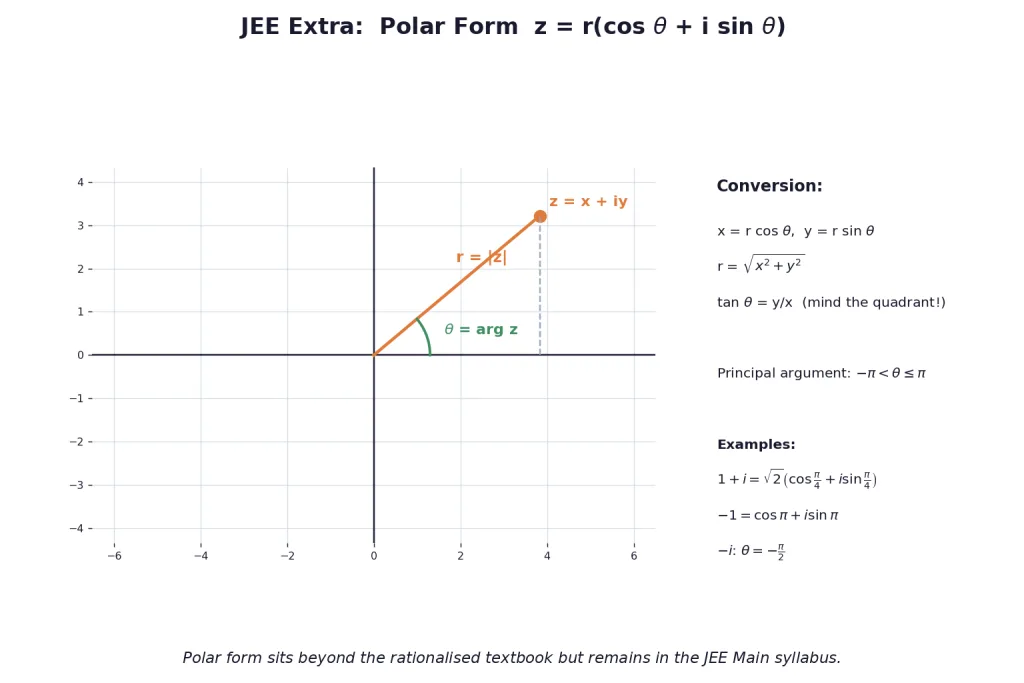
A non-zero z = x + iy sits at distance r=∣z∣=x2+y2 from the origin, in the direction making angle θ with the positive real axis. Then x=rcosθ, y=rsinθ, giving the polar form:
z=r(cosθ+isinθ)
θ is called the argument (arg z); the value chosen in (−π,π] is the principal argument.
Finding the argument safely: compute the acute reference angle α=tan−1xy, then place it by quadrant: Q I: θ=α; Q II: π−α; Q III: −(π−α); Q IV: −α (principal values).
Standard conversions to know cold:
1+i=2(cos4π+isin4π)
−1+3i=2(cos32π+isin32π)
−1=cosπ+isinπ; −i: r = 1, θ=−2π
Why polar form matters: moduli multiply and arguments ADD — z1z2 has modulus r1r2 and argument θ1+θ2. Multiplication becomes rotation-plus-scaling, which is why ×i rotates by 90°.
[JEE Tip] Never write arg z = tan−1xy blindly — that formula alone cannot tell Q I from Q III. Quadrant first, reference angle second. For −1−i: reference 4π, Q III, principal argument −43π (not 4π!).
Quadratic Equations Over the Complex Numbers
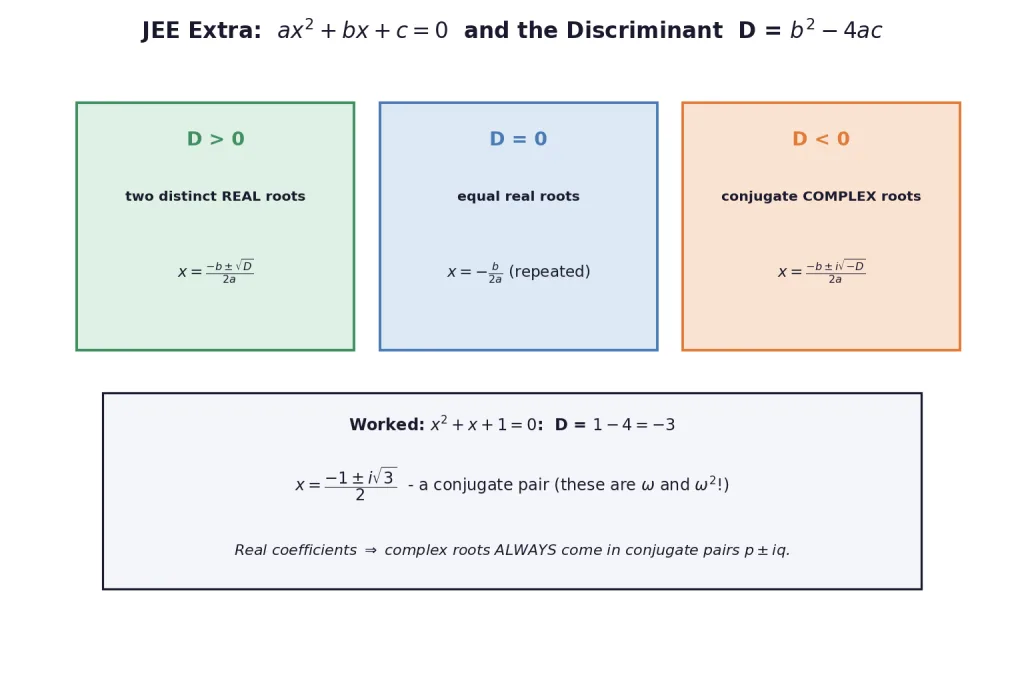
For ax2+bx+c=0 with real coefficients and a=0, the roots are
x=2a−b±D,D=b2−4ac
D > 0: two distinct real roots. D = 0: equal real roots −2ab.
D < 0: no real roots — but now D=i−D, giving the complex conjugate pairx=2a−b±i−D.
Model: x2+x+1=0 has D = −3 and roots 2−1±3i.
Root-coefficient relations
If α,β are the roots: α+β=−ab,αβ=ac
and conversely the equation with roots α,β is x2−(α+β)x+αβ=0. Power sums follow: α2+β2=(α+β)2−2αβ, α1+β1=αβα+β.
Key Point: With REAL coefficients, complex roots always arrive as conjugate pairs p±iq — one root reveals the other for free. (With complex coefficients this fails: x2−ix=0 has roots 0 and i.)
[JEE Tip] "Form the equation whose roots are…" = compute sum and product, plug into x2−Sx+P=0. For conjugate pairs p±iq: S = 2p, P = p2+q2 — both real, always.
Square Roots, Cube Roots of Unity, and the Triangle Inequality
Square roots of a complex number
To solve (x+iy)2=a+ib: match parts and add the modulus as a third equation:
x2−y2=a,2xy=b,x2+y2=a2+b2
Solve the first and third for x2,y2; the SIGN of b fixes whether x and y share signs. Model: −8+6i=±(1+3i).
Cube roots of unity
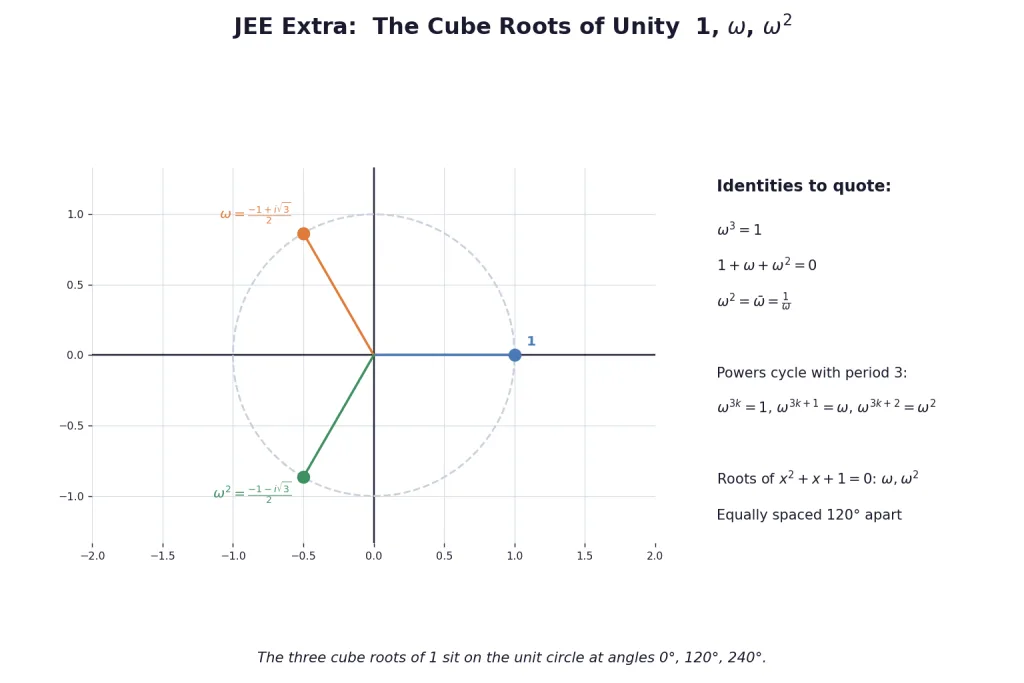
Solving x3=1: x3−1=(x−1)(x2+x+1)=0 gives 1 and the roots of x2+x+1=0:
ω=2−1+3i,ω2=2−1−3i
Key Point (the ω identities):ω3=1, 1+ω+ω2=0, ω2=ωˉ=ω1. Powers cycle with period 3: ω3k=1, ω3k+1=ω, ω3k+2=ω2.
Every ω computation reduces by these: ω100=ω99ω=ω; (1+ω)3=(−ω2)3=−ω6=−1.
The triangle inequality
∣z1+z2∣≤∣z1∣+∣z2∣and∣z1+z2∣≥∣z1∣−∣z2∣
Equality on the left iff the numbers point the same way. Consequence bounds: for ∣z∣=r, the value ∣z+a∣ lies between ∣r−∣a∣∣ and r+∣a∣.
[JEE Tip] Factorisations via ω: a2+ab+b2=(a−bω)(a−bω2) and a3+b3=(a+b)(a+bω)(a+bω2) — they turn intimidating JEE products into one-line evaluations.
Solved Examples
Example 1: Polar form conversions
Express in polar form: (i) 1+i (ii) −1+3i (iii) −2−2i.
Solution:
Step 1 — (i) Modulus, quadrant, reference angle.r=1+1=2; the point (1, 1) is in Q I with reference angle 4π, so θ=4π: 2(cos4π+isin4π).
Step 2 — (ii) Same ritual.r=1+3=2; Q II with reference 3π: θ=π−3π=32π: 2(cos32π+isin32π).
Step 3 — (iii) Watch the principal placement.r=4+4=22; Q III with reference 4π: principal θ=−(π−4π)=−43π: 22[cos(−43π)+isin(−43π)].
Takeaway: Modulus, quadrant, reference angle, principal placement — the four-step ritual, every time.
Example 2: Argument arithmetic
Find the principal argument of (i) z=i(1+i) (ii) z=1−i1+i, using argument addition.
Solution:
Step 1 — (i) Add the arguments. arg z = arg i + arg(1 + i) = 2π+4π=43π.
Step 2 — Verify the quadrant.i(1+i)=−1+i, in Q II with reference 4π — argument 43π ✓.
Step 3 — (ii) Subtract for a quotient. arg = arg(1 + i) − arg(1 − i) = 4π−(−4π)=2π.
Step 4 — Verify. The quotient is i, whose argument is indeed 2π ✓.
Takeaway: Arguments add over products and subtract over quotients — then verify the quadrant.
Example 3: A quadratic with complex roots
Solve x2+3x+9=0 over the complex numbers.
Solution:
Step 1 — Compute the discriminant.D=32−4(1)(9)=9−36=−27.
Step 2 — Write D in i-form.−27=i27=33i.
Step 3 — Apply the formula.x=2−3±33i — a conjugate pair, as real coefficients demand.
Takeaway:−27=33i — simplify the surd inside the i-form; the roots are conjugates.
Example 4: Nature of roots without solving
Without solving, classify the roots of: (i) 2x2−7x+3=0 (ii) x2−4x+4=0 (iii) x2+x+2=0.
Solution:
Step 1 — (i) Discriminant.D=49−24=25>0: two distinct real roots — and since 25 is a perfect square, they are rational.
Step 2 — (ii) Discriminant.D=16−16=0: equal real roots (x=2 twice).
Step 3 — (iii) Discriminant.D=1−8=−7<0: a conjugate pair of non-real roots.
Takeaway: D answers the classification question in one subtraction — solving is never required for "nature of roots".
Example 5: Root-coefficient relations at work
If α,β are the roots of x2−5x+3=0, find (i) α2+β2 (ii) α1+β1 (iii) the equation with roots α2,β2.
Solution:
Step 1 — Extract S and P.α+β=5 and αβ=3.
Step 2 — (i) Power sum.α2+β2=(α+β)2−2αβ=25−6=19.
Step 3 — (ii) Reciprocal sum.α1+β1=αβα+β=35.
Step 4 — (iii) New sum and product. Sum of new roots =α2+β2=19; product =(αβ)2=9: equation x2−19x+9=0.
Takeaway: Every symmetric function of the roots is reachable from S and P — the roots themselves are never needed.
Example 6: Forming an equation from complex roots
Form the quadratic equation with real coefficients having 2+3i as a root.
Solution:
Step 1 — Invoke the conjugate-pair rule. Real coefficients force the other root to be 2−3i.
Step 2 — Compute S and P.S=(2+3i)+(2−3i)=4; P=(2+3i)(2−3i)=4+9=13.
Step 3 — Write the equation.x2−Sx+P=0: x2−4x+13=0.
Takeaway: One complex root + real coefficients = the conjugate comes free; S and P are automatically real.
Example 7: Square root of a complex number
Find 3−4i.
Solution:
Step 1 — Set up the three equations.(x+iy)2=3−4i gives x2−y2=3, 2xy=−4, and the modulus equation x2+y2=∣3−4i∣=5.
Step 2 — Solve for the squares. Adding and halving: x2=4; subtracting: y2=1.
Step 3 — Fix the signs.xy=−2<0: opposite signs, so the roots are ±(2−i).
Step 4 — Check.(2−i)2=4−4i+i2=3−4i ✓.
Takeaway: The sign of the middle coefficient b decides same-signs (b > 0) or opposite-signs (b < 0) — the only place students slip.
Example 8: An ω evaluation
Evaluate ω100+ω200+ω300, where ω is a non-real cube root of unity.
Solution:
Step 1 — Reduce every exponent mod 3.100=3(33)+1, 200=3(66)+2, 300=3(100)+0.
Step 2 — Substitute.ω100+ω200+ω300=ω+ω2+1.
Step 3 — Invoke the master identity.1+ω+ω2=0.
Takeaway: Reduce every exponent mod 3, then invoke 1+ω+ω2=0 — the two-step that solves 90% of ω problems.
Example 9: The (1 + ω)-type powers
Evaluate (1+ω−ω2)7, using the ω identities.
Solution:
Step 1 — Convert 1+ω. From the sum identity, 1+ω=−ω2, so the base is −ω2−ω2=−2ω2.
Step 2 — Raise to the 7th power.(−2ω2)7=(−1)727ω14=−128ω14.
Step 3 — Reduce the exponent mod 3.14=3(4)+2: ω14=ω2, so the answer is −128ω2.
Takeaway: Convert 1+ω or 1+ω2 via the sum identity FIRST; powers then reduce mod 3.
Example 10: An ω product
Evaluate (1−ω+ω2)(1+ω−ω2).
Solution:
Step 1 — Collapse the first factor.1+ω2=−ω, so 1−ω+ω2=−ω−ω=−2ω.
Step 2 — Collapse the second.1+ω=−ω2, so 1+ω−ω2=−ω2−ω2=−2ω2.
Step 3 — Multiply.(−2ω)(−2ω2)=4ω3=4.
Takeaway: Both factors collapse before any multiplication — the identities do all the work.
Example 11: Triangle inequality bounds
If ∣z∣=3, find the maximum and minimum values of ∣z+4−3i∣ — the distance from z to the point −4+3i.
Solution:
Step 1 — Read the geometry. z runs over the circle of radius 3 centred at O; ∣z+4−3i∣=∣z−(−4+3i)∣ is the distance from z to the fixed point w=−4+3i.
Step 2 — Locate the fixed point.∣w∣=16+9=5 — it lies at distance 5 from the centre.
Step 3 — Apply the along-the-line bounds. Maximum =∣w∣+r=5+3=8; minimum =∣w∣−r=5−3=2.
Takeaway: Distances from a circle to a point are read off the line through the centre: ∣w∣−r≤∣z−w∣≤∣w∣+r.
Example 12: A root-relation with a twist
If one root of x2+px+q=0 (p, q real) is 1−i, find p and q.
Solution:
Step 1 — Conjugate partner. Real coefficients force the other root to be 1+i.
Step 2 — Sum gives p.S=2=−p: p=−2.
Step 3 — Product gives q.P=(1−i)(1+i)=1+1=2=q.
Step 4 — Check.x2−2x+2=0 has D=4−8=−4 and roots 22±2i=1±i ✓.
Takeaway: Read p and q straight from S and P — no substitution of the complex root needed.
Example 13: Polar multiplication in action
Using polar forms, compute the product (1+i)(3+i), and verify by expansion.