How to Use This Section

Here are 32 fully worked problems covering the entire chapter — powers of i, arithmetic in all four operations, standard-form conversions, moduli and conjugates, inverses, Argand-plane geometry, and the miscellaneous-level heavyweights — arranged in a deliberate easy → medium → hard progression.

One suggestion that multiplies the value of every problem: attempt each yourself before reading the solution. In this chapter especially, decide your STRATEGY first — expand, or use modulus/conjugate properties? The property route is usually five times shorter. Problems 1-10 warm up on powers and arithmetic, 11-22 build the modulus-conjugate machinery, 23-32 are Board and JEE-level.

Solved Examples

Example 1: Standard form warm-up

Express (5i)(35i)(5i)\left(-\frac{3}{5}i\right) in the form a+iba + ib.

Solution:

Step 1 — Multiply coefficients and i's separately. 5×(35)=35 \times \left(-\frac{3}{5}\right) = -3 and ii=i2=1i \cdot i = i^2 = -1.

Step 2 — Combine. (3)(1)=3=3+i0(-3)(-1) = 3 = 3 + i0.

Takeaway: Numbers with numbers, i's with i's.

Example 2: Power reduction

Evaluate i999i^{-999}.

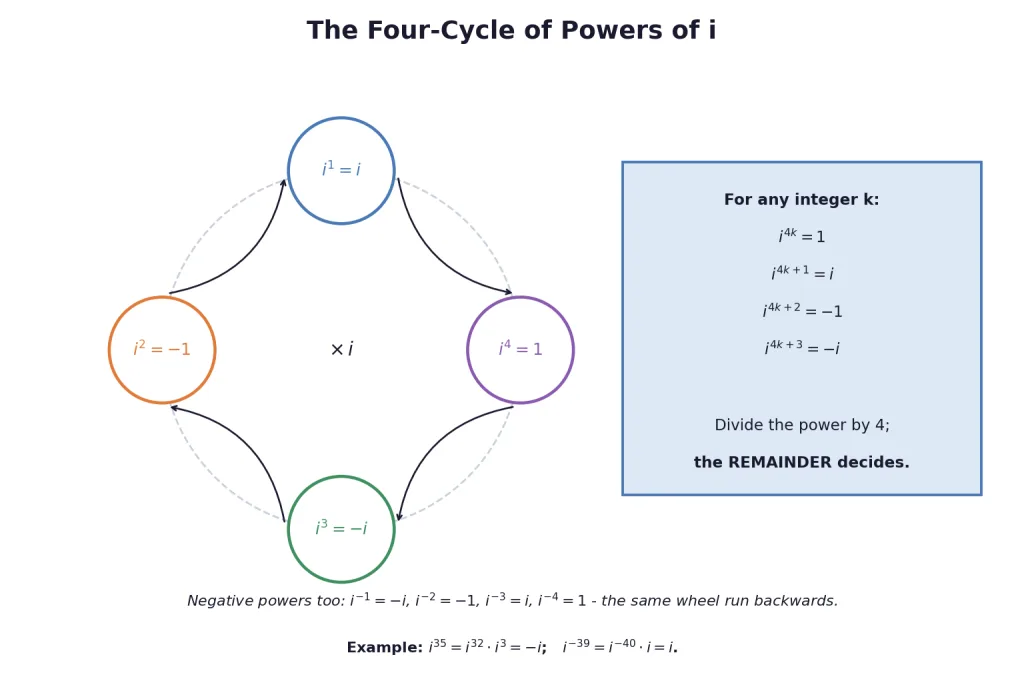
Four cycle of powers of i used for the reduction

Solution:

Step 1 — Add a free multiple of 4. 1000=4(250)1000 = 4(250), so i1000=1i^{1000} = 1 and i999=i999i1000=i1i^{-999} = i^{-999} \cdot i^{1000} = i^1.

Step 2 — Read the wheel. i999=ii^{-999} = i.

Takeaway: 1000 is a multiple of 4, so i1000=1i^{1000} = 1 costs nothing.

Example 3: A triple product

Express (1i)(3+6i)(1 - i)(-3 + 6i) in the form a+iba + ib, then multiply the result by ii.

Solution:

Step 1 — Expand the first product. 3+6i+3i6i2=3+9i+6=3+9i-3 + 6i + 3i - 6i^2 = -3 + 9i + 6 = 3 + 9i.

Step 2 — Multiply by i. (3+9i)i=3i+9i2=9+3i(3 + 9i)i = 3i + 9i^2 = -9 + 3i.

Step 3 — Notice the pattern. (a+bi)i=b+ai(a + bi) \cdot i = -b + ai — the parts swap with one sign flip.

Takeaway: Multiplying by i rotates the number: a preview of the rotation picture of multiplication.

Example 4: Collecting a long expression

Reduce (13+i73)+(4+i13)(43+i)\left(\frac{1}{3} + i\frac{7}{3}\right) + \left(4 + i\frac{1}{3}\right) - \left(-\frac{4}{3} + i\right) to standard form.

Solution:

Step 1 — Collect the real parts. 13+4+43=1+12+43=173\frac{1}{3} + 4 + \frac{4}{3} = \frac{1 + 12 + 4}{3} = \frac{17}{3}.

Step 2 — Collect the imaginary parts. 73+131=7+133=53\frac{7}{3} + \frac{1}{3} - 1 = \frac{7 + 1 - 3}{3} = \frac{5}{3}.

Step 3 — Assemble. 173+53i\frac{17}{3} + \frac{5}{3}i.

Takeaway: Line up the parts vertically and add like fractions — the i is just a column separator.

Example 5: The standard-form gauntlet

Reduce (114i21+i)(34i5+i)\left(\frac{1}{1 - 4i} - \frac{2}{1 + i}\right)\left(\frac{3 - 4i}{5 + i}\right) to the standard form.

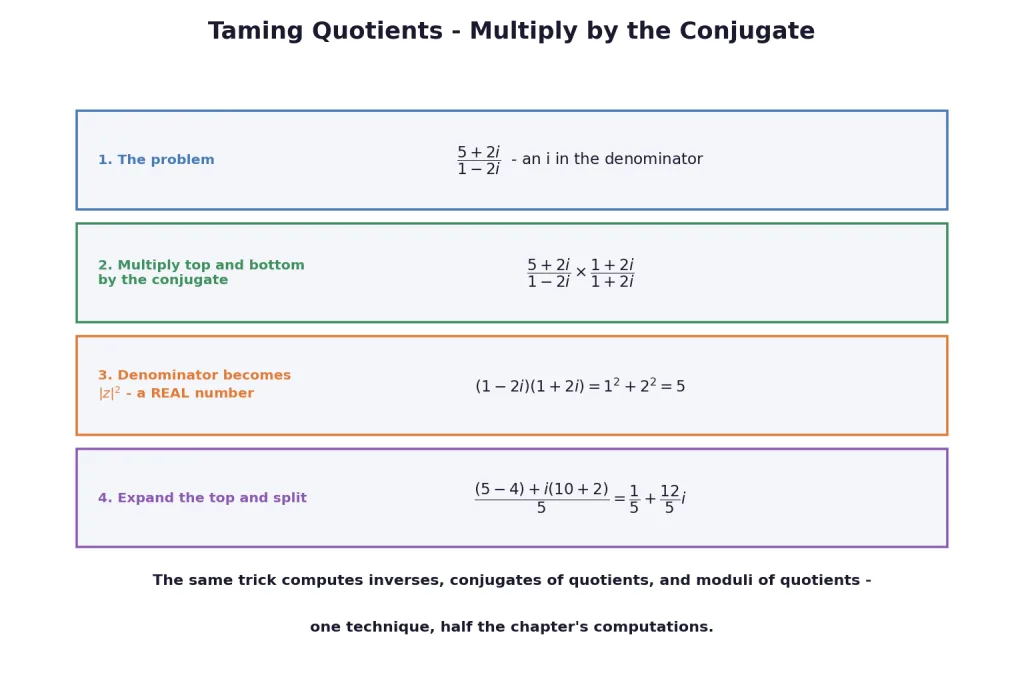
Conjugate rationalisation flow used at the final step

Solution:

Step 1 — Combine the first bracket over a common denominator. (1+i)2(14i)(14i)(1+i)=1+i2+8i1+i4i+4=1+9i53i\frac{(1 + i) - 2(1 - 4i)}{(1 - 4i)(1 + i)} = \frac{1 + i - 2 + 8i}{1 + i - 4i + 4} = \frac{-1 + 9i}{5 - 3i}.

Step 2 — Multiply by the second factor. (1+9i)(34i)(53i)(5+i)=3+4i+27i+3625+5i15i+3=33+31i2810i\frac{(-1 + 9i)(3 - 4i)}{(5 - 3i)(5 + i)} = \frac{-3 + 4i + 27i + 36}{25 + 5i - 15i + 3} = \frac{33 + 31i}{28 - 10i}.

Step 3 — Rationalise once, at the very end. (33+31i)(28+10i)282+102=924+330i+868i310884=614+1198i884\frac{(33 + 31i)(28 + 10i)}{28^2 + 10^2} = \frac{924 + 330i + 868i - 310}{884} = \frac{614 + 1198i}{884}.

Step 4 — Reduce the fractions. 614884=307442\frac{614}{884} = \frac{307}{442} and 1198884=599442\frac{1198}{884} = \frac{599}{442}: answer 307442+599442i\frac{307}{442} + \frac{599}{442}i.

Takeaway: The longest computation in the chapter. Strategy: simplify each bracket fully BEFORE multiplying; rationalise once at the very end.

Example 6: Modulus evaluation

If z1=2iz_1 = 2 - i and z2=1+iz_2 = 1 + i, find z1+z2+1z1z2+1\left|\frac{z_1 + z_2 + 1}{z_1 - z_2 + 1}\right|.

Solution:

Step 1 — Simplify the numerator. z1+z2+1=(2+1+1)+(1+1)i=4z_1 + z_2 + 1 = (2 + 1 + 1) + (-1 + 1)i = 4.

Step 2 — Simplify the denominator. z1z2+1=(21+1)+(11)i=22iz_1 - z_2 + 1 = (2 - 1 + 1) + (-1 - 1)i = 2 - 2i.

Step 3 — Take the modulus quotient. 422i=44+4=422=2\frac{|4|}{|2 - 2i|} = \frac{4}{\sqrt{4 + 4}} = \frac{4}{2\sqrt{2}} = \sqrt{2}.

Takeaway: Simplify inside first; the final step is one modulus quotient.

Example 7: Real-imaginary extraction

Let z1=2iz_1 = 2 - i, z2=2+iz_2 = -2 + i. Find (i) Re(z1z2zˉ1)\left(\frac{z_1 z_2}{\bar{z}_1}\right) (ii) Im(1z1zˉ1)\left(\frac{1}{z_1\bar{z}_1}\right).

Solution:

Step 1 — (i) Compute the product. z1z2=(2i)(2+i)=4+2i+2ii2=3+4iz_1z_2 = (2 - i)(-2 + i) = -4 + 2i + 2i - i^2 = -3 + 4i.

Step 2 — Divide by the conjugate. zˉ1=2+i\bar{z}_1 = 2 + i: 3+4i2+i×2i2i=6+3i+8i+45=2+11i5\frac{-3 + 4i}{2 + i} \times \frac{2 - i}{2 - i} = \frac{-6 + 3i + 8i + 4}{5} = \frac{-2 + 11i}{5}.

Step 3 — Read off. Re =25= -\frac{2}{5}.

Step 4 — (ii) Spot the shortcut. z1zˉ1=z12=5z_1\bar{z}_1 = |z_1|^2 = 5 is REAL, so 15\frac{1}{5} is real: Im =0= 0 — no computation needed.

Takeaway: Part (ii) needs NO computation once you see zzˉ=z2z\bar{z} = |z|^2 is always real.

Example 8: u + iv from a cube

If (x+iy)3=u+iv(x + iy)^3 = u + iv, show that ux+vy=4(x2y2)\frac{u}{x} + \frac{v}{y} = 4(x^2 - y^2).

Solution:

Step 1 — Expand the cube. (x+iy)3=x3+3x2(iy)+3x(iy)2+(iy)3=(x33xy2)+i(3x2yy3)(x + iy)^3 = x^3 + 3x^2(iy) + 3x(iy)^2 + (iy)^3 = (x^3 - 3xy^2) + i(3x^2y - y^3).

Step 2 — Identify u and v. u=x(x23y2)u = x(x^2 - 3y^2) and v=y(3x2y2)v = y(3x^2 - y^2).

Step 3 — Form the target combination. ux+vy=(x23y2)+(3x2y2)=4x24y2=4(x2y2)\frac{u}{x} + \frac{v}{y} = (x^2 - 3y^2) + (3x^2 - y^2) = 4x^2 - 4y^2 = 4(x^2 - y^2). ∎

Takeaway: Expand, name u and v, and the target combination collapses.

Example 9: The a² + b² pattern

If a+ib=(x+i)22x2+1a + ib = \frac{(x + i)^2}{2x^2 + 1}, prove that a2+b2=(x2+1)2(2x2+1)2a^2 + b^2 = \frac{(x^2 + 1)^2}{(2x^2 + 1)^2}.

Solution:

Step 1 — Recognise a2+b2a^2 + b^2 as a squared modulus. a2+b2=a+ib2=(x+i)22x2+12=x+i4(2x2+1)2a^2 + b^2 = |a + ib|^2 = \left|\frac{(x + i)^2}{2x^2 + 1}\right|^2 = \frac{|x + i|^4}{(2x^2 + 1)^2}.

Step 2 — Compute the small modulus. x+i2=x2+1|x + i|^2 = x^2 + 1, so x+i4=(x2+1)2|x + i|^4 = (x^2 + 1)^2.

Step 3 — Conclude. a2+b2=(x2+1)2(2x2+1)2a^2 + b^2 = \frac{(x^2 + 1)^2}{(2x^2 + 1)^2}. ∎

Takeaway: Every "prove a2+b2=a^2 + b^2 = \ldots" is a modulus-squared statement; never expand.

Example 10: Conjugate equation

Find all complex z with z2=zˉz^2 = \bar{z}.

Solution:

Step 1 — Take moduli of both sides. z2=zˉ=z|z|^2 = |\bar{z}| = |z|, so z(z1)=0|z|(|z| - 1) = 0: z=0|z| = 0 or z=1|z| = 1.

Step 2 — Case |z| = 0. z = 0, which satisfies 0=0ˉ0 = \bar{0} ✓.

Step 3 — Case |z| = 1: multiply the equation by z. z3=zzˉ=z2=1z^3 = z\bar{z} = |z|^2 = 1 — z is a CUBE ROOT of unity: z=1,ω,ω2z = 1, \omega, \omega^2.

Step 4 — Collect. Solution set {0,1,ω,ω2}\{0, 1, \omega, \omega^2\} — four solutions.

Takeaway: Taking moduli first splits the problem into clean cases; multiplying by z converted the conjugate into z2|z|^2. (Meet ω\omega properly in the JEE Corner.)

Example 11: A modulus equation

Find all complex z with z=z+1+2i|z| = z + 1 + 2i.

Solution:

Step 1 — Compare imaginary parts. The left side |z| is REAL, so the right side must be too: with z = x + iy, y+2=0y + 2 = 0 gives y=2y = -2.

Step 2 — Write the real-part equation. x2+4=x+1\sqrt{x^2 + 4} = x + 1 — which also demands x+10x + 1 \geq 0.

Step 3 — Square. x2+4=x2+2x+1x^2 + 4 = x^2 + 2x + 1 gives 2x=32x = 3, x=32x = \frac{3}{2} (and 32+1>0\frac{3}{2} + 1 > 0 ✓).

Step 4 — Assemble. z=322iz = \frac{3}{2} - 2i.

Takeaway: When a modulus equals a complex expression, the expression's imaginary part must vanish — harvest that condition first.

Example 12: Real quotient condition

Find real λ\lambda so that 2+λi1i\frac{2 + \lambda i}{1 - i} is (i) purely real (ii) purely imaginary.

Solution:

Step 1 — Rationalise. (2+λi)(1+i)(1i)(1+i)=(2λ)+(2+λ)i2\frac{(2 + \lambda i)(1 + i)}{(1 - i)(1 + i)} = \frac{(2 - \lambda) + (2 + \lambda)i}{2}.

Step 2 — (i) Purely real: kill the imaginary part. 2+λ=02 + \lambda = 0: λ=2\lambda = -2.

Step 3 — (ii) Purely imaginary: kill the real part. 2λ=02 - \lambda = 0: λ=2\lambda = 2.

Takeaway: Rationalise, then kill whichever part the question demands.

Example 13: Modulus of a power

Find (1+i)10\left|(1 + i)^{10}\right| without expanding.

Solution:

Step 1 — Apply zn=zn|z^n| = |z|^n. (1+i)10=1+i10|(1+i)^{10}| = |1 + i|^{10}.

Step 2 — Evaluate. 1+i=2|1 + i| = \sqrt{2}, so the answer is (2)10=25=32(\sqrt{2})^{10} = 2^5 = 32.

Takeaway: zn=zn|z^n| = |z|^n — ten-fold expansion avoided.

Example 14: Real and imaginary parts of 1/z

For z=43iz = 4 - 3i, find Re(1z)\left(\frac{1}{z}\right) and Im(1z)\left(\frac{1}{z}\right).

Solution:

Step 1 — Use the inverse formula. 1z=zˉz2=4+3i16+9=4+3i25\frac{1}{z} = \frac{\bar{z}}{|z|^2} = \frac{4 + 3i}{16 + 9} = \frac{4 + 3i}{25}.

Step 2 — Read off the parts. Re =425= \frac{4}{25}, Im =325= \frac{3}{25}.

Takeaway: One formula, both parts — the inverse re-read as parts.

Example 15: An i-quotient chain

Simplify i592+i590+i588+i586+i584i582+i580+i578+i576+i5741\frac{i^{592} + i^{590} + i^{588} + i^{586} + i^{584}}{i^{582} + i^{580} + i^{578} + i^{576} + i^{574}} - 1.

Solution:

Step 1 — Factor out the smallest power upstairs and downstairs. Numerator: i584(i8+i6+i4+i2+1)i^{584}(i^8 + i^6 + i^4 + i^2 + 1); denominator: i574(i8+i6+i4+i2+1)i^{574}(i^8 + i^6 + i^4 + i^2 + 1).

Step 2 — Cancel the identical brackets. Quotient =i584574=i10= i^{584 - 574} = i^{10}.

Step 3 — Reduce. 10=4(2)+210 = 4(2) + 2: i10=1i^{10} = -1.

Step 4 — Subtract 1. 11=2-1 - 1 = -2.

Takeaway: Factor out the smallest power; matching brackets cancel no matter how ugly.

Example 16: Equality with a quotient

Find real x, y if x+iy2+3i=1i\frac{x + iy}{2 + 3i} = 1 - i.

Solution:

Step 1 — Clear the denominator. x+iy=(1i)(2+3i)x + iy = (1 - i)(2 + 3i).

Step 2 — Expand. 2+3i2i3i2=2+i+3=5+i2 + 3i - 2i - 3i^2 = 2 + i + 3 = 5 + i.

Step 3 — Match parts. x = 5, y = 1.

Takeaway: Clearing the denominator first avoids rationalisation entirely.

Example 17: Conjugate of a power

Find (1+2i)2\overline{(1 + 2i)^2} two ways.

Solution:

Step 1 — Way 1: expand, then conjugate. (1+2i)2=1+4i+4i2=3+4i(1 + 2i)^2 = 1 + 4i + 4i^2 = -3 + 4i; conjugate: 34i-3 - 4i.

Step 2 — Way 2: conjugate, then square. (1+2i)=12i\overline{(1 + 2i)} = 1 - 2i, and (12i)2=14i4=34i(1 - 2i)^2 = 1 - 4i - 4 = -3 - 4i.

Step 3 — Compare. Same answer ✓ — the bar passes through powers.

Takeaway: zn=(zˉ)n\overline{z^n} = (\bar{z})^n — use whichever order is lighter.

Example 18: A symmetric system

If z1+z2=4+2iz_1 + z_2 = 4 + 2i and z1z2=2+4iz_1 - z_2 = 2 + 4i, find z1z_1, z2z_2 and compare z1|z_1| with z2|z_2|.

Solution:

Step 1 — Add the equations. 2z1=6+6i2z_1 = 6 + 6i: z1=3+3iz_1 = 3 + 3i.

Step 2 — Subtract them. 2z2=(42)+(24)i=22i2z_2 = (4 - 2) + (2 - 4)i = 2 - 2i: z2=1iz_2 = 1 - i.

Step 3 — Compare moduli. z1=9+9=32|z_1| = \sqrt{9 + 9} = 3\sqrt{2} and z2=2|z_2| = \sqrt{2} — NOT equal (z1=3z2|z_1| = 3|z_2|).

Takeaway: Complex linear systems solve exactly like real ones — add and subtract.

Example 19: The (1 + i)ⁿ real test

Find the smallest positive integer n for which (1+i)2n=(1i)2n(1 + i)^{2n} = (1 - i)^{2n}.

Solution:

Step 1 — Divide both sides. (1+i1i)2n=1\left(\frac{1 + i}{1 - i}\right)^{2n} = 1, and the base is the standard quotient i: i2n=1i^{2n} = 1.

Step 2 — Apply the cycle. im=1i^m = 1 exactly when m is a multiple of 4, so 2n must be a multiple of 4 — n must be even.

Step 3 — Take the smallest. n = 2. Check: (1+i)4=(2i)2=4(1+i)^4 = (2i)^2 = -4 and (1i)4=(2i)2=4(1-i)^4 = (-2i)^2 = -4 ✓.

Takeaway: A classic JEE one-liner — reduce to a power of i and quote the cycle.

Example 20: Modulus locus algebra

Show that z+1=z1|z + 1| = |z - 1| forces z to be purely imaginary; then describe the locus z1=zi|z - 1| = |z - i|.

Solution:

Step 1 — First locus: read as distances. Equidistant from 1-1 and 1 → the perpendicular bisector of the segment → the imaginary axis → Re z = 0: z is purely imaginary (or 0).

Step 2 — Second locus: same tool. Equidistant from 1 (point (1, 0)) and i (point (0, 1)) → the perpendicular bisector of THAT segment.

Step 3 — Identify the line. The midpoint is (12,12)\left(\frac{1}{2}, \frac{1}{2}\right) and the segment has slope 1-1, so the bisector is the line y = x: Re z = Im z.

Takeaway: Equal-modulus conditions are bisector statements; no algebra required once the picture is drawn.

Example 21: Inverse of a product

Find the multiplicative inverse of (3+4i)(2i)(3 + 4i)(2 - i) without expanding the product first.

Solution:

Step 1 — Invert factor by factor. [(3+4i)(2i)]1=(3+4i)1(2i)1=34i252+i5\left[(3+4i)(2-i)\right]^{-1} = (3+4i)^{-1}(2-i)^{-1} = \frac{3 - 4i}{25} \cdot \frac{2 + i}{5}.

Step 2 — Expand the light numerator. (34i)(2+i)=6+3i8i4i2=105i(3 - 4i)(2 + i) = 6 + 3i - 8i - 4i^2 = 10 - 5i.

Step 3 — Divide. 105i125=225125i\frac{10 - 5i}{125} = \frac{2}{25} - \frac{1}{25}i.

Takeaway: Properties first, arithmetic second — the light expansion happened in the numerator only.

Example 22: A purely imaginary product condition

For what real a is (1+ai)2(1 + ai)^2 purely imaginary?

Solution:

Step 1 — Expand. (1+ai)2=1+2ai+a2i2=(1a2)+2ai(1 + ai)^2 = 1 + 2ai + a^2i^2 = (1 - a^2) + 2ai.

Step 2 — Impose both conditions. Purely imaginary needs 1a2=01 - a^2 = 0 AND 2a02a \neq 0.

Step 3 — Solve. a=±1a = \pm 1 (both give 2a02a \neq 0 ✓).

Step 4 — Check. (1+i)2=2i(1 + i)^2 = 2i ✓ and (1i)2=2i(1 - i)^2 = -2i ✓.

Takeaway: The check confirms the beloved shortcut (1±i)2=±2i(1 \pm i)^2 = \pm 2i from the other side.

Example 23: The least-m power question

Find the least positive integer m for which (1+i1i)m=1\left(\frac{1 + i}{1 - i}\right)^m = 1.

Solution:

Step 1 — Collapse the base. 1+i1i=i\frac{1+i}{1-i} = i (multiply by the conjugate: (1+i)22=i\frac{(1+i)^2}{2} = i).

Step 2 — Apply the cycle. im=1i^m = 1 requires m to be a multiple of 4.

Step 3 — Take the least. m = 4.

Takeaway: After the base collapses to i, the cycle answers instantly.

Example 24: Sum with conjugate weights

If z=3+4iz = 3 + 4i, evaluate zzˉ+(z+zˉ)zz\bar{z} + (z + \bar{z}) - |z|.

Solution:

Step 1 — Compute each piece by formula. zzˉ=z2=9+16=25z\bar{z} = |z|^2 = 9 + 16 = 25; z+zˉ=2Rez=6z + \bar{z} = 2\,\mathrm{Re}\,z = 6; z=5|z| = 5.

Step 2 — Combine. 25+65=2625 + 6 - 5 = 26.

Takeaway: All three quantities are REAL — computed from formulas, never from expansion.

Example 25: A two-variable matching

Solve for real x, y: (1+i)x2i3+i+(23i)y+i3i=i\frac{(1+i)x - 2i}{3 + i} + \frac{(2 - 3i)y + i}{3 - i} = i.

Solution:

Step 1 — Clear both denominators at once. Multiply through by (3+i)(3i)=10(3+i)(3-i) = 10: [(1+i)x2i](3i)+[(23i)y+i](3+i)=10i[(1+i)x - 2i](3 - i) + [(2-3i)y + i](3 + i) = 10i.

Step 2 — Expand the first bracket. (1+i)(3i)=3i+3i+1=4+2i(1+i)(3-i) = 3 - i + 3i + 1 = 4 + 2i, so it contributes 4x+2xi6i24x + 2xi - 6i - 2 (using 2i(3i)=6i+2i2-2i(3 - i) = -6i + 2i^2).

Step 3 — Expand the second. (23i)(3+i)=6+2i9i+3=97i(2-3i)(3+i) = 6 + 2i - 9i + 3 = 9 - 7i, so it contributes 9y7yi+3i19y - 7yi + 3i - 1 (using i(3+i)=3i1i(3 + i) = 3i - 1).

Step 4 — Collect real and imaginary totals. Real: 4x+9y34x + 9y - 3; imaginary: 2x7y32x - 7y - 3. Matching with 0+10i0 + 10i: 4x+9y=34x + 9y = 3 and 2x7y=132x - 7y = 13.

Step 5 — Solve the linear system. Doubling the second and subtracting from the first: 9y+14y=3269y + 14y = 3 - 26, 23y=2323y = -23, y = 1-1; then 4x=3+9=124x = 3 + 9 = 12, x = 3.

Takeaway: The heaviest matching problem of the family — clear denominators once, expand ONCE, then it is a linear system.

Example 26: Modulus inequality preview

Show that z1+z2z1+z2|z_1 + z_2| \leq |z_1| + |z_2| for z1=3+4iz_1 = 3 + 4i, z2=4+3iz_2 = -4 + 3i, and identify when equality would hold.

Solution:

Step 1 — Compute the left side. z1+z2=1+7iz_1 + z_2 = -1 + 7i, so z1+z2=1+49=527.07|z_1 + z_2| = \sqrt{1 + 49} = 5\sqrt{2} \approx 7.07.

Step 2 — Compute the right side. z1+z2=5+5=10|z_1| + |z_2| = 5 + 5 = 10.

Step 3 — Compare. 52<105\sqrt{2} < 10 ✓ — the inequality holds strictly here.

Step 4 — When is it equality? Only when z1z_1 and z2z_2 point the same way (one is a positive real multiple of the other) — not the case for these two.

Takeaway: The triangle inequality in action; the JEE Corner states it in general.

Example 27: Argand geometry of multiplication by i

Plot z = 2+i2 + i, then iz, i2zi^2z, i3zi^3z. What figure do the four points form?

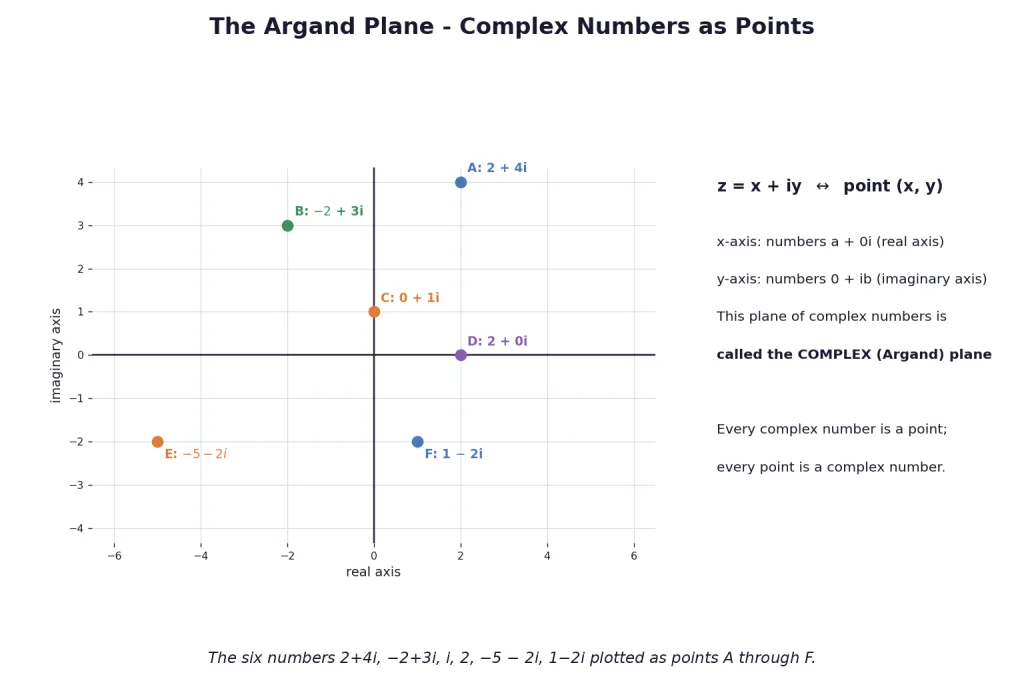
Argand plane used to plot the four rotated points

Solution:

Step 1 — Compute the four numbers. iz=i(2+i)=1+2iiz = i(2 + i) = -1 + 2i; i2z=z=2ii^2z = -z = -2 - i; i3z=iz=12ii^3z = -iz = 1 - 2i.

Step 2 — Compare moduli and positions. All four have modulus 5\sqrt{5}, and each is the previous one turned 90° anticlockwise about the origin.

Step 3 — Name the figure. Four points, equal distances from O, successive quarter-turns: a SQUARE centred at the origin.

Takeaway: Multiplication by i = quarter-turn — the geometric soul of i2=1i^2 = -1 (two quarter-turns = reversal).

Example 28: A conjugate-heavy proof

Prove that for any z, the number zzˉ2i\frac{z - \bar{z}}{2i} is real, and equals Im z.

Solution:

Step 1 — Write z = x + iy and subtract. zzˉ=(x+iy)(xiy)=2iyz - \bar{z} = (x + iy) - (x - iy) = 2iy.

Step 2 — Divide by 2i. 2iy2i=y\frac{2iy}{2i} = y — a real number, exactly Im z. ∎

Takeaway: Companion to Re z = z+zˉ2\frac{z + \bar{z}}{2}; the pair extracts coordinates from z algebraically.

Example 29: Square roots by matching parts

Find the square roots of 8+6i-8 + 6i: solve (x+iy)2=8+6i(x + iy)^2 = -8 + 6i for real x, y.

Solution:

Step 1 — Match real and imaginary parts. (x+iy)2=(x2y2)+2xyi(x + iy)^2 = (x^2 - y^2) + 2xyi: so x2y2=8x^2 - y^2 = -8 and 2xy=62xy = 6.

Step 2 — Add the modulus equation. x2+y2=8+6i=64+36=10x^2 + y^2 = |-8 + 6i| = \sqrt{64 + 36} = 10.

Step 3 — Solve the sum-difference pair. Adding and halving: x2=1x^2 = 1; subtracting: y2=9y^2 = 9.

Step 4 — Fix the signs. xy=3>0xy = 3 > 0: x and y share a sign. Roots: ±(1+3i)\pm(1 + 3i). Check: (1+3i)2=1+6i9=8+6i(1 + 3i)^2 = 1 + 6i - 9 = -8 + 6i ✓.

Takeaway: The three-equation method (real part, imaginary part, modulus) finds square roots of any complex number — formalised in the JEE Corner.

Example 30: Powers of a unit-modulus number

If z=32+12iz = \frac{\sqrt{3}}{2} + \frac{1}{2}i, compute z|z|, and show z6=1z^6 = -1.

Solution:

Step 1 — Modulus. z=34+14=1|z| = \sqrt{\frac{3}{4} + \frac{1}{4}} = 1 — z lies on the unit circle.

Step 2 — Square. z2=3414+23212i=12+32iz^2 = \frac{3}{4} - \frac{1}{4} + 2 \cdot \frac{\sqrt{3}}{2} \cdot \frac{1}{2}i = \frac{1}{2} + \frac{\sqrt{3}}{2}i.

Step 3 — Square again. (z2)2=1434+21232i=12+32i(z^2)^2 = \frac{1}{4} - \frac{3}{4} + 2 \cdot \frac{1}{2} \cdot \frac{\sqrt{3}}{2}i = -\frac{1}{2} + \frac{\sqrt{3}}{2}i.

Step 4 — One more multiplication. z6=z4z2=(12+32i)(12+32i)=1434i+34i34=1z^6 = z^4 \cdot z^2 = \left(-\frac{1}{2} + \frac{\sqrt{3}}{2}i\right)\left(\frac{1}{2} + \frac{\sqrt{3}}{2}i\right) = -\frac{1}{4} - \frac{\sqrt{3}}{4}i + \frac{\sqrt{3}}{4}i - \frac{3}{4} = -1. ∎

Takeaway: This z sits at 30° on the unit circle; six steps of 30° reach 180° — the polar form (JEE Corner) sees this instantly.

Example 31: A collected drill

Express in the form a+iba + ib: (i) 3+2i2i\frac{3 + 2i}{-2 - i} (ii) (32i)(3+2i)(1+i)(3 - 2i)(3 + 2i)(1 + i).

Solution:

Step 1 — (i) Rationalise. (3+2i)(2+i)(2i)(2+i)=6+3i4i+2i24+1=8i5\frac{(3 + 2i)(-2 + i)}{(-2 - i)(-2 + i)} = \frac{-6 + 3i - 4i + 2i^2}{4 + 1} = \frac{-8 - i}{5}.

Step 2 — Standard form. 8515i-\frac{8}{5} - \frac{1}{5}i.

Step 3 — (ii) Spot the conjugate pair FIRST. (32i)(3+2i)=9+4=13(3 - 2i)(3 + 2i) = 9 + 4 = 13 — real, instantly.

Step 4 — Finish. 13(1+i)=13+13i13(1 + i) = 13 + 13i.

Takeaway: Spot conjugate pairs before expanding — they collapse to z2|z|^2 and halve the work.

Example 32: The grand mixed finale

Given z1=1+iz_1 = 1 + i and z2=23iz_2 = 2 - 3i, compute: (i) z1z2z_1z_2 (ii) z1z2\frac{z_1}{z_2} (iii) z14z22|z_1^4 z_2^2| (iv) z1z2zˉ1zˉ2\overline{z_1 z_2} - \bar{z}_1\bar{z}_2.

Solution:

Step 1 — (i) Expand. (1+i)(23i)=23i+2i3i2=5i(1 + i)(2 - 3i) = 2 - 3i + 2i - 3i^2 = 5 - i.

Step 2 — (ii) Rationalise. (1+i)(2+3i)4+9=2+3i+2i313=1+5i13\frac{(1 + i)(2 + 3i)}{4 + 9} = \frac{2 + 3i + 2i - 3}{13} = \frac{-1 + 5i}{13}.

Step 3 — (iii) Use modulus rules, no expansion. z14z22=z14z22=(2)4(13)2=4×13=52|z_1^4z_2^2| = |z_1|^4|z_2|^2 = (\sqrt{2})^4(\sqrt{13})^2 = 4 \times 13 = 52.

Step 4 — (iv) Use the conjugate-product rule. z1z2=zˉ1zˉ2\overline{z_1z_2} = \bar{z}_1\bar{z}_2 identically, so the difference is 0 — no computation.

Takeaway: Four questions, four different tools — expansion, rationalisation, modulus rules, conjugate rules. Choosing the right tool is the whole exam skill for this chapter.