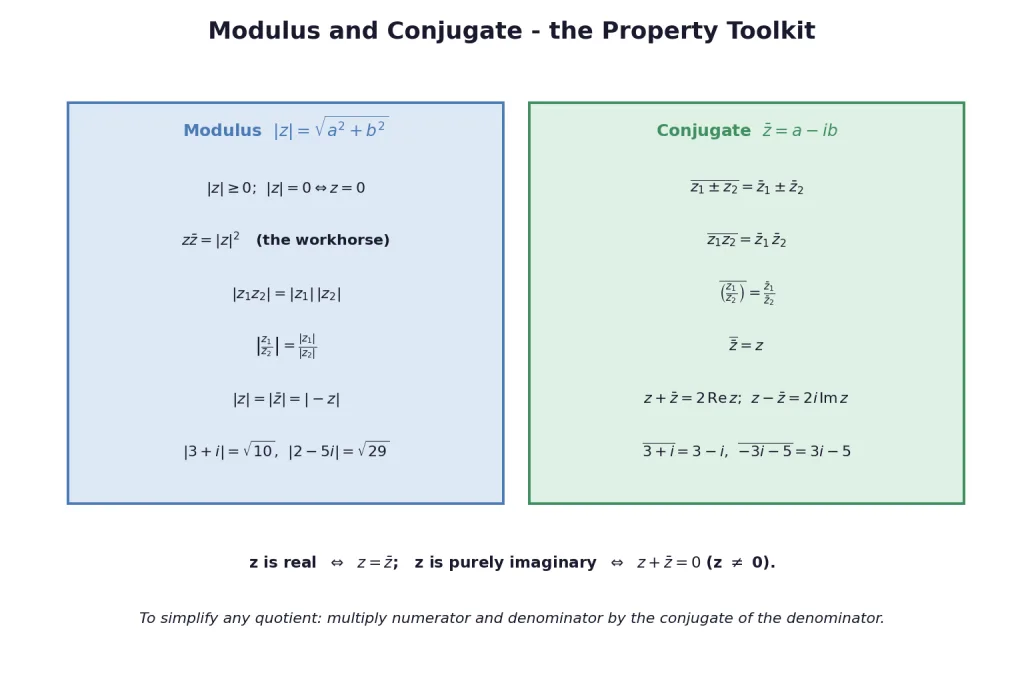
Key Point (Definitions): The modulus of z is the non-negative real number ∣z∣=a2+b2. The conjugate of z is the complex number zˉ=a−ib (flip the sign of the imaginary part only).
A complex number times its own conjugate is a real number — the squared modulus. Immediate payoff: the multiplicative inverse in one line,
z−1=z1=zzˉzˉ=∣z∣2zˉ
[Board Important] Two instant tests worth quoting: z is REAL ⟺z=zˉ; z is PURELY IMAGINARY ⟺z+zˉ=0 (with z = 0). Also z+zˉ=2Rez and z−zˉ=2iImz.
The Property Toolkit
For any complex numbers z1, z2 (with z2=0 where it appears in a denominator):
Modulus rules:
∣z1z2∣=∣z1∣∣z2∣ — moduli multiply
z2z1=∣z2∣∣z1∣ — and divide
∣z∣=∣zˉ∣=∣−z∣; and ∣z∣=0⟺z=0
Conjugate rules:
z1z2=zˉ1zˉ2 and (z2z1)=zˉ2zˉ1
z1±z2=zˉ1±zˉ2
zˉ=z (conjugating twice restores z)
The practical meaning: conjugates and moduli pass through products and quotients term by term. To find (1+2i)(2−i)(3−2i)(2+3i), never expand — compute 551313=513 directly.
[JEE Tip] Modulus questions about horrendous quotients are gifts: apply ∣z1z2∣=∣z1∣∣z2∣ factor-wise and skip all expansion. Conjugate questions distribute the bar the same way. Expansion is only for questions demanding the actual a + ib form.
Solved Examples
Example 1: Multiplicative inverse
Find the multiplicative inverse of 2−3i.
Solution:
Step 1 — Write the conjugate and the squared modulus.zˉ=2+3i and ∣z∣2=22+(−3)2=13.
Step 2 — Apply the formula.z−1=∣z∣2zˉ=132+3i=132+133i.
Step 3 — Check by multiplying.(2−3i)(132+3i)=134+9=1 ✓.
Takeaway: Inverse = conjugate over modulus-squared, verified by one multiplication.
Example 2: A quotient to standard form
Express 1−2i5+2i in the form a+ib.
Solution:
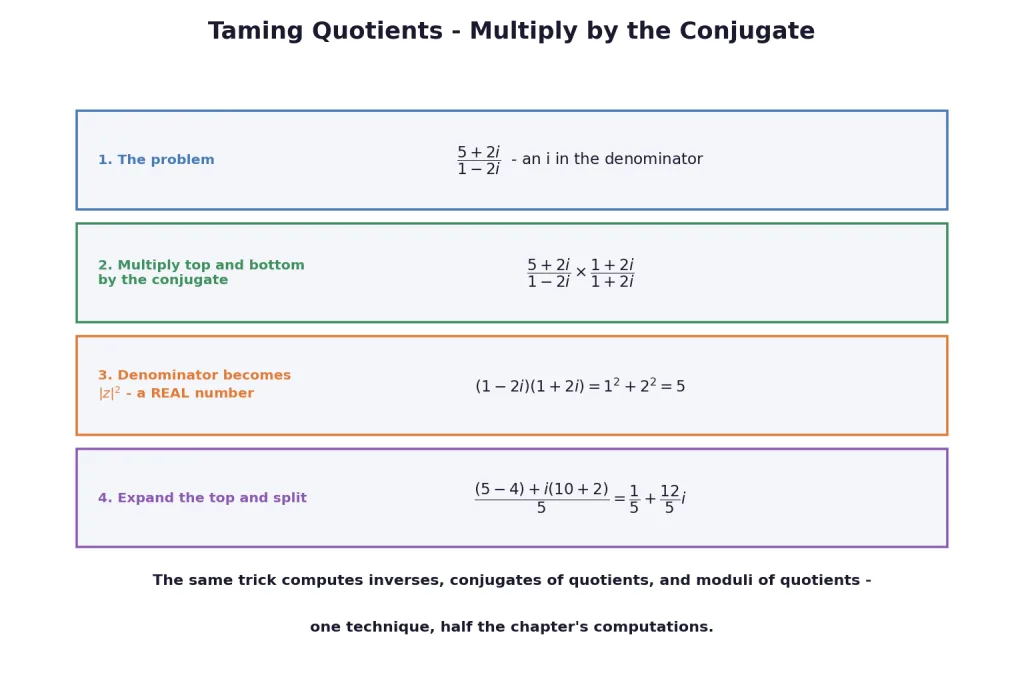
Step 1 — Multiply top and bottom by the conjugate of the denominator.(1−2i)(1+2i)(5+2i)(1+2i).
Step 2 — The denominator turns real.1−(2i)2=1+2=3.
Step 3 — Expand the numerator.5+52i+2i+2i2=3+62i.
Step 4 — Divide.33+62i=1+22i.
Takeaway: The denominator 1−(2i)2=3 is real by design — that is the conjugate trick working.
Example 3: Inverse of −i
Find the multiplicative inverse of −i.
Solution:
Step 1 — Conjugate and modulus.−i=i and ∣−i∣2=02+(−1)2=1.
Step 2 — Apply the formula.z−1=1i=i.
Step 3 — Check.(−i)(i)=−i2=1 ✓.
Takeaway: Unit-modulus numbers have inverse = conjugate.
Example 4: Two inverses with surds
Find the multiplicative inverses of (i) 4−3i (ii) 5+3i.
Solution:
Step 1 — (i) Modulus squared.∣z∣2=16+9=25.
Step 2 — Formula.z−1=254+3i=254+253i.
Step 3 — (ii) Modulus squared.∣z∣2=5+9=14.
Step 4 — Formula.z−1=145−3i=145−143i.
Takeaway: The formula handles surds without complaint.
Example 5: Modulus of a quotient, no expansion
Find (1+2i)(2−i)(3−2i)(2+3i).
Solution:
Step 1 — Take moduli factor-wise.∣3−2i∣=13, ∣2+3i∣=13, ∣1+2i∣=5, ∣2−i∣=5.
Step 2 — Multiply and divide.5⋅513⋅13=513.
Takeaway: Four multiplications avoided entirely — ∣z1z2∣=∣z1∣∣z2∣ is the fastest tool in the chapter.
Example 6: Conjugate of a quotient
Find the conjugate of (1+2i)(2−i)(3−2i)(2+3i).
Solution:
Step 1 — Expand top and bottom. Top: (3−2i)(2+3i)=6+9i−4i−6i2=12+5i. Bottom: (1+2i)(2−i)=2−i+4i−2i2=4+3i.
Step 2 — Rationalise the quotient.4+3i12+5i×4−3i4−3i=16+948−36i+20i+15=2563−16i.
Step 3 — Flip the imaginary sign.(2563−16i)=2563+2516i.
Takeaway: Here the a + ib form IS needed, so expansion is unavoidable; the conjugate then just flips one sign.
Example 7: The x² + y² = 1 classic
If x+iy=a−iba+ib, prove that x2+y2=1.
Solution:
Step 1 — Take moduli of both sides.∣x+iy∣=∣a−ib∣∣a+ib∣.
Step 2 — Conjugates share a modulus. Both are a2+b2, so the quotient is 1: ∣x+iy∣=1.
Step 3 — Square.x2+y2=1. ∎
Takeaway: Two lines by moduli (the expansion route takes ten). ∣z∣=1 statements are always modulus statements in disguise.
Example 8: The generalised version
If x−iy=c−ida−ib, prove that (x2+y2)2=c2+d2a2+b2.
Solution:
Step 1 — Clear the square root.(x−iy)2=c−ida−ib.
Step 2 — Take moduli.∣x−iy∣2=∣c−id∣∣a−ib∣, i.e. x2+y2=c2+d2a2+b2.
Step 3 — Square again.(x2+y2)2=c2+d2a2+b2. ∎
Takeaway: The same modulus trick, applied after clearing the square root.
Example 9: Product of four factors
If (a+ib)(c+id)(e+if)(g+ih)=A+iB, show that (a2+b2)(c2+d2)(e2+f2)(g2+h2)=A2+B2.
Solution:
Step 1 — Take moduli of both sides.∣a+ib∣∣c+id∣∣e+if∣∣g+ih∣=∣A+iB∣, since moduli multiply across any number of factors.
Step 2 — Square both sides. Each ∣⋅∣2 becomes its sum of squares: (a2+b2)(c2+d2)(e2+f2)(g2+h2)=A2+B2. ∎
Takeaway: The identity ∣z1z2∣=∣z1∣∣z2∣ extends to any number of factors; squaring finishes it.
Example 10: Modulus of a difference of quotients
Find the modulus of 1−i1+i−1+i1−i.
Solution:
Step 1 — Recognise the standard quotients.1−i1+i=i and 1+i1−i=−i.
Step 2 — Subtract.i−(−i)=2i.
Step 3 — Take the modulus.∣2i∣=2.
Takeaway: Recognising the two standard quotients turns this into mental arithmetic.
Example 11: Conjugate detective work
Find real numbers x and y if (x−iy)(3+5i) is the conjugate of −6−24i.
Solution:
Step 1 — Write down the target.−6−24i=−6+24i.
Step 2 — Expand the left side.(x−iy)(3+5i)=3x+5xi−3yi−5yi2=(3x+5y)+i(5x−3y).
Step 3 — Match real and imaginary parts.3x+5y=−6 and 5x−3y=24.
Step 4 — Solve the system. Multiply the first by 3 and the second by 5: 9x+15y=−18 and 25x−15y=120; adding, 34x=102, so x=3, and then y=5−6−9=−3.
Step 5 — Check.(3+3i)(3+5i)=9+15i+9i−15=−6+24i ✓.
Takeaway: "Is the conjugate of" just fixes the right-hand side; then it is equality of complex numbers again.
Example 12: A real-quotient condition
Find real y such that 1−iy1+iy has modulus 1, and show this holds for every real y.
Solution:
Step 1 — Take moduli.1−iy1+iy=1+y21+y2=1 for ALL real y.
Step 2 — See why. Numerator and denominator are conjugates of each other, and conjugates share a modulus.
Takeaway: A quotient of conjugates always lies on the unit circle — a fact reused in the β−α problem below.
Example 13: The unit-modulus quotient
If α and β are different complex numbers with ∣β∣=1, find 1−αˉββ−α.
Solution:
Step 1 — Replace the 1 in the denominator.∣β∣=1 means ββˉ=1, so 1−αˉβ=ββˉ−αˉβ.
Step 2 — Factor out β.=β(βˉ−αˉ)=β(β−α).
Step 3 — Take moduli.β(β−α)β−α=∣β∣∣β−α∣∣β−α∣=1⋅∣β−α∣∣β−α∣=1.
Final Answer: 1.
Takeaway: A JEE favourite — factor β out of the denominator using ββˉ=1, and the moduli cancel.
Example 14: Counting solutions
Find the number of non-zero integral solutions of ∣1−i∣x=2x.
Solution:
Step 1 — Compute the modulus.∣1−i∣=1+1=2=21/2.
Step 2 — Rewrite with equal bases.2x/2=2x.
Step 3 — Equate exponents.2x=x gives x=0 — but the question demands NON-ZERO solutions.
Step 4 — Conclude. There are no non-zero integral solutions: the count is 0.
Takeaway: Reduce to equal bases, and read the question's fine print ("non-zero").
Ready to test your knowledge?
Take a quick interactive quiz on this topic —
free, works without login.