
Complex Numbers as Points
Every ordered pair (x, y) of reals marks a unique point of the coordinate plane — and every complex number IS essentially an ordered pair. Identify them:
Key Point: The complex number is represented by the point P(x, y). The plane with a complex number attached to each of its points is called the complex plane or the Argand plane.
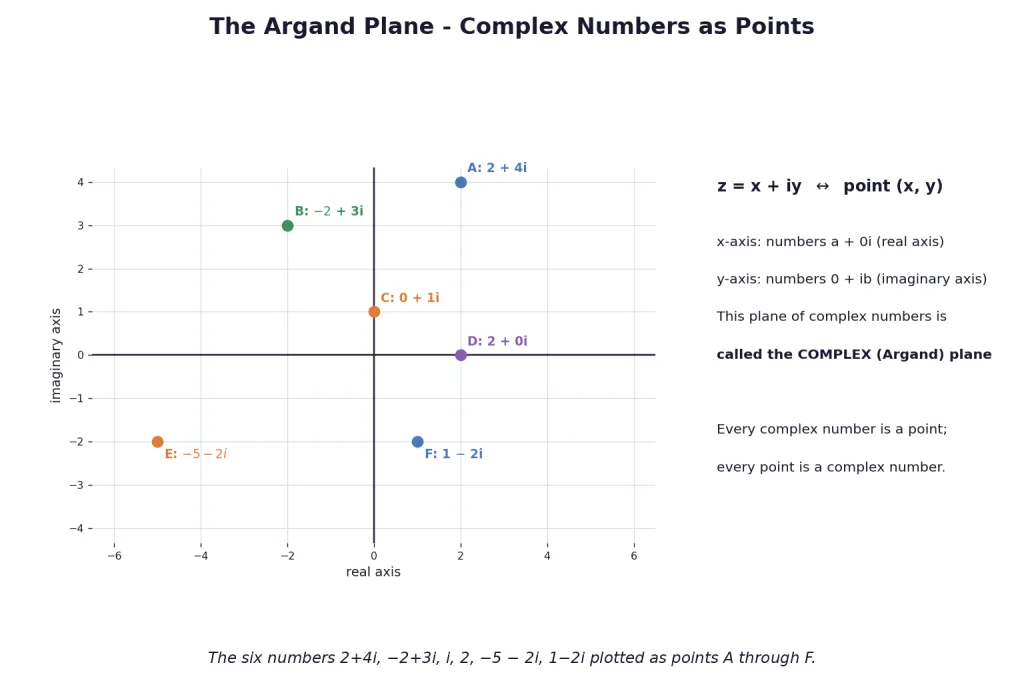
A gallery of examples: , , , , , .
- Points on the x-axis are the real numbers — so it is called the real axis.
- Points on the y-axis are the purely imaginary numbers — the imaginary axis.
[Board Important] Plotting complex numbers is a direct 1-mark skill; naming the axes correctly ("real axis", "imaginary axis") earns the second mark.
Modulus as Distance, Conjugate as Mirror
Distance
In the Argand plane, the modulus gets a geometric identity:
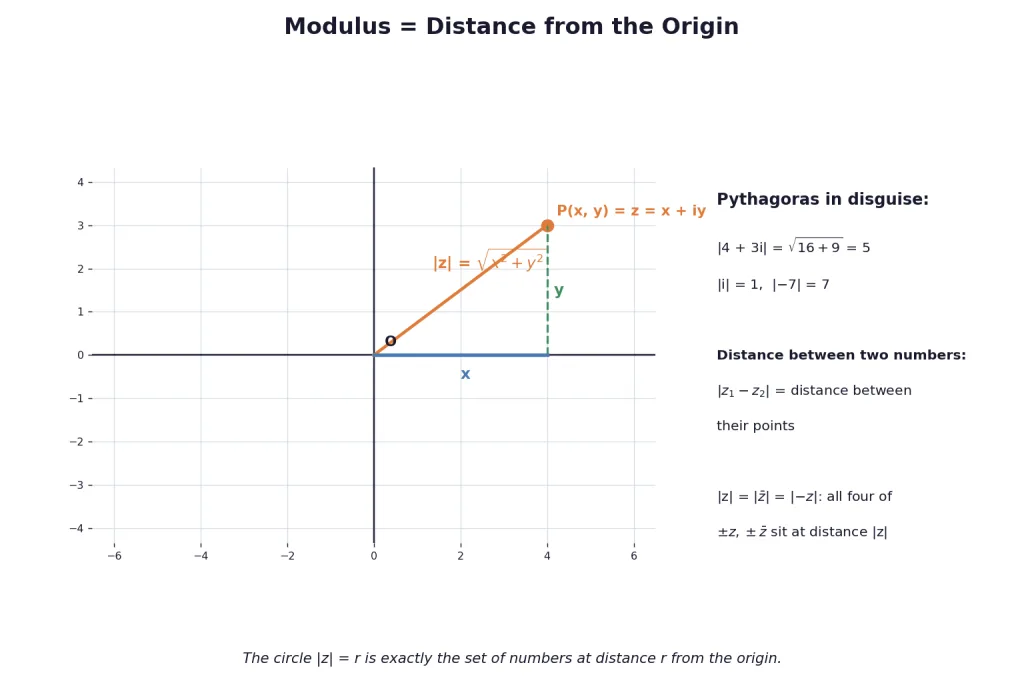
More generally, is the distance BETWEEN the points and — which turns modulus equations into geometry: describes the circle of radius 3 centred at the origin, and the circle of radius 2 centred at (1, 1).
Reflection
The conjugate also turns geometric:
Key Point: sits at P(x, y) and at Q(x, ) — the mirror image of P in the real axis.
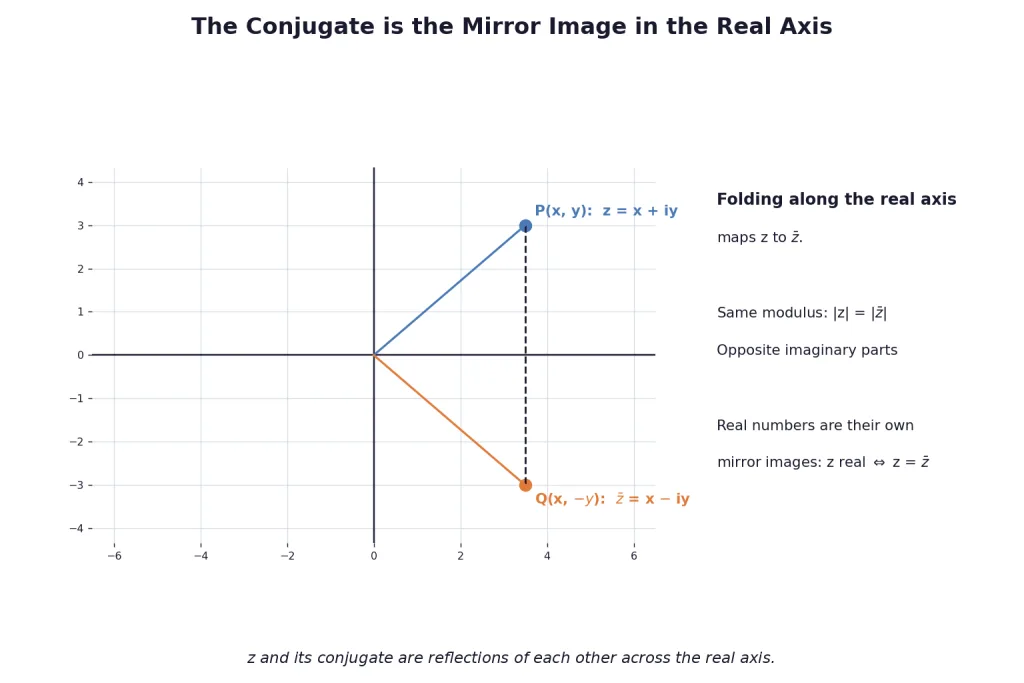
Consequences read straight off the picture: (reflection preserves distance), real numbers are their own mirror images, and the four numbers sit at the four "corners" equidistant from O.
[JEE Tip] Translate fluently in both directions: ↔ circle; ↔ perpendicular bisector of the segment ab; Im z > 0 ↔ upper half-plane. JEE locus questions are exactly this dictionary.
Solved Examples
Example 1: Plotting practice
Locate the points representing , , , , and , stating the quadrant (or axis) of each.
Solution:
Step 1 — Convert each number to its coordinate pair. sits at (x, y): , , , , , .
Step 2 — Read the quadrant from the signs. : both positive — quadrant I. : quadrant II. : quadrant III. : quadrant IV.
Step 3 — Handle the axis cases. lies on the imaginary axis; on the real axis — neither belongs to a quadrant.
Takeaway: Sign of the real part ↔ left/right; sign of the imaginary part ↔ up/down — identical to ordinary coordinates.
Example 2: Distances from the origin
Find the distance of each from the origin: (i) (ii) (iii) (iv) .
Solution:
Step 1 — (i) Modulus = distance. .
Step 2 — (ii) Same formula. .
Step 3 — (iii) A real number. — distance along the real axis.
Step 4 — (iv) A purely imaginary number. — distance along the imaginary axis.
Takeaway: Modulus = distance; the 3-4-5 and 5-12-13 triangles live in the Argand plane too.
Example 3: Distance between two complex numbers
Find the distance between and .
Solution:
Step 1 — Subtract. .
Step 2 — Take the modulus. .
Takeaway: IS the distance formula — no new machinery needed.
Example 4: Mirror images
Plot z = , , and , and describe the symmetry.
Solution:
Step 1 — Compute the four points. z at (3, 2); at (3, ); at (, ); at (, 2).
Step 2 — Name each reflection. is z reflected in the REAL axis; is z reflected through the ORIGIN; is z reflected in the IMAGINARY axis.
Step 3 — Observe the common modulus. All four have modulus — corners of a rectangle centred at O.
Takeaway: The four sign-conjugate variants of z make a rectangle; each reflection has its own algebraic name.
Example 5: Which numbers lie on an axis?
For what real x does lie (i) on the real axis (ii) on the imaginary axis?
Solution:
Step 1 — (i) Real axis means Im z = 0. gives .
Step 2 — (ii) Imaginary axis means Re z = 0. gives .
Step 3 — Notice the overlap. At x = 2 both parts vanish: z is the ORIGIN, which lies on both axes simultaneously.
Takeaway: Axis membership is a one-part condition; the origin satisfies both.
Example 6: The circle |z| = 2
Describe the set of points z with , and check whether and belong to it.
Solution:
Step 1 — Translate the condition. collects all points at distance 2 from the origin — the circle of radius 2 centred at O.
Step 2 — Test the first candidate. — not on the circle (it lies inside).
Step 3 — Test the second. ✓ — on the circle.
Takeaway: Modulus conditions are membership tests for circles — compute and compare.
Example 7: A locus as a perpendicular bisector
Describe the set of z with .
Solution:
Step 1 — Read the two moduli as distances. is the distance from z to the point 1 (at (1, 0)); is the distance to (at (, 0)).
Step 2 — Interpret the equality. Points equidistant from two fixed points form the PERPENDICULAR BISECTOR of the segment joining them — here, the imaginary axis (Re z = 0).
Step 3 — Confirm by algebra. gives , so ✓.
Takeaway: Equal distances = perpendicular bisector; algebra and geometry give the same one-line answer.
Example 8: Conjugate geometry in a computation
z = satisfies and . Find z and plot it.
Solution:
Step 1 — Use the sum. , so .
Step 2 — Use the difference. , so .
Step 3 — Assemble and place. — the point (3, 2) in quadrant I.
Takeaway: and isolate the two coordinates — the conjugate is a coordinate-extraction tool.
Example 9: Regions in the plane
Shade-describe the sets: (i) Im z > 0 (ii) (iii) Re z = 2.
Solution:
Step 1 — (i) Translate. Im z is the y-coordinate; y > 0 is the OPEN upper half-plane (boundary excluded — the inequality is strict).
Step 2 — (ii) Translate. Distance from O at most 1: the CLOSED unit disc — the circle together with its interior.
Step 3 — (iii) Translate. Re z = 2 fixes x = 2: the vertical line through (2, 0).
Takeaway: Equations give curves; inequalities give regions. The boundary belongs to the set exactly when the inequality is non-strict.
Example 10: Modulus from the plane, quadrant from signs
z = . Find |z|, the quadrant of z, and the mirror image of z in the real axis.
Solution:
Step 1 — Modulus. .
Step 2 — Quadrant. The point (, ) has negative x, positive y: quadrant II.
Step 3 — Mirror image. Reflection in the real axis is the conjugate: , in quadrant III.
Takeaway: This z is a JEE regular ( in disguise!); its geometry — modulus 2, 120° from the positive real axis — previews the polar form in the JEE Corner.