
The General Circle and Tangency
The chapter so far gives you the standard forms; JEE tests four extensions. This section builds each from what you already know.
1. The general equation of a circle. Expanding always yields the shape
Key Point (Reading the general form): centre , radius — a real circle needs (equality gives a point circle). Note the equation has equal coefficients and no term.
For : , , centre , radius .
2. Position of a point. Write . Then , , according as the point is inside, on, or outside the circle — the same verdict the squared-distance comparison reaches.
3. Tangency for the circle: distance = radius. The line (or any line) touches a circle exactly when the perpendicular distance from the centre equals the radius — the Chapter 9 distance formula does all the work. For this packages into .
4. Tangency for the other conics. Substitute into the conic and demand a repeated root (discriminant zero):
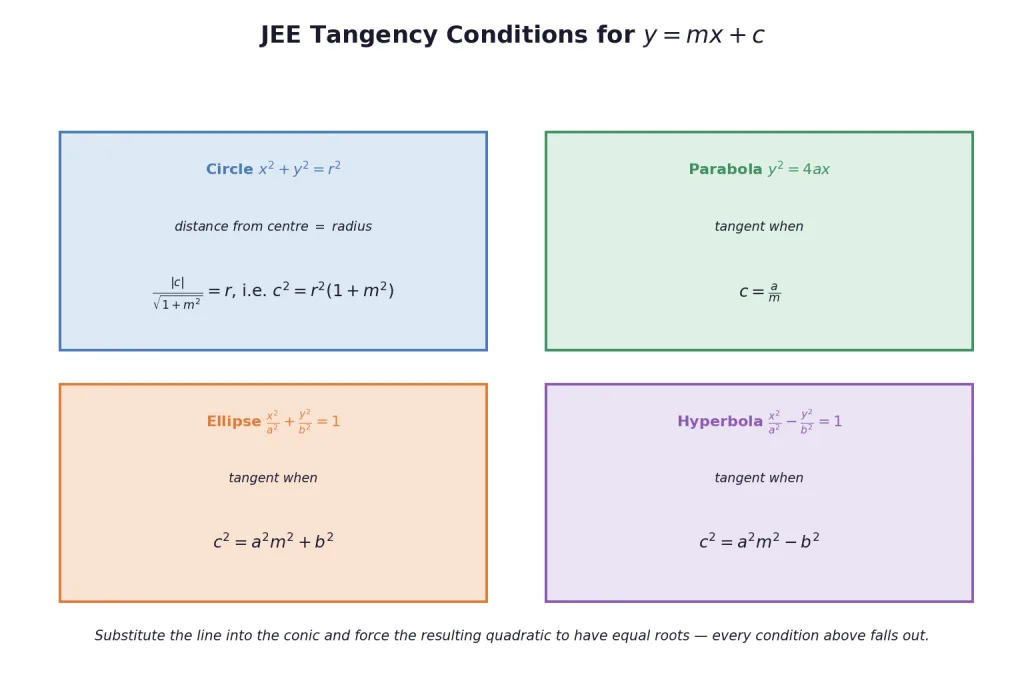
Key Point (Tangency conditions): to : . To : . To : .
So every slope gives exactly one tangent to a parabola, , and every slope gives two parallel tangents to an ellipse, . For the ellipse, the point of contact of is .
Focal Distances, Asymptotes, and Eccentricity Identities
5. Focal distance of a parabola. For on , the focal distance equals the directrix distance:
No square roots needed — this one line solves most "distance from the focus" numericals.
6. Focal distances of an ellipse. The derivation of the standard equation produced and , summing to automatically. On at : distances .
7. Asymptotes of a hyperbola. For large the branches of hug the lines
(the diagonals of the box). They never meet the curve, and the rectangular (equilateral) hyperbola has perpendicular asymptotes and .
8. Eccentricity identities worth caching.
Ellipse: . Hyperbola: . A hyperbola and its conjugate have eccentricities tied by
since and .
[JEE Tip] Most conics errors in the exam are sign errors on the three relations: circle needs no relation, ellipse , hyperbola , and the tangency conditions inherit the same sign pattern ( for ellipse, for hyperbola). Learn them as one table, not four facts.
JEE-Style Solved Examples
Example 1: Reading the general form
Find the centre and radius of , and the position of the origin relative to it.
Solution:
Step 1 — Match the general form. , : , .
Step 2 — Centre and radius. Centre ; radius .
Step 3 — Position of the origin. : outside.
Takeaway: Halve the linear coefficients and negate — the general form reads off in seconds.
Example 2: When is it a circle at all?
For which does represent a real circle?
Solution:
Step 1 — Radius formula. , : radius.
Step 2 — Demand positivity. : .
Step 3 — Boundary case. gives radius 0 — a single point .
Takeaway: is the gatekeeper: positive → circle, zero → point, negative → nothing.
Example 3: Tangency by distance = radius
For what is tangent to ?
Solution:
Step 1 — Distance from the centre. .
Step 2 — Set equal to the radius. : .
Step 3 — Both signs. — one tangent on each side of the circle.
Takeaway: Circle tangency is a Chapter 9 distance computation — no discriminants needed.
Example 4: Tangent to a parabola of given slope
Find the tangent to with slope 2.
Solution:
Step 1 — Apply the condition. : tangency needs .
Step 2 — Write the tangent. .
Step 3 — Point of contact. ; check: ✓.
Takeaway: Each slope gives exactly ONE tangent to a parabola — is worth memorising whole.
Example 5: Tangents to an ellipse of given slope
Find the tangents to with slope 1.
Solution:
Step 1 — Apply the condition. .
Step 2 — Both signs. : tangents and .
Takeaway: An ellipse admits TWO parallel tangents per slope — they sandwich the curve.
Example 6: Point of contact
Where does touch ?
Solution:
Step 1 — Apply the contact formula. .
Step 2 — Verify on the ellipse. ✓.
Step 3 — Verify on the line. ✓.
Takeaway: The contact point satisfies BOTH equations — two ten-second checks certify the formula.
Example 7: Focal distance of a parabola point
Find the focal distance of the point on with abscissa 4.
Solution:
Step 1 — Identify . : .
Step 2 — Apply . .
Takeaway: Focal distance = directrix distance = — the definition doing the arithmetic for you.
Example 8: Focal distances of an ellipse point
Find both focal distances of the point on with , and verify the sum.
Solution:
Step 1 — Eccentricity. : .
Step 2 — Apply . : distances and .
Step 3 — Verify. ✓.
Takeaway: turns ellipse focal distances into linear arithmetic — and their sum self-checks.
Example 9: Asymptotes and the angle between them
Find the asymptotes of and the tangent of the acute angle between them.
Solution:
Step 1 — Write the asymptotes. .
Step 2 — Angle between slopes . .
Step 3 — Simplify. .
Takeaway: Asymptote slopes are — the Chapter 9 angle formula does the rest.
Example 10: Conjugate hyperbola eccentricities
Show that the eccentricities of and of its conjugate satisfy .
Solution:
Step 1 — Write both eccentricities. ; the conjugate swaps the roles: .
Step 2 — Add the reciprocals. . ∎
Takeaway: Both hyperbolas share the same — the identity is that shared focus circle in disguise.
Example 11: A tangent to a hyperbola
For which is tangent to ?
Solution:
Step 1 — Apply the condition. .
Step 2 — Both signs. : tangents .
Step 3 — Slope audit. The condition needs , i.e. — satisfied by ✓.
Takeaway: Hyperbola tangents of slope exist only when beats the asymptote slope .
Example 12: Circle through three points (general form at work)
Find the circle through , and .
Solution:
Step 1 — Feed the points to the general form. : ; : , so ; : , so .
Step 2 — Write. .
Step 3 — Anatomy. Centre , radius .
Takeaway: Three points → three linear equations in — the general form exists exactly for this job.