
Focus, Directrix, and the Standard Equation
Key Point (Definition): A parabola is the set of all points equidistant from a fixed point (the focus) and a fixed line (the directrix): for every point , where is the perpendicular distance to the directrix.
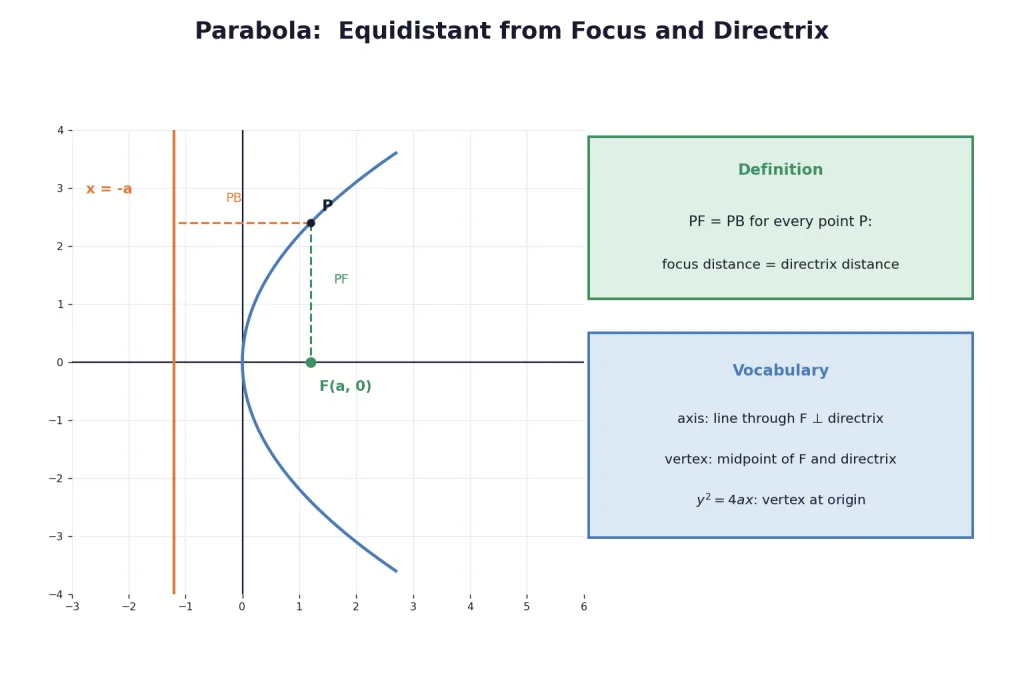
The axis is the line through perpendicular to the directrix; the vertex is where the parabola crosses its axis — the midpoint of the focus and the directrix. (If the fixed point lies on the fixed line, the "parabola" degenerates to a straight line through the point, perpendicular to the line.)
Deriving . Put the vertex at the origin with focus , , and directrix . For , the condition reads
Squaring and cancelling from both sides leaves , i.e.
The same construction in the other three orientations gives the full family:
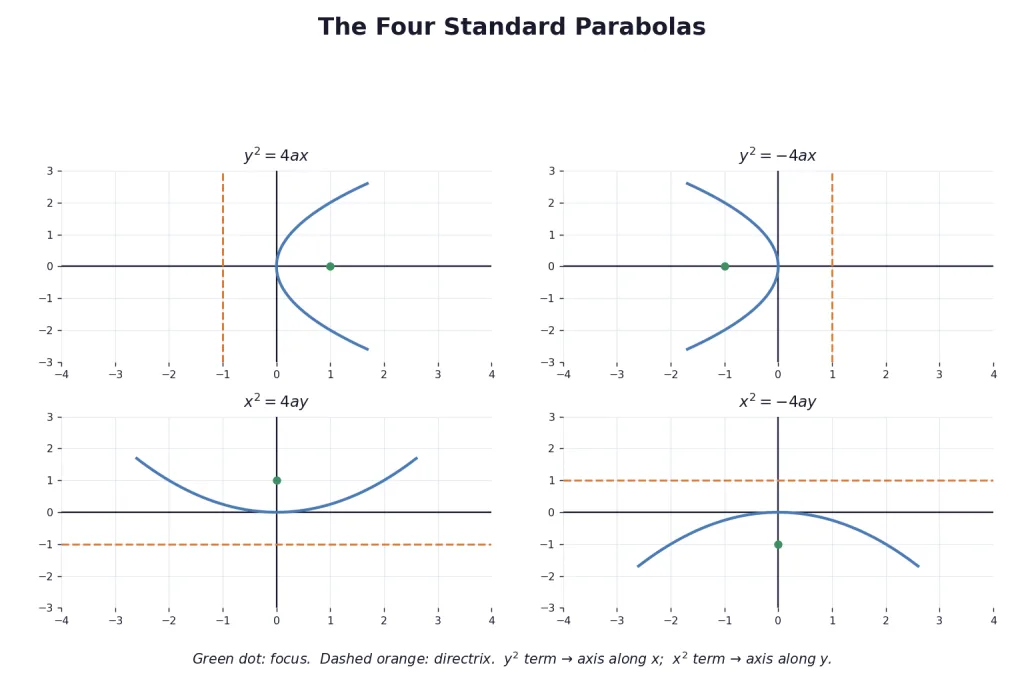
Key Point (The four standard parabolas): (opens right, focus , directrix ); (opens left, focus , directrix ); (opens up, focus , directrix ); (opens down, focus , directrix ).
Reading the orientation: a term means the axis is the -axis; an term means the axis is the -axis. The sign of the linear term says which way the curve opens.
Latus Rectum and Working the Standard Forms
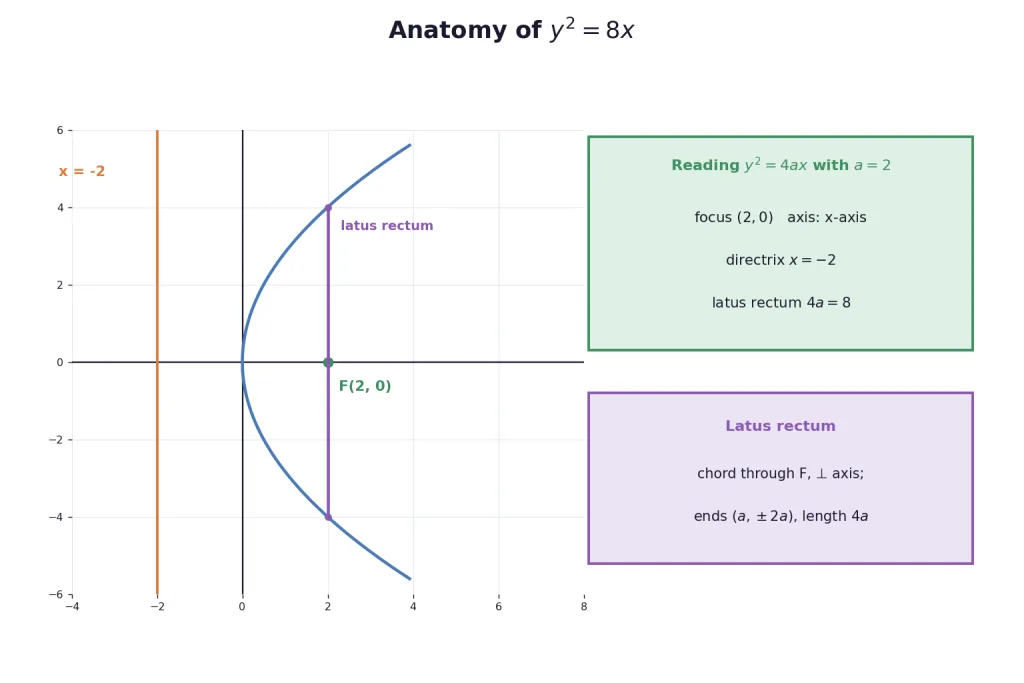
Key Point (Latus rectum): The latus rectum is the chord through the focus perpendicular to the axis. For its ends are and its length is .
Why: the end of the latus rectum is equidistant from focus and directrix, and its directrix distance is exactly (from to ), so on each side of the axis.
The two exam directions:
Equation → data: for , compare with : . Focus , axis the -axis, directrix , latus rectum 8.
Data → equation: identify the orientation first, then find .
Focus and directrix : opens right, , so . Vertex and focus : axis is the -axis, opens up, . Symmetric about the -axis through : the point sits below the vertex, so it opens down, with , giving .
[Board Tip] When a parabola is given by a point it passes through plus its axis, substitute the point into the correctly-oriented form — choosing when the curve actually opens left (or down) produces a negative and a lost mark. Check which quadrant the given point occupies first.
Solved Examples
Example 1: Reading everything from the equation
Find the focus, axis, directrix and latus rectum of .
Solution:
Step 1 — Identify the orientation. A term with a positive -side: opens right along the -axis.
Step 2 — Find . Compare with : , so .
Step 3 — Read off the anatomy. Focus ; axis: the -axis; directrix ; latus rectum .
Takeaway: One comparison gives ; every other quantity is a formula in .
Example 2: The same reading, three ways
Find the focus, directrix and latus rectum of: (i) ; (ii) ; (iii) .
Solution:
Step 1 — (i). : focus , directrix , latus rectum 12.
Step 2 — (ii). term, opens up, : focus , directrix , latus rectum 6.
Step 3 — (iii). Opens left, : focus , directrix , latus rectum 8.
Takeaway: The squared variable names the axis; the sign names the direction; is always the latus rectum.
Example 3: Downward and leftward flavours
Find the focus, directrix and latus rectum of: (i) ; (ii) ; (iii) .
Solution:
Step 1 — (i). Opens down, : focus , directrix , latus rectum 16.
Step 2 — (ii). Opens right, : focus , directrix , latus rectum 10.
Step 3 — (iii). Opens down, : focus , directrix , latus rectum 9.
Takeaway: Odd coefficients just make fractional — the reading routine never changes.
Example 4: From focus and directrix
Find the parabola with (i) focus and directrix ; (ii) focus and directrix .
Solution:
Step 1 — (i) Orientation. Focus on the positive -axis with the directrix behind the origin: opens right.
Step 2 — (i) Find and write. : .
Step 3 — (ii) Same shape. : .
Takeaway: The vertex is the midpoint of focus and directrix — here the origin, confirming the standard form applies.
Example 5: A downward parabola
Find the parabola with focus and directrix .
Solution:
Step 1 — Orientation. Focus below the origin, directrix above: opens down, form .
Step 2 — Find . Focus gives .
Step 3 — Write. .
Takeaway: The parabola always bends AWAY from its directrix and wraps around its focus.
Example 6: From vertex and focus
Find the parabola with vertex and focus at (i) ; (ii) ; (iii) .
Solution:
Step 1 — (i). Focus on the positive -axis: with : .
Step 2 — (ii). Focus on the positive -axis: .
Step 3 — (iii). Focus on the negative -axis: opens left: .
Takeaway: Vertex-to-focus direction IS the opening direction — read it straight off the coordinates.
Example 7: Orientation from a point
Find the parabola symmetric about the -axis, vertex at the origin, passing through .
Solution:
Step 1 — Choose the correct form. Symmetric about the -axis with the point BELOW the vertex: opens down, .
Step 2 — Substitute the point. gives .
Step 3 — Write. , i.e. .
Takeaway: Locate the point's quadrant BEFORE picking the form — a negative later means you chose wrong.
Example 8: Axis along the -axis
Find the parabola with vertex , axis along the -axis, passing through .
Solution:
Step 1 — Choose the form. The point has : opens right, .
Step 2 — Substitute. : .
Step 3 — Write. , i.e. .
Takeaway: The point plugs straight into the correctly-oriented form — one equation, one unknown.
Example 9: Symmetric about the -axis
Find the parabola with vertex , symmetric about the -axis, passing through .
Solution:
Step 1 — Choose the form. Point above the vertex: opens up, .
Step 2 — Substitute. : .
Step 3 — Write. , i.e. .
Takeaway: Check at the end: ✓ — substitution back is free insurance.
Example 10: Latus rectum ends — a coordinate check
For , verify that the ends of the latus rectum are and that its length is 12.
Solution:
Step 1 — Locate the focal chord. : the latus rectum is the vertical chord at .
Step 2 — Intersect with the parabola. : — ends and .
Step 3 — Measure. Length . ∎
Takeaway: The ends and length are worth memorising — they anchor countless focal-chord problems.