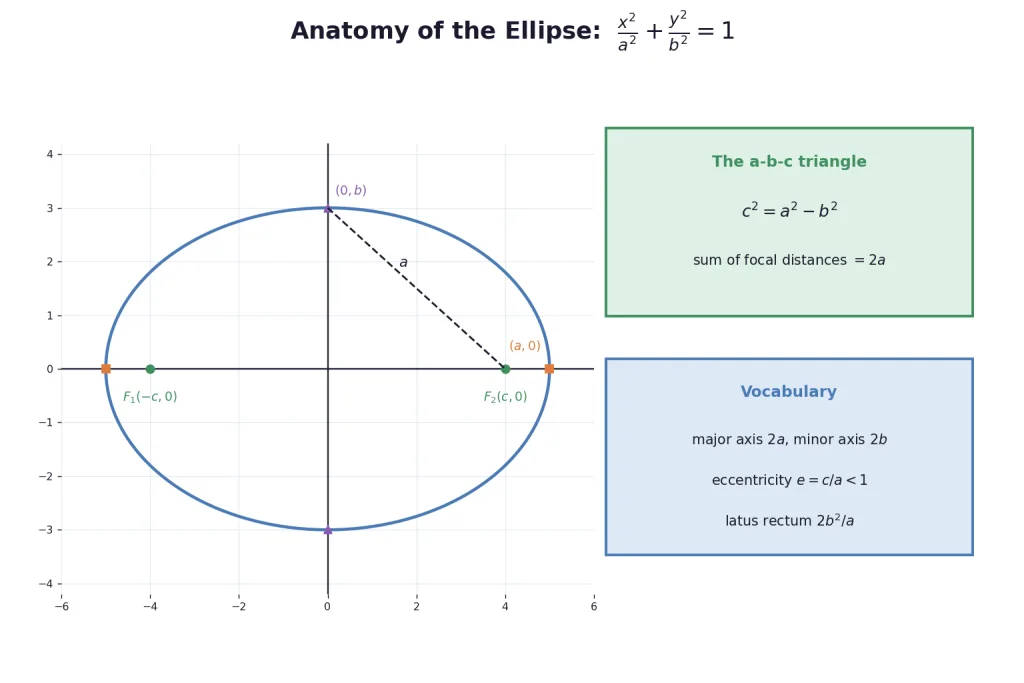
Key Point (Definition): An ellipse is the set of all points whose distances from two fixed points (the fociF1, F2) have a constant sum — always greater than the distance between the foci.
The midpoint of F1F2 is the centre; the line through the foci is the major axis (length 2a); the perpendicular line through the centre is the minor axis (length 2b); the ends of the major axis are the vertices. Write 2c for the distance between the foci.
Where c2=a2−b2 comes from (the two-point argument): the vertex end of the major axis gives sum =(c+a)+(a−c)=2a; the end of the minor axis gives sum =2b2+c2. Setting them equal:
a=b2+c2,i.e.c2=a2−b2
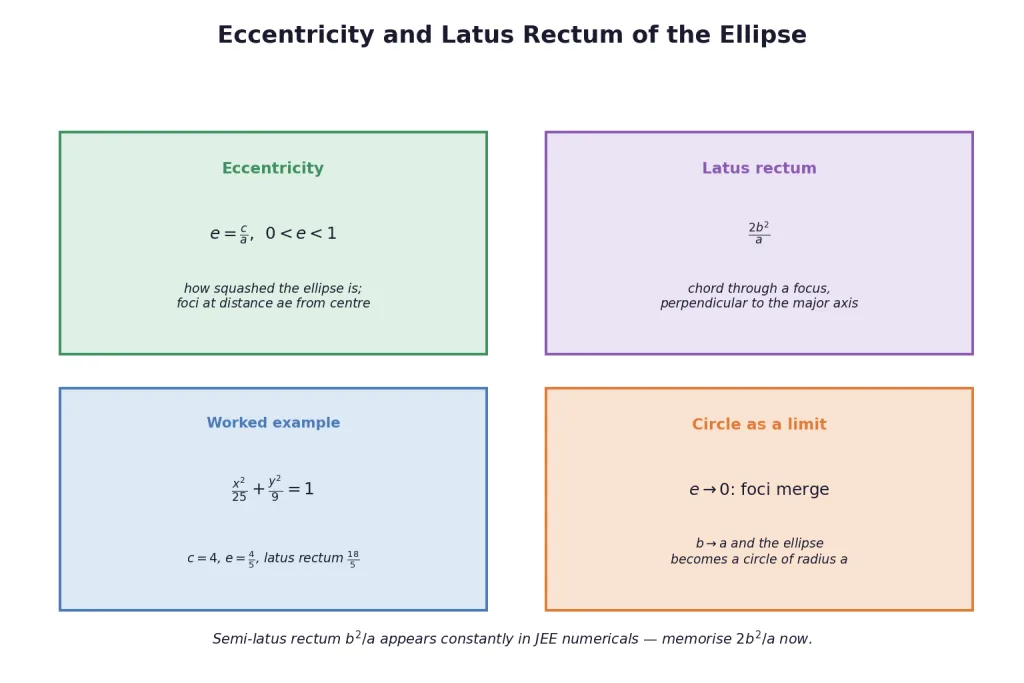
Key Point (Eccentricity):e=ac, with 0<e<1 for a genuine ellipse. The foci sit at distance ae from the centre. As e→0 the foci merge and the ellipse becomes a circle (b→a).
Deriving the standard equation. With centre at the origin and foci (±c,0), the condition PF1+PF2=2a becomes, after two squarings,
a2x2+a2−c2y2=1⇒a2x2+b2y2=1
Along the way one finds the tidy focal distances PF1=a+acx and PF2=a−acx — worth remembering for the JEE Corner. The curve lives in the box −a≤x≤a, −b≤y≤b and is symmetric about both axes.
Both Orientations and the Latus Rectum
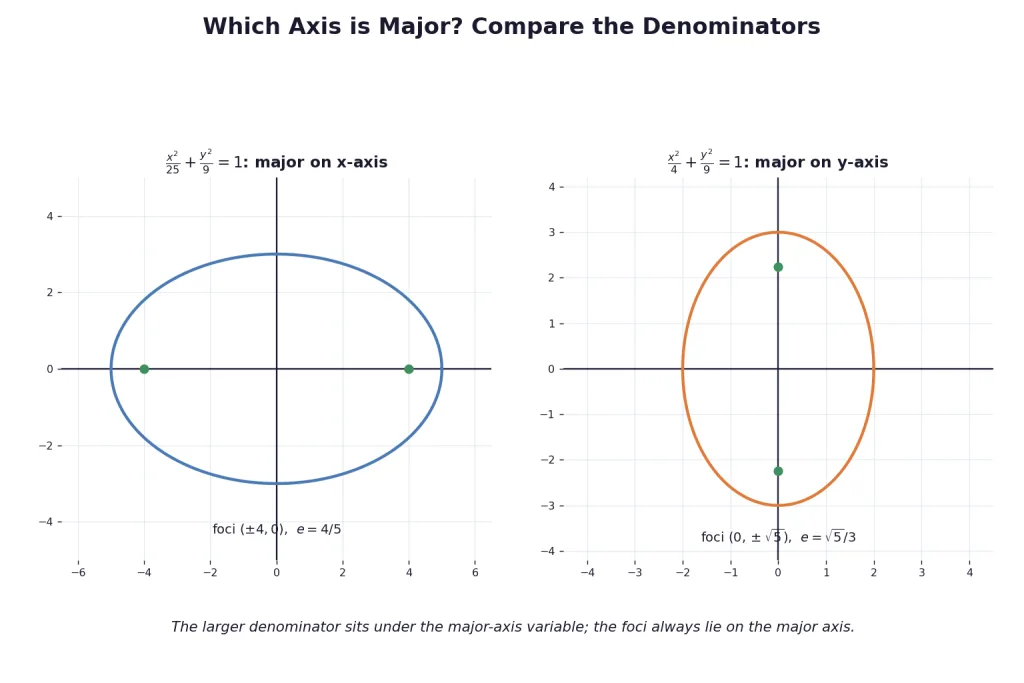
Key Point (Standard equations): Major axis on the x-axis: a2x2+b2y2=1 with foci (±c,0). Major axis on the y-axis: b2x2+a2y2=1 with foci (0,±c). In both, a>b and c2=a2−b2.
Which is which? The larger denominator sits under the major-axis variable, and the foci always lie on the major axis.
Key Point (Latus rectum): the focal chord perpendicular to the major axis has length a2b2 — substitute x=ae into the equation and the semi-length comes out as ab2.
The standard workflow:
Given the equation, read a and b from the denominators, compute c=a2−b2, then list foci, vertices, axis lengths, e=ac and latus rectum a2b2. For 25x2+9y2=1: c=4, foci (±4,0), vertices (±5,0), e=54, latus rectum 518.
Given data, pick the orientation from where the foci/vertices lie, then solve for the missing constant: vertices (±13,0) and foci (±5,0) give b2=169−25=144, so 169x2+144y2=1. Two points on the ellipse give two linear equations in a21 and b21.
[Board Tip]c2=a2−b2 for the ellipse but c2=a2+b2 for the hyperbola. Mixing the two is the single most common conics error — anchor it as "ellipse: a is the hypotenuse."
Solved Examples
Example 1: Full anatomy from the equation
For 25x2+9y2=1, find the foci, vertices, axis lengths, eccentricity and latus rectum.
Solution:
Step 1 — Read a and b. Larger denominator under x2: major on the x-axis, a=5, b=3.
Step 2 — Compute c.c=a2−b2=25−9=4.
Step 3 — List everything. Foci (±4,0); vertices (±5,0); major axis 10; minor axis 6; e=ac=54; latus rectum a2b2=518.
Takeaway: One c-computation unlocks the entire list — everything else is direct substitution.
Example 2: Major axis on the y-axis
Analyse 9x2+4y2=36.
Solution:
Step 1 — Normalise. Divide by 36: 4x2+9y2=1.
Step 2 — Orient. The larger denominator (9) sits under y2: major on the y-axis, a=3, b=2.
Step 3 — Compute and list.c=9−4=5: foci (0,±5), vertices (0,±3), major axis 6, minor axis 4, e=35, latus rectum 32(4)=38.
Takeaway: Always divide to "=1" form first — the raw coefficients invert the apparent roles of a and b.
Example 3: Reading practice
Find foci, eccentricity and latus rectum of: (i) 36x2+16y2=1; (ii) 4x2+25y2=1; (iii) 16x2+9y2=1.