
One Cone, Four Curves
Take a fixed vertical line (the axis) and a line meeting it at a point (the vertex) at a fixed angle . Rotating around sweeps out a double-napped right circular cone; each position of the rotating line is a generator, and the vertex separates the two nappes.
A conic section is the curve where a plane cuts this cone. Everything depends on the angle that the cutting plane makes with the axis:
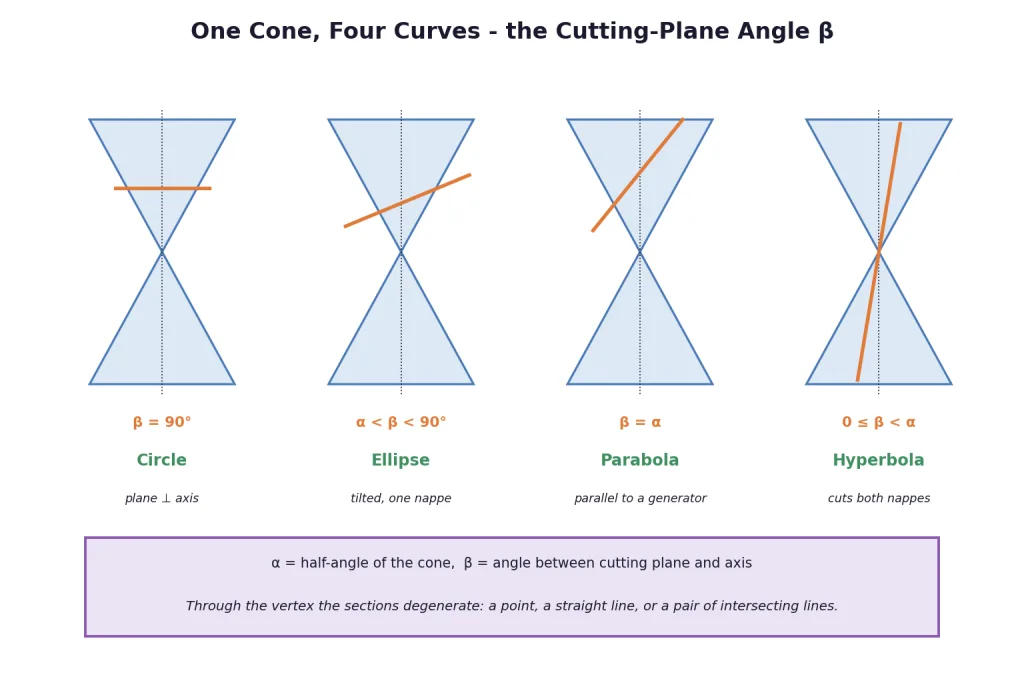
Key Point (The angle dictionary): cutting away from the vertex, gives a circle; gives an ellipse; gives a parabola; makes the plane cut both nappes — a hyperbola.
When the plane passes through the vertex, the sections degenerate: a point (when ), a straight line (when — the degenerate parabola), or a pair of intersecting lines (when — the degenerate hyperbola).
These four curves run planetary orbits, telescope mirrors, headlight reflectors and suspension-bridge cables — and the rest of the chapter gives each one a clean coordinate equation.
The Circle as a Locus
Key Point (Definition and equation): A circle is the set of all points at a fixed distance (the radius) from a fixed point (the centre). Writing with the distance formula and squaring:
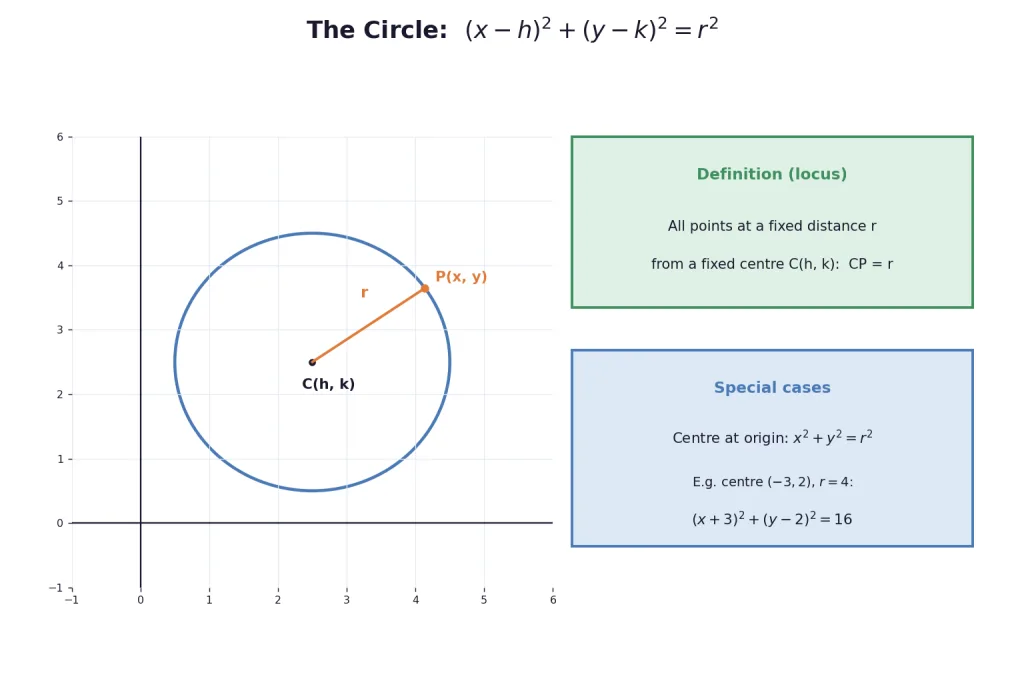
Centre at the origin gives the familiar . Centre , radius 4 gives .
Reading centre and radius from an expanded equation. An equation like hides its centre. Complete the square in and separately:
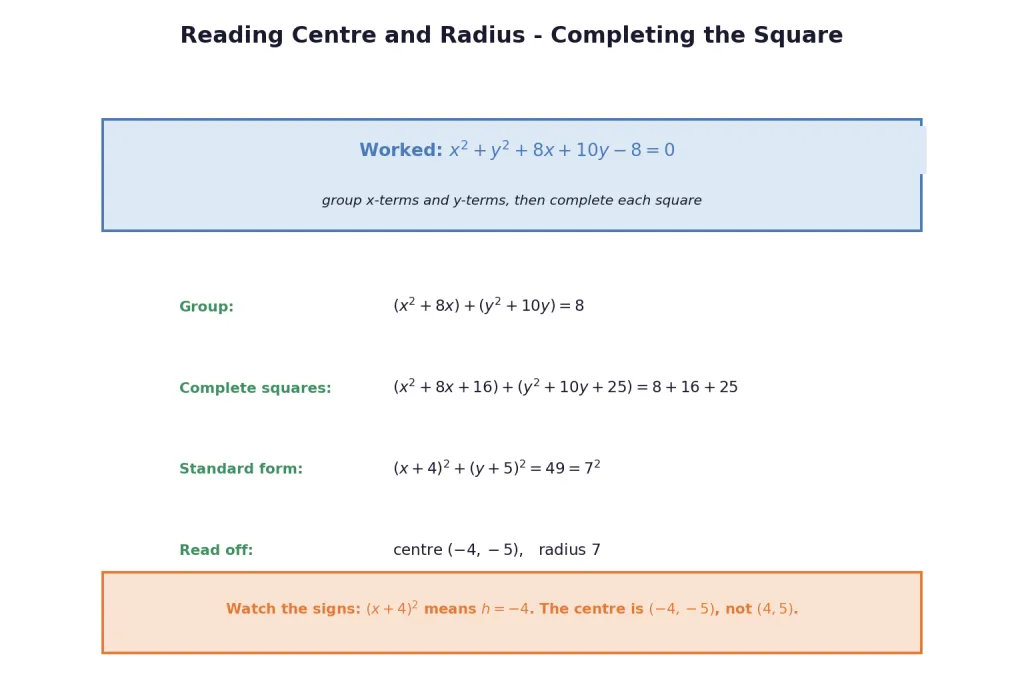
so the centre is and the radius is 7.
Finding a circle from conditions. Two points on the circle plus a line containing the centre determine everything: the centre is equidistant from the two points (or lies on the perpendicular bisector of their chord), giving equations to solve simultaneously — the chord-bisector method worked through below.
[Board Tip] Signs are the classic trap: means , so the centre is , never . Say the standard form out loud as " minus " before reading off coordinates.
Solved Examples
Example 1: Writing the equation directly
Find the equation of the circle with (i) centre and radius , (ii) centre and radius 4.
Solution:
Step 1 — (i) Centre at the origin. : .
Step 2 — (ii) Substitute with signs. , : , i.e. .
Takeaway: turns the bracket into — say " minus " before substituting.
Example 2: A drill in both directions
Write the equations: (i) centre , radius 2; (ii) centre , radius ; (iii) centre , radius ; (iv) centre , radius .
Solution:
Step 1 — (i). , which expands to — through the origin.
Step 2 — (ii). ; multiplying by 144: .
Step 3 — (iii). , i.e. — also through the origin.
Step 4 — (iv). , i.e. .
Takeaway: Expanded forms whose constant is 0 pass through the origin — a quick structural read.
Example 3: Completing the square
Find the centre and radius of .
Solution:
Step 1 — Group and complete each square. .
Step 2 — Write the standard form. .
Step 3 — Read off. Centre , radius 7.
Takeaway: Add HALF the coefficient, squared, to both sides — and remember means .
Example 4: Reading centre and radius
Find the centre and radius of: (i) ; (ii) ; (iii) ; (iv) .
Solution:
Step 1 — (i) Direct read. Centre , radius 6.
Step 2 — (ii) Complete squares. : centre , radius .
Step 3 — (iii) Again. : centre , radius .
Step 4 — (iv) Normalise FIRST. Divide by 2: , so : centre , radius .
Takeaway: If and carry a coefficient, divide it out before completing any square.
Example 5: Two points and a centre line
Find the circle through and whose centre lies on .
Solution:
Step 1 — Equidistance condition. .
Step 2 — Expand and simplify. The terms cancel: , i.e. .
Step 3 — Solve with the centre line. Substitute : gives : , .
Step 4 — Radius. : the circle is .
Takeaway: "Equidistant from two points" plus "on a line" is always two linear equations in .
Example 6: Chord bisector method
Find the circle through and whose centre lies on .
Solution:
Step 1 — Perpendicular bisector of the chord. Midpoint ; chord slope ; bisector: , i.e. .
Step 2 — Intersect with the centre line. Solve and : multiply the second by 2 and subtract: , so centre .
Step 3 — Radius and equation. : , i.e. .
Takeaway: The centre always sits on the perpendicular bisector of every chord — one bisector plus the given line pins it.
Example 7: Same method, messier numbers
Find the circle through and whose centre lies on .
Solution:
Step 1 — Bisector of the chord. Midpoint ; chord slope ; bisector: , i.e. .
Step 2 — Solve with the centre line. gives ; substituting: , so , .
Step 3 — Radius and equation. : expanding, .
Takeaway: Keep everything in fractions — the final expanded form clears them automatically.
Example 8: Radius given, centre constrained
Find the circle of radius 5 whose centre lies on the -axis and which passes through .
Solution:
Step 1 — Name the centre. On the -axis: .
Step 2 — Distance condition. gives .
Step 3 — Both roots. : or — circles and .
Takeaway: A squared condition means two centres — report both circles unless something excludes one.
Example 9: Through the origin; from centre and a point
(i) Find the circle through making intercepts and on the axes. (ii) Find the circle with centre passing through .
Solution:
Step 1 — (i) Use the general form. through gives ; through : , so ; through : .
Step 2 — (i) Write it. .
Step 3 — (ii) Radius from the point. : .
Takeaway: Three points on a circle → three linear equations in — the general form is built for this.
Example 10: Inside, on, or outside?
Does lie inside, outside or on the circle ?
Solution:
Step 1 — Squared distance from the centre. .
Step 2 — Compare with . .
Step 3 — Conclude. The point lies inside the circle.
Takeaway: Compare squared distances — no square roots needed for an inside/on/outside verdict.