Definition and the Standard Equation
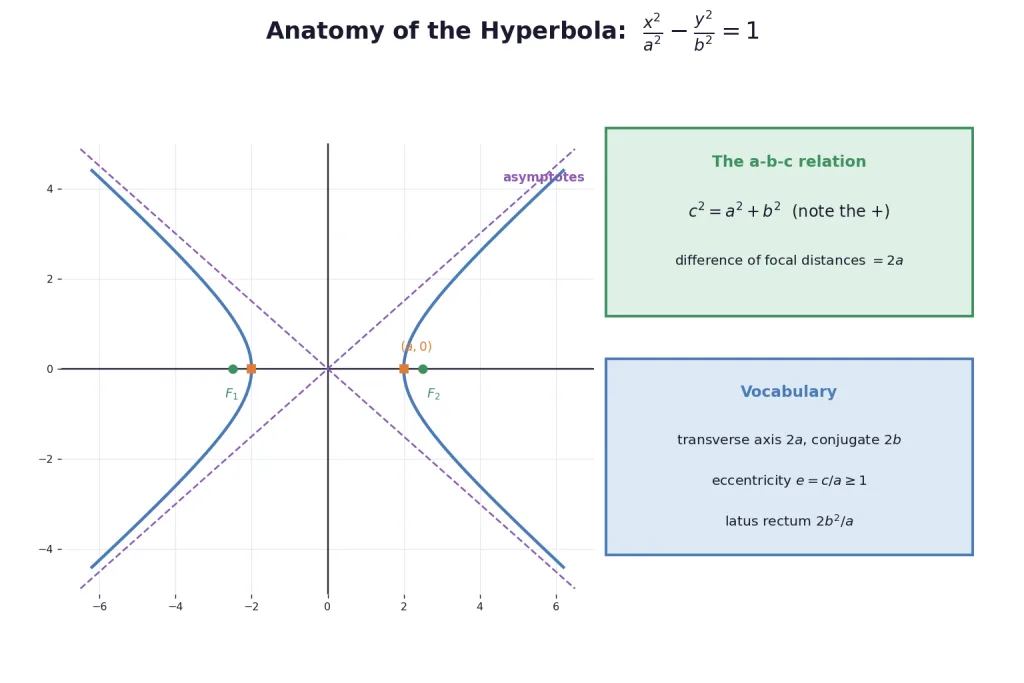
Key Point (Definition): A hyperbola is the set of all points whose distances from two fixed points (the foci ) have a constant difference — farther distance minus closer distance.
The midpoint of the foci is the centre ; the line through the foci is the transverse axis ; the perpendicular line through the centre is the conjugate axis ; the intersections with the transverse axis are the vertices . Write 2 c 2c 2 c 2 a 2a 2 a
b = c 2 − a 2 , i.e. c 2 = a 2 + b 2 b = \sqrt{c^2 - a^2}, \qquad\text{i.e.}\qquad c^2 = a^2 + b^2 b = c 2 − a 2 , i.e. c 2 = a 2 + b 2
Taking the point P P P 2 a 2a 2 a
Deriving the equation. With foci ( ± c , 0 ) (\pm c, 0) ( ± c , 0 ) P F 1 − P F 2 = 2 a PF_1 - PF_2 = 2a P F 1 − P F 2 = 2 a
x 2 a 2 − y 2 c 2 − a 2 = 1 ⇒ x 2 a 2 − y 2 b 2 = 1 \frac{x^2}{a^2} - \frac{y^2}{c^2 - a^2} = 1 \;\Rightarrow\; \frac{x^2}{a^2} - \frac{y^2}{b^2} = 1 a 2 x 2 − c 2 − a 2 y 2 = 1 ⇒ a 2 x 2 − b 2 y 2 = 1
Since x 2 a 2 = 1 + y 2 b 2 ≥ 1 \frac{x^2}{a^2} = 1 + \frac{y^2}{b^2} \ge 1 a 2 x 2 = 1 + b 2 y 2 ≥ 1 x = − a x = -a x = − a x = a x = a x = a branches .
Key Point (Eccentricity): e = c a ≥ 1 e = \frac{c}{a} \ge 1 e = a c ≥ 1 c ≥ a c \ge a c ≥ a a e ae a e a = b a = b a = b equilateral (its eccentricity is 2 \sqrt{2} 2
Both Orientations, Latus Rectum, and the Workflow
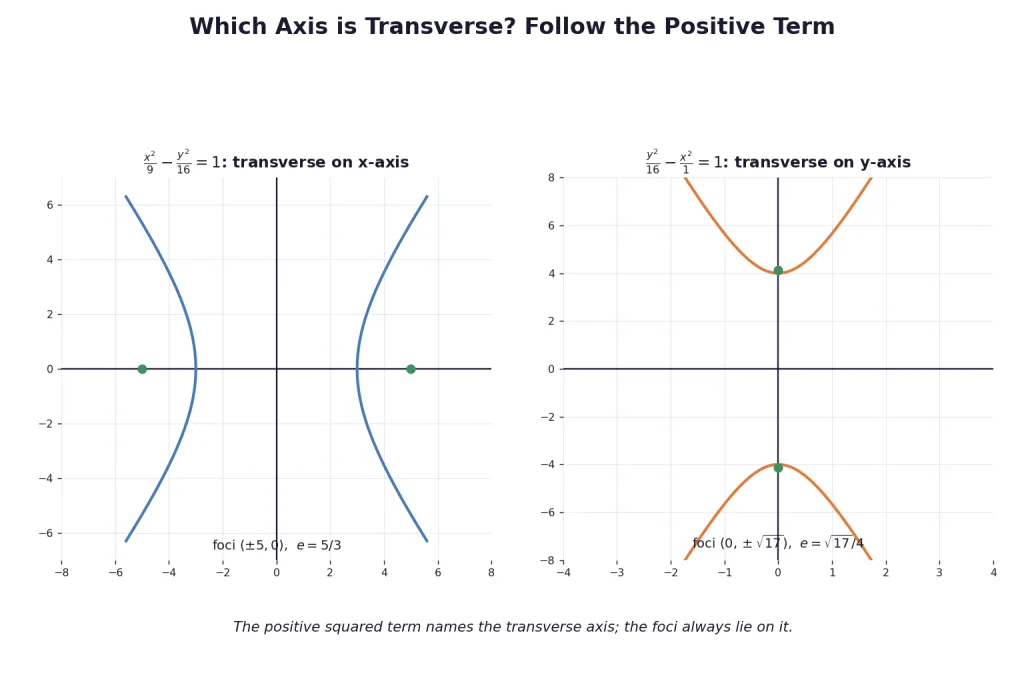
Key Point (Standard equations): Transverse axis on the x x x x 2 a 2 − y 2 b 2 = 1 \frac{x^2}{a^2} - \frac{y^2}{b^2} = 1 a 2 x 2 − b 2 y 2 = 1 ( ± c , 0 ) (\pm c, 0) ( ± c , 0 ) y y y y 2 a 2 − x 2 b 2 = 1 \frac{y^2}{a^2} - \frac{x^2}{b^2} = 1 a 2 y 2 − b 2 x 2 = 1 ( 0 , ± c ) (0, \pm c) ( 0 , ± c ) c 2 = a 2 + b 2 c^2 = a^2 + b^2 c 2 = a 2 + b 2
Which is which? Follow the positive term : its denominator is a 2 a^2 a 2 not about which denominator is larger.
Key Point (Latus rectum): as for the ellipse, the focal chord perpendicular to the transverse axis has length 2 b 2 a \frac{2b^2}{a} a 2 b 2
The standard workflow:
Equation → data: for x 2 9 − y 2 16 = 1 \frac{x^2}{9} - \frac{y^2}{16} = 1 9 x 2 − 16 y 2 = 1 a = 3 a = 3 a = 3 b = 4 b = 4 b = 4 c = 9 + 16 = 5 c = \sqrt{9 + 16} = 5 c = 9 + 16 = 5 ( ± 5 , 0 ) (\pm 5, 0) ( ± 5 , 0 ) ( ± 3 , 0 ) (\pm 3, 0) ( ± 3 , 0 ) e = 5 3 e = \frac{5}{3} e = 3 5 32 3 \frac{32}{3} 3 32 y 2 − 16 x 2 = 16 y^2 - 16x^2 = 16 y 2 − 16 x 2 = 16 y 2 16 − x 2 1 = 1 \frac{y^2}{16} - \frac{x^2}{1} = 1 16 y 2 − 1 x 2 = 1
Data → equation: foci ( 0 , ± 3 ) (0, \pm 3) ( 0 , ± 3 ) ( 0 , ± 11 2 ) \left(0, \pm\frac{\sqrt{11}}{2}\right) ( 0 , ± 2 11 ) a 2 = 11 4 a^2 = \frac{11}{4} a 2 = 4 11 b 2 = 9 − 11 4 = 25 4 b^2 = 9 - \frac{11}{4} = \frac{25}{4} b 2 = 9 − 4 11 = 4 25 100 y 2 − 44 x 2 = 275 100y^2 - 44x^2 = 275 100 y 2 − 44 x 2 = 275 ( 0 , ± 12 ) (0, \pm 12) ( 0 , ± 12 ) b 2 = 18 a b^2 = 18a b 2 = 18 a 144 = a 2 + 18 a 144 = a^2 + 18a 144 = a 2 + 18 a a = 6 a = 6 a = 6 b 2 = 108 b^2 = 108 b 2 = 108 3 y 2 − x 2 = 108 3y^2 - x^2 = 108 3 y 2 − x 2 = 108
[Board Tip] For the hyperbola the sum c 2 = a 2 + b 2 c^2 = a^2 + b^2 c 2 = a 2 + b 2 c c c beyond the vertices. If your computed focus lands between the vertices, you have used the ellipse relation by mistake.
Solved Examples
Example 1: Both orientations
Find the foci, vertices, eccentricity and latus rectum of: (i) x 2 9 − y 2 16 = 1 \frac{x^2}{9} - \frac{y^2}{16} = 1 9 x 2 − 16 y 2 = 1 y 2 − 16 x 2 = 16 y^2 - 16x^2 = 16 y 2 − 16 x 2 = 16
Solution:
Step 1 — (i) Identify. Positive term in x x x x x x a = 3 a = 3 a = 3 b = 4 b = 4 b = 4
Step 2 — (i) Compute c c c c = 9 + 16 = 5 c = \sqrt{9 + 16} = 5 c = 9 + 16 = 5 ( ± 5 , 0 ) (\pm 5, 0) ( ± 5 , 0 ) ( ± 3 , 0 ) (\pm 3, 0) ( ± 3 , 0 ) e = 5 3 e = \frac{5}{3} e = 3 5 2 ( 16 ) 3 = 32 3 \frac{2(16)}{3} = \frac{32}{3} 3 2 ( 16 ) = 3 32
Step 3 — (ii) Normalise. y 2 16 − x 2 1 = 1 \frac{y^2}{16} - \frac{x^2}{1} = 1 16 y 2 − 1 x 2 = 1 y y y a = 4 a = 4 a = 4 b = 1 b = 1 b = 1 c = 17 c = \sqrt{17} c = 17
Step 4 — (ii) List. Foci ( 0 , ± 17 ) (0, \pm\sqrt{17}) ( 0 , ± 17 ) ( 0 , ± 4 ) (0, \pm 4) ( 0 , ± 4 ) e = 17 4 e = \frac{\sqrt{17}}{4} e = 4 17 2 ( 1 ) 4 = 1 2 \frac{2(1)}{4} = \frac{1}{2} 4 2 ( 1 ) = 2 1
Takeaway: ADD to get c c c
Example 2: Reading practice
Analyse: (i) x 2 16 − y 2 9 = 1 \frac{x^2}{16} - \frac{y^2}{9} = 1 16 x 2 − 9 y 2 = 1 y 2 9 − x 2 27 = 1 \frac{y^2}{9} - \frac{x^2}{27} = 1 9 y 2 − 27 x 2 = 1 9 y 2 − 4 x 2 = 36 9y^2 - 4x^2 = 36 9 y 2 − 4 x 2 = 36
Solution:
Step 1 — (i). a = 4 a = 4 a = 4 b = 3 b = 3 b = 3 c = 5 c = 5 c = 5 ( ± 5 , 0 ) (\pm 5, 0) ( ± 5 , 0 ) ( ± 4 , 0 ) (\pm 4, 0) ( ± 4 , 0 ) e = 5 4 e = \frac{5}{4} e = 4 5 9 2 \frac{9}{2} 2 9
Step 2 — (ii). a = 3 a = 3 a = 3 b 2 = 27 b^2 = 27 b 2 = 27 c = 36 = 6 c = \sqrt{36} = 6 c = 36 = 6 ( 0 , ± 6 ) (0, \pm 6) ( 0 , ± 6 ) ( 0 , ± 3 ) (0, \pm 3) ( 0 , ± 3 ) e = 2 e = 2 e = 2 2 ( 27 ) 3 = 18 \frac{2(27)}{3} = 18 3 2 ( 27 ) = 18
Step 3 — (iii). Normalise: y 2 4 − x 2 9 = 1 \frac{y^2}{4} - \frac{x^2}{9} = 1 4 y 2 − 9 x 2 = 1 a = 2 a = 2 a = 2 b = 3 b = 3 b = 3 c = 13 c = \sqrt{13} c = 13 ( 0 , ± 13 ) (0, \pm\sqrt{13}) ( 0 , ± 13 ) ( 0 , ± 2 ) (0, \pm 2) ( 0 , ± 2 ) e = 13 2 e = \frac{\sqrt{13}}{2} e = 2 13 2 ( 9 ) 2 = 9 \frac{2(9)}{2} = 9 2 2 ( 9 ) = 9
Takeaway: The transverse axis follows the POSITIVE term, not the larger denominator — the hyperbola's orientation rule differs from the ellipse's.
Example 3: Rescale first
Analyse: (i) 16 x 2 − 9 y 2 = 576 16x^2 - 9y^2 = 576 16 x 2 − 9 y 2 = 576 5 y 2 − 9 x 2 = 36 5y^2 - 9x^2 = 36 5 y 2 − 9 x 2 = 36 49 y 2 − 16 x 2 = 784 49y^2 - 16x^2 = 784 49 y 2 − 16 x 2 = 784
Solution:
Step 1 — (i). Divide by 576: x 2 36 − y 2 64 = 1 \frac{x^2}{36} - \frac{y^2}{64} = 1 36 x 2 − 64 y 2 = 1 a = 6 a = 6 a = 6 b = 8 b = 8 b = 8 c = 10 c = 10 c = 10 ( ± 10 , 0 ) (\pm 10, 0) ( ± 10 , 0 ) ( ± 6 , 0 ) (\pm 6, 0) ( ± 6 , 0 ) e = 5 3 e = \frac{5}{3} e = 3 5 2 ( 64 ) 6 = 64 3 \frac{2(64)}{6} = \frac{64}{3} 6 2 ( 64 ) = 3 64
Step 2 — (ii). y 2 36 / 5 − x 2 4 = 1 \frac{y^2}{36/5} - \frac{x^2}{4} = 1 36/5 y 2 − 4 x 2 = 1 a 2 = 36 5 a^2 = \frac{36}{5} a 2 = 5 36 b 2 = 4 b^2 = 4 b 2 = 4 c 2 = 56 5 c^2 = \frac{56}{5} c 2 = 5 56 ( 0 , ± 2 70 5 ) \left(0, \pm\frac{2\sqrt{70}}{5}\right) ( 0 , ± 5 2 70 ) e = 56 / 5 36 / 5 = 14 3 e = \sqrt{\frac{56/5}{36/5}} = \frac{\sqrt{14}}{3} e = 36/5 56/5 = 3 14 2 ( 4 ) 6 / 5 = 4 5 3 \frac{2(4)}{6/\sqrt{5}} = \frac{4\sqrt{5}}{3} 6/ 5 2 ( 4 ) = 3 4 5
Step 3 — (iii). y 2 16 − x 2 49 = 1 \frac{y^2}{16} - \frac{x^2}{49} = 1 16 y 2 − 49 x 2 = 1 c = 65 c = \sqrt{65} c = 65 ( 0 , ± 65 ) (0, \pm\sqrt{65}) ( 0 , ± 65 ) ( 0 , ± 4 ) (0, \pm 4) ( 0 , ± 4 ) e = 65 4 e = \frac{\sqrt{65}}{4} e = 4 65 2 ( 49 ) 4 = 49 2 \frac{2(49)}{4} = \frac{49}{2} 4 2 ( 49 ) = 2 49
Takeaway: Fractional a 2 a^2 a 2
Example 4: From vertices and foci
Find the hyperbola with: (i) foci ( 0 , ± 3 ) (0, \pm 3) ( 0 , ± 3 ) ( 0 , ± 11 2 ) \left(0, \pm\frac{\sqrt{11}}{2}\right) ( 0 , ± 2 11 ) ( ± 2 , 0 ) (\pm 2, 0) ( ± 2 , 0 ) ( ± 3 , 0 ) (\pm 3, 0) ( ± 3 , 0 ) ( 0 , ± 5 ) (0, \pm 5) ( 0 , ± 5 ) ( 0 , ± 8 ) (0, \pm 8) ( 0 , ± 8 ) ( 0 , ± 3 ) (0, \pm 3) ( 0 , ± 3 ) ( 0 , ± 5 ) (0, \pm 5) ( 0 , ± 5 )
Solution:
Step 1 — (i). a 2 = 11 4 a^2 = \frac{11}{4} a 2 = 4 11 c 2 = 9 c^2 = 9 c 2 = 9 b 2 = 9 − 11 4 = 25 4 b^2 = 9 - \frac{11}{4} = \frac{25}{4} b 2 = 9 − 4 11 = 4 25 y 2 11 / 4 − x 2 25 / 4 = 1 \frac{y^2}{11/4} - \frac{x^2}{25/4} = 1 11/4 y 2 − 25/4 x 2 = 1 100 y 2 − 44 x 2 = 275 100y^2 - 44x^2 = 275 100 y 2 − 44 x 2 = 275
Step 2 — (ii). b 2 = 9 − 4 = 5 b^2 = 9 - 4 = 5 b 2 = 9 − 4 = 5 x 2 4 − y 2 5 = 1 \frac{x^2}{4} - \frac{y^2}{5} = 1 4 x 2 − 5 y 2 = 1
Step 3 — (iii). b 2 = 64 − 25 = 39 b^2 = 64 - 25 = 39 b 2 = 64 − 25 = 39 y 2 25 − x 2 39 = 1 \frac{y^2}{25} - \frac{x^2}{39} = 1 25 y 2 − 39 x 2 = 1
Step 4 — (iv). b 2 = 25 − 9 = 16 b^2 = 25 - 9 = 16 b 2 = 25 − 9 = 16 y 2 9 − x 2 16 = 1 \frac{y^2}{9} - \frac{x^2}{16} = 1 9 y 2 − 16 x 2 = 1
Takeaway: b 2 = c 2 − a 2 b^2 = c^2 - a^2 b 2 = c 2 − a 2 a a a c c c
Example 5: From an axis length
Find the hyperbola with: (i) foci ( ± 5 , 0 ) (\pm 5, 0) ( ± 5 , 0 ) ( 0 , ± 13 ) (0, \pm 13) ( 0 , ± 13 )
Solution:
Step 1 — (i). 2 a = 8 2a = 8 2 a = 8 a = 4 a = 4 a = 4 c = 5 c = 5 c = 5 b 2 = 25 − 16 = 9 b^2 = 25 - 16 = 9 b 2 = 25 − 16 = 9 x 2 16 − y 2 9 = 1 \frac{x^2}{16} - \frac{y^2}{9} = 1 16 x 2 − 9 y 2 = 1
Step 2 — (ii). Conjugate axis 24 gives b = 12 b = 12 b = 12 c = 13 c = 13 c = 13 a 2 = 169 − 144 = 25 a^2 = 169 - 144 = 25 a 2 = 169 − 144 = 25 y 2 25 − x 2 144 = 1 \frac{y^2}{25} - \frac{x^2}{144} = 1 25 y 2 − 144 x 2 = 1
Takeaway: Transverse length fixes a a a b b b
Example 6: Latus rectum data
Find the hyperbola with: (i) foci ( 0 , ± 12 ) (0, \pm 12) ( 0 , ± 12 ) ( ± 3 5 , 0 ) (\pm 3\sqrt{5}, 0) ( ± 3 5 , 0 ) ( ± 4 , 0 ) (\pm 4, 0) ( ± 4 , 0 )
Solution:
Step 1 — (i) Set up the quadratic. 2 b 2 a = 36 \frac{2b^2}{a} = 36 a 2 b 2 = 36 b 2 = 18 a b^2 = 18a b 2 = 18 a c 2 = a 2 + b 2 c^2 = a^2 + b^2 c 2 = a 2 + b 2 144 = a 2 + 18 a 144 = a^2 + 18a 144 = a 2 + 18 a
Step 2 — (i) Solve. a 2 + 18 a − 144 = 0 a^2 + 18a - 144 = 0 a 2 + 18 a − 144 = 0 ( a + 24 ) ( a − 6 ) = 0 (a + 24)(a - 6) = 0 ( a + 24 ) ( a − 6 ) = 0 a = 6 a = 6 a = 6 b 2 = 108 b^2 = 108 b 2 = 108 y 2 36 − x 2 108 = 1 \frac{y^2}{36} - \frac{x^2}{108} = 1 36 y 2 − 108 x 2 = 1 3 y 2 − x 2 = 108 3y^2 - x^2 = 108 3 y 2 − x 2 = 108
Step 3 — (ii). b 2 = 4 a b^2 = 4a b 2 = 4 a 45 = a 2 + 4 a 45 = a^2 + 4a 45 = a 2 + 4 a ( a + 9 ) ( a − 5 ) = 0 (a+9)(a-5) = 0 ( a + 9 ) ( a − 5 ) = 0 a = 5 a = 5 a = 5 b 2 = 20 b^2 = 20 b 2 = 20 x 2 25 − y 2 20 = 1 \frac{x^2}{25} - \frac{y^2}{20} = 1 25 x 2 − 20 y 2 = 1
Step 4 — (iii). b 2 = 6 a b^2 = 6a b 2 = 6 a 16 = a 2 + 6 a 16 = a^2 + 6a 16 = a 2 + 6 a ( a + 8 ) ( a − 2 ) = 0 (a+8)(a-2) = 0 ( a + 8 ) ( a − 2 ) = 0 a = 2 a = 2 a = 2 b 2 = 12 b^2 = 12 b 2 = 12 x 2 4 − y 2 12 = 1 \frac{x^2}{4} - \frac{y^2}{12} = 1 4 x 2 − 12 y 2 = 1
Takeaway: Latus rectum + foci always produces a quadratic in a a a
Example 7: From eccentricity
Find the hyperbola with vertices ( ± 7 , 0 ) (\pm 7, 0) ( ± 7 , 0 ) e = 4 3 e = \frac{4}{3} e = 3 4
Solution:
Step 1 — Find c c c a = 7 a = 7 a = 7 c = a e = 28 3 c = ae = \frac{28}{3} c = a e = 3 28
Step 2 — Find b 2 b^2 b 2 b 2 = c 2 − a 2 = 784 9 − 49 = 784 − 441 9 = 343 9 b^2 = c^2 - a^2 = \frac{784}{9} - 49 = \frac{784 - 441}{9} = \frac{343}{9} b 2 = c 2 − a 2 = 9 784 − 49 = 9 784 − 441 = 9 343
Step 3 — Write. x 2 49 − 9 y 2 343 = 1 \frac{x^2}{49} - \frac{9y^2}{343} = 1 49 x 2 − 343 9 y 2 = 1
Takeaway: e e e a a a c c c b 2 b^2 b 2
Example 8: Through a point
Find the hyperbola with foci ( 0 , ± 10 ) (0, \pm\sqrt{10}) ( 0 , ± 10 ) ( 2 , 3 ) (2, 3) ( 2 , 3 )
Solution:
Step 1 — Set up with one unknown. y 2 a 2 − x 2 b 2 = 1 \frac{y^2}{a^2} - \frac{x^2}{b^2} = 1 a 2 y 2 − b 2 x 2 = 1 b 2 = 10 − a 2 b^2 = 10 - a^2 b 2 = 10 − a 2 ( 2 , 3 ) (2,3) ( 2 , 3 ) 9 a 2 − 4 10 − a 2 = 1 \frac{9}{a^2} - \frac{4}{10 - a^2} = 1 a 2 9 − 10 − a 2 4 = 1
Step 2 — Clear denominators. 9 ( 10 − a 2 ) − 4 a 2 = a 2 ( 10 − a 2 ) 9(10 - a^2) - 4a^2 = a^2(10 - a^2) 9 ( 10 − a 2 ) − 4 a 2 = a 2 ( 10 − a 2 ) a 4 − 23 a 2 + 90 = 0 a^4 - 23a^2 + 90 = 0 a 4 − 23 a 2 + 90 = 0
Step 3 — Solve and audit. ( a 2 − 5 ) ( a 2 − 18 ) = 0 (a^2 - 5)(a^2 - 18) = 0 ( a 2 − 5 ) ( a 2 − 18 ) = 0 a 2 = 5 a^2 = 5 a 2 = 5 a 2 < c 2 = 10 a^2 < c^2 = 10 a 2 < c 2 = 10
Step 4 — Write. a 2 = b 2 = 5 a^2 = b^2 = 5 a 2 = b 2 = 5 y 2 5 − x 2 5 = 1 \frac{y^2}{5} - \frac{x^2}{5} = 1 5 y 2 − 5 x 2 = 1
Takeaway: Always audit quadratic-in-a 2 a^2 a 2 a 2 < c 2 a^2 < c^2 a 2 < c 2
Example 9: Eccentricity of the equilateral hyperbola
Show that every hyperbola with a = b a = b a = b 2 \sqrt{2} 2
Solution:
Step 1 — Apply the relation. c 2 = a 2 + b 2 = 2 a 2 c^2 = a^2 + b^2 = 2a^2 c 2 = a 2 + b 2 = 2 a 2
Step 2 — Take the ratio. c = a 2 c = a\sqrt{2} c = a 2 e = c a = 2 e = \frac{c}{a} = \sqrt{2} e = a c = 2 a a a
Takeaway: All equilateral hyperbolas are similar — one shape at every scale, like all circles.