
Solved Examples — the Full Chapter Workout
Thirty worked problems: circle synthesis, the full applied set (mirrors, beams, bridges, arches, rods, racecourses), cross-conic drills and eccentricity identities. Attempt each before reading the solution.
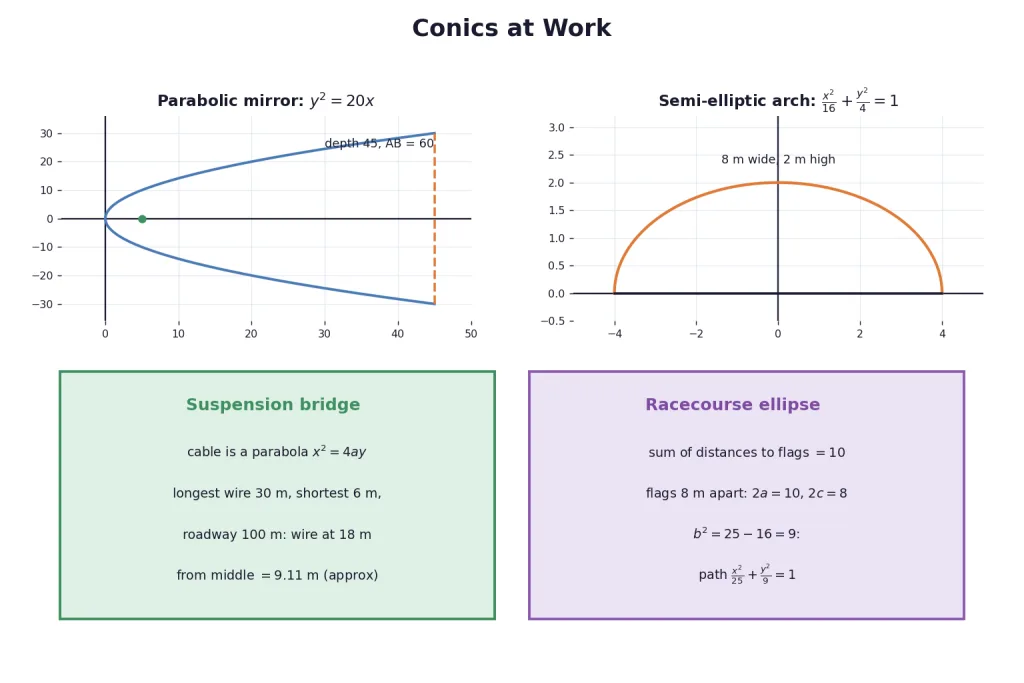
Example 1: The parabolic mirror
The focus of a parabolic mirror is 5 cm from its vertex. If the mirror is 45 cm deep, find the distance across the open end.
Solution:
Step 1 — Model. Vertex at the origin, axis along the positive -axis: , so .
Step 2 — Evaluate at the rim. Depth : , so .
Step 3 — Read the width. cm.
Takeaway: Place the vertex at the origin and the axis along a coordinate axis — the physics then reads straight off the equation.
Example 2: The deflected beam
A beam supported at ends 12 m apart deflects 3 cm at the centre, taking a parabolic shape. How far from the centre is the deflection 1 cm?
Solution:
Step 1 — Model from the lowest point. Vertex at the centre's deflected position, opening up: through .
Step 2 — Find . gives .
Step 3 — Deflection 1 cm. That point sits m above the vertex: : m.
Takeaway: Convert units once at the start (cm → m) and the parabola handles the rest.
Example 3: The sliding rod (15 cm)
A rod of length 15 cm slides with on the -axis and on the -axis. on the rod has cm. Show that the locus of is an ellipse.
Solution:
Step 1 — Parametrise by the rod's angle. With the rod at angle to the -axis and : dropping perpendiculars, and .
Step 2 — Eliminate . : .
Step 3 — Conclude. The locus is an ellipse with , . ∎
Takeaway: is the standard eliminator — express and in terms of one angle and square-add.
Example 4: A concentric circle
Find the circle concentric with and passing through the origin.
Solution:
Step 1 — Extract the centre. Completing squares: centre .
Step 2 — New radius. Through : .
Step 3 — Write. , i.e. .
Takeaway: Concentric = same centre, new radius — only the constant term changes in the expanded form.
Example 5: Circle from the ends of a diameter
Find the circle with and as ends of a diameter.
Solution:
Step 1 — Centre = midpoint. .
Step 2 — Radius from either end. .
Step 3 — Write. .
Takeaway: Diameter ends give the centre for free — midpoint first, then one distance.
Example 6: Anatomy plus a point test
Find the centre and radius of , and check whether lies on it.
Solution:
Step 1 — Complete squares. : centre , radius 5.
Step 2 — Test the point. Distance from to : .
Step 3 — Conclude. Equal to : the point lies ON the circle.
Takeaway: The on/inside/outside test is one squared-distance comparison — no roots required.
Example 7: The reflector's focus
A parabolic reflector is 20 cm in diameter and 5 cm deep. Find the focus.
Solution:
Step 1 — Model. Vertex at origin, axis along : the rim point lies on .
Step 2 — Solve for . : .
Step 3 — Conclude. Focus — 5 cm from the vertex, exactly in the plane of the rim.
Takeaway: A reflector focused at its rim plane is a designed coincidence here — the numbers force it.
Example 8: The parabolic arch
An arch shaped like a parabola with vertical axis is 10 m high and 5 m wide at the base. How wide is it 2 m below the vertex?
Solution:
Step 1 — Model downward from the vertex. Measuring downward from the top: through .
Step 2 — Find . : .
Step 3 — Evaluate at . : , so the width is m.
Takeaway: Choosing the measuring direction (downward) keeps every number positive — a free simplification.
Example 9: The suspension bridge
A suspension-bridge cable hangs as a parabola over a 100 m roadway; the longest vertical wire is 30 m and the shortest (central) is 6 m. Find the wire 18 m from the middle.
Solution:
Step 1 — Model from the cable's lowest point. Vertex there; the cable rises m over the half-span 50 m: through .
Step 2 — Find . : .
Step 3 — Sag at . m.
Step 4 — Wire length. m (approx).
Takeaway: Wires measure roadway-to-cable: add the central clearance back after computing the parabolic rise.
Example 10: Triangle on the latus rectum
Find the area of the triangle formed by joining the vertex of to the ends of its latus rectum.
Solution:
Step 1 — Locate the latus rectum. : ; ends .
Step 2 — Base and height. Base (horizontal chord); height (vertex to chord).
Step 3 — Area. .
Takeaway: The latus rectum triangle of always has area — here ✓.
Example 11: The inscribed equilateral triangle
An equilateral triangle is inscribed in with one vertex at the parabola's vertex. Find its side.
Solution:
Step 1 — Set up by symmetry. The other two vertices are ; the side from the origin makes with the axis: .
Step 2 — Use the parabola. with : , so (and ).
Step 3 — Side length. The vertical side is .
Takeaway: Symmetry about the axis halves the work — impose the half-angle , not .
Example 12: A chord of
Find the points of at height , and the chord length between them.
Solution:
Step 1 — Substitute the height. : .
Step 2 — Chord. From to : length 12.
Takeaway: Horizontal chords of have length — direct substitution, no formulas.
Example 13: The semi-elliptic arch
An arch is a semi-ellipse, 8 m wide and 2 m high. Find its height 1.5 m from one end.
Solution:
Step 1 — Model. Centre at the base's midpoint: (, ).
Step 2 — Convert the position. 1.5 m from the end means .
Step 3 — Solve for the height. : height m.
Takeaway: "Distance from the end" must be converted to a coordinate from the CENTRE before substituting.
Example 14: The sliding rod (12 cm)
A 12 cm rod slides with its ends on the axes. Find the locus of the point 3 cm from the end touching the -axis.
Solution:
Step 1 — Parametrise. , : with rod angle , , .
Step 2 — Eliminate. .
Takeaway: The distances to the two rod-ends become the two semi-axes — horizontal, vertical.
Example 15: The racecourse ellipse
A runner keeps the sum of distances from two flag posts equal to 10 m; the posts are 8 m apart. Find the path.
Solution:
Step 1 — Translate to ellipse data. Constant sum ; focal separation : , .
Step 2 — Find . .
Step 3 — Write. .
Takeaway: The definition IS the model — flag posts are foci, the rope length is .
Example 16: Ellipse anatomy —
Find the foci, eccentricity and latus rectum.
Solution:
Step 1 — Read. , , major on .
Step 2 — Compute. .
Step 3 — List. Foci , , latus rectum .
Takeaway: Surd values of are normal — leave them exact.
Example 17: Ellipse anatomy —
Find the foci, eccentricity and latus rectum.
Solution:
Step 1 — Orient. : major on , , .
Step 2 — Compute. .
Step 3 — List. Foci , , latus rectum .
Takeaway: marks quite a flat ellipse — large means strong elongation.
Example 18: Building an ellipse from and the foci
Find the ellipse with foci and eccentricity .
Solution:
Step 1 — Recover . and : .
Step 2 — Find . .
Step 3 — Write. .
Takeaway: plus either or recovers the other by one division — then the relation gives .
Example 19: Hyperbola anatomy —
Find the foci, vertices, eccentricity and latus rectum.
Solution:
Step 1 — Normalise. Divide by 576: : , .
Step 2 — Compute. .
Step 3 — List. Foci , vertices , , latus rectum .
Takeaway: The 6-8-10 triangle hiding inside — hyperbola -- triples are Pythagorean by construction.
Example 20: Building a hyperbola from and the foci
Find the hyperbola with foci and eccentricity 2.
Solution:
Step 1 — Recover . .
Step 2 — Find . .
Step 3 — Write. .
Takeaway: Same recovery as the ellipse — only the formula flips to a subtraction from .
Example 21: Latus rectum equals transverse axis
For which hyperbolas does the latus rectum equal the transverse axis?
Solution:
Step 1 — Set the condition. .
Step 2 — Simplify. : — the equilateral hyperbola.
Step 3 — Consequence. : .
Takeaway: Geometric conditions on the latus rectum translate to algebra in in one line.
Example 22: Checking the defining difference
For , verify at a vertex that the difference of focal distances is .
Solution:
Step 1 — Anatomy. , : foci , vertex .
Step 2 — Two focal distances. From : to : 3; to : 13.
Step 3 — Difference. ✓. ∎
Takeaway: Verifying the definition at a vertex takes seconds and confirms and simultaneously.
Example 23: Classify the conic
Name the curve: (i) ; (ii) ; (iii) ; (iv) .
Solution:
Step 1 — (i). Both squares positive, unequal coefficients: ellipse .
Step 2 — (ii). Opposite signs: hyperbola .
Step 3 — (iii). One square only: parabola with , .
Step 4 — (iv). Equal positive coefficients: circle of radius 6.
Takeaway: Signs and coefficient patterns classify instantly: unequal = ellipse, = hyperbola, one square = parabola, equal = circle.
Example 24: A quick circle read
Find the centre and radius of .
Solution:
Step 1 — Complete squares. .
Step 2 — Read. Centre , radius 3.
Takeaway: Half the linear coefficients (sign-flipped) give the centre — a ten-second read once practised.
Example 25: Latus rectum half the minor axis
If the latus rectum of an ellipse equals half its minor axis, find the eccentricity.
Solution:
Step 1 — Set the condition. gives , so .
Step 2 — Convert to . .
Step 3 — Conclude. .
Takeaway: Latus-rectum conditions reduce to the ratio , and finishes.
Example 26: Latus rectum half the major axis
If the latus rectum of an ellipse equals half its major axis, find the eccentricity.
Solution:
Step 1 — Set the condition. gives .
Step 2 — Convert. .
Step 3 — Conclude. .
Takeaway: Compare with Example 25 — "half the minor" and "half the major" give different, easily-confused answers.
Example 27: A focal-distance preview
The parabola passes through . Find , the focus, and the distance from to the focus.
Solution:
Step 1 — Find . : ; focus , directrix .
Step 2 — Focal distance. From to : 6.
Step 3 — Confirm via the definition. Directrix distance ✓ — equal, as the parabola demands.
Takeaway: The focal distance of on is always — the definition in formula form.
Example 28: Same numbers, different conics
Compare the distance between the foci of and .
Solution:
Step 1 — Ellipse. : focal distance .
Step 2 — Hyperbola. : focal distance 10.
Step 3 — Compare. The sign flip pushes the foci from inside the vertices to beyond them.
Takeaway: Identical denominators, different signs: subtract for the ellipse, add for the hyperbola.
Example 29: A parameter from a point
For what does pass through ? Find the radius then.
Solution:
Step 1 — Substitute the point. : .
Step 2 — Complete squares. .
Step 3 — Read. Radius .
Takeaway: A point on the curve pins the free parameter first; the geometry follows after.
Example 30: Ellipse from latus rectum and eccentricity
Find the ellipse (major axis on the -axis) with latus rectum 8 and eccentricity .
Solution:
Step 1 — Convert to a ratio. .
Step 2 — Apply the latus rectum. .
Step 3 — Write. , : , foci .
Takeaway: Express through FIRST — the latus rectum then collapses to an equation in alone.