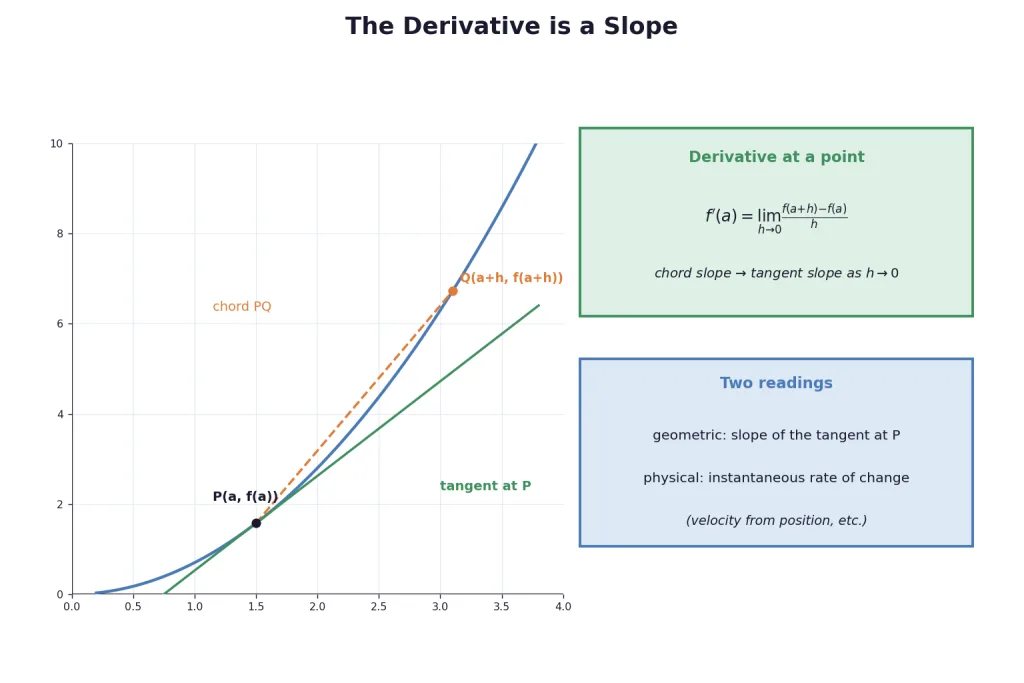
Key Point (Definition 1): the derivative of f at a point a is
f′(a)=h→0limhf(a+h)−f(a)
provided the limit exists. It measures how fast f changes at a.
Geometric reading: the quotient hf(a+h)−f(a) is the slope of the chord PQ; as h→0, Q slides into P and the chord becomes the tangent: f′(a)=tanψ, the tangent's slope. Physical reading: with s(t) a position function, s′(t) is the instantaneous velocity — exactly the falling-body computation of Section 1.
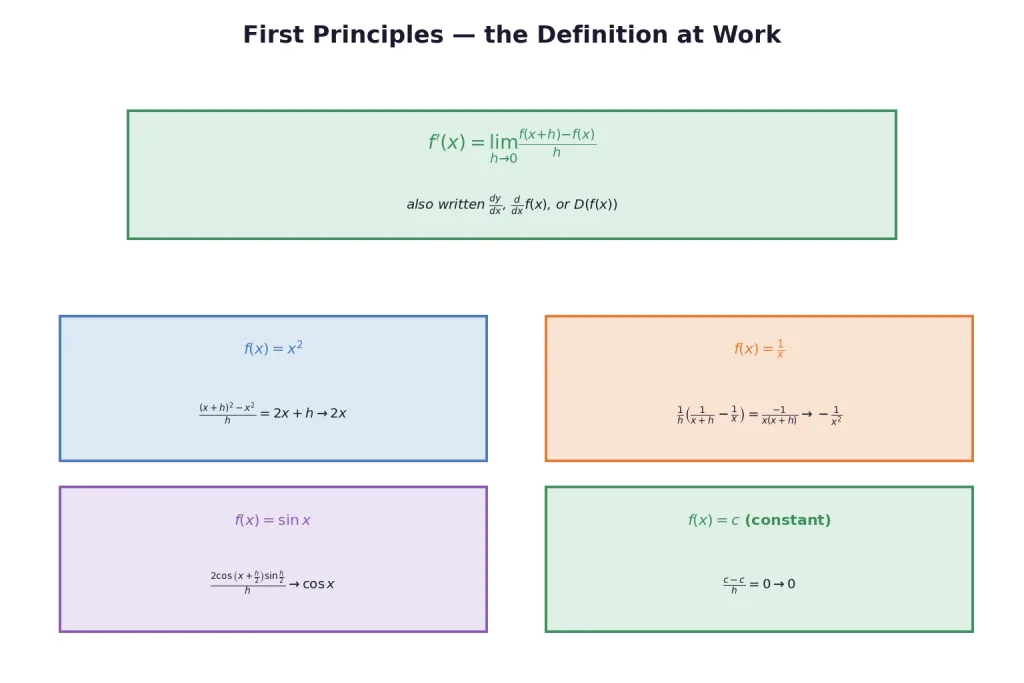
Key Point (Definition 2 — first principles): letting the point vary gives the derivative function
f′(x)=h→0limhf(x+h)−f(x)
also written dxdy, dxdf(x) or D(f(x)).
Four first-principles classics:f(x)=10x gives f′=10; f(x)=x2 gives h(x+h)2−x2=2x+h→2x; a constant gives 0; and f(x)=x1 gives x(x+h)−1→−x21.
The Algebra of Derivatives and the Standard Table
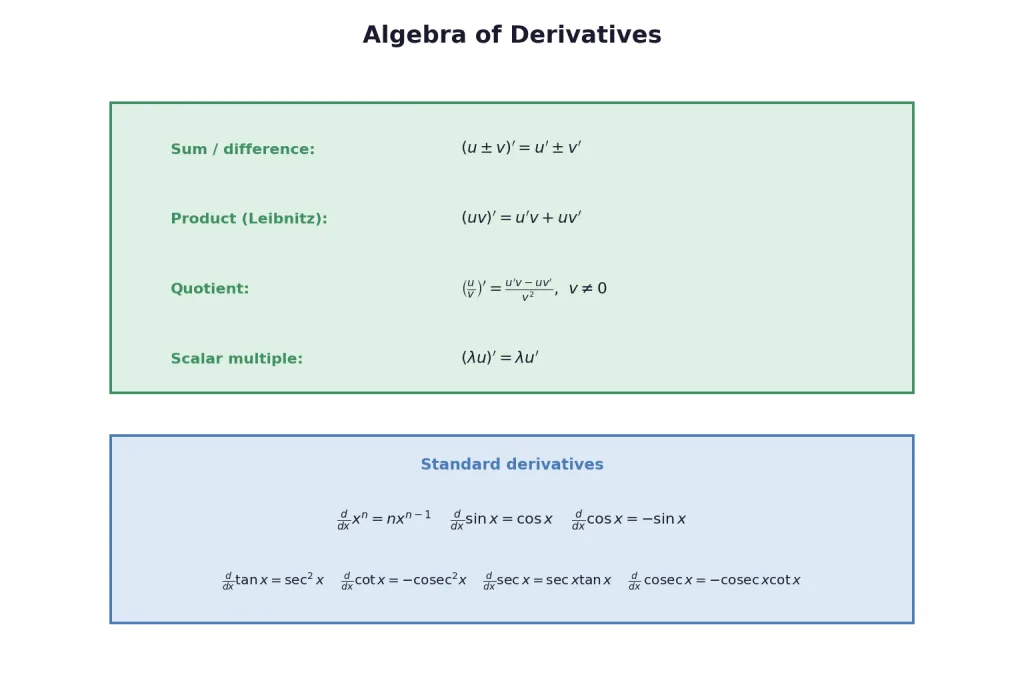
Key Point (Theorem 5 — rules): with u=f(x), v=g(x) differentiable:
(u±v)′=u′±v′(uv)′=u′v+uv′(vu)′=v2u′v−uv′(v=0)
The product rule is Leibnitz's rule — note it is notu′v′.
The power rule (Theorem 6): dxdxn=nxn−1 — provable from the binomial theorem, since (x+h)n−xn=h(nxn−1+⋯); true in fact for all real n. Combined with the sum rule it differentiates every polynomial: dxd(anxn+⋯+a1x+a0)=nanxn−1+⋯+a1.
Trigonometric derivatives: using sinA−sinB factorisation and hsinh→1:
dxdsinx=cosxdxdcosx=−sinxdxdtanx=sec2x
and by the quotient rule, dxdcotx=−cosec2x, dxdsecx=secxtanx, dxdcosecx=−cosecxcotx.
[Board Tip] "From first principles" in a question is an instruction, not a suggestion — write the limh→0 quotient and evaluate it. Quoting the answer from the standard table scores zero on such questions, however correct it is.
Solved Examples
Example 1: Derivative at a point
(i) Find f′(2) for f(x)=3x. (ii) For f(x)=2x2+3x−5, find f′(−1) and verify f′(0)+3f′(−1)=0.
Solution:
Step 1 — (i) Write the quotient.hf(2+h)−f(2)=h3(2+h)−6=h3h=3.
Step 2 — (i) Limit. Constantly 3: f′(2)=3.
Step 3 — (ii) Two point-derivatives. At −1: hf(−1+h)−f(−1)=h2h2−h=2h−1→−1. At 0: h2h2+3h=2h+3→3.
Step 4 — (ii) Verify.f′(0)+3f′(−1)=3+3(−1)=0 ✓. ∎
Takeaway: At a specific point, expand f(a+h), cancel f(a), divide by h — the surviving expression's limit is the derivative.
Example 2: sin x at 0 and constants
(i) Find the derivative of sinx at x=0. (ii) Find the derivative of f(x)=3 at x=0 and x=3.
Solution:
Step 1 — (i) The quotient is an old friend.hsin(0+h)−sin0=hsinh.
Step 2 — (i) Limit. The fundamental limit: 1.
Step 3 — (ii) Constants never move.h3−3=0 for every h, at every point: derivative 0.
Takeaway:(sinx)′=cosx evaluated at 0 gives cos0=1 — consistent with the fundamental limit, as it must be.
Example 3: Quick point evaluations
Find: (i) the derivative of x2−2 at x=10; (ii) of x at x=1; (iii) of 99x at x=100.
Solution:
Step 1 — (i).f′(x)=2x: f′(10)=20.
Step 2 — (ii).f′(x)=1 everywhere; at 1, still 1.
Step 3 — (iii).f′(x)=99 everywhere — the flashy point x=100 changes nothing.
Takeaway: Linear functions have constant derivatives; a dramatic evaluation point is usually a distraction test.
Example 4: First principles, four flavours
Differentiate from first principles: (i) x3−27; (ii) (x−1)(x−2); (iii) x21; (iv) x−1x+1.
Solution:
Step 1 — (i) Cube expansion.h(x+h)3−x3=3x2+3xh+h2→3x2 (the −27 dies immediately).
Step 2 — (ii) Expand first.(x−1)(x−2)=x2−3x+2: the quotient collapses to 2x+h−3→2x−3.
Step 2 — (ii) Quotient rule.u=x+1, v=x: v2u′v−uv′=x2x−(x+1).
Step 3 — (ii) Simplify.−x21. (Faster: xx+1=1+x1, whose derivative is −x21 at sight.)
Takeaway: Rewrite before you differentiate — splitting xx+1 avoids the quotient rule entirely.
Example 8: sin x and tan x from first principles
Compute the derivatives of (i) sinx and (ii) tanx.
Solution:
Step 1 — (i) Factor the difference of sines.hsin(x+h)−sinx=h2cos(x+2h)sin2h.
Step 2 — (i) Split and limit.cos(x+2h)⋅h/2sin(h/2)→cosx⋅1=cosx.
Step 3 — (ii) Combine tangents.htan(x+h)−tanx=hcos(x+h)cosxsinh→cos2x1=sec2x.
Takeaway: Both proofs run through the SAME two tools: a sum-to-product identity and θsinθ→1.
Example 9: Products and double angles
Differentiate: (i) sin2x; (ii) sin2x; (iii) cotx.
Solution:
Step 1 — (i) Leibnitz on sinx⋅sinx.cosxsinx+sinxcosx=2sinxcosx=sin2x.
Step 2 — (ii) Write sin2x=2sinxcosx and Leibnitz again.2(cos2x−sin2x)=2cos2x.
Step 3 — (iii) Quotient rule on sinxcosx.sin2x−sin2x−cos2x=−sin2x1=−cosec2x.
Takeaway: Without the chain rule (a Class 12 tool), double angles are handled by product-form rewrites — and the answers preview the chain rule's pattern.
Example 10: Algebraic workouts
Differentiate: (i) (5x3+3x−1)(x−1); (ii) x−3(5+3x); (iii) x5(3−6x−9).