The Sandwich Theorem and lim x → 0 sin x x = 1 \lim_{x \to 0} \frac{\sin x}{x} = 1 lim x → 0 x s i n x = 1
Two comparison facts drive every trigonometric limit.
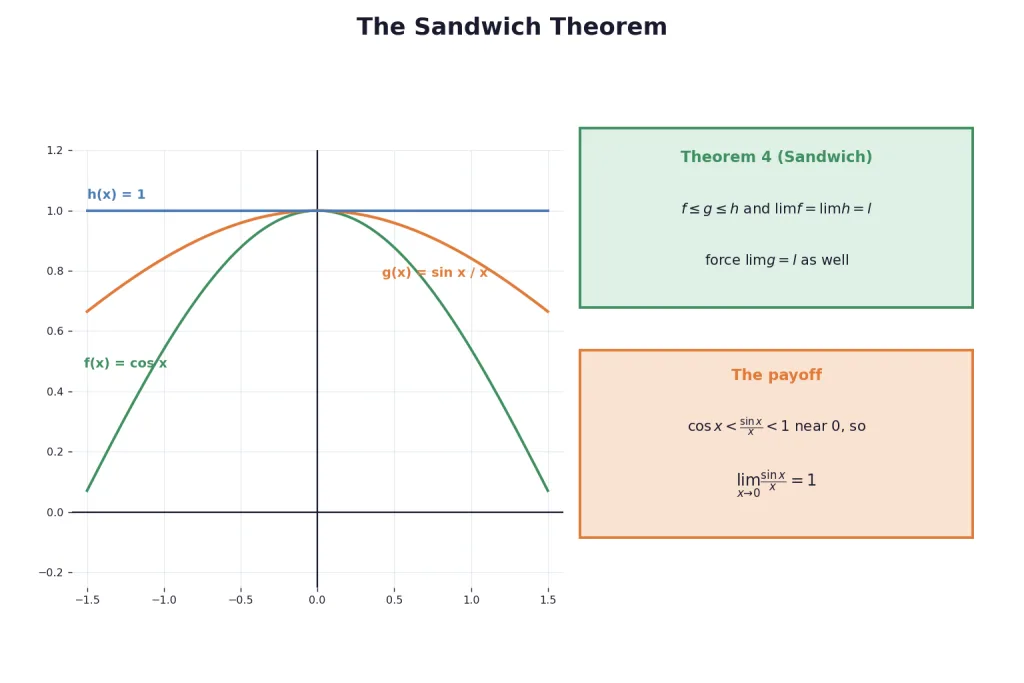
Key Point (Theorems 3-4): if f ( x ) ≤ g ( x ) f(x) \le g(x) f ( x ) ≤ g ( x ) a a a lim f ≤ lim g \lim f \le \lim g lim f ≤ lim g Sandwich Theorem : if f ( x ) ≤ g ( x ) ≤ h ( x ) f(x) \le g(x) \le h(x) f ( x ) ≤ g ( x ) ≤ h ( x ) lim x → a f ( x ) = l = lim x → a h ( x ) \lim_{x \to a} f(x) = l = \lim_{x \to a} h(x) lim x → a f ( x ) = l = lim x → a h ( x ) lim x → a g ( x ) = l \lim_{x \to a} g(x) = l lim x → a g ( x ) = l
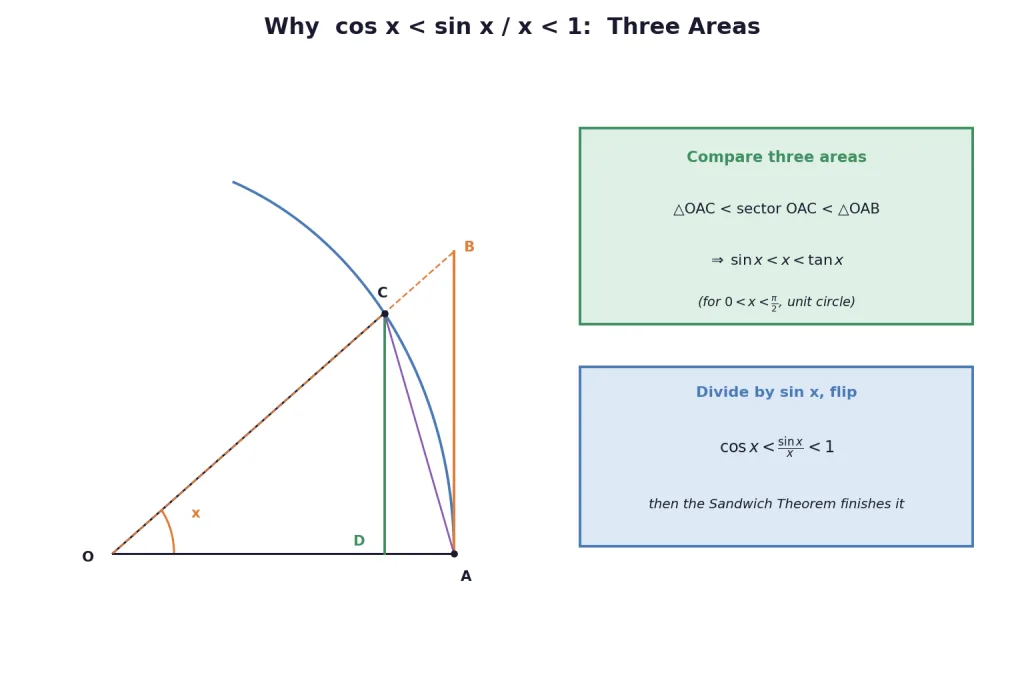
The bread for the sandwich comes from areas in a unit circle. For 0 < x < π 2 0 < x < \frac{\pi}{2} 0 < x < 2 π O A C OAC O A C O A C OAC O A C O A B OAB O A B
sin x < x < tan x ⇒ cos x < sin x x < 1 \sin x < x < \tan x \;\Rightarrow\; \cos x < \frac{\sin x}{x} < 1 sin x < x < tan x ⇒ cos x < x sin x < 1
(dividing by sin x > 0 \sin x > 0 sin x > 0 cos x → 1 \cos x \to 1 cos x → 1
Key Point (Theorem 5):
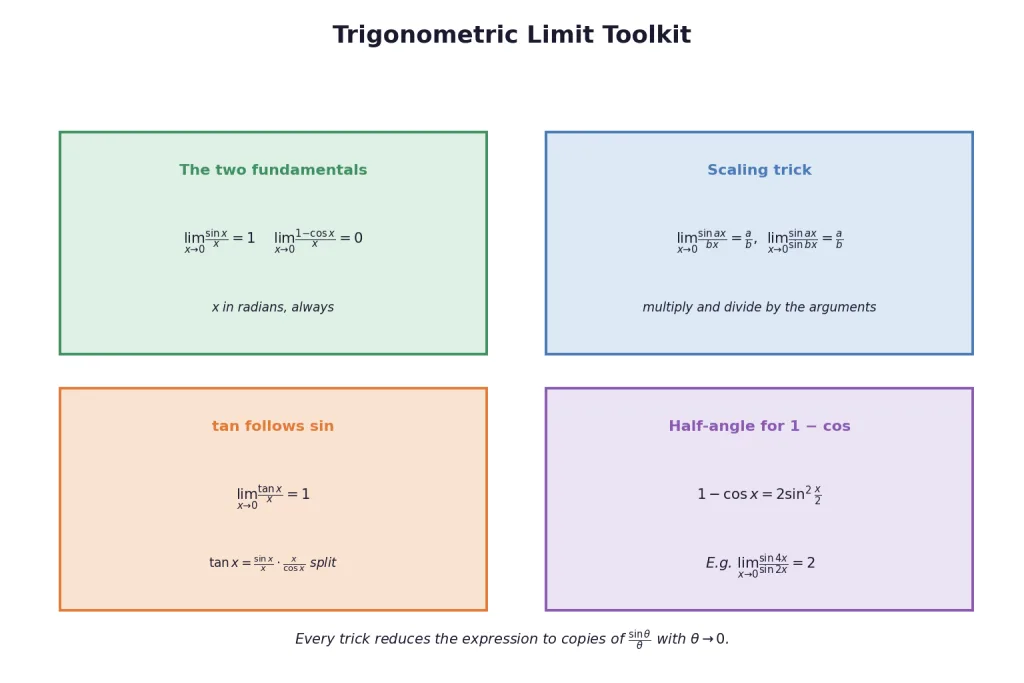
lim x → 0 sin x x = 1 and lim x → 0 1 − cos x x = 0 \lim_{x \to 0} \frac{\sin x}{x} = 1 \qquad\text{and}\qquad \lim_{x \to 0} \frac{1 - \cos x}{x} = 0 x → 0 lim x sin x = 1 and x → 0 lim x 1 − cos x = 0
The second follows from the first via 1 − cos x = 2 sin 2 x 2 1 - \cos x = 2\sin^2\frac{x}{2} 1 − cos x = 2 sin 2 2 x x x x radians — the area comparison lives on the unit circle.
Every trigonometric limit in this chapter reduces to copies of sin θ θ \frac{\sin\theta}{\theta} θ s i n θ θ → 0 \theta \to 0 θ → 0
Scaling: lim x → 0 sin a x b x = a b \lim_{x \to 0} \frac{\sin ax}{bx} = \frac{a}{b} lim x → 0 b x s i n a x = b a a x ax a x sin a x a x ⋅ a b → 1 ⋅ a b \frac{\sin ax}{ax} \cdot \frac{a}{b} \to 1 \cdot \frac{a}{b} a x s i n a x ⋅ b a → 1 ⋅ b a lim x → 0 sin a x sin b x = a b \lim_{x \to 0}\frac{\sin ax}{\sin bx} = \frac{a}{b} lim x → 0 s i n b x s i n a x = b a lim x → 0 sin 4 x sin 2 x = 2 \lim_{x \to 0} \frac{\sin 4x}{\sin 2x} = 2 lim x → 0 s i n 2 x s i n 4 x = 2
tan follows sin: tan x x = sin x x ⋅ 1 cos x → 1 \frac{\tan x}{x} = \frac{\sin x}{x} \cdot \frac{1}{\cos x} \to 1 x t a n x = x s i n x ⋅ c o s x 1 → 1
1 − cos 1 - \cos 1 − cos 1 − cos 2 x 1 − cos x = 2 sin 2 x 2 sin 2 x 2 → x 2 x 2 / 4 = 4 \frac{1 - \cos 2x}{1 - \cos x} = \frac{2\sin^2 x}{2\sin^2\frac{x}{2}} \to \frac{x^2}{x^2/4} = 4 1 − c o s x 1 − c o s 2 x = 2 s i n 2 2 x 2 s i n 2 x → x 2 /4 x 2 = 4 sin θ ≈ θ \sin\theta \approx \theta sin θ ≈ θ
Shifts: near a ≠ 0 a \ne 0 a = 0 y = x − a y = x - a y = x − a lim x → π / 2 tan 2 x x − π 2 \lim_{x \to \pi/2}\frac{\tan 2x}{x - \frac{\pi}{2}} lim x → π /2 x − 2 π t a n 2 x y = x − π 2 y = x - \frac{\pi}{2} y = x − 2 π tan ( 2 y + π ) = tan 2 y \tan(2y + \pi) = \tan 2y tan ( 2 y + π ) = tan 2 y tan 2 y y → 2 \frac{\tan 2y}{y} \to 2 y t a n 2 y → 2
[Board Tip] Before invoking sin θ θ → 1 \frac{\sin\theta}{\theta} \to 1 θ s i n θ → 1 same expression sits in both numerator and denominator: sin 4 x x \frac{\sin 4x}{x} x s i n 4 x 4 ⋅ sin 4 x 4 x → 4 4 \cdot \frac{\sin 4x}{4x} \to 4 4 ⋅ 4 x s i n 4 x → 4
Solved Examples
Example 1: The scaling template
Evaluate: (i) lim x → 0 sin 4 x sin 2 x \lim_{x \to 0} \frac{\sin 4x}{\sin 2x} lim x → 0 s i n 2 x s i n 4 x lim x → 0 tan x x \lim_{x \to 0} \frac{\tan x}{x} lim x → 0 x t a n x
Solution:
Step 1 — (i) Scale each sine by its own argument. sin 4 x sin 2 x = sin 4 x 4 x ⋅ 2 x sin 2 x ⋅ 4 x 2 x \frac{\sin 4x}{\sin 2x} = \frac{\sin 4x}{4x} \cdot \frac{2x}{\sin 2x} \cdot \frac{4x}{2x} s i n 2 x s i n 4 x = 4 x s i n 4 x ⋅ s i n 2 x 2 x ⋅ 2 x 4 x
Step 2 — (i) Pass to the limit. The two scaled sines → 1 \to 1 → 1 4 2 = 2 \frac{4}{2} = 2 2 4 = 2
Step 3 — (ii) Split tan. tan x x = sin x x ⋅ 1 cos x → 1 × 1 = 1 \frac{\tan x}{x} = \frac{\sin x}{x} \cdot \frac{1}{\cos x} \to 1 \times 1 = 1 x t a n x = x s i n x ⋅ c o s x 1 → 1 × 1 = 1
Takeaway: Multiply-and-divide so every sine sits over its OWN argument — the ratio of the arguments is the answer.
Example 2: General scalings
Evaluate: (i) lim x → 0 sin a x b x \lim_{x \to 0} \frac{\sin ax}{bx} lim x → 0 b x s i n a x lim x → 0 sin a x sin b x \lim_{x \to 0} \frac{\sin ax}{\sin bx} lim x → 0 s i n b x s i n a x a , b ≠ 0 a, b \ne 0 a , b = 0
Solution:
Step 1 — (i) Insert a x ax a x sin a x b x = sin a x a x ⋅ a b \frac{\sin ax}{bx} = \frac{\sin ax}{ax} \cdot \frac{a}{b} b x s i n a x = a x s i n a x ⋅ b a
Step 2 — (i) Limit. 1 ⋅ a b = a b 1 \cdot \frac{a}{b} = \frac{a}{b} 1 ⋅ b a = b a
Step 3 — (ii) Same idea twice. sin a x a x ⋅ b x sin b x ⋅ a b → a b \frac{\sin ax}{ax} \cdot \frac{bx}{\sin bx} \cdot \frac{a}{b} \to \frac{a}{b} a x s i n a x ⋅ s i n b x b x ⋅ b a → b a
Takeaway: sin ( fast ) slow \frac{\sin(\text{fast})}{\text{slow}} slow s i n ( fast ) a b \frac{a}{b} b a
Example 3: Shifts and quiet denominators
Evaluate: (i) lim x → π sin ( π − x ) π ( π − x ) \lim_{x \to \pi} \frac{\sin(\pi - x)}{\pi(\pi - x)} lim x → π π ( π − x ) s i n ( π − x ) lim x → 0 cos x π − x \lim_{x \to 0} \frac{\cos x}{\pi - x} lim x → 0 π − x c o s x
Solution:
Step 1 — (i) Substitute the vanishing quantity. Let y = π − x y = \pi - x y = π − x x → π x \to \pi x → π y → 0 y \to 0 y → 0
Step 2 — (i) Recognise the fundamental limit. 1 π ⋅ sin y y → 1 π \frac{1}{\pi} \cdot \frac{\sin y}{y} \to \frac{1}{\pi} π 1 ⋅ y s i n y → π 1
Step 3 — (ii) Check before machinery. At 0 nothing vanishes in the denominator: substitute directly, cos 0 π − 0 = 1 π \frac{\cos 0}{\pi - 0} = \frac{1}{\pi} π − 0 c o s 0 = π 1
Takeaway: First ask WHETHER anything tends to 0 — part (ii) needs no trick at all, and spotting that saves a minute.
Example 4: Double angles
Evaluate lim x → 0 cos 2 x − 1 cos x − 1 \lim_{x \to 0} \frac{\cos 2x - 1}{\cos x - 1} lim x → 0 c o s x − 1 c o s 2 x − 1
Solution:
Step 1 — Half-angle both. cos 2 x − 1 = − 2 sin 2 x \cos 2x - 1 = -2\sin^2 x cos 2 x − 1 = − 2 sin 2 x cos x − 1 = − 2 sin 2 x 2 \cos x - 1 = -2\sin^2\frac{x}{2} cos x − 1 = − 2 sin 2 2 x
Step 2 — Form the ratio. sin 2 x sin 2 x 2 \frac{\sin^2 x}{\sin^2\frac{x}{2}} s i n 2 2 x s i n 2 x
Step 3 — Scale each sine. ( sin x x ) 2 x 2 \left(\frac{\sin x}{x}\right)^2 x^2 ( x s i n x ) 2 x 2 ( sin ( x / 2 ) x / 2 ) 2 x 2 4 \left(\frac{\sin(x/2)}{x/2}\right)^2 \frac{x^2}{4} ( x /2 s i n ( x /2 ) ) 2 4 x 2 x 2 x 2 / 4 = 4 \frac{x^2}{x^2/4} = 4 x 2 /4 x 2 = 4
Takeaway: 1 − cos ( anything ) 1 - \cos(\text{anything}) 1 − cos ( anything ) 2 sin 2 ( half ) 2\sin^2(\text{half}) 2 sin 2 ( half )
Example 5: Mixed algebraic-trig
Evaluate: (i) lim x → 0 a x + x cos x b sin x \lim_{x \to 0} \frac{ax + x\cos x}{b\sin x} lim x → 0 b s i n x a x + x c o s x lim x → 0 x sec x \lim_{x \to 0} x \sec x lim x → 0 x sec x
Solution:
Step 1 — (i) Factor the common x x x x ( a + cos x ) b sin x = a + cos x b ⋅ x sin x \frac{x(a + \cos x)}{b \sin x} = \frac{a + \cos x}{b} \cdot \frac{x}{\sin x} b s i n x x ( a + c o s x ) = b a + c o s x ⋅ s i n x x
Step 2 — (i) Limit each factor. a + 1 b × 1 = a + 1 b \frac{a + 1}{b} \times 1 = \frac{a+1}{b} b a + 1 × 1 = b a + 1
Step 3 — (ii) No indeterminacy. x sec x = x cos x → 0 1 = 0 x \sec x = \frac{x}{\cos x} \to \frac{0}{1} = 0 x sec x = c o s x x → 1 0 = 0
Takeaway: x sin x → 1 \frac{x}{\sin x} \to 1 s i n x x → 1
Example 6: sin and linear terms together
Evaluate lim x → 0 sin a x + b x a x + sin b x \lim_{x \to 0} \frac{\sin ax + bx}{ax + \sin bx} lim x → 0 a x + s i n b x s i n a x + b x a , b , a + b ≠ 0 a, b, a + b \ne 0 a , b , a + b = 0
Solution:
Step 1 — Divide top and bottom by x x x a ⋅ sin a x a x + b a + b ⋅ sin b x b x \frac{a \cdot \frac{\sin ax}{ax} + b}{a + b \cdot \frac{\sin bx}{bx}} a + b ⋅ b x s i n b x a ⋅ a x s i n a x + b
Step 2 — Pass to the limit. Each scaled sine → 1 \to 1 → 1 a + b a + b \frac{a + b}{a + b} a + b a + b
Step 3 — Conclude. The limit is 1 — with the hypothesis a + b ≠ 0 a + b \ne 0 a + b = 0
Takeaway: Dividing by x x x
Example 7: cosec minus cot
Evaluate lim x → 0 ( c o s e c x − cot x ) \lim_{x \to 0} (\mathrm{cosec}\, x - \cot x) lim x → 0 ( cosec x − cot x )
Solution:
Step 1 — Combine over sin x \sin x sin x c o s e c x − cot x = 1 − cos x sin x \mathrm{cosec}\, x - \cot x = \frac{1 - \cos x}{\sin x} cosec x − cot x = s i n x 1 − c o s x
Step 2 — Half-angle everything. 2 sin 2 x 2 2 sin x 2 cos x 2 = tan x 2 \frac{2\sin^2\frac{x}{2}}{2\sin\frac{x}{2}\cos\frac{x}{2}} = \tan\frac{x}{2} 2 s i n 2 x c o s 2 x 2 s i n 2 2 x = tan 2 x
Step 3 — Limit. tan x 2 → tan 0 = 0 \tan\frac{x}{2} \to \tan 0 = 0 tan 2 x → tan 0 = 0
Takeaway: An ∞ − ∞ \infty - \infty ∞ − ∞
Example 8: A shift to π 2 \frac{\pi}{2} 2 π
Evaluate lim x → π / 2 tan 2 x x − π 2 \lim_{x \to \pi/2} \frac{\tan 2x}{x - \frac{\pi}{2}} lim x → π /2 x − 2 π t a n 2 x
Solution:
Step 1 — Shift the variable. Let y = x − π 2 → 0 y = x - \frac{\pi}{2} \to 0 y = x − 2 π → 0 2 x = 2 y + π 2x = 2y + \pi 2 x = 2 y + π
Step 2 — Use periodicity. tan ( 2 y + π ) = tan 2 y \tan(2y + \pi) = \tan 2y tan ( 2 y + π ) = tan 2 y
Step 3 — Scale. tan 2 y y = 2 ⋅ tan 2 y 2 y → 2 × 1 = 2 \frac{\tan 2y}{y} = 2 \cdot \frac{\tan 2y}{2y} \to 2 \times 1 = 2 y t a n 2 y = 2 ⋅ 2 y t a n 2 y → 2 × 1 = 2
Takeaway: Shift so the new variable tends to 0, then let periodicity clean up the trig — the π \pi π
Example 9: The second fundamental limit at work
Evaluate lim x → 0 1 − cos x x 2 \lim_{x \to 0} \frac{1 - \cos x}{x^2} lim x → 0 x 2 1 − c o s x
Solution:
Step 1 — Half-angle. 1 − cos x x 2 = 2 sin 2 x 2 x 2 \frac{1 - \cos x}{x^2} = \frac{2\sin^2\frac{x}{2}}{x^2} x 2 1 − c o s x = x 2 2 s i n 2 2 x
Step 2 — Scale the sine. = 1 2 ( sin x 2 x 2 ) 2 → 1 2 = \frac{1}{2}\left(\frac{\sin\frac{x}{2}}{\frac{x}{2}}\right)^2 \to \frac{1}{2} = 2 1 ( 2 x s i n 2 x ) 2 → 2 1
Step 3 — Compare with the x x x Against x x x x 2 x^2 x 2 1 2 \frac{1}{2} 2 1 1 − cos x 1 - \cos x 1 − cos x x 2 2 \frac{x^2}{2} 2 x 2
Takeaway: 1 − cos x x → 0 \frac{1-\cos x}{x} \to 0 x 1 − c o s x → 0 1 − cos x x 2 → 1 2 \frac{1-\cos x}{x^2} \to \frac{1}{2} x 2 1 − c o s x → 2 1
Example 10: A sin-tan mix
Evaluate lim x → 0 sin 3 x + 7 x 4 x + sin 2 x \lim_{x \to 0} \frac{\sin 3x + 7x}{4x + \sin 2x} lim x → 0 4 x + s i n 2 x s i n 3 x + 7 x
Solution:
Step 1 — Divide by x x x 3 sin 3 x 3 x + 7 4 + 2 sin 2 x 2 x \frac{3\frac{\sin 3x}{3x} + 7}{4 + 2\frac{\sin 2x}{2x}} 4 + 2 2 x s i n 2 x 3 3 x s i n 3 x + 7
Step 2 — Limit each piece. 3 ( 1 ) + 7 4 + 2 ( 1 ) = 10 6 \frac{3(1) + 7}{4 + 2(1)} = \frac{10}{6} 4 + 2 ( 1 ) 3 ( 1 ) + 7 = 6 10
Step 3 — Simplify. 5 3 \frac{5}{3} 3 5
Takeaway: Every sin k x \sin kx sin k x k k k x x x 3 + 7 4 + 2 \frac{3 + 7}{4 + 2} 4 + 2 3 + 7
Example 11: A sandwich argument
Show that lim x → 0 x 2 sin 1 x = 0 \lim_{x \to 0} x^2 \sin\frac{1}{x} = 0 lim x → 0 x 2 sin x 1 = 0
Solution:
Step 1 — Bound the oscillation. ∣ sin 1 x ∣ ≤ 1 \left|\sin\frac{1}{x}\right| \le 1 sin x 1 ≤ 1 x ≠ 0 x \ne 0 x = 0 − x 2 ≤ x 2 sin 1 x ≤ x 2 -x^2 \le x^2 \sin\frac{1}{x} \le x^2 − x 2 ≤ x 2 sin x 1 ≤ x 2
Step 2 — Squeeze. Both outer functions tend to 0 as x → 0 x \to 0 x → 0
Step 3 — Conclude. By the Sandwich Theorem the middle limit is 0. ∎
Takeaway: "Bounded × vanishing → 0" — the sandwich handles wild oscillation that no substitution could.
Example 12: Radians matter
What is lim x → 0 sin x ° x \lim_{x \to 0} \frac{\sin x°}{x} lim x → 0 x s i n x ° x ° x° x ° x x x
Solution:
Step 1 — Convert. x ° = π x 180 x° = \frac{\pi x}{180} x ° = 180 π x
Step 2 — Rebuild the fundamental ratio. sin x ° x = π 180 ⋅ sin π x 180 π x 180 \frac{\sin x°}{x} = \frac{\pi}{180} \cdot \frac{\sin\frac{\pi x}{180}}{\frac{\pi x}{180}} x s i n x ° = 180 π ⋅ 180 π x s i n 180 π x
Step 3 — Limit. π 180 × 1 = π 180 \frac{\pi}{180} \times 1 = \frac{\pi}{180} 180 π × 1 = 180 π
Takeaway: sin θ θ → 1 \frac{\sin\theta}{\theta} \to 1 θ s i n θ → 1