
Limits at Infinity and Rationalization
The rationalised syllabus stops at finite points and rational functions; JEE adds four standard extensions.
1. Limits at infinity of rational functions. Divide top and bottom by the highest power of present. With numerator degree and denominator degree :
Key Point (Degree comparison): gives limit 0; gives the ratio of leading coefficients; gives no (finite) limit — the expression grows without bound.
So , while blows up.
2. Rationalization for with surds. Multiply by the conjugate to release the hidden factor:
The same trick handles forms: .
3. Sandwich applications. Anything of the form (bounded) × (vanishing) dies: because — even though itself oscillates forever and has no limit.
[JEE Tip] At infinity, resist substituting : divide by the top power first and let each term visibly go to 0. The one-line "ratio of leading coefficients" quote is safe only after that habit is solid.
Exponential-Log Limits, Differentiability, and Tangent Applications
4. The exponential-logarithmic standard limits. Four limits power a huge share of JEE Main limit questions:
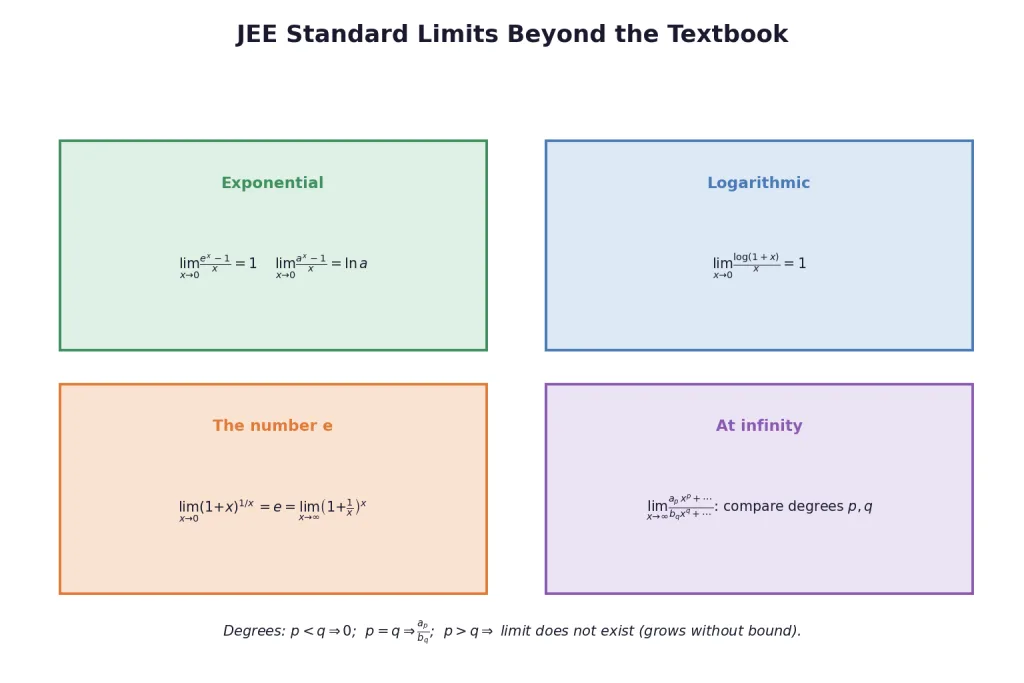
Key Point: ; ; ; .
Scaling works exactly as for : , and .
5. Differentiability is stronger than continuity. is continuous at 0, but the one-sided derivative limits disagree: from the right , from the left . So is not differentiable at 0 — a corner. Differentiable continuous, never the converse.
6. The derivative in action. Tangent-slope questions: the slope of at is , so "where is the tangent parallel to a given line?" means solving . Rate questions: if then — the derivative is the instantaneous rate of one quantity with respect to another, with the falling body's as the prototype.
[JEE Tip] " exists", "continuous", "differentiable" is a strict ladder — each rung implies the ones below it and not above. Exam statements love testing the gaps: sits exactly one rung short of the top at 0.
JEE-Style Solved Examples
Example 1: Degrees equal
Evaluate .
Solution:
Step 1 — Divide by the top power . .
Step 2 — Let each reciprocal die. .
Step 3 — Read off. — the ratio of leading coefficients, as the equal degrees promise.
Takeaway: Divide-by-top-power makes the "leading coefficients" shortcut VISIBLE — do it until the shortcut is reflex, then quote it.
Example 2: An rationalization
Evaluate .
Solution:
Step 1 — Multiply by the conjugate. .
Step 2 — Divide by . .
Step 3 — Limit. .
Takeaway: Never subtract infinities — rationalise so the difference becomes a ratio, then divide by the top power.
Example 3: A double-surd rationalization
Evaluate .
Solution:
Step 1 — Conjugate. .
Step 2 — Cancel . .
Step 3 — Substitute. .
Takeaway: The conjugate releases the hidden factor of — a with surds is a factoring problem wearing a disguise.
Example 4: Exponential scaling
Evaluate .
Solution:
Step 1 — Match the argument. .
Step 2 — Standard limit. .
Step 3 — Conclude. .
Takeaway: — the exponential scales exactly like .
Example 5: Two exponentials
Evaluate ().
Solution:
Step 1 — Add and subtract 1. .
Step 2 — Split. .
Step 3 — Combine. .
Takeaway: "Insert " converts any into two standard limits — a two-second manoeuvre worth automating.
Example 6: A log limit
Evaluate .
Solution:
Step 1 — Match the argument. .
Step 2 — Standard limit. .
Step 3 — Conclude. .
Takeaway: — same scaling law, third family.
Example 7: The form
Evaluate .
Solution:
Step 1 — Force the -shape. .
Step 2 — Inner limit. With : .
Step 3 — Conclude. .
Takeaway: — the exponent collects whatever the fraction carries.
Example 8: Bounded times vanishing
Show that , although does not exist.
Solution:
Step 1 — Bound. gives .
Step 2 — Squeeze. Both bounds : the product . ∎
Step 3 — Contrast. Alone, sweeps infinitely often near 0 — no limit; the vanishing factor is what tames it.
Takeaway: Bounded × vanishing → 0, by sandwich — and neither factor needs a limit of its own for the product to have one.
Example 9: A corner point
Show that is continuous but not differentiable at 0.
Solution:
Step 1 — Continuity. LHL ; RHL ; — all agree ✓.
Step 2 — The derivative quotient. : from the right , from the left .
Step 3 — Conclude. The one-sided limits disagree: does not exist — a corner. ∎
Takeaway: Differentiable continuous, never conversely — is the one-line counterexample every JEE statement question expects you to know.
Example 10: Where is the tangent parallel to a line?
Find the point on where the tangent has slope 1.
Solution:
Step 1 — Differentiate. .
Step 2 — Set the slope. : .
Step 3 — Find the point. : the point is .
Takeaway: A "tangent parallel to a given line" question always means: differentiate, equate slopes, solve, then substitute BACK for the point.
Example 11: A rate of change
The area of a circle is . Find the rate of change of with respect to at .
Solution:
Step 1 — Differentiate with respect to . .
Step 2 — Evaluate. At : .
Step 3 — Interpret. is the circumference — growing a disc adds a rim, so area's rate IS the boundary length.
Takeaway: Derivatives against any variable work the same way — and good rate answers admit a geometric reading.
Example 12: Mixing families
Evaluate .
Solution:
Step 1 — Divide top and bottom by . .
Step 2 — Limit each family. Top (exponential standard); bottom (workhorse with ).
Step 3 — Divide. .
Takeaway: Divide-by- is the universal splitter — each family contributes its standard constant, and the answer is their ratio.