
Not Everything Is an Equation
Earlier classes trained you to translate statements into equations. But many real conditions refuse the equals sign. The height of every student in the class is less than 160 cm. The classroom can hold at most 60 tables or chairs. These statements compare quantities without pinning them to one value — they are inequalities.
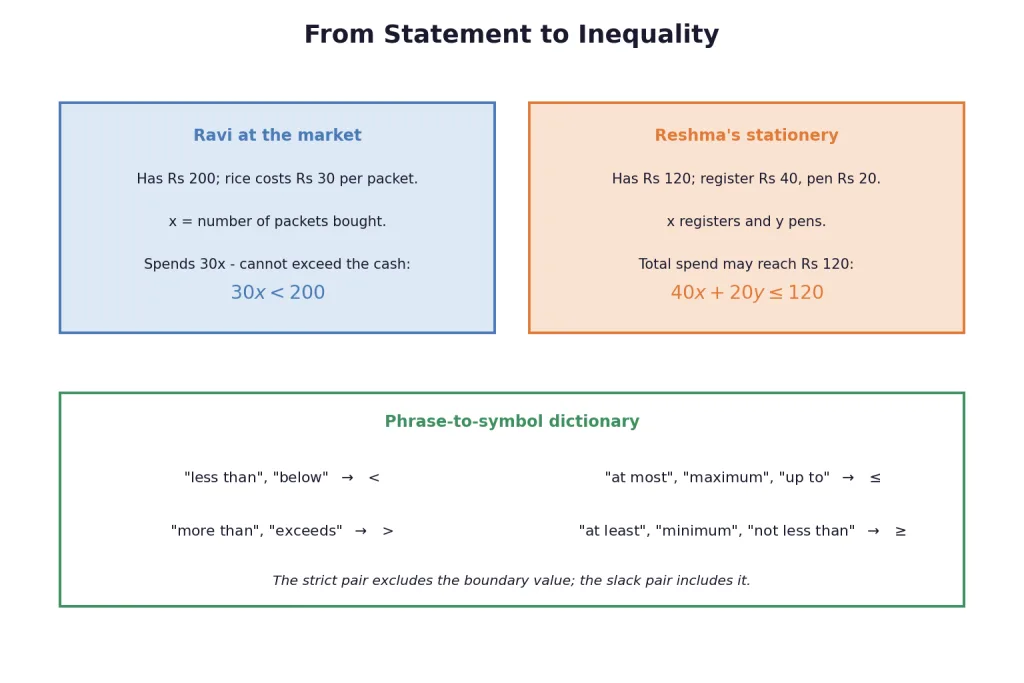
The textbook opens with two market scenes worth remembering, because they birth the two standard forms of the chapter:
- Ravi has ₹200 and buys rice at ₹30 per packet. If is the number of packets, his spend stays below the cash (packets are whole, so he may not be able to exhaust ₹200 exactly): .
- Reshma has ₹120 for registers (₹40 each) and pens (₹20 each). Buying registers and pens, her spend may go up to the full amount: .
Key Point (Definition): Two real numbers or two algebraic expressions related by the symbol , , or form an inequality.
The statement actually bundles two statements — the inequality or the equation . That is exactly what "less than or equal to" means.
The Four Symbols and the Kinds of Inequalities
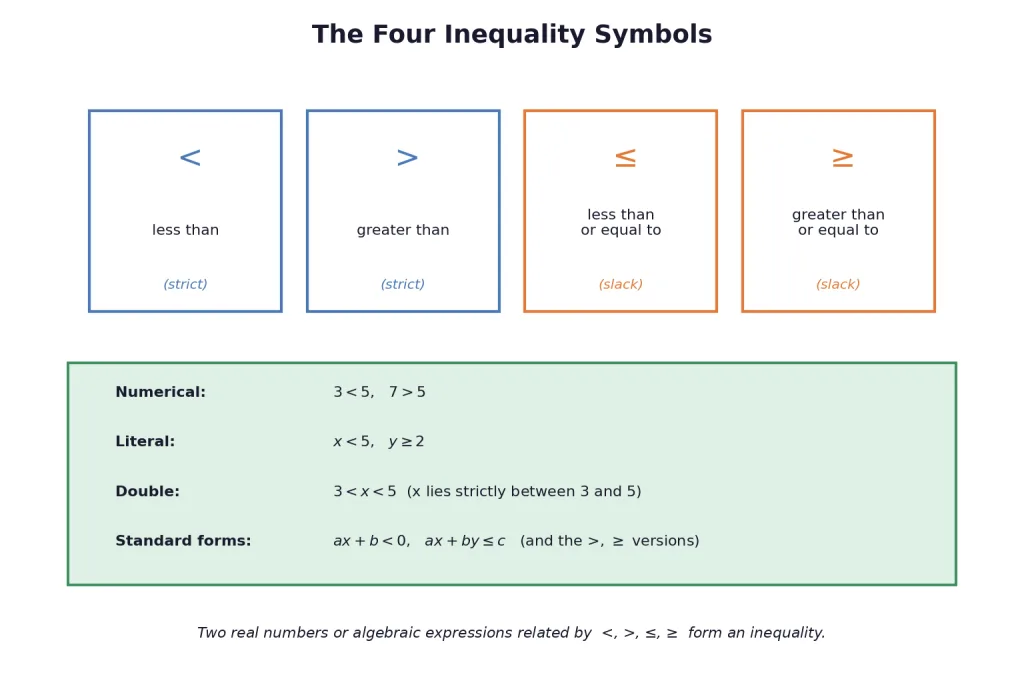
The four symbols split into two families:
- Strict inequalities use or — the boundary value is excluded. Example: .
- Slack inequalities use or — the boundary value is allowed. Example: .
By what they compare:
- Numerical inequalities compare numbers: , .
- Literal inequalities involve variables: , .
- Double inequalities trap a variable between two bounds: reads " is greater than 3 and less than 5" — two conditions in one chain.
The general forms this chapter solves are the linear inequalities in one variable — , , , with — and their two-variable cousins etc., which supply the word problems.
[Board Tip] Translation vocabulary is where marks are won: "at most" and "maximum" mean ; "at least", "minimum" and "not less than" mean ; "more than" and "exceeds" mean the strict ; "less than" and "below" mean the strict . Read the sentence twice before choosing strict vs slack.
What Counts as a Solution?
Return to Ravi's , where counts rice packets — so cannot be negative or fractional. Test values one by one: gives ✓, gives ✓, … , gives ✓, but gives ✗.
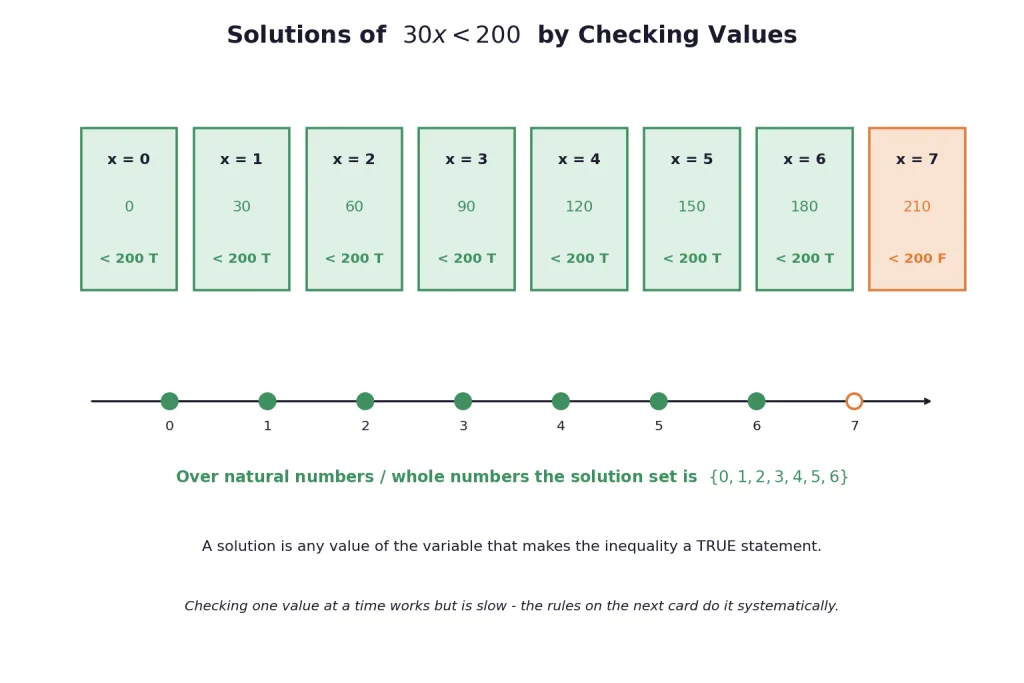
Key Point: Any value of the variable that makes an inequality a true statement is a solution; the set of all such values is the solution set. Here the solution set is .
Two lessons hide in this example:
- The solution set depends on the allowed number system. Over whole numbers the answer above is a finite list; over reals, would give every real — an infinite interval.
- Trial and error is slow. Checking values one at a time works for tiny problems but is hopeless in general — we need the systematic rules of the next section.
[JEE Tip] "Solution set changes with the domain" is a favourite trap: the same inequality can have solution set over naturals, over integers, and over reals. Always note which set the question specifies.
Solved Examples
Example 1: Classifying inequalities
Classify each as numerical, literal or double, and as strict or slack: (i) (ii) (iii) (iv) .
Solution:
Step 1 — (i) What is compared, and how? Two NUMBERS compared with : numerical and strict (the boundary is excluded).
Step 2 — (ii) A variable appears. Literal, and makes it slack (the value 4 itself is allowed).
Step 3 — (iii) Two bounds in one chain. A double inequality — equivalent to AND — with both parts strict.
Step 4 — (iv) Two variables, slack sign. Literal (in two variables) and slack.
Takeaway: Two independent classifications: what is compared (numerical/literal/double) and whether the boundary counts (strict/slack).
Example 2: Translating statements
Write an inequality for each: (i) a bus can carry at most 45 passengers () (ii) the temperature stayed above 20°C (iii) a pass needs at least 33 marks () (iv) the perimeter of a rectangle does not exceed 60 cm.
Solution:
Step 1 — (i) "At most" includes the boundary. 45 passengers is itself allowed: .
Step 2 — (ii) "Above" is strict. 20°C itself was never touched: .
Step 3 — (iii) "At least" includes the boundary. Exactly 33 marks passes: .
Step 4 — (iv) "Does not exceed" means up to and including. .
Takeaway: The phrase decides strict vs slack: at most/at least/not less than keep the boundary; above/below/exceeds drop it.
Example 3: Ravi's inequality, rebuilt
Ravi has ₹200; rice costs ₹30 per packet. Why is the correct model and not ?
Solution:
Step 1 — List the possible spends. Rice sells only in whole packets, so the spend takes the values — multiples of 30.
Step 2 — Check whether the boundary is reachable. ₹200 is NOT a multiple of ₹30, so the spend can never equal 200; the largest achievable spend is .
Step 3 — Choose the sign. Since equality is impossible, the strict form models the situation faithfully.
Step 4 — Contrast. If packets cost ₹25 instead, would exactly exhaust the cash, and the slack form would be right.
Takeaway: Strict vs slack is a modelling decision — ask whether the boundary value is actually attainable.
Example 4: Solution set by checking values
Find the solution set of when (i) is a natural number (ii) is an integer.
Solution:
Step 1 — Divide by the positive coefficient. Dividing by 24 (positive — no sign flip): .
Step 2 — (i) Collect the naturals. Naturals below 4.17: .
Step 3 — (ii) Collect the integers. All integers below 4.17: — infinitely many on the left.
Takeaway: Same inequality, different domains, different solution sets — always note which number system the question specifies.
Example 5: Double inequality in words
Express "a solution must be kept between 30°C and 35°C" as an inequality, and state whether the bounds are included.
Solution:
Step 1 — Read "between" carefully. Without the word "inclusive", "between" is read as strict on both sides.
Step 2 — Write the chain. .
Step 3 — State the boundary status. Neither 30 nor 35 is an allowed temperature — both bounds excluded.
Takeaway: "Between a and b" (bare) = strict double inequality; add "inclusive" and both signs become slack.
Example 6: One chain, two statements
Write as two separate conditions, and list the integers satisfying it.
Solution:
Step 1 — Split the chain. The chain means AND simultaneously.
Step 2 — List the integers. .
Step 3 — Check the two boundaries. enters (slack side ✓); stays out (strict side ✗) — a chain can mix the two sign types.
Takeaway: A double inequality is a conjunction; handle each end with its own sign.
Example 7: Which values solve it?
Is a solution of (i) ? (ii) ? (iii) ?
Solution:
Step 1 — (i) Substitute. , and is FALSE — not a solution.
Step 2 — (ii) Substitute. is TRUE — a solution; the slack sign saves the boundary value.
Step 3 — (iii) Substitute. , and is FALSE — the strict sign rejects equality.
Takeaway: Parts (ii) and (iii) hit the boundary from both sides — everything hangs on strict vs slack.
Example 8: Reshma's spending choices
With , can Reshma buy (i) 2 registers and 2 pens? (ii) 3 registers? (iii) 1 register and 5 pens?
Solution:
Step 1 — (i) Compute the spend. , and ✓ — allowed, using the full amount.
Step 2 — (ii) Compute. ✓ — also allowed.
Step 3 — (iii) Compute. , and ✗ — not affordable.
Step 4 — Note the structure. A two-variable inequality has solution PAIRS , not single numbers.
Takeaway: Substitution decides membership; slack signs admit exact-budget purchases.