
Why JEE Cares About This Chapter
JEE rarely asks "solve " — but inequalities power half the paper from behind: domains of functions, modulus conditions, sign analysis of rational expressions, and range restrictions inside bigger problems. This corner builds the three tools the rationalised textbook stops short of: modulus inequalities, rational inequalities, and the wavy-curve method.
Key Point: Solution sets combine exactly like sets from Chapter 1 — "and" means intersection (), "or" means union (). JEE answers are intervals or unions of intervals; fluency in notation is assumed.
[JEE Tip] The single most dangerous move in this territory: multiplying an inequality by an expression whose sign you don't know (like ). Either split into cases, or — far better — bring everything to one side and analyse signs.
Modulus Inequalities: Think Distance
is the distance of from 0, and the distance from . Every modulus inequality is a distance statement:
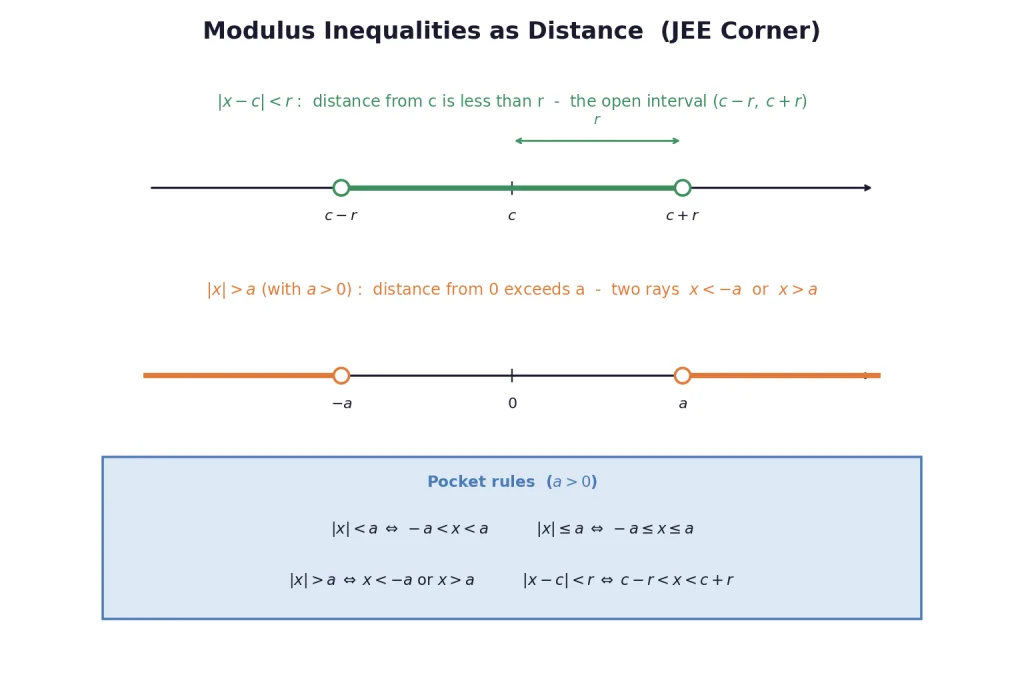
For :
- — a band around 0. Similarly .
- or — two rays, written .
- — the band of radius around .
- — everything outside that band.
Two degenerate cases JEE loves: has no solution when (a modulus is never negative), and holds for all when .
Key Point: "Less than" moduli give single intervals (bands); "greater than" moduli give unions of two rays. If your answer's shape disagrees, recheck.
[JEE Tip] For , run both conversions at once: the solution is a band of radius minus the open band of radius — two symmetric closed intervals around .
Rational Inequalities and the Wavy Curve
To solve you may NOT multiply across by — its sign is unknown. Instead:
- Bring everything to one side as a single fraction with factored .
- Mark the critical points — zeros of numerator and denominator — on the number line.
- Determine the sign in each region: for one test value, or note that the sign alternates at each simple (odd-power) factor.
- Select regions matching the required sign. Zeros of the numerator join the answer only for slack signs (); zeros of the denominator are always excluded.
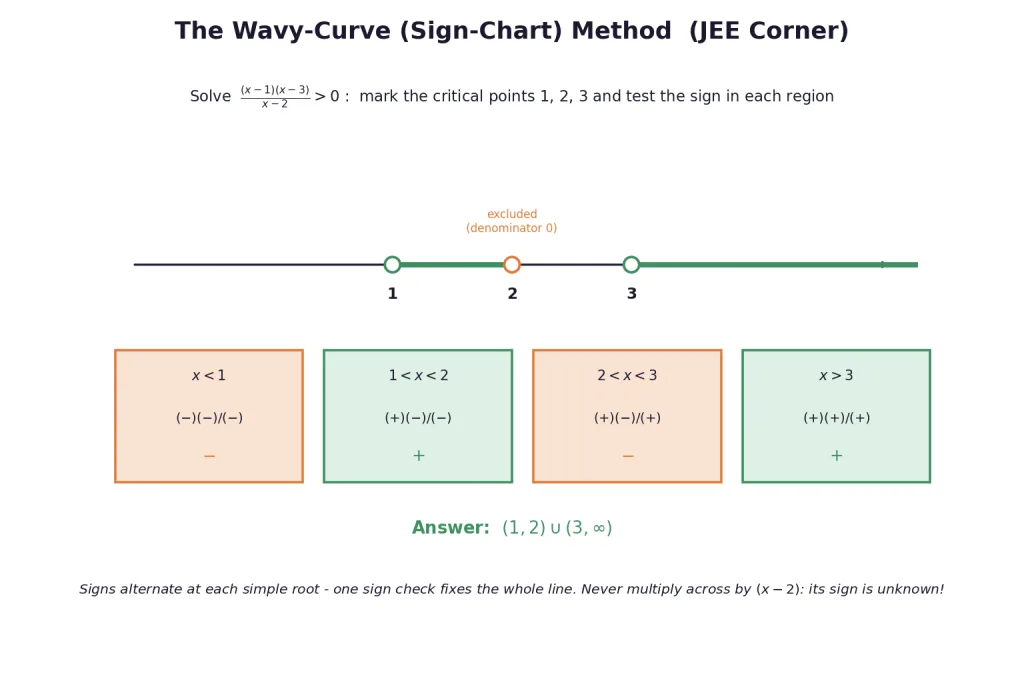
Worked instance: . Critical points 1, 2, 3. Rightmost region positive, alternating leftwards: on , on , on , on . Answer: .
Quadratic inequalities are the same machine: factors to , giving .
[JEE Tip] For an even-power factor like , the sign does NOT alternate there — the curve touches and returns. Alternation is only for odd powers.
Solved Examples
Example 1: The four basic modulus forms
Solve (i) (ii) .
Solution:
Step 1 — (i) Read as distance. Distance from 0 below 3: the BAND , i.e. .
Step 2 — (ii) Read as distance. Distance from 0 at least 2: two RAYS, or .
Step 3 — Write the union. — square brackets from the slack sign.
Takeaway: "Less than" moduli give bands; "greater than" moduli give unions of rays.
Example 2: A shifted band
Solve .
Solution:
Step 1 — Read as distance from 2. The distance is below 5: .
Step 2 — Interval. — the open band of radius 5 around 2.
Takeaway: is always the band .
Example 3: A shifted pair of rays
Solve .
Solution:
Step 1 — Rewrite the centre. : distance from at least 4.
Step 2 — Write the rays. or .
Step 3 — Union. .
Takeaway: hides the centre — rewrite before placing the rays.
Example 4: An annulus on the line (JEE classic)
Solve .
Solution:
Step 1 — Outer bound. gives the band .
Step 2 — Inner bound. gives the rays or .
Step 3 — Intersect. — two symmetric closed intervals around 1.
Takeaway: A two-sided modulus condition is band-minus-band: run both conversions and intersect.
Example 5: Modulus of a linear expression
Solve .
Solution:
Step 1 — Convert to a chain. .
Step 2 — Add 2 throughout. .
Step 3 — Divide by 3. : interval .
Takeaway: Inside the modulus may be any linear expression — convert, then run the usual chain algebra.
Example 6: Degenerate moduli
Solve (i) (ii) .
Solution:
Step 1 — (i) Compare against zero. A modulus is never negative, so it can never be below : solution .
Step 2 — (ii) Same comparison. A modulus is always : every real works — solution .
Takeaway: No algebra needed — only the definition. JEE plants these to reward definition-level thinking.
Example 7: First rational inequality
Solve .
Solution:
Step 1 — Mark the critical points. Numerator zero: 1; denominator zero: 2.
Step 2 — Sign-test each region. : ✓; : ✗; : ✓.
Step 3 — Collect the positive regions. .
Takeaway: A fraction is positive when numerator and denominator share a sign — never multiply across by the unknown-sign denominator.
Example 8: Slack sign — endpoints diverge
Solve .
Solution:
Step 1 — Critical points and sign. Points and 3; the fraction is negative between them (opposite signs).
Step 2 — Decide each endpoint separately. makes the fraction 0 — allowed by : INCLUDE. kills the denominator: ALWAYS exclude.
Step 3 — Interval. .
Takeaway: Numerator zeros join under slack signs; denominator zeros never join.
Example 9: Full wavy curve
Solve .
Solution:
Step 1 — Mark the critical points. 1, 2, 3 — all simple (odd-power) factors, so the sign alternates at each.
Step 2 — Read the wavy curve. Rightmost region positive; alternating leftwards: left to right.
Step 3 — Collect non-negative regions with endpoint care. — numerator zeros 1, 3 enter (slack sign); denominator zero 2 stays out.
Takeaway: The wavy curve reads all three regions in one sweep — one test value fixes the rightmost sign, alternation does the rest.
Example 10: Quadratic inequality by factoring
Solve .
Solution:
Step 1 — Factor. .
Step 2 — Sign-analyse. A product of two factors is positive OUTSIDE the roots: or (between them, the parabola dips negative).
Step 3 — Union. .
Takeaway: Quadratic inequalities are the wavy curve with no denominator.
Example 11: Never cross-multiply
Solve .
Solution:
Step 1 — Refuse the illegal move. Multiplying by (unknown sign) is ambiguous. Instead move 2 across: .
Step 2 — Combine into one fraction. .
Step 3 — Sign-analyse. Critical points (numerator) and 1 (denominator): : ✓; : ✗; : ✓.
Step 4 — Endpoints. Include (numerator zero, slack sign); exclude 1 (denominator). Solution: .
Takeaway: Bring everything to one side and sign-analyse — the answer's two-piece shape could never come from naive cross-multiplication.
Example 12: Rational inequality with a constant on the right
Solve .
Solution:
Step 1 — Move 3 across and combine. , i.e. .
Step 2 — Clear the leading minus. Multiply numerator by and flip: .
Step 3 — Sign-analyse. Negative between the critical points and ; include (numerator zero), exclude (denominator).
Step 4 — Interval. .
Takeaway: Factor out early to keep the leading coefficient positive — the flip is easier to track on a whole inequality than inside a sign chart.
Example 13: Inequalities meet domains
Find the domain of .
Solution:
Step 1 — Write the conditions. Square roots need non-negative inputs: AND .
Step 2 — Solve each. and .
Step 3 — Intersect. Domain .
Takeaway: Domains are systems of inequalities in disguise.
Example 14: Modulus plus a side condition
Solve together with .
Solution:
Step 1 — Convert the modulus. gives .
Step 2 — Intersect with the side condition. Clip the band by the ray .
Step 3 — Result. .
Takeaway: Extra conditions clip the modulus band — draw both on one number line.
Example 15: Union vs intersection in one problem
Given the conditions and , find the set of satisfying (i) both (ii) at least one.
Solution:
Step 1 — (i) "Both" = intersection. Overlap of and : .
Step 2 — (ii) "At least one" = union. .
Step 3 — Note the phrasing rule. "and/simultaneously" intersects; "or/at least one" unites.
Takeaway: JEE phrasing decides the operation — read for the conjunction before computing.