
How to Use This Section
Thirty fully worked examples sweep the whole chapter — solving over naturals, integers and reals; sign-flip situations; fractional and bracketed inequalities; number-line graphs; double inequalities; systems; and every standard class of word problem — averages, consecutive integers, geometry, formula ranges and mixtures — solved in full.
[Board Tip] Work each example yourself before reading the solution. In this chapter the errors are stereotyped — a missed flip, a wrong bracket, an ignored domain — so comparing your attempt against the worked steps is the fastest diagnostic there is.
Solving over Different Number Sets
Example 1: One inequality, two domains
Solve when (i) is a natural number (ii) is an integer.
Solution:
Step 1 — Divide by the positive 24. .
Step 2 — (i) Filter by naturals. .
Step 3 — (ii) Filter by integers. .
Takeaway: Solve once, filter per domain.
Example 2: Strict boundary check
Solve when (i) is an integer (ii) is a real number.
Solution:
Step 1 — Collect. Add 3: ; divide by 5: .
Step 2 — (i) Integers. — 2 itself is excluded by the strict sign.
Step 3 — (ii) Reals. .
Takeaway: The strict sign evicts the boundary in every domain.
Example 3: A right-facing ray
Solve when (i) is an integer (ii) is a real number.
Solution:
Step 1 — Collect. Subtract 8: , so .
Step 2 — (i) Integers. .
Step 3 — (ii) Reals. .
Takeaway: Rays open away from the boundary; list integers from the first admitted value.
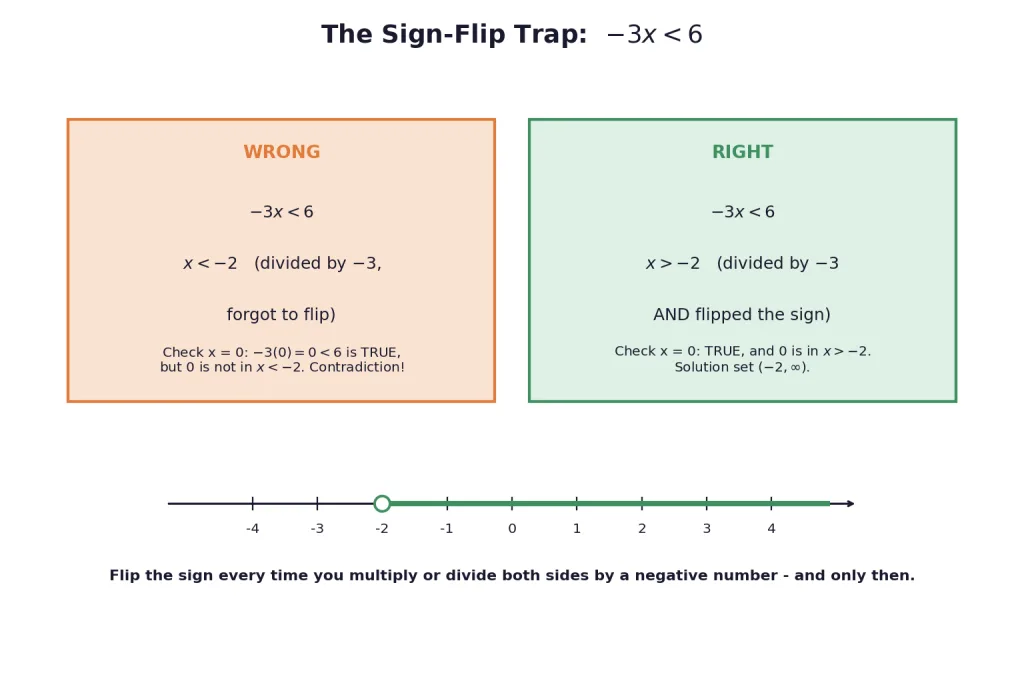
Example 4: The flip via −x
Solve for real .
Solution:
Step 1 — Collect. Subtract and 3: .
Step 2 — Multiply by and FLIP. .
Step 3 — Interval. ; check x = 0: ✓.
Takeaway: is NOT — the flip is compulsory.
Example 5: Flip with a coefficient
Solve for real .
Solution:
Step 1 — Collect. gives .
Step 2 — Divide by and FLIP. .
Step 3 — Interval. ; check x = : ✓.
Takeaway: Same flip, negative coefficient this time — the rule does not care how the negative arose.
Brackets and Fractions
Example 6: Brackets both sides
Solve .
Solution:
Step 1 — Expand. .
Step 2 — Collect. Add 3x, subtract 2: , i.e. .
Step 3 — Interval. — slack sign, closed end.
Takeaway: Reading "" as "" is a free rewrite — no flip involved.
Example 7: Fractions of x on one side
Solve .
Solution:
Step 1 — Combine coefficients. , so the LHS is .
Step 2 — Solve. gives .
Step 3 — Interval. .
Takeaway: Combine like terms BEFORE clearing denominators — here the 11's cancel beautifully.
Example 8: Cross-shaped fractions
Solve .
Solution:
Step 1 — Multiply by the positive 15. .
Step 2 — Expand. .
Step 3 — Collect. , so : .
Takeaway: LCM-multiply once; the rest is bracket algebra.
Example 9: Three fractions
Solve .
Solution:
Step 1 — Multiply by 30 (LCM of 2, 3, 5). .
Step 2 — Simplify the right side. .
Step 3 — Collect. gives , so : .
Takeaway: Distribute the minus over BOTH terms of the second fraction — the is where errors live.
Example 10: Brackets with a constant
Solve .
Solution:
Step 1 — Expand. , i.e. .
Step 2 — Collect. , so .
Step 3 — Interval. .
Takeaway: Keep x's coefficient positive by collecting onto the larger side — no flip needed then.
Example 11: Three fractions, strict
Solve .
Solution:
Step 1 — Multiply by 60. .
Step 2 — Simplify the right. .
Step 3 — Collect. gives : .
Takeaway: Moving 15x right instead of 16x left keeps everything positive — choose the collection direction wisely.
Example 12: A heavier three-fraction chain
Solve .
Solution:
Step 1 — Multiply by 60. .
Step 2 — Simplify each side. LHS ; RHS .
Step 3 — Collect. gives , so : .
Takeaway: — sign care inside the subtracted bracket decides the whole problem.
Number-Line Graphs
Example 13: Solve and graph
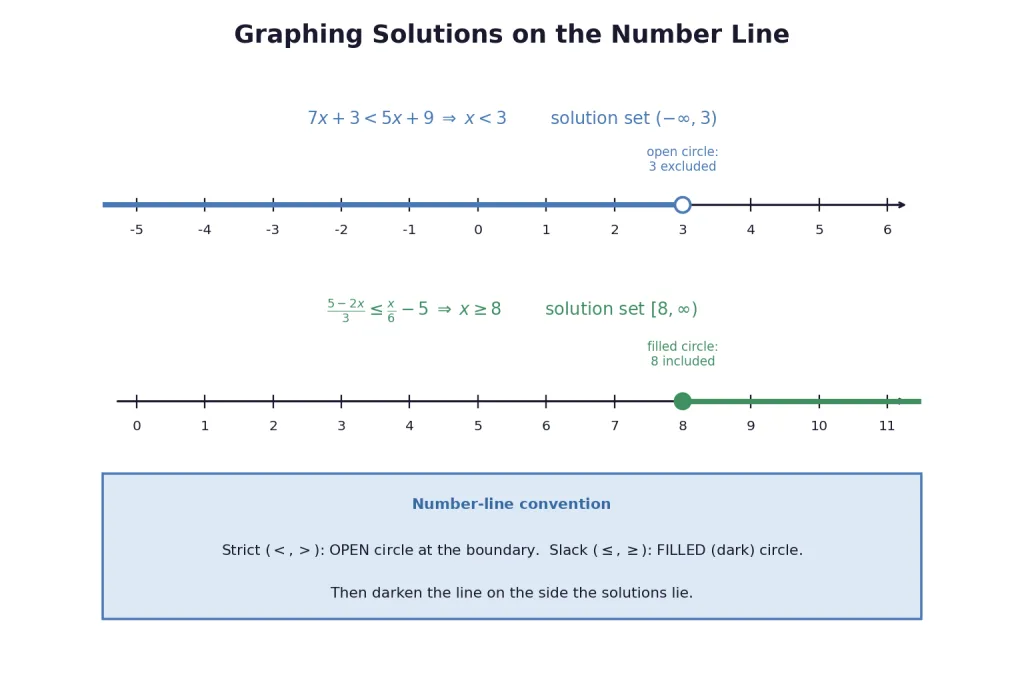
Solve and show the graph of the solutions.
Solution:
Step 1 — Collect. Subtract 2x, add 2: .
Step 2 — Graph. Strict sign → OPEN circle at 3; solutions below → dark line to the left: .
Takeaway: Circle from the sign, direction from the inequality.
Example 14: Slack version
Solve and graph the solutions.
Solution:
Step 1 — Collect. , so .
Step 2 — Graph. Slack sign → FILLED circle at ; dark line rightwards: .
Takeaway: The filled circle earns the "boundary included" mark.
Example 15: Brackets then graph
Solve and graph the solutions.
Solution:
Step 1 — Expand. .
Step 2 — Collect. , so .
Step 3 — Graph. Open circle at , dark line rightwards: .
Takeaway: Collecting to keep the coefficient positive avoided a flip entirely.
Example 16: A graph read backwards
A number line shows a filled circle at 2 with the dark line running left. Write the inequality and the interval.
Solution:
Step 1 — Decode the circle. Filled: 2 is INCLUDED — slack sign.
Step 2 — Decode the direction. Dark line left: solutions below 2.
Step 3 — Write both forms. ; interval .
Takeaway: The graph-to-algebra dictionary runs both ways — exams test the reverse direction too.
Double Inequalities
Example 17: The basic closed chain
Solve .
Solution:
Step 1 — Add 4 to all three parts. .
Step 2 — Divide by the positive 3. .
Step 3 — Interval. The closed interval — both signs slack throughout.
Takeaway: Whatever you do to the middle, do to both ends.
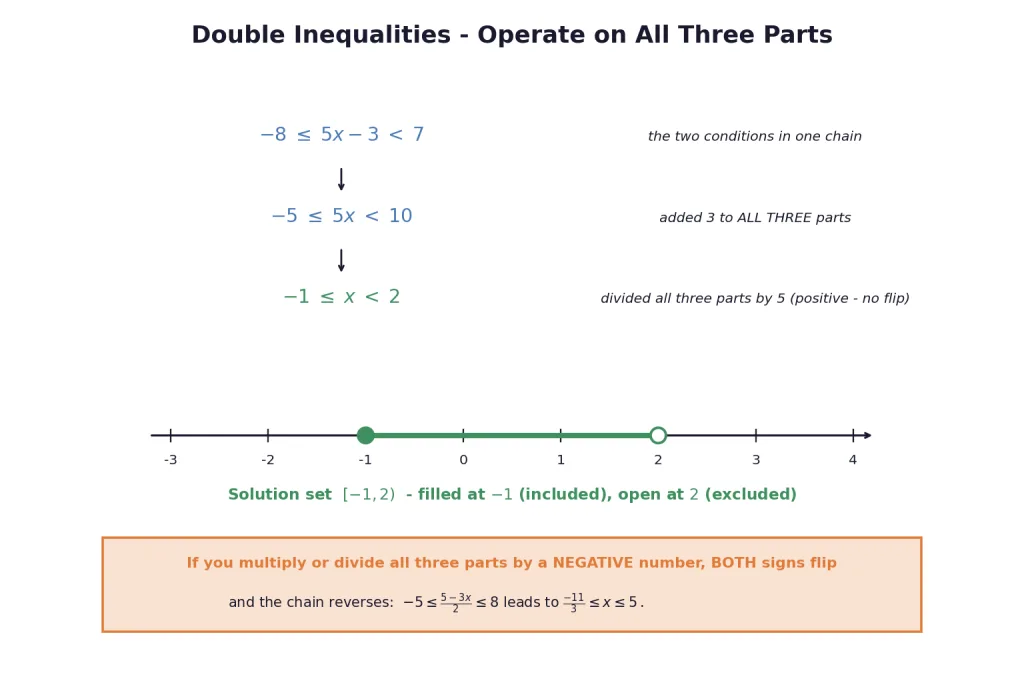
Example 18: Chain with a negative multiplier
Solve .
Solution:
Step 1 — Subtract 4 throughout. .
Step 2 — Multiply by — negative, BOTH signs flip. .
Step 3 — Reorder. , i.e. .
Takeaway: Flip both signs, then rewrite smallest-to-largest — two moves, one deliberate step.
Example 19: Mixed strict-slack chain
Solve .
Solution:
Step 1 — Multiply by the positive . .
Step 2 — Add 2 throughout. .
Step 3 — Interval. — the strict and slack ends keep their own brackets.
Takeaway: Each end of a chain carries its own sign type all the way to the final bracket.
Example 20: Fraction in the middle
Solve .
Solution:
Step 1 — Multiply all parts by 2. .
Step 2 — Subtract 11. .
Step 3 — Divide by 3. : interval .
Takeaway: Peel the middle expression layer by layer — multiply, subtract, divide.
Example 21: A double negative to simplify first
Solve .
Solution:
Step 1 — Simplify the double negative. , so the chain is .
Step 2 — Subtract 4 throughout. .
Step 3 — Multiply by the positive . : interval .
Takeaway: Tidy the expression BEFORE operating on the chain — the buried double negative changes everything.
Systems of Inequalities
Example 22: A two-sided trap
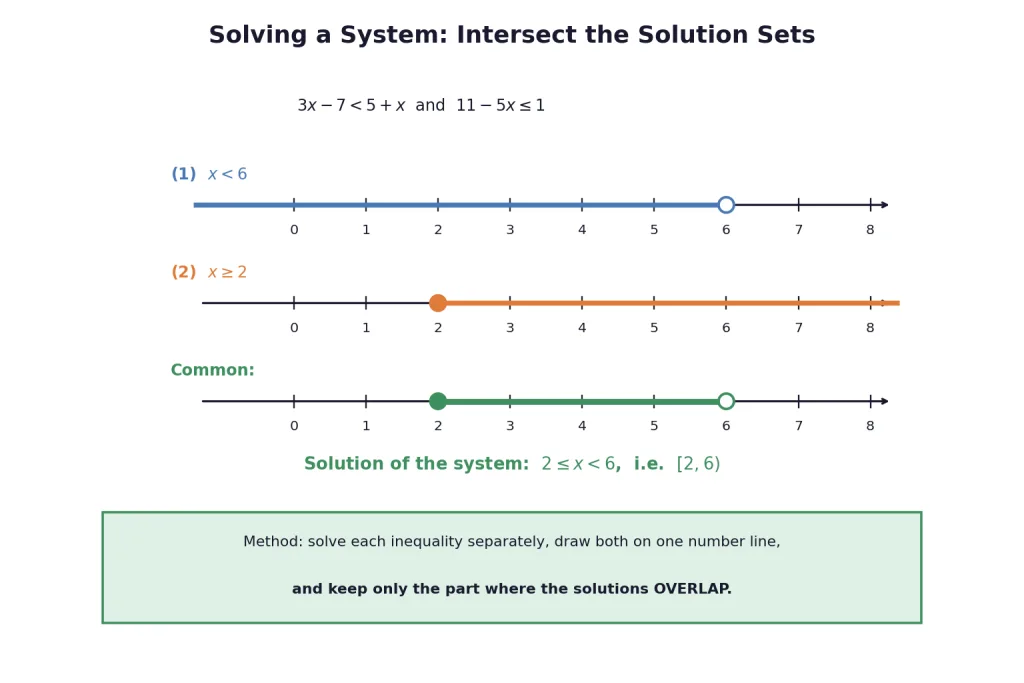
Solve the system and .
Solution:
Step 1 — Solve the first. gives .
Step 2 — Solve the second. gives , so .
Step 3 — Intersect. — the overlap of the two rays.
Takeaway: Opposite-facing conditions trap x in an interval; same-facing ones reduce to the tighter ray.
Example 23: A system with no solution
Solve and .
Solution:
Step 1 — Solve each. First: . Second: .
Step 2 — Attempt the intersection. The rays point away from each other with a gap between 3 and 4 — no overlap.
Step 3 — Conclude. Solution set .
Takeaway: State the empty set explicitly — it is a complete, correct answer.
Example 24: Counting integer solutions of a system
How many integers satisfy both and ?
Solution:
Step 1 — Intersect. .
Step 2 — List the integers. .
Step 3 — Count. Five — the slack end admits , the strict end excludes 3.
Takeaway: Bracket types decide the count at each end.
Example 25: Always true, never true
Solve (i) (ii) .
Solution:
Step 1 — (i) Expand. — the x-terms cancel, leaving : FALSE for every x.
Step 2 — Conclude (i). Solution .
Step 3 — (ii) Expand. collapses to : TRUE for every x.
Step 4 — Conclude (ii). Solution .
Takeaway: When the variable cancels, the leftover numerical statement decides: everything or nothing.
Word Problems
Example 26: Average with four tests
Scores so far: 72, 78, 69. What must the fourth score be for an average of at least 75?
Solution:
Step 1 — Translate. , i.e. .
Step 2 — Solve. .
Step 3 — Interpret. At least 81 marks (and at most 100, in context).
Takeaway: The four-step recipe scales to any number of tests.
Example 27: Consecutive evens, tighter bounds
Find all pairs of consecutive even positive integers, both smaller than 14, whose sum is more than 20.
Solution:
Step 1 — Conditions on the smaller even x. Both below 14: , so ; sum: , so .
Step 2 — Filter by parity. Even x in : only.
Step 3 — List. Single pair: .
Takeaway: Tight bounds can shrink the answer to one pair — or none; count carefully.
Example 28: Boric acid dilution
640 litres of 8% boric acid solution is to be diluted with 2% solution so the mixture is more than 4% but less than 6% boric acid. How much 2% solution must be added?
Solution:
Step 1 — Track acid and volume. Adding x litres: acid ; volume .
Step 2 — More than 4%. gives , so .
Step 3 — Less than 6%. gives , so .
Step 4 — Combine. Between 320 and 1280 litres.
Takeaway: Here the ADDED solution is the weaker one — the same acid-tracking method handles dilution and enrichment alike.
Example 29: IQ range, younger group
With and , find the mental-age range if .
Solution:
Step 1 — Substitute CA = 10. , so .
Step 2 — Divide all parts by 10. years.
Takeaway: A clean-coefficient formula turns the chain into one division.
Example 30: Interval plus integrality
A parking lot charges ₹40 for the first hour and ₹25 for each additional hour. With at most ₹200, for how many whole hours can a car be parked?
Solution:
Step 1 — Model the cost. For hours: cost .
Step 2 — Translate the budget. gives , so , i.e. .
Step 3 — Interpret with integrality. Whole hours: — at most 7 hours.
Takeaway: Step 4 of the recipe: trim to whole, positive values — 7.4 hours is not a purchasable quantity.