
The Four-Step Recipe
Every word problem in this chapter yields to the same routine:
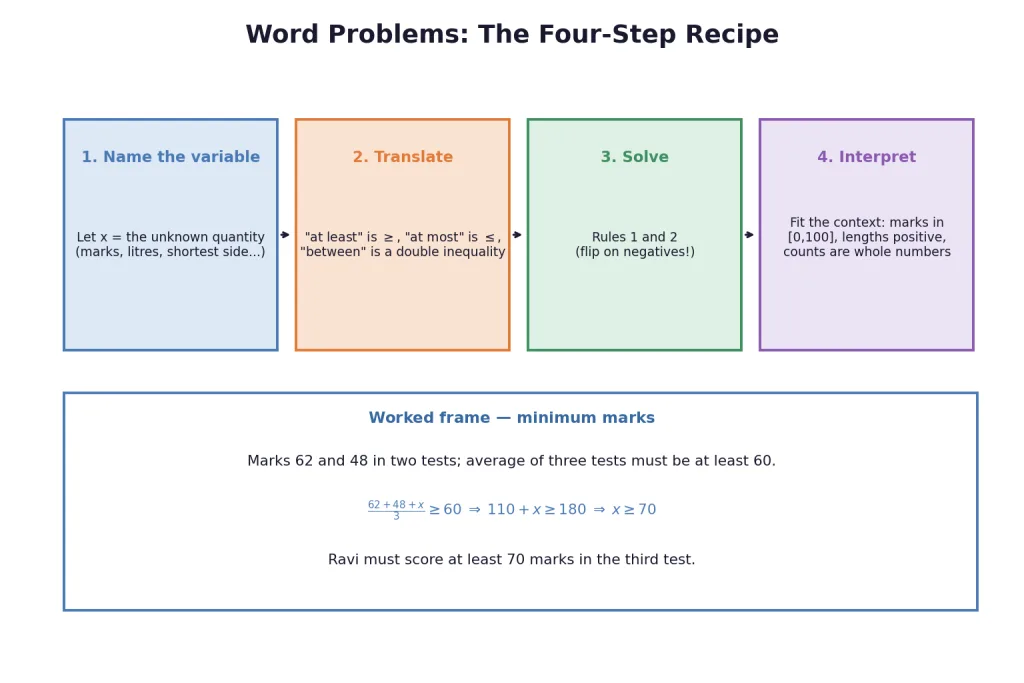
- Name the variable — let be the unknown the question asks about (marks, litres, the shortest side…).
- Translate — "at least" is , "at most" is , "between" is a double inequality, "more than" is strict .
- Solve — Rules 1 and 2, flipping on negative multipliers.
- Interpret — cut the mathematical answer down to the physically sensible values: marks lie in , lengths are positive, counts are whole numbers, odd integers step by 2.
Key Point: Step 4 is where word problems differ from bare algebra. The inequality may allow , but if is marks out of 100 the honest answer is .
[Board Tip] End with a sentence: "the student must score at least 70 marks." Boards award the final mark to the interpreted answer, not the interval.
The Standard Problem Types
Averages and marks. An average condition multiplies up to a linear inequality. Only the unknown score is a variable; the rest are numbers.
Consecutive integers. Consecutive odd (or even) numbers are and . Two conditions arise — a size condition () and a sum condition () — making a small system whose integer solutions give the pairs.
Geometry. Sides expressed in one variable (, , ) feed a perimeter condition; board-cutting gives a total-length condition plus a comparison condition.
Ranges through a formula. A double inequality on one quantity converts to a double inequality on another via a linear formula — Celsius to Fahrenheit by , IQ to mental age by .
Mixtures. Track the amount of pure substance: litres of a solution carries litres of acid. "Resulting mixture between and " gives a double inequality in .
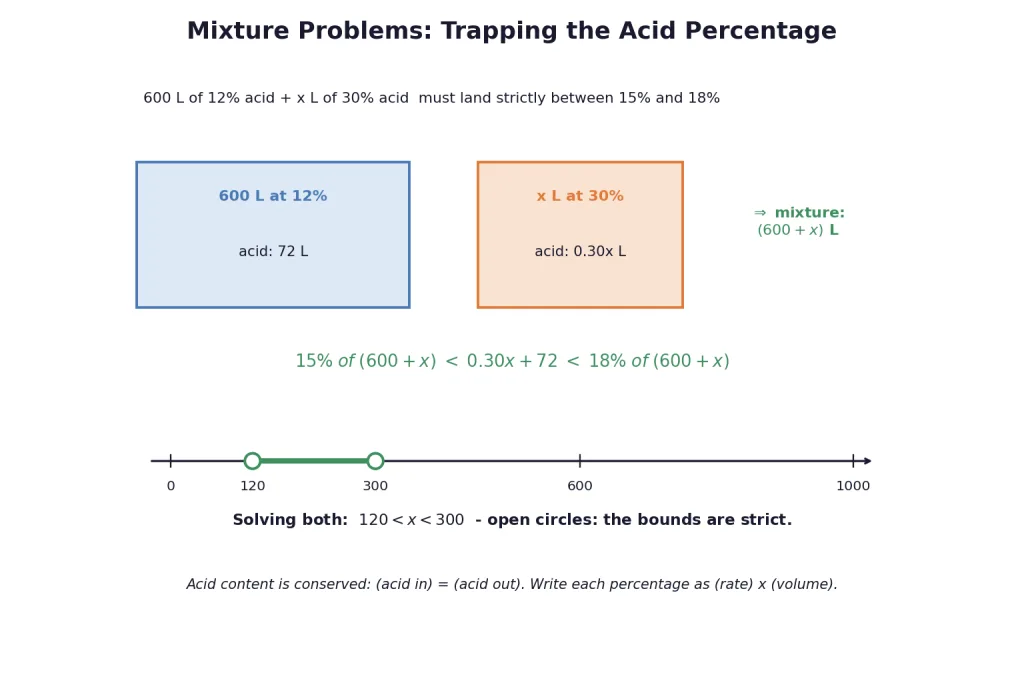
[JEE Tip] In mixture problems never average the percentages — weight them by volume. The inequality compares litres of acid, not percentage labels.
Solved Examples
Example 1: Minimum marks
Marks in two terminal exams are 62 and 48. Find the minimum marks in the annual exam for an average of at least 60.
Solution:
Step 1 — Name the variable and translate. Let be the annual-exam marks; "average at least 60" gives .
Step 2 — Clear the denominator. Multiply by 3: .
Step 3 — Solve and interpret. : the minimum required is 70 marks.
Takeaway: Average conditions multiply up to linear inequalities — only the unknown score is a variable.
Example 2: Ravi's unit tests
Ravi scored 70 and 75 in the first two unit tests. Find the minimum marks in the third test for an average of at least 60.
Solution:
Step 1 — Translate. .
Step 2 — Clear and collect. , so .
Step 3 — Interpret. He needs at least 35 marks.
Takeaway: Same recipe as Example 1 — the numbers change, the structure does not.
Example 3: Sunita's Grade A
Grade 'A' needs an average of 90 or more in five exams (each out of 100). Sunita scored 87, 92, 94 and 95. What must she score in the fifth exam?
Solution:
Step 1 — Translate. , i.e. .
Step 2 — Solve. .
Step 3 — Interpret with the cap. Marks cannot exceed 100, so she must score between 82 and 100.
Takeaway: Step 4 of the recipe trims the mathematical ray to the physically possible range.
Example 4: Consecutive odd naturals
Find all pairs of consecutive odd natural numbers, both larger than 10, with sum less than 40.
Solution:
Step 1 — Model the pair. Let the smaller odd number be ; the pair is and .
Step 2 — Write both conditions. Size: . Sum: , i.e. , so .
Step 3 — Intersect and filter by parity. with x odd: .
Step 4 — List the pairs. — note 19 may appear as the LARGER member.
Takeaway: Consecutive odd (or even) numbers step by 2; the conditions form a small system whose integer solutions give the pairs.
Example 5: Odd, small this time
Find all pairs of consecutive odd positive integers, both smaller than 10, whose sum is more than 11.
Solution:
Step 1 — Conditions on the smaller odd x. Both below 10: , so . Sum: , so .
Step 2 — Intersect and filter. with x odd: .
Step 3 — List the pairs. and .
Takeaway: "Both smaller than 10" binds the LARGER member — write the condition on the right element.
Example 6: Consecutive evens
Find all pairs of consecutive even positive integers, both larger than 5, with sum less than 23.
Solution:
Step 1 — Conditions. Smaller even x: and .
Step 2 — Solve the sum condition. .
Step 3 — Filter by parity. Even x with : .
Step 4 — List. .
Takeaway: Parity filtering happens LAST, after the interval is pinned down.
Example 7: Triangle sides
The longest side of a triangle is 3 times the shortest, and the third side is 2 cm shorter than the longest. If the perimeter is at least 61 cm, find the minimum length of the shortest side.
Solution:
Step 1 — Express all sides in one variable. Shortest : sides are , , .
Step 2 — Translate the perimeter condition. , so .
Step 3 — Solve. gives .
Step 4 — Interpret. The shortest side is at least 9 cm.
Takeaway: One variable, three sides — geometry problems feed a single linear condition.
Example 8: Cutting a board
A 91 cm board is cut into three lengths: the second is 3 cm longer than the shortest, the third is twice the shortest. The third piece must be at least 5 cm longer than the second. Find possible lengths of the shortest piece.
Solution:
Step 1 — Model the pieces. Shortest : pieces , , .
Step 2 — Total-length condition. , so , giving .
Step 3 — Comparison condition. , so .
Step 4 — Intersect. (cm).
Takeaway: Two independent conditions — a budget and a comparison — trap x in a closed interval.
Example 9: Celsius to Fahrenheit
A solution must stay between 30°C and 35°C. Find the range in °F, given .
Solution:
Step 1 — Substitute the formula into the chain. .
Step 2 — Multiply all parts by . .
Step 3 — Add 32 throughout. — between 86°F and 95°F.
Takeaway: A linear formula converts a range in one quantity to a range in the other — operate on all three parts.
Example 10: Fahrenheit to Celsius
A solution is kept between 68°F and 77°F. Find the range in °C.
Solution:
Step 1 — Substitute. .
Step 2 — Subtract 32 throughout. .
Step 3 — Multiply by . — between 20°C and 25°C.
Takeaway: The inverse conversion runs the same chain backwards — subtract first this time.
Example 11: The acid mixture
A manufacturer has 600 litres of 12% acid solution. How many litres of 30% solution must be added so the mixture is more than 15% but less than 18% acid?
Solution:
Step 1 — Track volumes and acid separately. Adding litres: total volume ; total acid litres.
Step 2 — Write the double condition on ACID, not percentages. .
Step 3 — Solve the left inequality. gives , so .
Step 4 — Solve the right. gives , so .
Step 5 — Combine. More than 120 but less than 300 litres.
Takeaway: Never average percentage labels — weight them by volume; the inequality compares litres of acid.
Example 12: Dilution with water
How many litres of water must be added to 1125 litres of 45% acid so the mixture is more than 25% but less than 30% acid?
Solution:
Step 1 — Identify what stays constant. Water adds volume but NO acid: acid stays litres; volume becomes .
Step 2 — More than 25%. gives , so .
Step 3 — Less than 30%. gives , so .
Step 4 — Combine. Between 562.5 and 900 litres of water.
Takeaway: In dilution, the pure-substance amount is the invariant — anchor both inequalities to it.
Example 13: The IQ range
. For a group of 12-year-old children, . Find the range of their mental age .
Solution:
Step 1 — Substitute CA = 12. .
Step 2 — Multiply all parts by . .
Step 3 — Interpret. Mental age lies between 9.6 and 16.8 years (inclusive — the bounds were slack).
Takeaway: Formula-range problems are double inequalities wearing a story; the slack/strict character of the given range survives into the answer.