
Drawing the Answer: Number Line Graphs
A solution set over the reals is a piece of the number line — so draw it. The standard convention:
- Strict inequality ( or ): put an open circle on the boundary number — it is not a solution — and darken the line on the side where solutions lie.
- Slack inequality ( or ): put a filled (dark) circle on the boundary — it is a solution — and darken the correct side.
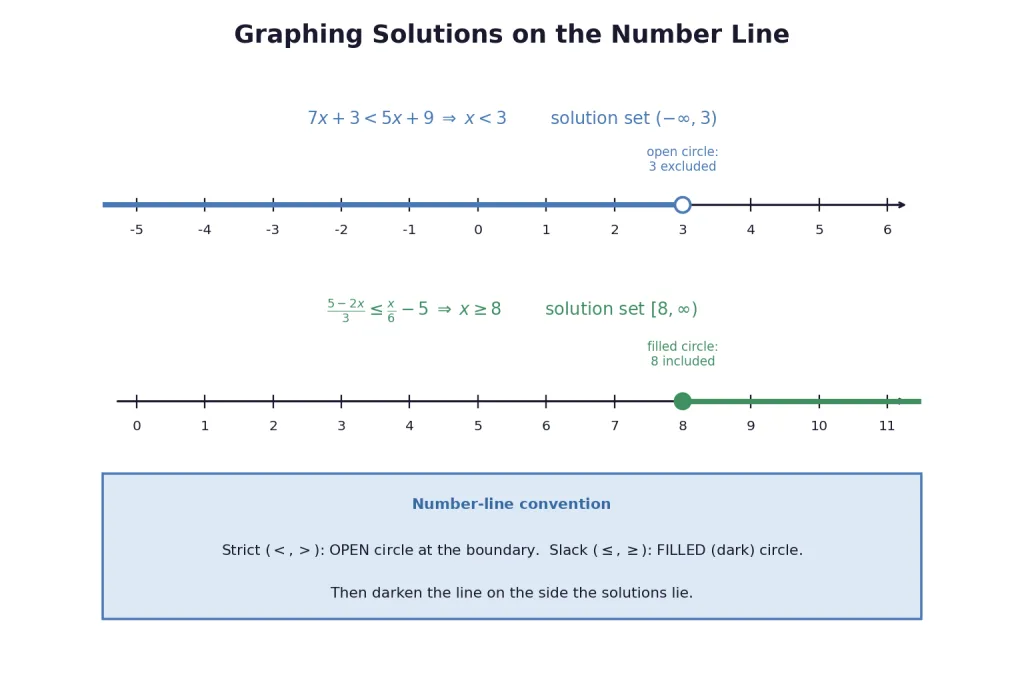
Worked instance: reduces to , i.e. — open circle at 3, dark line to the left. And: multiplies up to , i.e. , so , giving — filled circle at 1, dark line to the right.
[Board Tip] When a question says "show the graph of the solutions," the open-vs-filled circle carries a mark. Match it to the sign before drawing anything.
Double Inequalities: Operate on All Three Parts
A condition like is two inequalities sharing a middle. Solve them together by doing each move to all three parts:
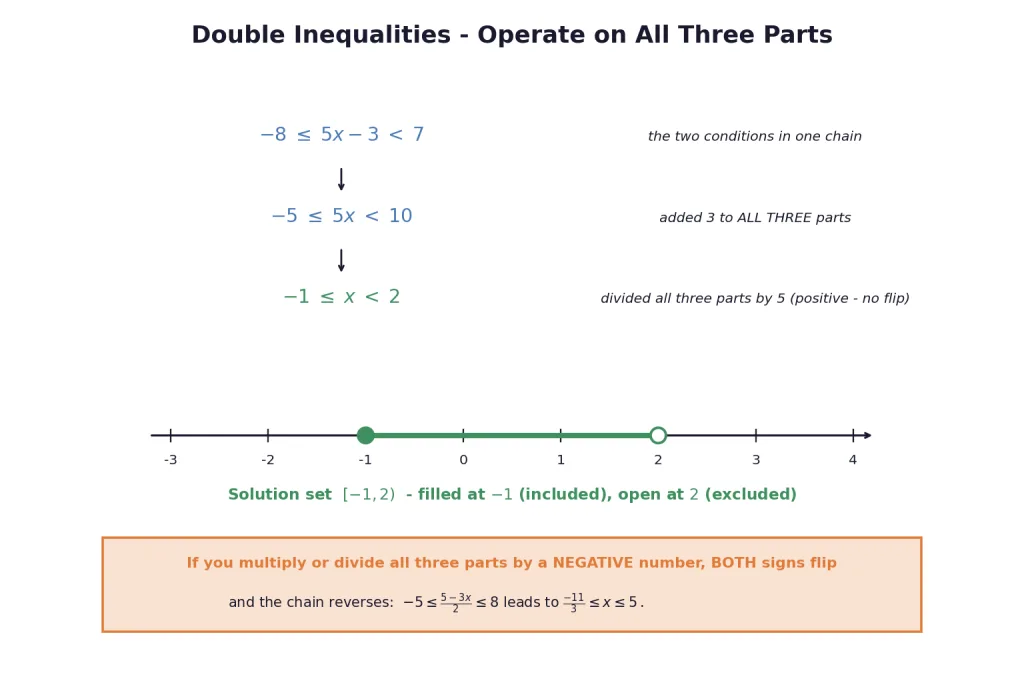
Worked instance: . Add 3 throughout: . Divide by 5 (positive): — the interval .
A negative-divisor instance: . Multiply by 2: . Subtract 5: . Divide by — negative, so both signs flip and the chain reverses: , i.e. .
Key Point: Whatever you do to the middle, do to both ends. Dividing all three parts by a negative flips both inequality signs — then rewrite the chain smallest-to-largest.
[JEE Tip] Keep the variable only in the middle. If appears in an end as well, split the chain into its two separate inequalities and solve as a system instead.
Systems of Inequalities: Intersect the Solutions
When two (or more) inequalities must hold simultaneously, solve each on its own, then keep the common part — the intersection of the solution sets.
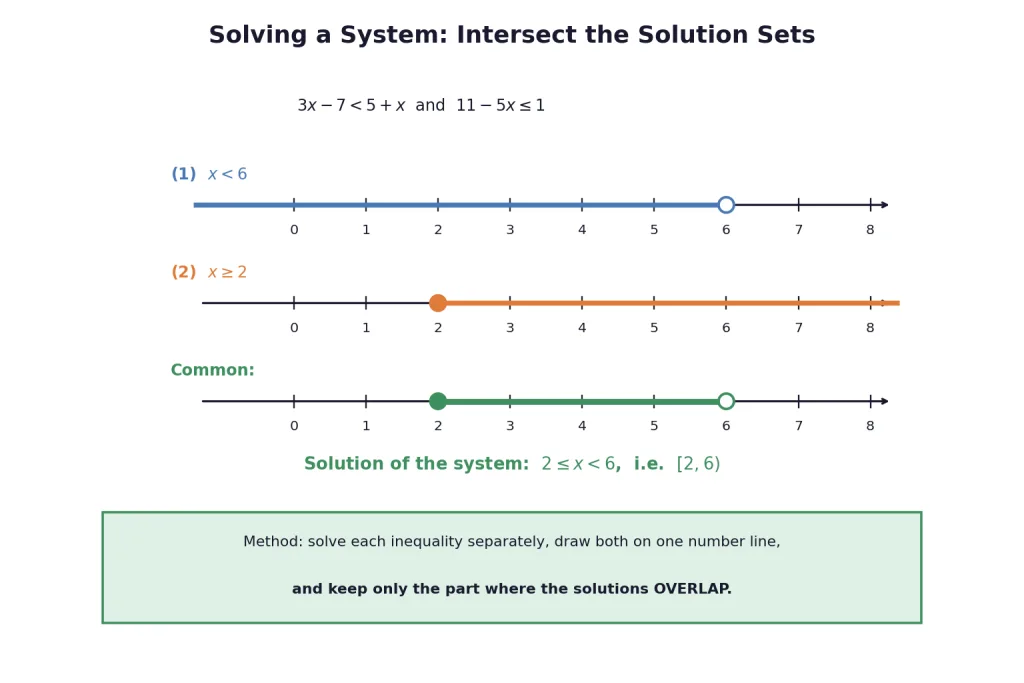
Worked instance: solve and . The first gives , i.e. . The second gives , flip: . Drawing both on one number line, the overlap is — the interval .
Key Point: System = intersection. Draw each solution set on the same number line; the answer is where all the dark lines overlap. If they never overlap, the system has no solution.
A double inequality is just a system in disguise ( and ) — chains are the compact way to write systems whose middle expression is shared.
[Board Tip] Report the final answer with correct brackets: the boundary that came from a slack inequality gets a square bracket, the strict one a round bracket — exactly as in above.
Solved Examples
Example 1: Graph included
Solve and show the graph of the solutions.
Solution:
Step 1 — Collect. Subtract and 3 from both sides: , so .
Step 2 — Choose the circle. Strict sign — 3 is NOT a solution: OPEN circle at 3.
Step 3 — Darken the correct side. Solutions lie below 3: dark line to the left, i.e. .
Takeaway: Sign type decides the circle; direction of the inequality decides the darkened side.
Example 2: Fractions then graph
Solve and graph the solutions.
Solution:
Step 1 — Simplify the right side first. .
Step 2 — Clear denominators with the positive 4. .
Step 3 — Expand and collect. gives , so .
Step 4 — Graph. Filled circle at 1 (slack — included), dark line rightwards: .
Takeaway: Combine each side into one fraction before clearing denominators — fewer terms to track.
Example 3: The basic chain
Solve .
Solution:
Step 1 — Add 3 to ALL THREE parts. .
Step 2 — Divide all parts by the positive 5. , i.e. .
Step 3 — Graph. Filled circle at (slack end), open circle at 2 (strict end), dark line between.
Takeaway: Whatever you do to the middle, do to both ends — the chain moves as one object.
Example 4: Chain with a negative divisor
Solve .
Solution:
Step 1 — Multiply all parts by 2. .
Step 2 — Subtract 5 throughout. .
Step 3 — Divide by , flipping BOTH signs. .
Step 4 — Rewrite smallest-to-largest. , i.e. .
Takeaway: A negative division flips both signs AND forces a reorder — do the two moves together, deliberately.
Example 5: A system with a graph
Solve the system and , and represent the solutions on the number line.
Solution:
Step 1 — Solve the first inequality. gives , so .
Step 2 — Solve the second. ; divide by and FLIP: .
Step 3 — Intersect on one number line. The overlap of and is , i.e. — filled at 2, open at 6.
Takeaway: Solve each inequality separately; the system's answer is where the dark lines overlap.
Example 6: Both strict
Solve and .
Solution:
Step 1 — First inequality. , so .
Step 2 — Second. , so .
Step 3 — Intersect. : the open interval .
Takeaway: Two mirror-image strict conditions produce a symmetric open interval.
Example 7: Flip inside a system
Solve and .
Solution:
Step 1 — First inequality. gives .
Step 2 — Second. gives .
Step 3 — Intersect. Both point the same way; the STRONGER condition wins: solution .
Takeaway: When both conditions face the same direction, the intersection is simply the tighter one.
Example 8: Chain with negative multiplier
Solve .
Solution:
Step 1 — Divide all parts by , flipping both signs. .
Step 2 — Add 4 throughout. .
Step 3 — Divide by the positive 2. .
Step 4 — Reorder. , i.e. — note the slack end moved to 1 with the flip.
Takeaway: After a flip, track WHICH end carries the slack sign — it travels with the boundary, not with the position in the chain.
Example 9: A heavier system
Solve and .
Solution:
Step 1 — Expand and solve the first. gives , so .
Step 2 — Solve the second. gives , so .
Step 3 — Intersect. , i.e. — both ends slack, both included.
Takeaway: Opposite-facing conditions trap x in a closed interval; brackets record the two slack signs.
Example 10: An empty intersection
Solve the system and .
Solution:
Step 1 — Solve each. First: . Second: , so .
Step 2 — Attempt the intersection. No real number is simultaneously below and above 3 — the dark lines never overlap.
Step 3 — State the conclusion. Solution set: .
Takeaway: A perfectly legitimate answer; state it explicitly rather than manufacturing a fake interval.