
The Two Rules — Almost Like Equations
For equations you learned two moves: add/subtract the same number on both sides, and multiply/divide both sides by the same non-zero number. Inequalities keep both moves, with one crucial amendment.
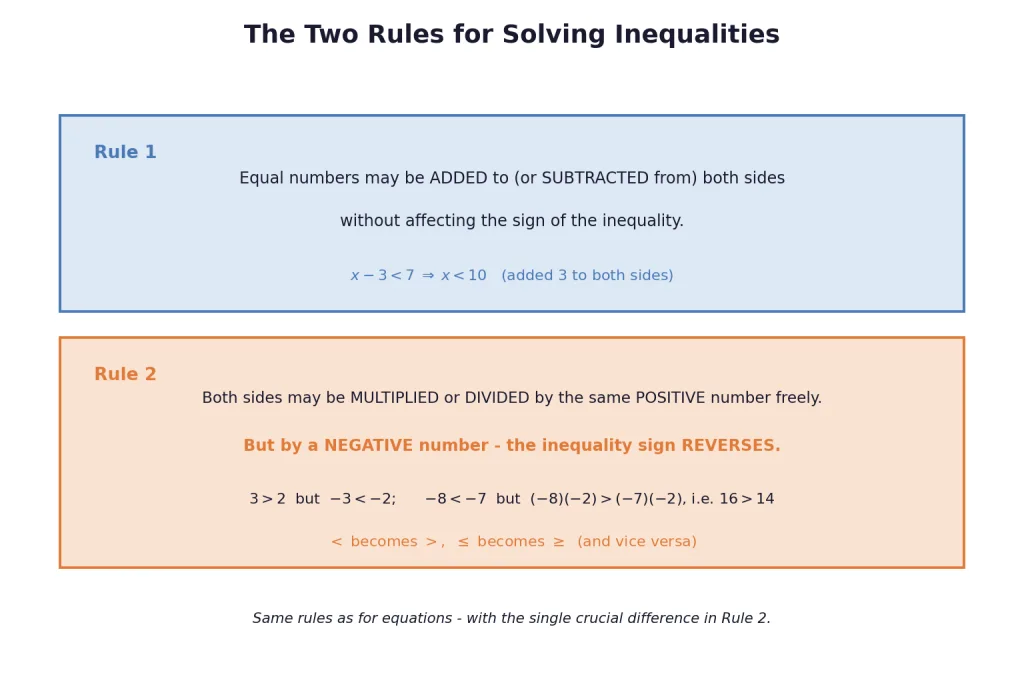
Key Point (Rule 1): Equal numbers may be added to or subtracted from both sides of an inequality without affecting its sign.
Key Point (Rule 2): Both sides may be multiplied or divided by the same positive number freely. But when both sides are multiplied or divided by a negative number, the inequality sign reverses: becomes , becomes , and vice versa.
Why the flip? Watch the number line: , yet — multiplying by mirrors every number through 0 and reverses order. A quick check: , but .
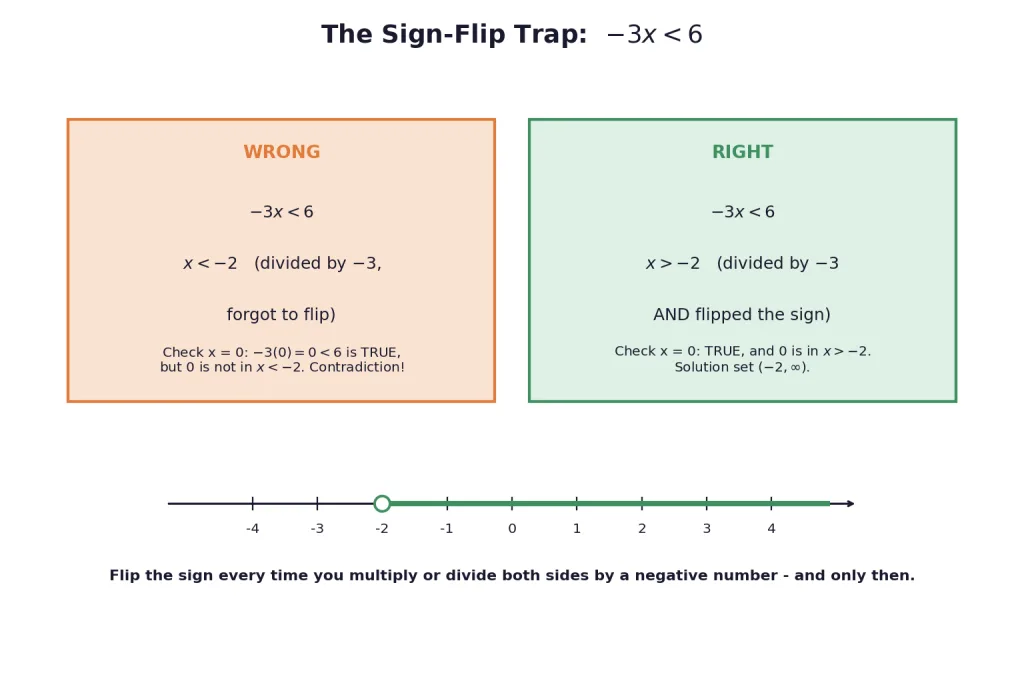
[Board Tip] The single most-lost mark in this chapter: dividing by a negative and forgetting the flip. Habit to build — the moment you write or , flip the sign in the same line, then continue.
Writing Answers: Interval Notation
Over the reals, solution sets of linear inequalities are intervals — unbroken stretches of the number line. Compact notation:
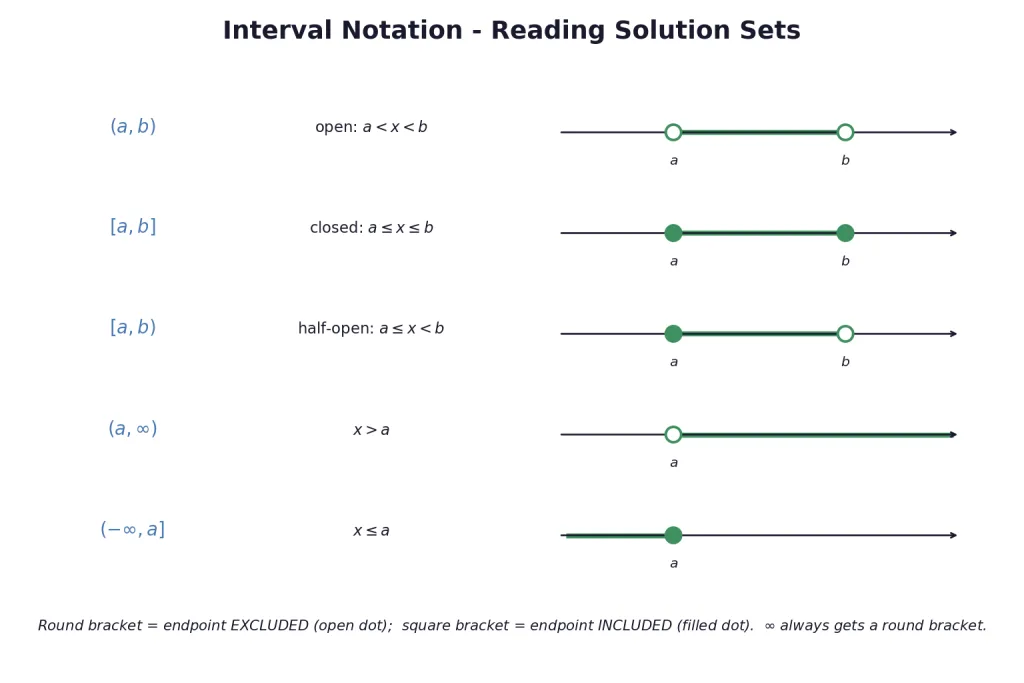
- — open: , endpoints excluded.
- — closed: , endpoints included.
- and — half-open: one end in, one end out.
- means ; means ; means ; means .
Key Point: Round bracket = endpoint excluded; square bracket = endpoint included. The symbols and are not numbers, so they always take a round bracket.
Unless a question says otherwise, this chapter solves inequalities over the real numbers — so expect interval answers. When the question restricts to naturals or integers, list the values instead.
[JEE Tip] Interval notation is the working language of Sets (Chapter 1) revisited: solution sets combine by intersection () when conditions must hold together and union () when either suffices. JEE answers are almost always reported as intervals or unions of intervals.
Solved Examples
Example 1: Same inequality, different worlds
Solve when (i) is a natural number (ii) is an integer.
Solution:
Step 1 — Divide by the positive coefficient (Rule 2, no flip). .
Step 2 — (i) Collect the naturals. Naturals below : solution set .
Step 3 — (ii) Collect the integers. — the domain changes the answer, not the algebra.
Takeaway: Solve once over the reals, then filter by the allowed number system.
Example 2: Collect, then divide
Solve when (i) is an integer (ii) is a real number.
Solution:
Step 1 — Add 3 to both sides (Rule 1). .
Step 2 — Subtract 3x (Rule 1). .
Step 3 — Divide by the positive 2 (Rule 2). .
Step 4 — Report per domain. (i) Integers: . (ii) Reals: .
Takeaway: Rule 1 moves terms across; only the final division touches the coefficient.
Example 3: The flip appears
Solve .
Solution:
Step 1 — Collect x on one side. Subtract and 3 from both sides: .
Step 2 — Divide by — negative, so FLIP. .
Step 3 — Write the interval and check. Solution set . Check x = 0: ✓ and ✓.
Takeaway: The flip happens in the same line as the negative division — never a line later.
Example 4: Fractions first
Solve .
Solution:
Step 1 — Clear denominators with the positive 6. — no flip, 6 is positive.
Step 2 — Expand and collect. gives .
Step 3 — Divide by and FLIP. .
Step 4 — Interval. — square bracket, since the slack sign includes 8.
Takeaway: Clear fractions with a POSITIVE multiplier first; save any negative division for one deliberate, flipped step.
Example 5: Negative coefficient from the start
Solve when (i) is a natural number (ii) is an integer.
Solution:
Step 1 — Divide by and FLIP. .
Step 2 — (i) Filter by naturals. No natural number is negative: solution set (empty).
Step 3 — (ii) Filter by integers. Integers below : .
Takeaway: An empty solution set is a legitimate answer — say so explicitly rather than forcing values.
Example 6: Brackets both sides
Solve for real .
Solution:
Step 1 — Expand both sides. .
Step 2 — Collect. Subtract 2x and add 3: .
Step 3 — Interval. — square bracket because the sign is slack.
Takeaway: Expansion first, collection second; the bracket type in the answer mirrors the sign type.
Example 7: When everything cancels
Solve (i) (ii) .
Solution:
Step 1 — (i) Expand. , i.e. .
Step 2 — Collect. gives , so : solution .
Step 3 — (ii) Simplify each side fully first. LHS ; RHS .
Step 4 — Collect. gives , so : solution .
Takeaway: Simplify each side COMPLETELY before moving terms across — most sign errors happen mid-shuffle.
Example 8: Fractional two-sided
Solve .
Solution:
Step 1 — Multiply by the positive 6. .
Step 2 — Collect. .
Step 3 — Multiply by and FLIP. : solution set .
Takeaway: is NOT — the flip converts it to ; check with x = : ✓.
Example 9: Checking a claimed answer
A student solves and reports . Verify and correct.
Solution:
Step 1 — Redo the algebra. Subtract 7: ; divide by and FLIP: .
Step 2 — Diagnose. The student forgot the flip on dividing by .
Step 3 — Refute the claim with a test value. x = 0 satisfies "", but is FALSE — so cannot be the solution set.
Step 4 — State the correction. .
Takeaway: One test value can demolish a wrong answer — build the checking habit.
Example 10: Strictness survives the algebra
Solve .
Solution:
Step 1 — Clear denominators with the positive 15. .
Step 2 — Expand. .
Step 3 — Collect. , so .
Step 4 — Interval. .
Takeaway: The stayed throughout — only negative multipliers change it, and we used only positive ones.