
When Order Stops Mattering
From three tennis players X, Y, Z, how many 2-player teams? The team of X and Y is the team of Y and X — order is irrelevant. Only three teams exist: XY, YZ, ZX. Each unordered selection is a combination; twelve people shaking hands pairwise, or chords through 7 points on a circle, are combinations of things taken 2 at a time.
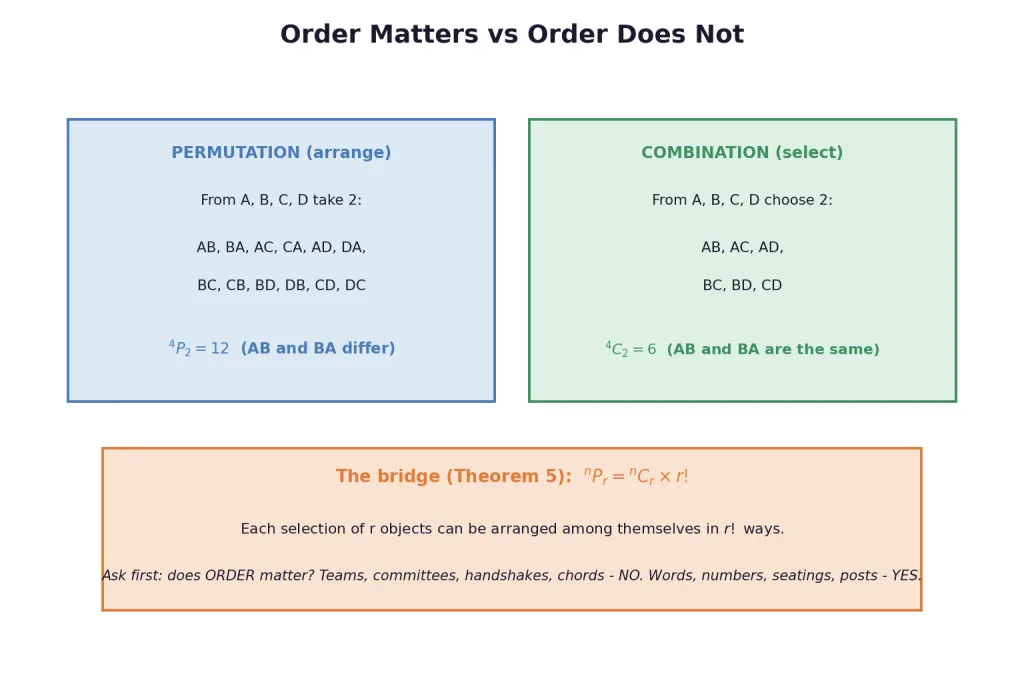
Key Point (Theorem 5): for — every selection of objects spawns exactly arrangements. Hence
with (selecting nothing can be done in exactly one way) and .
The test to apply on every problem: does swapping the chosen objects create a new outcome? Words, numbers, seatings, posts — yes, use permutations. Teams, committees, handshakes, chords, card hands — no, use combinations.
[Board Tip] When a selection is followed by an arrangement (choose 5 letters, then form words), do both: select with , then multiply by the arrangements — that is Theorem 5 working forwards.
The Identities That Do the Work
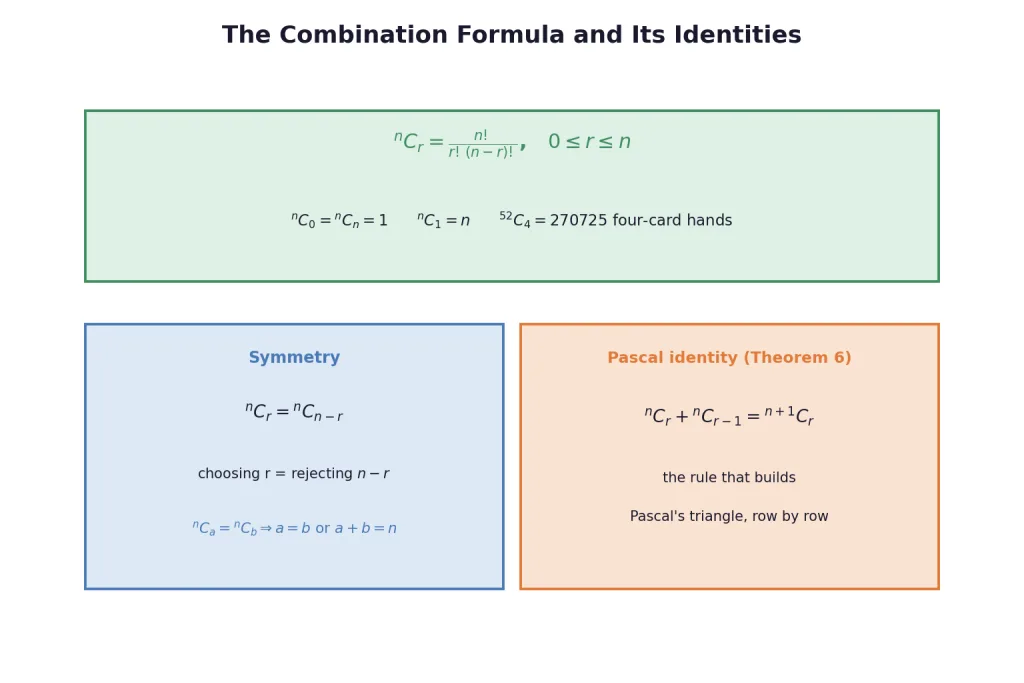
- Symmetry: — choosing objects to take is the same as choosing objects to leave behind. Compute as , never by expanding factorials.
- The equality rule: or . Model instance: gives , so .
- Pascal identity (Theorem 6): — the rule that builds Pascal's triangle and powers the Binomial Theorem next chapter.
Multi-group selections multiply group by group: a committee of 1 man from 2 and 2 women from 3 forms in ways — the multiplication principle applied to independent selections.
[JEE Tip] Both roots of matter in exams: from conclude (since , use ), then . Check symmetry before grinding factorials.
Solved Examples
Example 1: The equality rule
If , find .
Solution:
Step 1 — Apply the equality rule. forces or ; here , so .
Step 2 — Evaluate the target. — there is exactly one way to take everything.
Takeaway: Two indices, one n: unequal indices always mean they add to n.
Example 2: A small committee
A committee of 3 is to be formed from 2 men and 3 women. How many committees? How many with exactly 1 man and 2 women?
Solution:
Step 1 — All committees. Any 3 of the 5 people: .
Step 2 — Constrained committees: select group by group. 1 man from 2: ; 2 women from 3: .
Step 3 — Multiply the independent selections. .
Takeaway: Composition constraints split the selection into groups; the multiplication principle glues them.
Example 3: Four cards from 52
How many ways to choose 4 cards from a 52-card pack? How many of these have (i) all four of the same suit (ii) all four from different suits (iii) all face cards (iv) two red and two black (v) all the same colour?
Solution:
Step 1 — Total. .
Step 2 — (i) Same suit. Pick within one suit () and multiply by the 4 suits: .
Step 3 — (ii) All different suits. One card from each suit's 13: .
Step 4 — (iii) All face cards. J, Q, K in four suits = 12 cards: .
Step 5 — (iv) Two red, two black. .
Step 6 — (v) One colour. All red or all black — alternatives ADD: .
Takeaway: One deck, five patterns — per-suit multiplication, per-colour cases, and the add-vs-multiply divide all on display.
Example 4: Symmetry at work
If , find .
Solution:
Step 1 — Equality rule. , so .
Step 2 — Evaluate. .
Takeaway: Solve for n first; the requested value is then one small computation.
Example 5: Ratio equations
Determine if (i) (ii) .
Solution:
Step 1 — Form the ratio once. after cancelling against .
Step 2 — (i) Set equal to 12. gives : .
Step 3 — (ii) Set equal to 11. gives : .
Takeaway: Simplify the ratio symbolically first — both parts then reduce to one-line linear equations.
Example 6: Chords and teams
(i) How many chords can be drawn through 21 points on a circle? (ii) In how many ways can a team of 3 boys and 3 girls be selected from 5 boys and 4 girls?
Solution:
Step 1 — (i) A chord is an unordered pair. .
Step 2 — (ii) Select each group. and .
Step 3 — Multiply. .
Takeaway: Geometric objects like chords are selections in disguise — swapping endpoints changes nothing.
Example 7: Balls of three colours
Find the number of ways of selecting 9 balls from 6 red, 5 white and 5 blue balls, if each selection has 3 balls of each colour.
Solution:
Step 1 — Select within each colour. , , .
Step 2 — Multiply the independent choices. .
Takeaway: A fixed composition (3 + 3 + 3) turns one selection into a product of three.
Example 8: Exactly one ace
Determine the number of 5-card combinations from 52 cards with exactly one ace.
Solution:
Step 1 — Choose the ace. One of the 4 aces: .
Step 2 — Choose the non-aces. Four cards from the 48 non-aces: .
Step 3 — Multiply. .
Takeaway: "Exactly one" splits the hand into an ace part and a non-ace part — never mix the pools.
Example 9: Cricket team with bowlers
From 17 players of whom only 5 can bowl, how many teams of 11 contain exactly 4 bowlers?
Solution:
Step 1 — Choose the bowlers. .
Step 2 — Fill the rest of the team. players from the 12 non-bowlers: .
Step 3 — Multiply. .
Takeaway: Composition first (4 bowlers + 7 others), then one combination per pool.
Example 10: Balls and courses
(i) From 5 black and 6 red balls, in how many ways can 2 black and 3 red be selected? (ii) A student picks 5 courses from 9 available, 2 of which are compulsory. In how many ways?
Solution:
Step 1 — (i) Select per colour and multiply. .
Step 2 — (ii) Lock the compulsory pair. Both compulsory courses are auto-included, leaving free slots.
Step 3 — Fill the free slots. From the other 7 courses: .
Takeaway: Compulsory members consume slots before counting begins — reduce both the pool and the selection size.