
Why ROOT Has 12 Arrangements, Not 24
Rearrange the letters of ROOT. If the two O's were distinguishable — and — there would be arrangements. But and are the same word ROOT. Every genuine word is counted times, once per internal ordering of the O's.
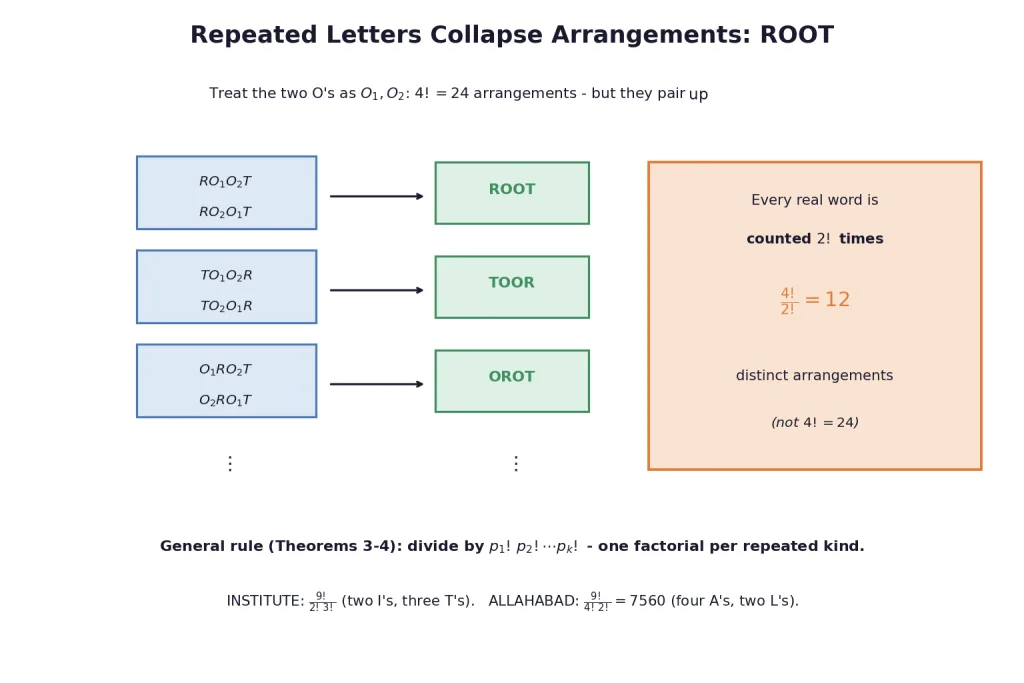
Key Point (Theorems 3-4): The number of permutations of objects where are alike of one kind, alike of a second kind, …, alike of a -th kind (rest all different) is
One factorial in the denominator per repeated kind. INSTITUTE (2 I's, 3 T's): . ALLAHABAD (4 A's, 2 L's): .
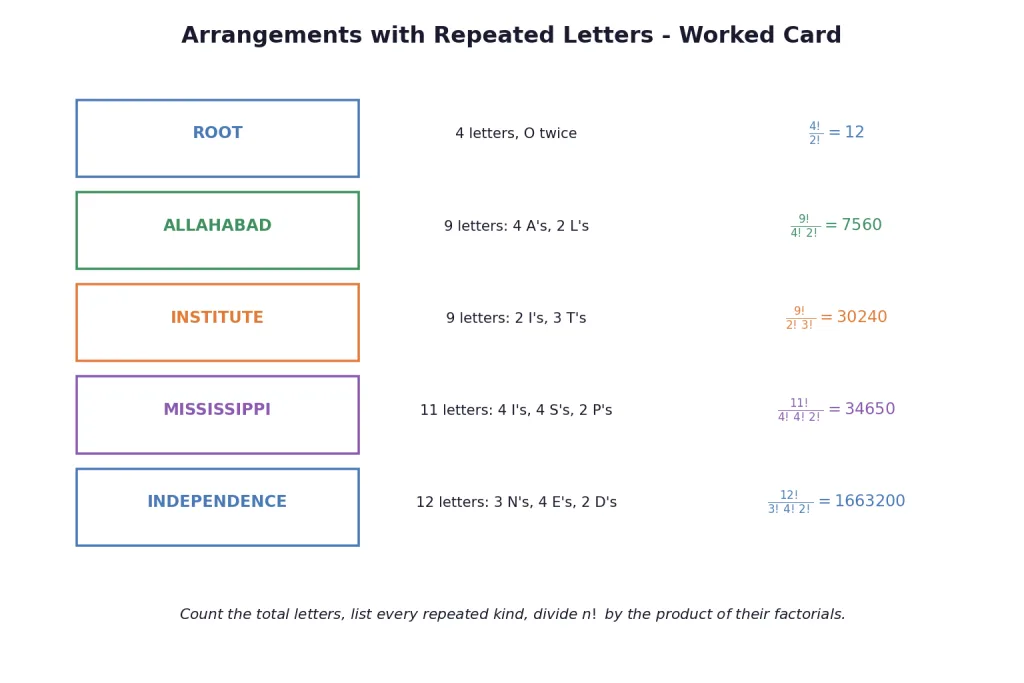
[Board Tip] First write the letter inventory: total count, then each repeated letter with its multiplicity. MISSISSIPPI = 11 letters: 4 I's, 4 S's, 2 P's . The inventory line earns method marks even if arithmetic slips.
Digit-Building and Restrictions
The same machinery drives number-building problems:
- 4-digit numbers from digits 1-9, no repetition: order matters, digits distinct — .
- Numbers between 100 and 1000 from 0-5, no repetition: count all 3-digit strings , then subtract those starting with 0 (really 2-digit numbers): fixing 0 in the hundreds place leaves . Answer: .
Key Point (the zero trap): When 0 is among the digits, strings with a leading 0 are not genuine numbers. Either lock the first place to a nonzero digit, or count all strings and subtract the leading-zero ones.
Restriction problems on words follow fixed patterns:
- Fix a position (words starting with P): place the fixed letter, arrange the rest — INDEPENDENCE starting with P: .
- Vowels together: bundle the vowels into one block, arrange blocks, then arrange within — DAUGHTER: .
- Vowels NOT (all) together: complement — all arrangements minus the together count: .
[JEE Tip] In "never together" problems, be precise about the claim: "not all together" is the complement of one bundle; "no two adjacent" needs the stronger gap method (Section 6). The MISSISSIPPI four-I's problem below means not all four in one block.
Solved Examples
Example 1: ALLAHABAD
Find the number of permutations of the letters of ALLAHABAD.
Solution:
Step 1 — Write the letter inventory. 9 letters — 4 A's, 2 L's, the rest all different.
Step 2 — Apply the repeated-objects formula. — one factorial per repeated kind.
Step 3 — Evaluate. .
Takeaway: The inventory line comes first, always — it dictates the entire denominator.
Example 2: 4-digit numbers
How many 4-digit numbers can be formed using digits 1 to 9, repetition not allowed?
Solution:
Step 1 — Identify the setting. Order matters, all nine digits distinct, no zero to worry about: a straight permutation count.
Step 2 — Apply the formula. .
Takeaway: With no 0 in the digit set, number-building is pure .
Example 3: The zero trap
How many numbers between 100 and 1000 can be formed with digits 0, 1, 2, 3, 4, 5, repetition not allowed?
Solution:
Step 1 — Rephrase the range. Numbers between 100 and 1000 are exactly the 3-digit numbers.
Step 2 — Count all 3-digit strings. .
Step 3 — Subtract the fakes. Strings starting with 0 are really 2-digit numbers: fix 0 first, arrange 2 of the remaining 5: .
Step 4 — Conclude. .
Takeaway: When 0 is in the digit set, either lock the first place to nonzero or count-and-subtract the leading-zero strings.
Example 4: Digit drills
(i) How many 3-digit numbers from digits 1-9, no repetition? (ii) How many 4-digit numbers exist in all (digits 0-9, no repetition)?
Solution:
Step 1 — (i) No zero present. .
Step 2 — (ii) Zero present: lock the first place. First digit nonzero: 9 ways; then 9, 8, 7 remaining digits for the other places.
Step 3 — Multiply. .
Takeaway: The same problem with and without 0 — the leading-place lock is the only difference.
Example 5: 4-digit and even
From digits 1-5 (no repetition): how many 4-digit numbers, and how many of them are even?
Solution:
Step 1 — All 4-digit numbers. .
Step 2 — Even: lock the units place first. Units must be 2 or 4: 2 ways.
Step 3 — Fill the rest. Three places from the remaining four digits: .
Step 4 — Multiply. .
Takeaway: Parity restrictions live in the units place — lock it first, then permute the rest.
Example 6: DAUGHTER vowels
How many 8-letter arrangements of DAUGHTER have (i) all vowels together (ii) vowels not all together?
Solution:
Step 1 — (i) Bundle the vowels. Tie A, U, E into one block; with the 5 consonants that makes 6 objects: arrangements.
Step 2 — Arrange inside the bundle. The three vowels order themselves in ways.
Step 3 — Multiply. .
Step 4 — (ii) Complement. All arrangements minus the together count: .
Takeaway: Bundle for "together"; complement for "not all together".
Example 7: Coloured discs
In how many ways can 4 red, 3 yellow and 2 green discs be arranged in a row (same-colour discs indistinguishable)?
Solution:
Step 1 — Inventory. discs in kinds of sizes 4, 3, 2.
Step 2 — Apply the formula. .
Takeaway: Identical objects of each colour behave exactly like repeated letters.
Example 8: INDEPENDENCE
For the word INDEPENDENCE (12 letters: 3 N's, 4 E's, 2 D's), count the arrangements in which (i) all (ii) words start with P (iii) all vowels occur together (iv) vowels never all together (v) words begin with I and end in P.
Solution:
Step 1 — (i) Total. .
Step 2 — (ii) Fix P at the left. The remaining 11 letters keep their repeats: .
Step 3 — (iii) Bundle the vowels EEEEI. Block + 7 consonants = 8 objects with 3 N's and 2 D's: ; inside the block the vowels arrange in ways. Total .
Step 4 — (iv) Complement. .
Step 5 — (v) Pin both ends. I left, P right; the middle 10 letters: .
Takeaway: One word, five standard restriction patterns — fixing, bundling, complementing and end-pinning all in one drill.
Example 9: EQUATION and MONDAY
(i) How many words use all letters of EQUATION exactly once? (ii) From MONDAY (no repetition): words using 4 letters; all 6 letters; all letters with a vowel first?
Solution:
Step 1 — (i) All distinct. EQUATION has 8 distinct letters: .
Step 2 — (ii) Four at a time. .
Step 3 — All six. .
Step 4 — Vowel first. First place O or A (2 ways), the rest in : .
Takeaway: Distinct-letter words are plain factorials and falling products — the repeats machinery switches off.
Example 10: MISSISSIPPI
In how many distinct permutations of MISSISSIPPI do the four I's NOT come together?
Solution:
Step 1 — Total arrangements. Inventory: 11 letters — 4 I's, 4 S's, 2 P's: .
Step 2 — Count the four-I's-together arrangements. Bundle IIII (internally identical — 1 way); with the 7 other letters that is 8 objects with 4 S's and 2 P's: .
Step 3 — Complement. .
Takeaway: "Not together" for a block of identical letters = total minus one-block count; the identical letters contribute no internal factor.
Example 11: PERMUTATIONS
In how many ways can the letters of PERMUTATIONS be arranged if (i) words start with P and end with S (ii) vowels are all together (iii) there are always 4 letters between P and S?
Solution:
Step 1 — Inventory. 12 letters with T appearing twice.
Step 2 — (i) Pin both ends. P first, S last; the middle 10 letters (2 T's): .
Step 3 — (ii) Bundle the vowels. E, U, A, I, O are all distinct — one block + 7 consonants (2 T's) = 8 units: ; vowels inside: . Total .
Step 4 — (iii) Slide the (P, S) frame. Exactly 4 letters between them means positions for — 7 slots, times 2 for swapping P and S: 14 ways. The other 10 letters fill the rest: .
Step 5 — Multiply. .
Takeaway: Distance conditions become sliding-frame counts: enumerate the frame positions, then permute the rest.