
The Factorial
Products like appear so often in counting that they get their own symbol:
Key Point (Definition): for a natural number , with the convention . Immediately, .
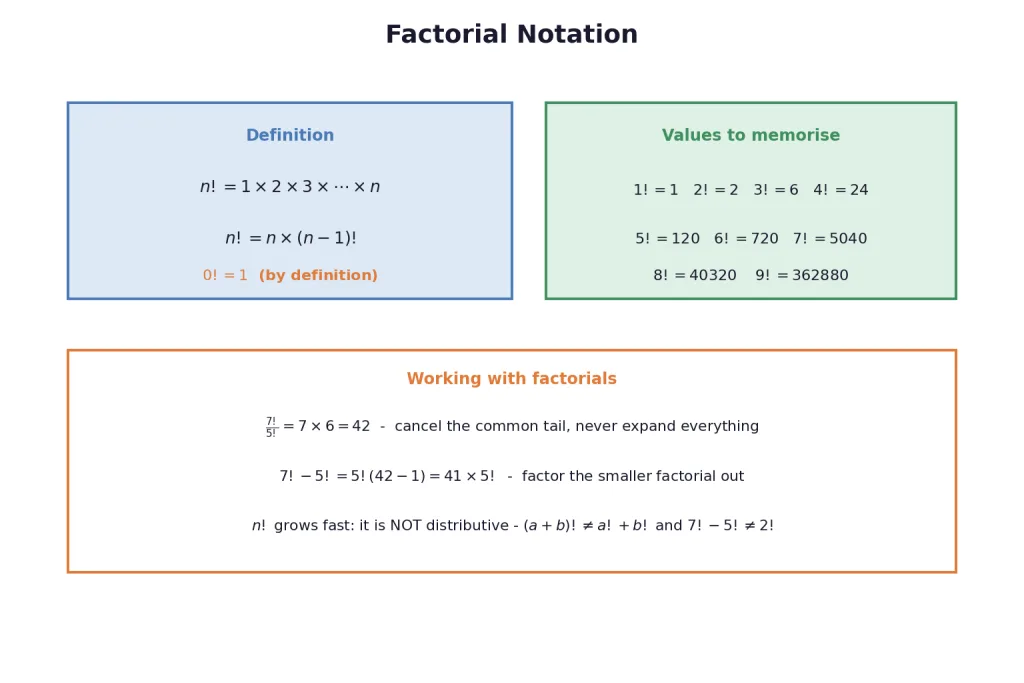
The working skills:
- Cancel tails, never expand: ; .
- Factor out the smaller factorial: .
- Equations with factorials: from , multiply through by : , so .
[Board Tip] (it is , while ) — factorials do not add, multiply or distribute like ordinary powers. Exam setters plant this trap deliberately.
Permutations and the Formula for
A permutation is an arrangement in a definite order of a number of objects taken some or all at a time. The 24 ROSE words are the permutations of 4 different letters taken all at a time.
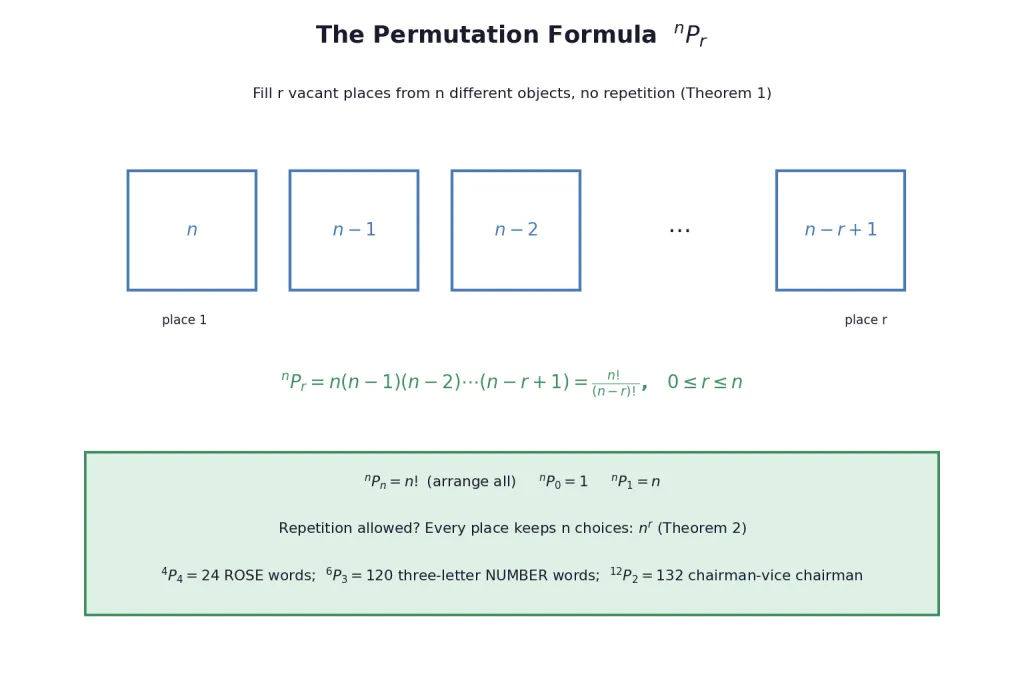
Key Point (Theorems 1-2): The number of permutations of different objects taken at a time is
when repetition is not allowed — and when repetition is allowed.
The derivation is the vacant-places method run in general: the first place has choices, the next , down to for the -th place; multiplying and rewriting the product as a quotient of factorials gives the formula. Special values: , , .
Quick illustrations: 3-letter words from NUMBER (with repetition: ); a Chairman and Vice-Chairman from 12 people — order matters because the posts differ.
[JEE Tip] Equations in reduce to polynomial equations after cancelling common factors — e.g. gives , so . Always discard roots that violate or negativity — the algebra offers them, the counting rejects them.
Solved Examples
Example 1: Evaluate
Evaluate (i) (ii) (iii) .
Solution:
Step 1 — (i) and (ii) by the definition. and .
Step 2 — (iii) Factor out the smaller factorial. .
Step 3 — Evaluate. (or directly ).
Takeaway: Factor the smaller factorial out of sums and differences — never expand both.
Example 2: Compute quotients
Compute (i) (ii) .
Solution:
Step 1 — (i) Cancel the common tail. .
Step 2 — (ii) Cancel, then divide. .
Takeaway: Quotients of factorials are falling products — expansion is never needed.
Example 3: The shape of
Evaluate for , .
Solution:
Step 1 — Substitute. .
Step 2 — Cancel the 3! tail. .
Takeaway: This expression is the combination count — the formula arrives before its name.
Example 4: Factorial equation
If , find .
Solution:
Step 1 — Multiply through by . .
Step 2 — Cancel each quotient. .
Step 3 — Conclude. .
Takeaway: Clearing by the LARGEST factorial turns the equation into simple arithmetic.
Example 5: Same trick again
If , find .
Solution:
Step 1 — Multiply by . .
Step 2 — Evaluate. , so .
Takeaway: The same clearing move works for any such pair of consecutive reciprocals.
Example 6: Evaluate
Evaluate when (i) (ii) .
Solution:
Step 1 — (i) Two falling factors. .
Step 2 — (ii) Five falling factors. .
Takeaway: is a product of exactly r falling factors starting at n — the permutation formula in the making.
Example 7: NUMBER words
How many 3-letter words (with or without meaning) can be formed from the letters of NUMBER (i) without repetition (ii) with repetition?
Solution:
Step 1 — (i) Apply the permutation formula. NUMBER has 6 distinct letters: .
Step 2 — (ii) With repetition every place stays full. .
Takeaway: Same six letters, two settings — the repetition clause switches between and .
Example 8: Two posts
In how many ways can a Chairman and a Vice-Chairman be chosen from 12 persons, no person holding both posts?
Solution:
Step 1 — Recognise that order matters. The posts are DIFFERENT — (A chair, B vice) is not (B chair, A vice).
Step 2 — Apply the formula. .
Step 3 — Contrast. Choosing an unordered pair of equal committee members would be — the permutation-combination divide previewed.
Takeaway: Distinct posts = ordered arrangement; identical roles = unordered selection.
Example 9: Solve for
Find such that (i) , (ii) , .
Solution:
Step 1 — (i) Write both sides as falling products. .
Step 2 — Cancel the common non-zero factors. .
Step 3 — Solve the quadratic. gives : (reject — counts cannot be negative).
Step 4 — (ii) Same strategy. ; cancelling gives , so , .
Takeaway: Cancel the shared falling factors first; the leftover equation is tiny. Discard roots the counting context forbids.
Example 10: Solve for
Find if .
Solution:
Step 1 — Write in factorial form. .
Step 2 — Expand the larger denominator. , so the equation collapses to .
Step 3 — Solve. gives or .
Step 4 — Domain check. The symbols need and : only survives.
Takeaway: The algebra offers extra roots; the symbol domains () reject them.
Example 11: A ratio
Find if .
Solution:
Step 1 — Relate the two symbols. .
Step 2 — Form the ratio. .
Step 3 — Conclude. .
Takeaway: Spotting the one-factor relationship makes this a one-liner.
Example 12: Two little equations
Find if (i) (ii) .
Solution:
Step 1 — (i) Factorial form and collapse. ; with : .
Step 2 — Solve and check. gives or ; domain keeps .
Step 3 — (ii) Same route. gives : or ; domain keeps .
Takeaway: Both parts ride the same expansion — set it up once, reuse it.