
Counting Without Listing
How many outfits can Mohan make from 3 pants and 2 shirts? You could list all six — or notice the structure: 3 ways to pick a pant, and for every such choice, 2 ways to pick a shirt. So , no listing needed.
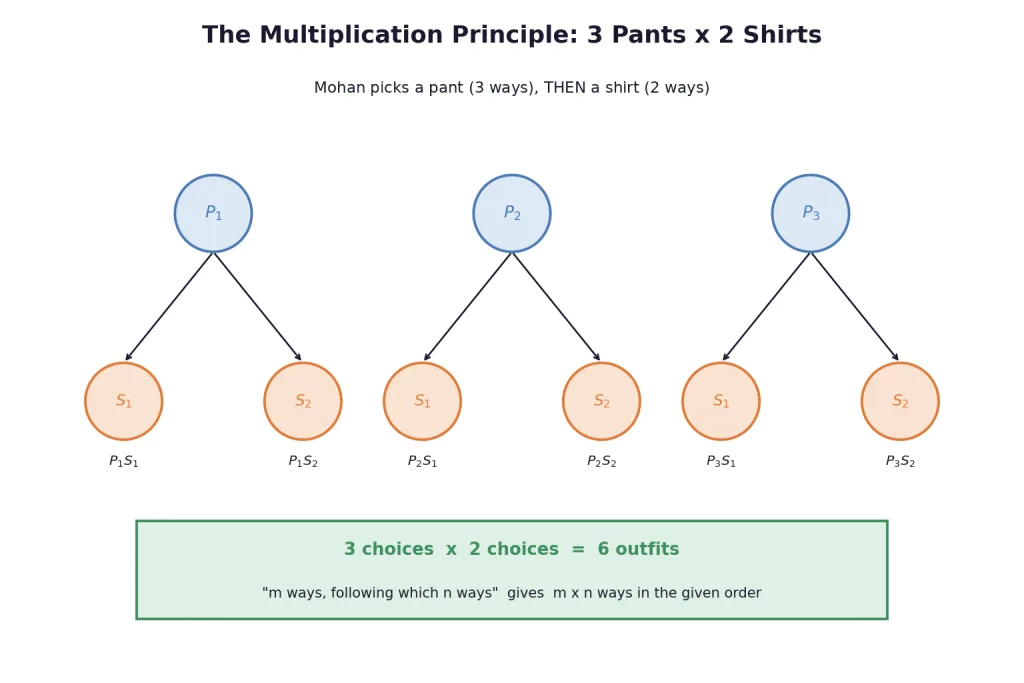
Key Point (Fundamental Principle of Counting): "If an event can occur in different ways, following which another event can occur in different ways, then the total number of occurrence of the events in the given order is ." Also called the multiplication principle.
The principle chains to any number of events. Sabnam's 2 school bags, 3 tiffin boxes and 2 water bottles give ways of carrying one of each:
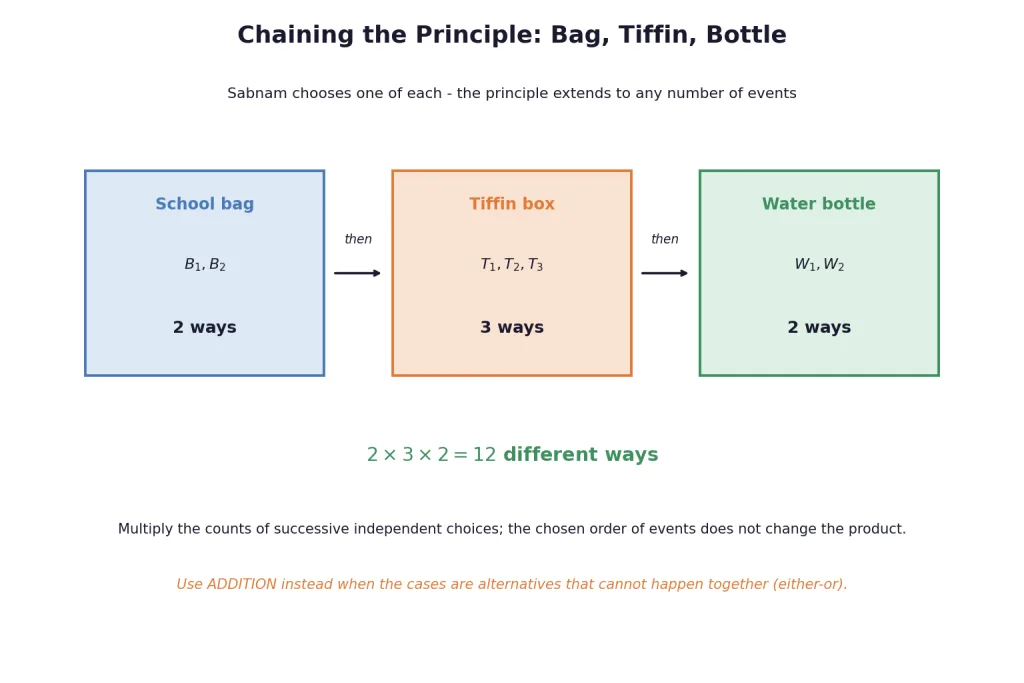
Multiply or add? Multiply when choices happen in succession (this AND then that). Add when the possibilities are alternatives that cannot happen together (this OR that) — as in the flag-signal problem, where a signal uses 2 or 3 or 4 or 5 flags and the four separate counts add up.
The Vacant-Places Method
Most counting problems in this chapter are solved by one picture: draw a box for each position, write in how many choices remain for that box, and multiply.
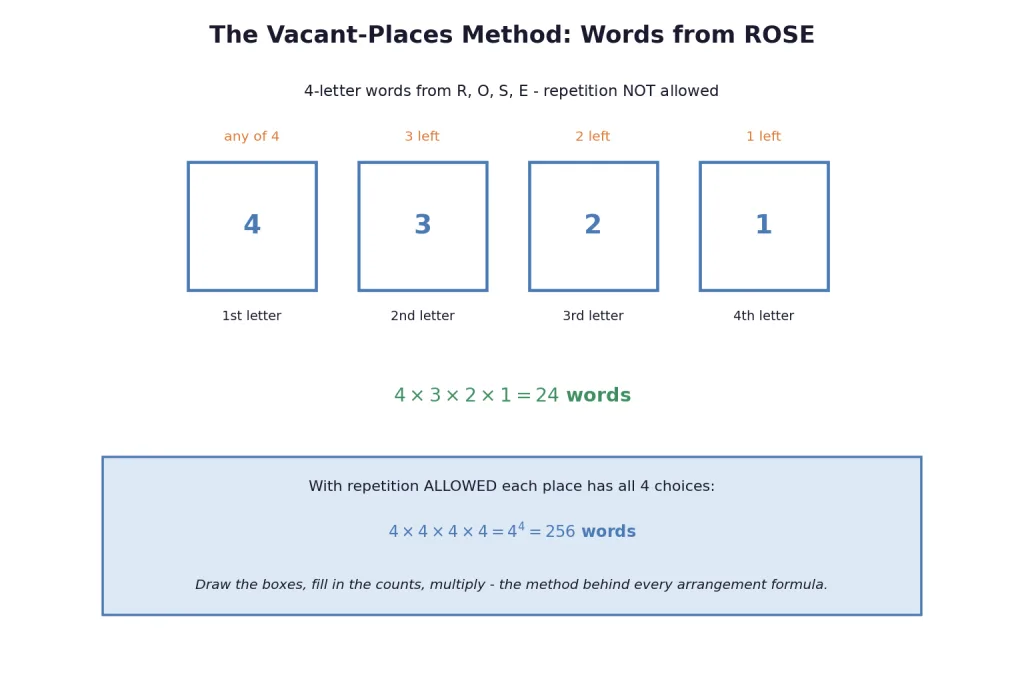
Model problem: 4-letter words from ROSE with no repetition — the first place has 4 choices, then 3, then 2, then 1: words. With repetition allowed, every place keeps all 4 choices: .
Key Point: Fill the most restricted place first. For 2-digit even numbers from 1-5 with repetition, start at the units place — only 2 or 4 work (2 ways) — then the tens place takes any of the 5 digits: numbers.
[Board Tip] Read the repetition clause twice. "No digit repeated" shrinks the choices box by box (); "digits can be repeated" keeps every box full. Half the errors in this topic are repetition misreads.
[JEE Tip] When a restriction involves a specific position (last digit even, first letter a vowel, number starts with 67), lock those positions first and count the free positions afterwards — the multiplication principle does not care in which order you fill the boxes, only that you fix one order and count consistently.
Solved Examples
Example 1: Two-flag signals
Given 4 flags of different colours, how many signals can be generated if a signal requires 2 flags, one below the other?
Solution:
Step 1 — Fill the upper place. Any of the 4 flags: 4 ways.
Step 2 — Fill the lower place. Any of the remaining 3 flags: 3 ways.
Step 3 — Multiply. signals — order matters: red over blue is a different signal from blue over red.
Takeaway: Successive choices multiply; the ordering of positions is what makes this a signal count, not a selection count.
Example 2: Even numbers with repetition
How many 2-digit even numbers can be formed from 1, 2, 3, 4, 5 if digits can be repeated?
Solution:
Step 1 — Fill the most restricted place first. Units must be even: 2 or 4 — 2 ways.
Step 2 — Fill the tens place. Repetition allowed, so any of the 5 digits: 5 ways.
Step 3 — Multiply. numbers.
Takeaway: Lock the restricted position first; the free positions follow.
Example 3: Add the alternatives
Five different flags are available. How many signals can be generated by arranging at least 2 flags in order on a vertical staff?
Solution:
Step 1 — Split into mutually exclusive cases. A signal uses exactly 2, 3, 4 or 5 flags — no overlap between cases.
Step 2 — Count each case by the multiplication principle. 2 flags: ; 3 flags: ; 4 flags: ; 5 flags: .
Step 3 — Add across cases. signals.
Takeaway: Multiply WITHIN a case (successive choices), add ACROSS cases (alternatives).
Example 4: Repetition on vs off
How many 3-digit numbers can be formed from 1, 2, 3, 4, 5 if (i) repetition is allowed (ii) repetition is not allowed?
Solution:
Step 1 — (i) Repetition allowed. Every place keeps all 5 choices: .
Step 2 — (ii) Repetition off. Choices shrink place by place: .
Takeaway: The repetition clause decides whether the boxes stay full or shrink — read it twice.
Example 5: Even with repetition, six digits
How many 3-digit even numbers can be formed from 1, 2, 3, 4, 5, 6 if digits can be repeated?
Solution:
Step 1 — Units place first. Even digits available: 2, 4, 6 — 3 ways.
Step 2 — Free places. Tens and hundreds each take any of the 6 digits: .
Step 3 — Multiply. .
Takeaway: With repetition on, only the restricted place differs from a free place.
Example 6: Letter codes
How many 4-letter codes can be formed using the first 10 letters of the English alphabet, if no letter repeats?
Solution:
Step 1 — Set up the vacant places. Four boxes with shrinking choices: .
Step 2 — Multiply. codes.
Takeaway: A no-repetition code count is a falling product — the start of a factorial.
Example 7: Telephone numbers
How many 5-digit telephone numbers can be constructed using digits 0-9 if each number starts with 67 and no digit appears more than once?
Solution:
Step 1 — Lock the fixed positions. The first two places are 6, 7 — both now used up.
Step 2 — Count the free places. Three places choose from the 8 unused digits: .
Step 3 — Multiply. numbers.
Takeaway: Locked positions consume their digits — subtract them from the pool before counting the free places.
Example 8: Tosses and flags
(i) A coin is tossed 3 times; how many outcome sequences are possible? (ii) With 5 flags of different colours, how many 2-flag signals (one below the other) exist?
Solution:
Step 1 — (i) Chain the tosses. Each toss has 2 outcomes and repetition is inherent: sequences.
Step 2 — (ii) Fill the two flag places. Upper flag 5 ways, lower flag 4 ways: signals.
Takeaway: Independent repeatable stages give powers; distinct-object stages give falling products.