
How to Use This Section
Thirty fully worked examples sweep the whole chapter — counting-principle drills, selection-then-arrangement problems, repeated-letter words, digit-building with conditions, committees with constraints, and the full range of miscellaneous-level problems — dictionary ranks, geometry counts and all-or-none constraints — solved in full.
[Board Tip] Before every solution, write one line: order matters / order does not matter, and repetition allowed / not allowed. Those two decisions choose the formula; everything after is arithmetic. Attempt each example yourself before reading on.
Selection Followed by Arrangement
Example 1: INVOLUTE words
How many words of 3 vowels and 2 consonants can be formed from the letters of INVOLUTE?
Solution:
Step 1 — Inventory. INVOLUTE has 4 vowels (I, O, U, E) and 4 consonants (N, V, L, T), all distinct.
Step 2 — Select the letters. letter-sets.
Step 3 — Arrange each set. Five distinct letters: .
Step 4 — Multiply. words.
Takeaway: Select with C, then arrange with a factorial — Theorem 5 working forwards.
Example 2: DAUGHTER words
How many words of 2 vowels and 3 consonants can be formed from the letters of DAUGHTER?
Solution:
Step 1 — Inventory. Vowels A, U, E (3); consonants D, G, H, T, R (5).
Step 2 — Select. letter-sets.
Step 3 — Arrange. per set; total .
Takeaway: Same two-phase pattern; only the inventory changes.
Example 3: Alphabet words
How many words with 2 different vowels and 2 different consonants can be formed from the English alphabet (5 vowels, 21 consonants)?
Solution:
Step 1 — Select. .
Step 2 — Arrange the 4 chosen letters. .
Step 3 — Multiply. .
Takeaway: The pools scale up but the recipe is unchanged — select per pool, then arrange the union.
Example 4: EQUATION in blocks
In how many ways can the letters of EQUATION be arranged so that all vowels occur together and all consonants occur together?
Solution:
Step 1 — Form the two blocks. Vowels E, U, A, I, O (5 distinct); consonants Q, T, N (3 distinct).
Step 2 — Arrange the blocks. Two blocks in a row: ways.
Step 3 — Arrange within each block. Vowels: ; consonants: .
Step 4 — Multiply. .
Takeaway: Double-bundling: blocks arrange among themselves AND within themselves.
Example 5: Part-wise question selection
A paper has 12 questions: 5 in Part I and 7 in Part II. A student attempts 8 questions, at least 3 from each part. In how many ways?
Solution:
Step 1 — List the legal compositions. (Part I, Part II) totals of 8 with each at least 3 and at most the stock: .
Step 2 — Count each composition. : ; : ; : .
Step 3 — Add across cases. .
Takeaway: At-least conditions on two pools: enumerate compositions, multiply within, add across.
Example 6: Exam-choice drill
A student must answer 4 of 6 questions in Section A and 3 of 5 in Section B. In how many ways can the questions be chosen?
Solution:
Step 1 — Select per section. and .
Step 2 — Multiply. .
Takeaway: Fixed per-section quotas need no case split — one product finishes it.
Committees and At-Least Conditions
Example 7: Girls-and-boys teams
A group has 4 girls and 7 boys. In how many ways can a 5-member team be selected with (i) no girl (ii) at least one boy and one girl (iii) at least 3 girls?
Solution:
Step 1 — (i) No girl. All five from the 7 boys: .
Step 2 — (ii) List the mixed compositions. (boys, girls) = : .
Step 3 — (iii) At least 3 girls. Only 4 girls exist, so the cases are (3 girls, 2 boys) and (4 girls, 1 boy): .
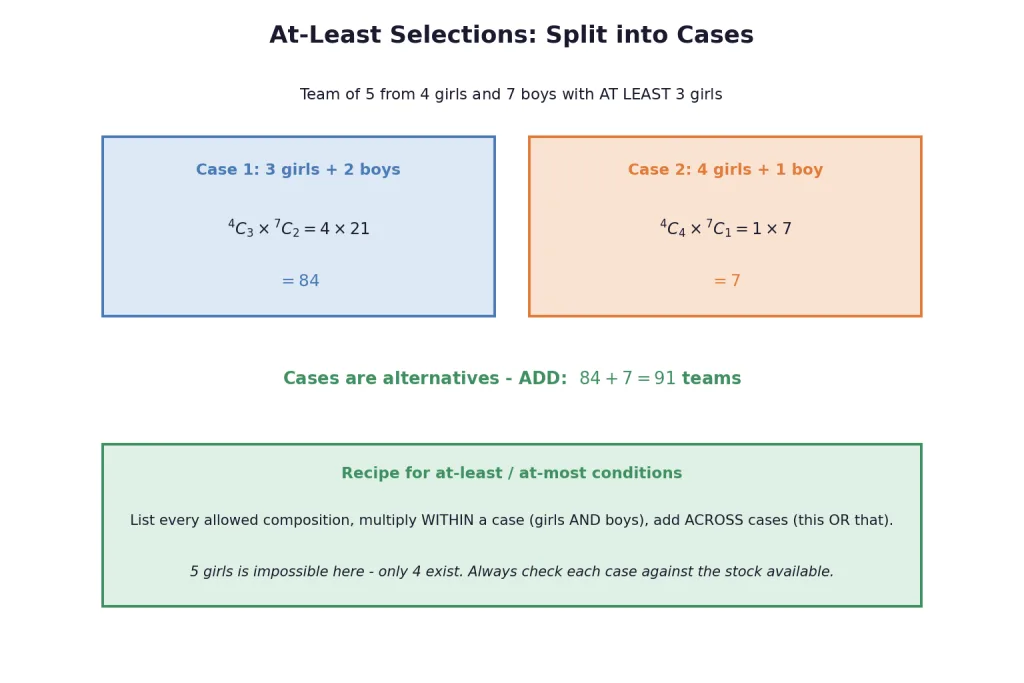
Takeaway: Check each case against the stock available — 5 girls is impossible with only 4 in the group.
Example 8: Committee of 7
From 9 boys and 4 girls, a committee of 7 is formed. Count the ways with (i) exactly 3 girls (ii) at least 3 girls (iii) at most 3 girls.
Solution:
Step 1 — (i) Exactly 3 girls. .
Step 2 — (ii) At least 3. Exactly 3 or exactly 4: .
Step 3 — (iii) At most 3. Complement of exactly-4: .
Takeaway: "At least" and "at most" partition around "exactly" — pick whichever side needs fewer cases.
Example 9: At least 2 women
From 6 men and 4 women, how many committees of 5 have at least 2 women?
Solution:
Step 1 — List the cases. Women 2, 3 or 4.
Step 2 — Count each. 2: ; 3: ; 4: .
Step 3 — Add. .
Takeaway: Three clean cases beat one error-prone complement here — choose the shorter route each time.
Example 10: All or none
From a class of 25 students, 10 are chosen for an excursion. Three students decide that either all of them join or none. In how many ways can the party be chosen?
Solution:
Step 1 — Case: all three join. Choose the remaining 7 from the other 22: .
Step 2 — Case: none joins. All 10 from the same 22: .
Step 3 — Add the alternatives. .
Takeaway: A joint constraint on a clique collapses to two cases — in together or out together.
Example 11: Bowling squad variant
From 15 players including 5 bowlers, how many teams of 11 contain at least 4 bowlers?
Solution:
Step 1 — Case: exactly 4 bowlers. .
Step 2 — Case: all 5 bowlers. .
Step 3 — Add. .
Takeaway: With only 5 bowlers in stock, "at least 4" is just two cases.
Example 12: Exactly one king
How many 5-card combinations from 52 cards contain exactly one king?
Solution:
Step 1 — Choose the king. .
Step 2 — Choose the rest from non-kings. .
Step 3 — Multiply. .
Takeaway: "Exactly one" always splits the pool into the special four and the remaining 48.
Arrangements with Restrictions
Example 13: No two boys together
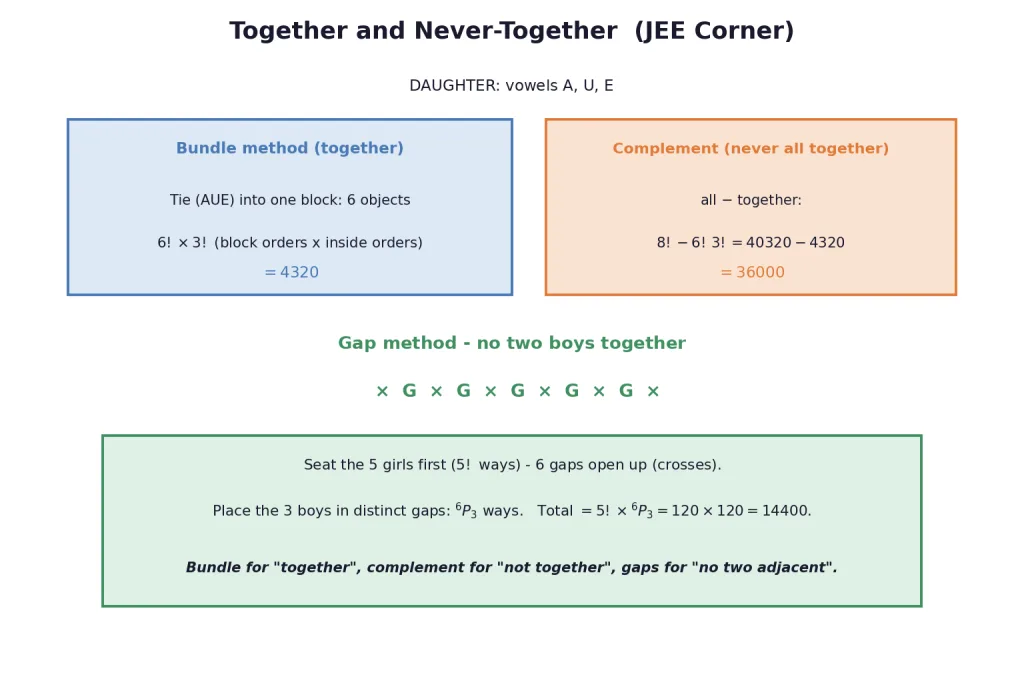
In how many ways can 5 girls and 3 boys be seated in a row so that no two boys are together?
Solution:
Step 1 — Seat the unrestricted group first. The 5 girls arrange in ways, opening 6 gaps: .
Step 2 — Place the boys in distinct gaps. Choose and order 3 of the 6 gaps: .
Step 3 — Multiply. .
Takeaway: "No two adjacent" is the gap method — one boy per gap makes adjacency impossible by construction.
Example 14: Women in even places
Seat 5 men and 4 women in a row so that the women occupy the even places.
Solution:
Step 1 — Identify the even places. Nine seats have four even positions (2, 4, 6, 8) — exactly enough for the 4 women.
Step 2 — Seat each group. Women in the even seats: ; men in the five odd seats: .
Step 3 — Multiply. .
Takeaway: Position-class restrictions split the seating into two independent arrangements.
Example 15: ASSASSINATION
In how many ways can the letters of ASSASSINATION be arranged so that all the S's are together?
Solution:
Step 1 — Inventory. 13 letters — 3 A's, 4 S's, 2 I's, 2 N's, plus T and O.
Step 2 — Glue the S's. SSSS becomes one block: units, still carrying 3 A's, 2 I's, 2 N's.
Step 3 — Arrange the units. — the S's are identical, so the block has NO internal factor.
Takeaway: Bundling identical letters adds no internal arrangements — the repeats live in the outer count only.
Example 16: TRIANGLE vowels apart
How many arrangements of TRIANGLE (8 distinct letters, vowels I, A, E) have the vowels NOT all together?
Solution:
Step 1 — Total. .
Step 2 — Vowels together. Bundle (IAE): .
Step 3 — Complement. .
Takeaway: "Not all together" = total − one-bundle count, every time.
Example 17: ALGEBRA with vowels together
How many arrangements of ALGEBRA have all vowels together?
Solution:
Step 1 — Inventory. Vowels A, E, A (two A's); consonants L, G, B, R.
Step 2 — Bundle and arrange the units. Block + 4 consonants = 5 distinct units: .
Step 3 — Arrange inside the block. (the two A's are identical).
Step 4 — Multiply. . (For contrast, all arrangements: .)
Takeaway: Repeats inside the bundle divide the internal factor, exactly as they would anywhere else.
Example 18: DELHI pinned ends
How many arrangements of DELHI (i) in all (ii) start with D and end with I?
Solution:
Step 1 — (i) All distinct. .
Step 2 — (ii) Pin the ends. D first and I last leaves the middle three letters free: .
Takeaway: Every pinned letter simply drops out of the factorial.
Digit-Building Problems
Example 19: Greater than 1000000
How many numbers greater than 1000000 can be formed using the digits 1, 2, 0, 2, 4, 2, 4?
Solution:
Step 1 — Translate the condition. All seven digits are used, so every number is 7-digit; "greater than 1000000" just forbids a leading 0.
Step 2 — Count all 7-digit strings. Three 2's and two 4's: .
Step 3 — Subtract the leading-zero strings. Fix 0 first; the rest arrange in ways.
Step 4 — Conclude. .
Takeaway: The zero trap coexists happily with repeated digits — the divide-by-repeats applies to both counts.
Example 20: Divisible by 10
How many 6-digit numbers, divisible by 10 and with no digit repeated, can be formed from 0, 1, 3, 5, 7, 9?
Solution:
Step 1 — Translate divisibility. Divisible by 10 forces the units digit to be 0.
Step 2 — Arrange the rest. The other five digits fill five places freely: .
Takeaway: Locking 0 in the units place also kills the leading-zero worry in one stroke.
Example 21: Divisible by 5, distinct digits
How many 4-digit numbers with all distinct digits (0-9) are divisible by 5?
Solution:
Step 1 — Case: units 0. The first three places take .
Step 2 — Case: units 5. The leading digit avoids 0 and 5 (8 ways), then : .
Step 3 — Add the cases. .
Takeaway: Units-5 needs its own leading-zero care — the two cases are NOT symmetric.
Example 22: All-odd digits
How many 3-digit numbers have all digits odd and distinct?
Solution:
Step 1 — Identify the pool. Odd digits: 1, 3, 5, 7, 9 — five of them, no zero issues.
Step 2 — Permute. .
Takeaway: A zero-free pool reduces digit-building to a plain permutation.
Example 23: COMBINE words
From the letters of COMBINE (7 distinct): (i) how many 4-letter words? (ii) how many of them start with C?
Solution:
Step 1 — (i) Free count. .
Step 2 — (ii) Pin C first. Three more letters from the remaining six: .
Takeaway: Pinning one letter converts into — one factor shorter.
Geometry Counts and Dictionary Order
Example 24: Diagonals of a polygon
How many diagonals does a polygon with 10 sides have?
Solution:
Step 1 — Count all vertex pairs. segments.
Step 2 — Remove the sides. 10 of those pairs are adjacent vertices — the polygon's sides.
Step 3 — Subtract. diagonals.
Takeaway: Diagonals = pairs − sides; in general .
Example 25: Triangles with collinear points
From 12 points in a plane of which 5 are collinear, how many triangles can be drawn?
Solution:
Step 1 — Count all triples. .
Step 2 — Remove degenerate triples. Any 3 of the 5 collinear points fail to form a triangle: .
Step 3 — Subtract. triangles.
Takeaway: Collinear points cost exactly their own — nothing more.
Example 26: Parallelogram grid
A set of 4 parallel lines is intersected by another set of 3 parallel lines. How many parallelograms are formed?
Solution:
Step 1 — A parallelogram needs two lines from each family. Choose them: and .
Step 2 — Multiply. parallelograms.
Takeaway: Grid-figure counts are products of per-family pair choices.
Example 27: Handshake equation
At a party every pair of the guests shakes hands once, making 45 handshakes. Find .
Solution:
Step 1 — Model. Handshakes are unordered pairs: .
Step 2 — Solve. gives : .
Takeaway: equal to a product of consecutive integers reads off the answer directly.
Example 28: The 50th word of AGAIN
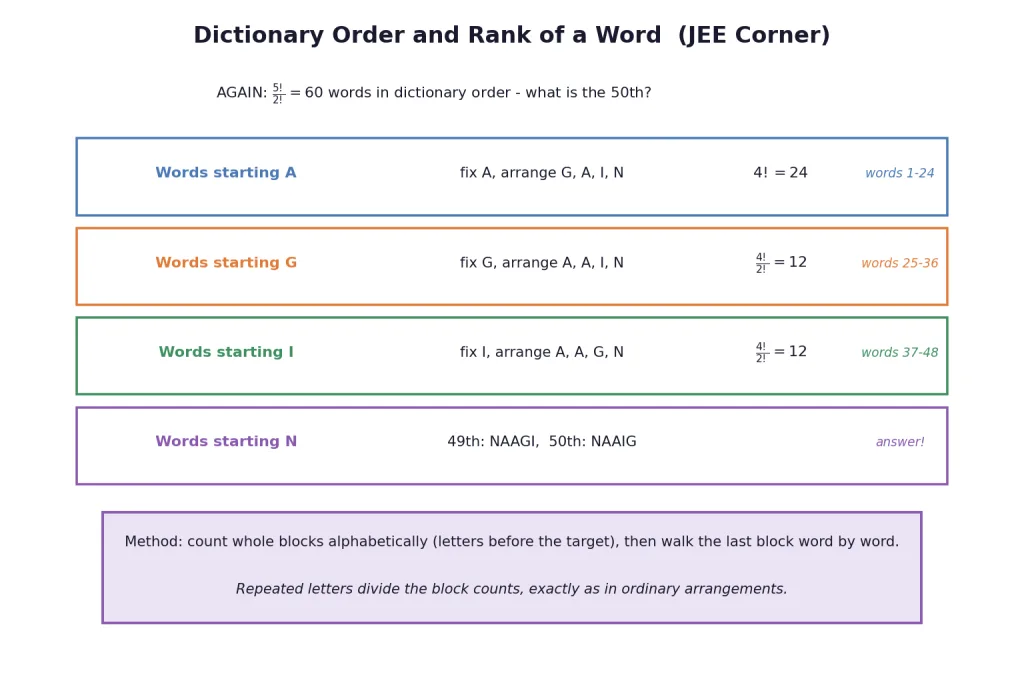
AGAIN has arrangements. Written in dictionary order, what is the 50th word?
Solution:
Step 1 — Count the A-block. Fix A; arrange G, A, I, N (all distinct now): words — ranks 1-24.
Step 2 — Count the G- and I-blocks. Fixing G leaves A, A, I, N: (ranks 25-36); fixing I likewise 12 (ranks 37-48).
Step 3 — Walk into the N-block. Rank 49 is the alphabetically first N-word: NAAGI; rank 50 is the next: NAAIG.
Takeaway: Count whole alphabetical blocks until the target rank falls inside one, then walk word by word.
Example 29: Before the first E
If all permutations of EXAMINATION are listed as in a dictionary, how many words come before the first word starting with E?
Solution:
Step 1 — Inventory and alphabet check. EXAMINATION: 11 letters — 2 A's, 2 I's, 2 N's; among its letters only A precedes E alphabetically.
Step 2 — Count the A-block. Fix one A; the remaining 10 letters (E, X, M, I, N, A, T, I, O, N) carry 2 I's and 2 N's: .
Step 3 — Conclude. All of these precede every E-word: 907200.
Takeaway: Fixing a letter REMOVES one copy from the inventory — recount the repeats before dividing.
Example 30: Equality-rule drill
If , find .
Solution:
Step 1 — Equality rule. , so .
Step 2 — Evaluate. .
Takeaway: The same two-step as every equality-rule problem — find n, then compute.