
What JEE Adds
The textbook chapter gives you the four formulas — the counting principle, , repeated-letter division and . JEE Main tests those plus a small toolkit of standard moves: circular arrangements, the bundle-gap-complement trio for adjacency restrictions, dictionary rank, any-size selections (), and case-split at-least/at-most counts. Every one of them is a two-line extension of what you already know — and every one appears in past papers year after year.
Key Point: JEE counting problems are rarely hard; they are precise. The mark is lost in reading — "at least" vs "exactly", "not all together" vs "no two together", "numbers" vs "strings with leading zeros". Slow down on the sentence, not the arithmetic.
Circular Permutations
Around a round table, rotating everyone one seat produces the same seating — only relative order matters. Fix one person as an anchor and arrange the remaining linearly:
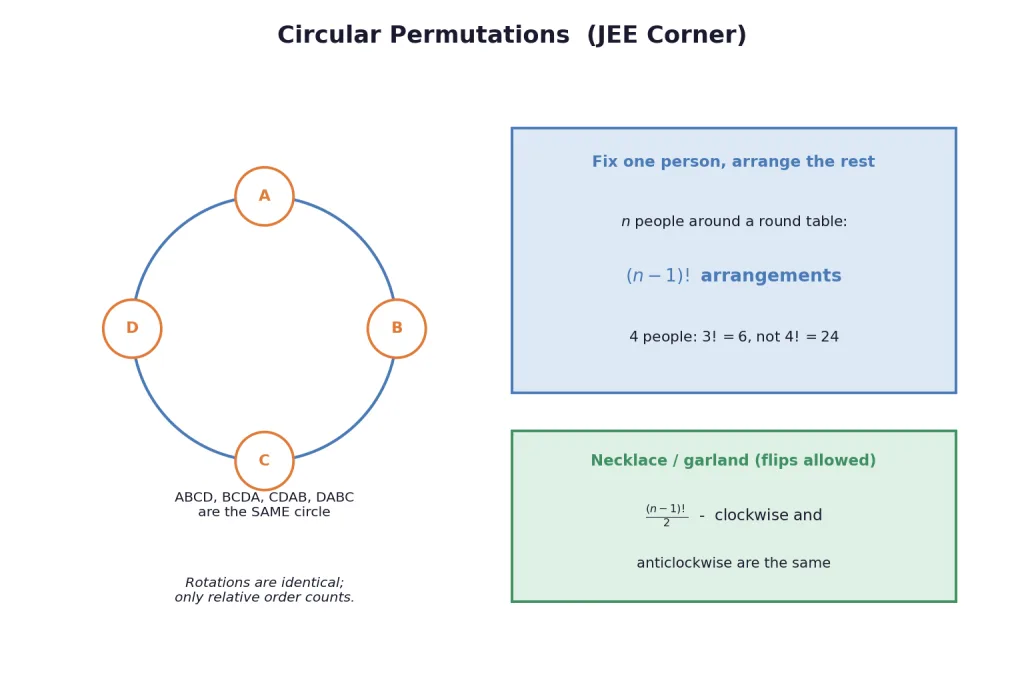
Key Point: distinct objects in a circle: arrangements. If clockwise and anticlockwise are indistinguishable (necklaces, garlands): .
Standard variants:
- 5 people at a round table: .
- Garland of 6 different flowers: .
- Couple must sit together at a round table of 6: bundle the couple — 5 units in a circle: , times inside: .
- 4 men and 4 women alternating at a round table: seat the men circularly (), then the women in the 4 gaps between them (): .
[JEE Tip] Circular formulas apply to unnumbered seats. If the chairs are numbered (or one seat is special), rotations become distinguishable and the count returns to plain .
Bundle, Gap, Complement — and Rank
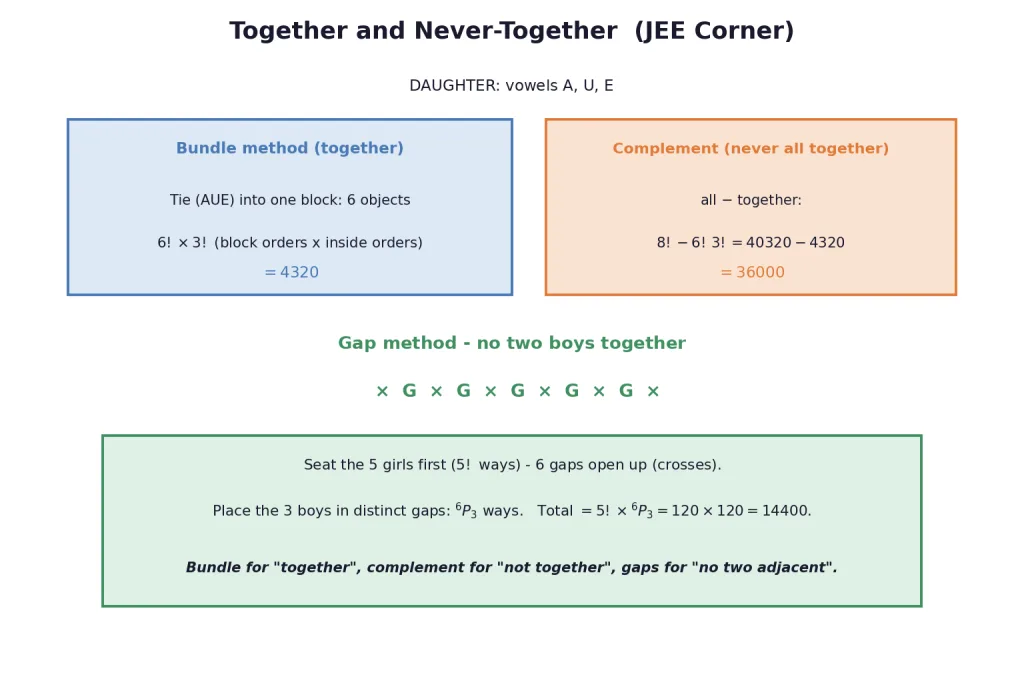
The three adjacency moves, in one line each:
- Together (bundle): glue the group into one unit; multiply by internal arrangements. DAUGHTER vowels together: .
- Not all together (complement): total minus together: .
- No two adjacent (gaps): arrange the free objects, then place the restricted ones in the gaps. 5 girls, 3 boys, no two boys adjacent: . Gaps are the only correct tool here — the complement of "all together" is weaker.
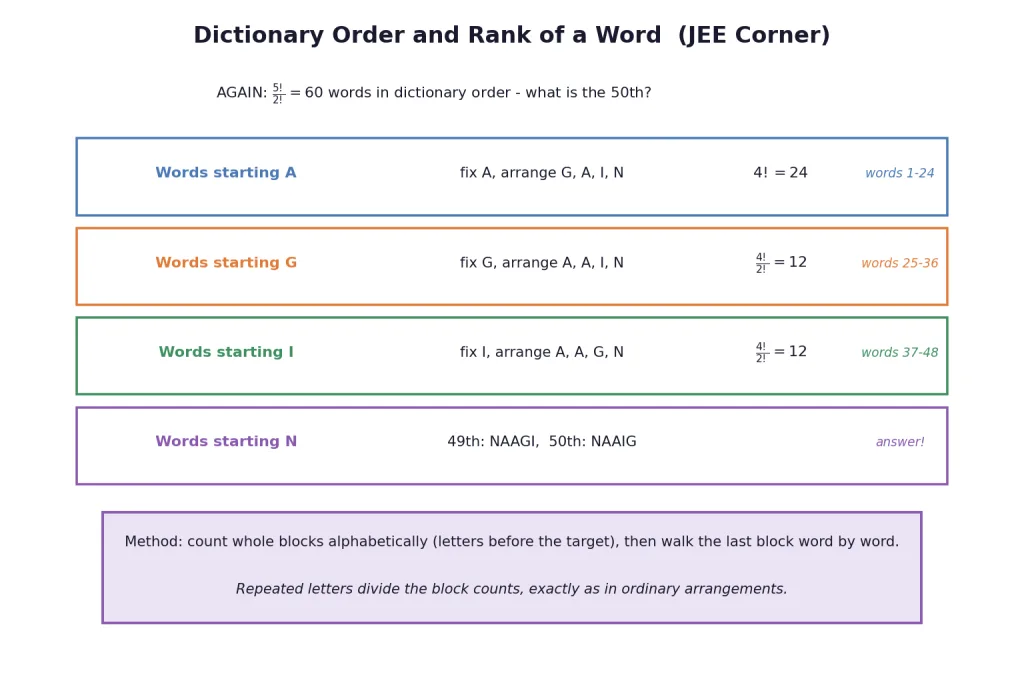
Dictionary rank: to find the position of a word among all arrangements of its letters listed alphabetically, count the complete blocks that precede it — words starting with an earlier letter, then within the block, words with an earlier second letter, and so on.
Any-size selections: each of distinct objects is either in or out — subsets, if at least one object must be chosen. For "at least one" questions on identical objects or with conditions, complement counting (all minus none) is almost always the shortest route.
[JEE Tip] — the selection-of-any-size identity — reappears as a binomial identity next chapter. Quote it, don't re-derive it.
Solved Examples
Example 1: Round table basics
In how many ways can 5 friends sit around a circular table?
Solution:
Step 1 — Break the rotation symmetry. Around an unmarked round table, rotating everyone one seat gives the same seating. Fix one friend as an anchor.
Step 2 — Arrange the rest linearly. The remaining 4 friends fill the seats relative to the anchor: .
Takeaway: Circle of distinct people = — anchor one, arrange the rest.
Example 2: Garland
How many different garlands can be made from 6 different flowers?
Solution:
Step 1 — Circular count. As a circle: .
Step 2 — Kill the flip. A garland looks the same turned over, so clockwise and anticlockwise versions coincide: divide by 2.
Step 3 — Compute. garlands.
Takeaway: Necklaces and garlands are circles that can flip: .
Example 3: Couple together, round table
In how many ways can 6 people sit at a round table if two particular people must sit together?
Solution:
Step 1 — Bundle the pair. Glue the two into one unit — now 5 units sit in a circle: .
Step 2 — Open the bundle. The pair swaps internally: .
Step 3 — Multiply. seatings.
Takeaway: The bundle method works in circles too — just apply to the reduced unit count.
Example 4: Alternating men and women
In how many ways can 4 men and 4 women sit alternately around a round table?
Solution:
Step 1 — Seat one group circularly. The 4 men around the table: .
Step 2 — Fill the gaps. The men create exactly 4 gaps between them; the 4 women fill them linearly (the anchor is already fixed): .
Step 3 — Multiply. .
Takeaway: No extra factor of 2 — swapping "men's seats" and "women's seats" is just a rotation of the same seating.
Example 5: Circle vs numbered chairs
Eight delegates sit (i) around an unmarked round table (ii) on 8 numbered chairs in a circle. Count the seatings.
Solution:
Step 1 — (i) Unmarked table. Rotations are identical, so anchor one delegate: .
Step 2 — (ii) Numbered chairs. Chair numbers make every rotation a different assignment — the symmetry is gone: .
Step 3 — Check the ratio. ✓ — each circular seating splits into 8 distinguishable rotations.
Takeaway: belongs to unnumbered seats only; numbering any seat restores .
Example 6: No two alike adjacent — gaps with repeats
In how many arrangements of the word MISSISSIPPI do no two I's appear together?
Solution:
Step 1 — Arrange the non-I letters. M, four S's and two P's: .
Step 2 — Count the gaps. Seven letters in a row create 8 gaps (including both ends).
Step 3 — Place the identical I's. Choose 4 of the 8 gaps — combinations, because the I's are identical: .
Step 4 — Multiply. . (For contrast, the weaker condition "the four I's are not all together" gives 33810 — a different question.)
Takeaway: Gap method with identical movers uses , not — ordering identical letters would overcount.
Example 7: Rank of a word
Find the rank of the word RACE among all arrangements of its letters in dictionary order.
Solution:
Step 1 — Alphabetise the letters. A, C, E, R.
Step 2 — Count whole blocks before the R-block. Words starting with A, C or E: .
Step 3 — Locate RACE inside the R-block. After R, the smallest completion is A-C-E — which is exactly RACE, the first R-word.
Step 4 — Add. Rank .
Takeaway: Rank = (words strictly before it) + 1 — never forget the final +1.
Example 8: Rank with repeated letters
Find the rank of AGAIN in the dictionary listing of its own arrangements.
Solution:
Step 1 — Alphabetise. Letters A, A, G, I, N — first letters available: A, G, I, N.
Step 2 — Words before the A-G block. AGAIN starts A-G. Earlier second letters: only A (from A-A…): arrange the remaining G, I, N freely: words.
Step 3 — Inside the A-G block. Third letter of AGAIN is A — the smallest available; A-G-A words arrange I, N: AGAIN then AGANI. AGAIN is the very first.
Step 4 — Add. Rank .
Takeaway: With repeated letters, count remaining stock carefully at each position — the two A's are identical.
Example 9: Any-size selections
A shop stocks 8 different books. In how many ways can a customer buy at least one book?
Solution:
Step 1 — In-or-out per book. Each of the 8 distinct books is independently bought or not: subsets.
Step 2 — Exclude the empty purchase. "At least one" removes exactly one subset: .
Takeaway: Distinct objects, any size: ; at least one: .
Example 10: At least one of each type — complement
From 5 different maths and 4 different physics books, how many selections contain at least one book of each subject?
Solution:
Step 1 — Nonempty choice per subject. Maths: ; physics: .
Step 2 — Multiply the independent choices. .
Step 3 — Why not ? That count () allows all-maths or all-physics selections, which break the "one of each" condition.
Takeaway: Apply the nonempty correction per pool, then multiply.
Example 11: At least one ace
How many 5-card hands from 52 cards contain at least one ace?
Solution:
Step 1 — Complement. "At least one ace" = all hands − hands with no ace.
Step 2 — Count both. All: ; ace-free (choose from 48 non-aces): .
Step 3 — Subtract. .
Takeaway: Never compute "at least one" by cases when the complement is a single subtraction. (And is wrong — it counts multi-ace hands more than once.)
Example 12: Exactly vs at least — the contrast
From 6 men and 5 women, count committees of 4 with (i) exactly 2 women (ii) at least 2 women.
Solution:
Step 1 — (i) Exactly 2 women. .
Step 2 — (ii) Add the higher cases. Women : ; women : .
Step 3 — Total. .
Takeaway: "At least " = sum of the "exactly" cases from up to the stock limit.
Example 13: Total selections from mixed identical objects
A basket has 4 identical apples and 3 identical oranges. How many non-empty selections of fruit are possible?
Solution:
Step 1 — Identical objects are chosen by count only. Apples: take 0, 1, 2, 3 or 4 — that is ways. Oranges: ways.
Step 2 — Multiply and remove the empty case. .
Takeaway: Identical stock contributes options per type — the formula is for distinct objects only.
Example 14: Sum of all numbers formed
Find the sum of all 4-digit numbers formed using digits 1, 2, 3, 4 exactly once each.
Solution:
Step 1 — Count appearances per place. There are numbers; by symmetry each digit occupies each place times.
Step 2 — Sum one place. Column total: in each of units, tens, hundreds, thousands.
Step 3 — Assemble by place value. .
Takeaway: The digit-sum trick: (appearances per place) × (digit sum) × ().
Example 15: Choosing with a forbidden pair
From 10 people including A and B, how many committees of 4 contain neither A nor B together — i.e. A and B are never BOTH on the committee?
Solution:
Step 1 — Complement. Count committees with BOTH A and B: fix them, choose 2 more from the other 8: .
Step 2 — Subtract from the total. .
Step 3 — Sanity check by cases. Neither: ; exactly one of A, B: ; ✓.
Takeaway: A forbidden pairing is one clean complement — and a case count confirms it in ten seconds.