
The Geometric Mean
Key Point (Definition): The geometric mean of two positive numbers and is — the number that makes a G.P. The G.M. of 2 and 8 is 4, and indeed has constant ratio 2.
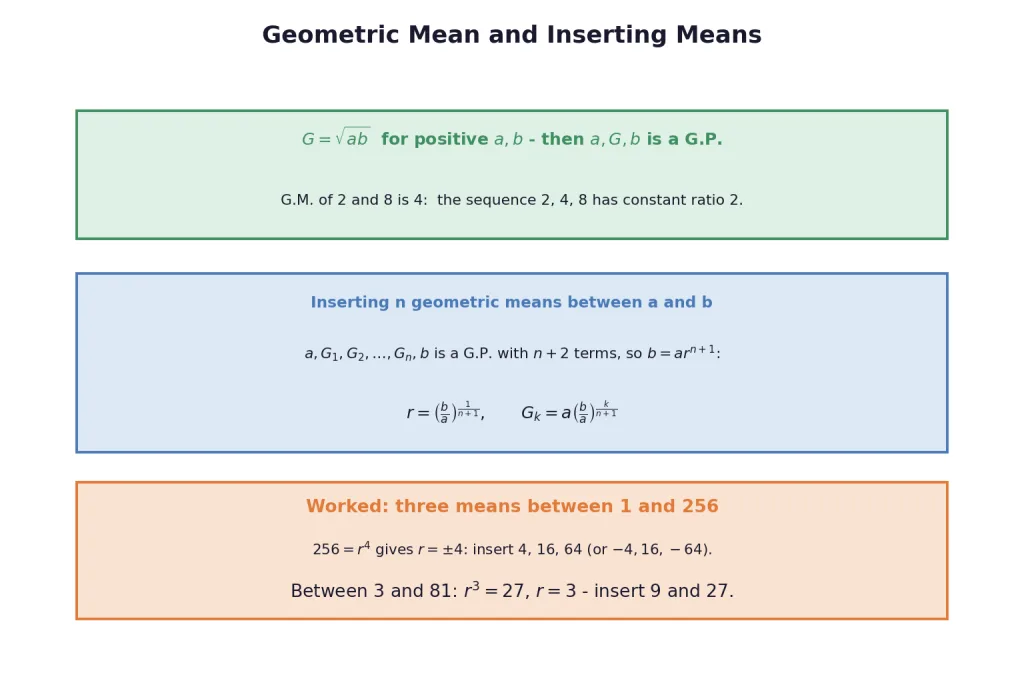
Inserting geometric means: to place between positive and so that is a G.P., note is the -th term, so :
For example: three means between 1 and 256 need , so — insert (or ). Likewise, two means between 3 and 81 need : insert 9 and 27.
[Board Tip] Count carefully: inserting means makes terms, so the exponent on is — the most common slip in these problems.
A.M. ≥ G.M.
Let and for positive reals . Then
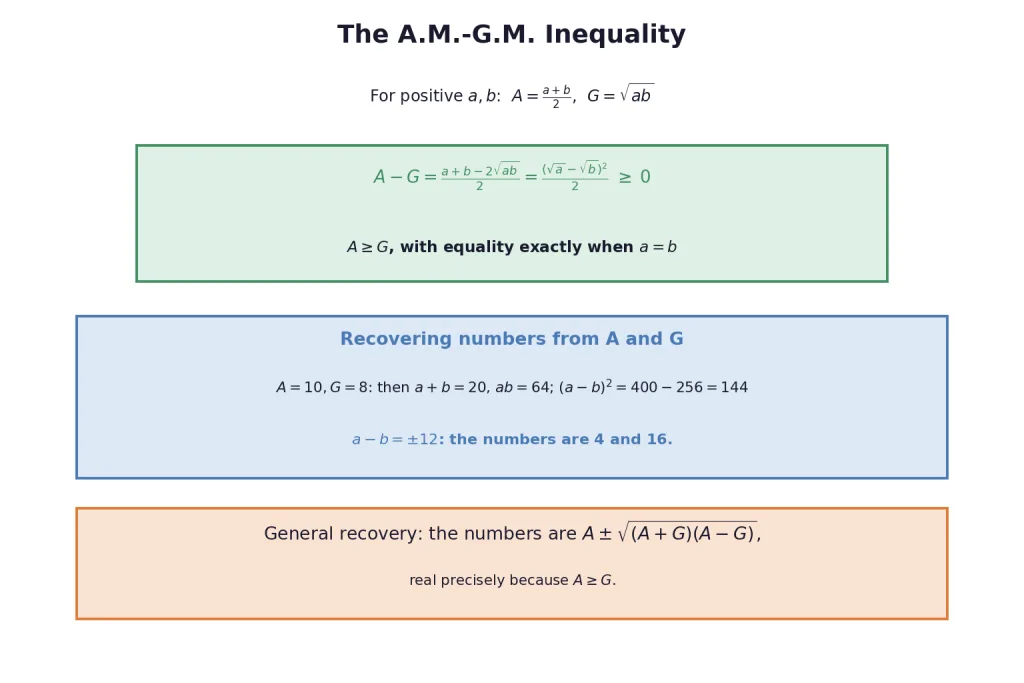
Key Point: always, with equality exactly when — the square vanishes only then.
Recovering the numbers from and : give and . Then , so : the numbers are 4 and 16.
The general recovery — the numbers are — is real precisely because .
[JEE Tip] The identity is the bridge from (sum, product) to the pair itself — the same bridge used for quadratic roots. A.M./G.M. of the roots of are and ; given A.M. 8 and G.M. 5, the equation is .
Solved Examples
Example 1: Insert three means
Insert three numbers between 1 and 256 so that the resulting sequence is a G.P.
Solution:
Step 1 — Count the terms. Three insertions make 5 terms, so 256 is the 5th: .
Step 2 — Solve for . gives .
Step 3 — Write the means. For : , , . For : .
Step 4 — Check. has constant ratio 4 ✓.
Takeaway: An even power of always admits both signs — report both G.P.s unless positivity is demanded.
Example 2: Insert two means
Insert two numbers between 3 and 81 so that the resulting sequence is a G.P.
Solution:
Step 1 — Count. Two insertions make 4 terms: .
Step 2 — Solve. gives (odd power — one real root).
Step 3 — Write the means. and : the G.P. is ✓.
Takeaway: Odd exponent → a single ratio; the sign ambiguity of Example 1 disappears.
Example 3: Numbers from A.M. and G.M.
If the A.M. and G.M. of two positive numbers are 10 and 8, find the numbers.
Solution:
Step 1 — Convert to sum and product. ; .
Step 2 — Bridge to the difference. , so .
Step 3 — Solve the pair. , : , .
Step 4 — Check. A.M. ✓; G.M. ✓.
Takeaway: is the bridge from (sum, product) to the numbers themselves.
Example 4: The G.M. of two specific numbers
Find the geometric mean of (i) 4 and 9 (ii) and 8.
Solution:
Step 1 — (i). .
Step 2 — (ii). .
Takeaway: The G.M. tames mismatched sizes — a half and an 8 average (geometrically) to 2.
Example 5: Quadratic from A.M. and G.M.
The A.M. and G.M. of the roots of a quadratic are 8 and 5. Find the equation.
Solution:
Step 1 — Convert. Sum of roots ; product .
Step 2 — Assemble. : .
Takeaway: A.M. and G.M. are just disguised sum and product — quadratics follow immediately.
Example 6: An exponent from the G.M.
Find so that is the geometric mean of and .
Solution:
Step 1 — Set the equation. ; cross-multiply:
Step 2 — Group and factor. .
Step 3 — Cancel and conclude. For : , forcing : .
Takeaway: Collect the powers of on one side and on the other — a ratio-equals-1 equation kills the exponent.
Example 7: Ratio from a sum condition
The sum of two numbers is 6 times their geometric mean. Show the numbers are in the ratio .
Solution:
Step 1 — Normalise by the G.M. ; divide by and set : .
Step 2 — Solve the quadratic in . gives .
Step 3 — Convert back to the ratio. ; with , note , so
— exactly the stated ratio. ∎
Takeaway: The substitution converts symmetric sum-G.M. conditions into one quadratic.
Example 8: Ratio of A.M. to G.M.
If the ratio of the A.M. and G.M. of two positive numbers is , show .
Solution:
Step 1 — Set up. . With : .
Step 2 — Solve. gives (taking ).
Step 3 — Form the ratio. The other root is and the two roots multiply to 1, so . ∎
Takeaway: The same -substitution generalises Example 7 — with it reproduces it exactly.
Example 9: Equality case of A.M.-G.M.
For which positive pairs does hold?
Solution:
Step 1 — Use the identity. .
Step 2 — Set it to zero. A square vanishes only when its base does: .
Step 3 — Conclude. Exactly the pairs with .
Takeaway: The equality case is as important as the inequality — optimisation arguments hinge on it.
Example 10: A quick A.M.-G.M. application
Show that for any positive , .
Solution:
Step 1 — Choose the pair. Apply to , .
Step 2 — Compute the G.M. — the product is engineered to be constant.
Step 3 — Conclude. , so , with equality at .
Takeaway: A.M.-G.M. gives minimum-value results whenever a product stays constant — a JEE staple.