
Numbers in a Definite Order
How many ancestors do you have over 300 years? With a 30-year generation gap, the generations contribute people — numbers arranged in a definite order according to a rule. That is a sequence. The successive quotients of — — form another.
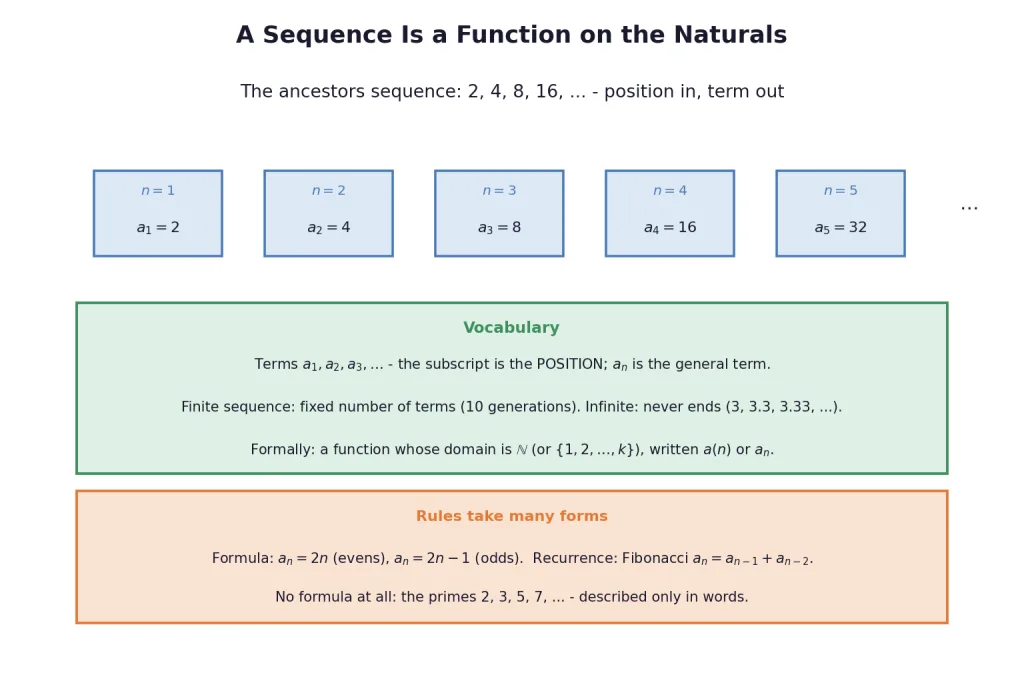
Key Point: The numbers in a sequence are its terms, written — the subscript records the position. The -th term is the general term. A sequence with a fixed number of terms is finite (the 10 generations); otherwise it is infinite (the quotients never end).
Formally, a sequence is a function whose domain is (or a subset ) — sometimes written for . Position in, term out.
[Board Tip] "Write the first three terms of " means substitute : the terms are . Substitution IS the method — no cleverness needed.
Three Kinds of Rules — and Series
A sequence's rule can be:
- A formula: even naturals ; odd naturals .
- A recurrence — each term built from earlier ones. The Fibonacci sequence: and for , giving
- A verbal description only: the primes — no formula for the -th prime exists.
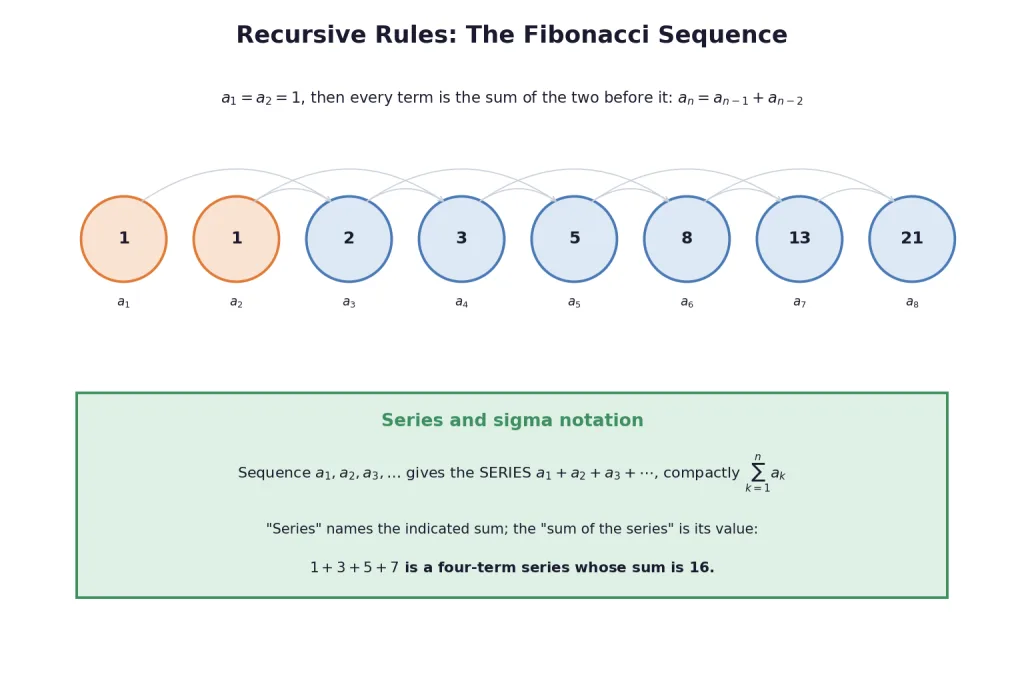
Key Point (Series): From a sequence , the expression is the associated series, compactly in sigma notation. The word "series" names the indicated sum; the "sum of the series" is its value — is a four-term series whose sum is 16.
[JEE Tip] Recursive definitions must be unrolled in order — to get of , , compute first (), then . There is no shortcut without solving the recurrence.
Solved Examples
Example 1: Terms by substitution
Write the first three terms of (i) (ii) .
Solution:
Step 1 — (i) Substitute . , , .
Step 2 — (ii) Substitute again. , , .
Takeaway: A formula rule needs nothing but substitution — position in, term out.
Example 2: A distant term
What is the 20th term of the sequence ?
Solution:
Step 1 — Substitute into each factor. , , .
Step 2 — Multiply. ; .
Takeaway: The middle factor is negative for every — expect negative distant terms.
Example 3: Recurrence and its series
The sequence is defined by , for . Find the first five terms and write the corresponding series.
Solution:
Step 1 — Unroll the recurrence in order. , , , .
Step 2 — Recognise the pattern. These are the odd numbers: .
Step 3 — Write the series.
Takeaway: "Add 2 each time" from 1 generates exactly the odd numbers — recurrence and formula describe one sequence.
Example 4: Formula drills
Write the first five terms of (i) (ii) .
Solution:
Step 1 — (i) Substitute to . .
Step 2 — (ii) Powers of 2. .
Takeaway: Writing a couple of factored forms before multiplying keeps the arithmetic honest.
Example 5: Alternating signs
Write the first five terms of .
Solution:
Step 1 — Read the two factors. controls the sign (positive at ); controls the size.
Step 2 — Substitute. , , , , .
Takeaway: A factor alternates signs starting positive; would start negative.
Example 6: Indicated terms
Find (i) and for (ii) for (iii) for (iv) for .
Solution:
Step 1 — (i). ; .
Step 2 — (ii). .
Step 3 — (iii). makes : .
Step 4 — (iv). .
Takeaway: Every part is one substitution — the only care point is evaluating the sign factor correctly.
Example 7: Recurrences unrolled
Write the first five terms of (i) , (ii) , .
Solution:
Step 1 — (i) Unroll in order. , , , . Series:
Step 2 — (ii) Divide by the index each time. , , , .
Step 3 — Spot the pattern in (ii). The denominators are : .
Takeaway: Recurrences have no shortcut — each term needs the one before it, computed in order.
Example 8: Fibonacci ratios
For the Fibonacci sequence, find for .
Solution:
Step 1 — List the terms. .
Step 2 — Form the successive ratios. , , , , .
Takeaway: The ratios oscillate and settle toward the golden ratio — a preview of limits.