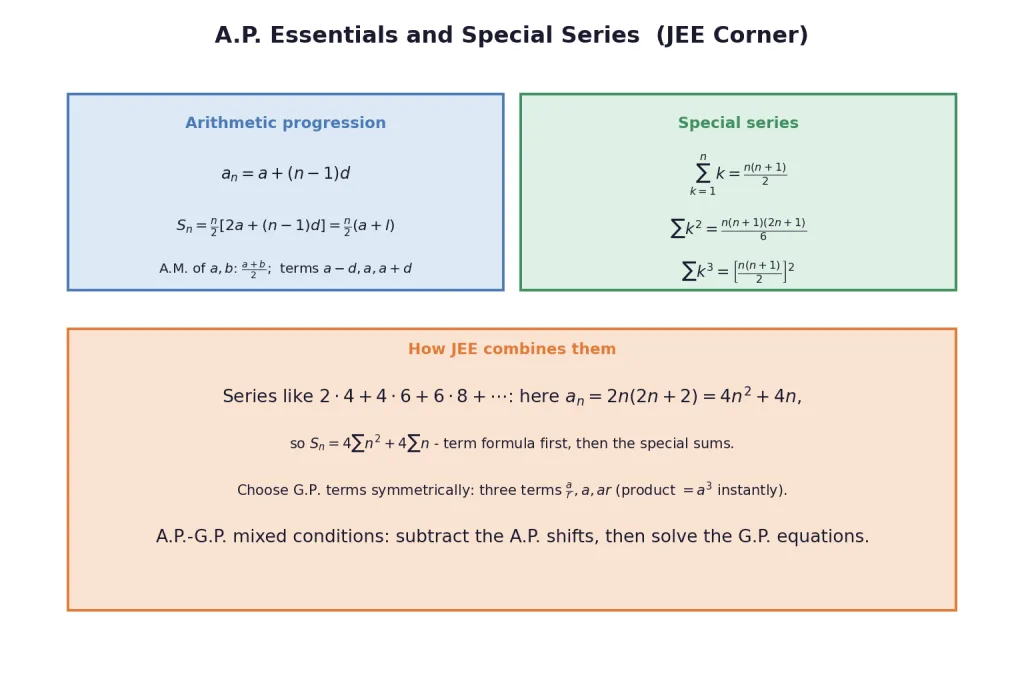
[JEE Tip] For series like 2⋅4+4⋅6+6⋅8+⋯, first write the n-th term — an=2n(2n+2)=4n2+4n — then sum with the special series. Term formula first, sums second, always.
The Infinite G.P.
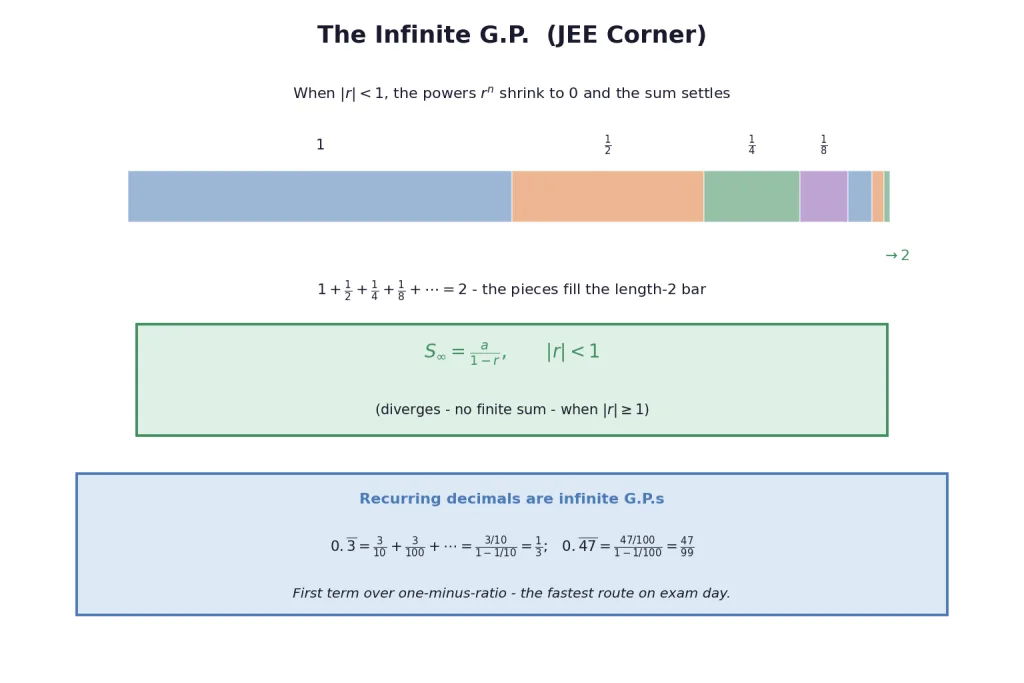
When ∣r∣<1 the powers rn→0, and the sum of the whole infinite series settles to a finite value:
Key Point (Sum to infinity):
S∞=1−ra,∣r∣<1
— no finite sum exists when ∣r∣≥1. The picture: 1+21+41+⋯=2, the halves filling a length-2 bar.
Recurring decimals are infinite G.P.s: 0.3=103+1003+⋯=1−1/103/10=31, and 0.47=1−1/10047/100=9947.
Choosing terms symmetrically: three G.P. terms as ra,a,ar (product a3); four terms with given product as r3a,ra,ar,ar3. Three A.P. terms as a−d,a,a+d (sum 3a).
A.M.-G.M. as an optimiser: for a fixed sum a+b=s, the product ab≤(2s)2 is maximised when a=b — the equality case of A≥G turned into a tool.
[JEE Tip] "The sum of an infinite G.P. is S and its first term is a" instantly gives r=1−Sa — one line, no algebra. Check ∣r∣<1 at the end.
Solved Examples
Example 1: A.P. basics
Find the 10th term and the sum of the first 20 terms of the A.P. 2,7,12,…
Solution:
Step 1 — Identify.a=2, d=5.
Step 2 — Term.a10=a+9d=2+45=47.
Step 3 — Sum.S20=220[2(2)+19(5)]=10×99=990.
Takeaway: Two formulas, two substitutions — A.P. basics should cost under a minute.
Example 2: Inserting arithmetic means
Insert three arithmetic means between 3 and 19.
Solution:
Step 1 — Count the steps. Three means make 5 terms, so 4 steps: d=419−3=4.
Step 2 — Write the means.7,11,15.
Step 3 — Check.3,7,11,15,19 climbs by 4 throughout ✓.
Takeaway:n means → divide the gap by n+1 — same counting rule as geometric insertion.
Example 3: Infinite G.P. — direct
Evaluate 1+31+91+271+⋯
Solution:
Step 1 — Identify.a=1, r=31, and ∣r∣<1 so the infinite sum exists.
Step 2 — Apply S∞=1−ra.1−311=23.
Takeaway: Check ∣r∣<1 before quoting S∞ — the formula is meaningless otherwise.
Example 4: Infinite G.P. — solve for r
An infinite G.P. has first term 8 and sum 32. Find the common ratio.
Solution:
Step 1 — Set up.1−r8=32.
Step 2 — Solve.1−r=328=41: r=43.
Step 3 — Validate.43<1 ✓ — the G.P. genuinely converges.
Takeaway:r=1−Sa in one line — then confirm the convergence condition.
Example 5: Recurring decimals
Express (i) 0.3 (ii) 0.47 as fractions using infinite G.P.s.
Solution:
Step 1 — (i) Write the G.P.0.3=103+1003+⋯: a=103, r=101.
Step 2 — Sum.1−1/103/10=9/103/10=31.
Step 3 — (ii) Two-digit block.a=10047, r=1001: 99/10047/100=9947.
Takeaway: Repeating block over 99…9 (one 9 per digit) — the G.P. derivation proves the school rule.
Example 6: Special series — direct sums
Evaluate (i) 1+2+⋯+100 (ii) 12+22+⋯+102 (iii) 13+23+⋯+53.
Solution:
Step 1 — (i).2100×101=5050.
Step 2 — (ii).610×11×21=62310=385.
Step 3 — (iii).[25×6]2=152=225.
Takeaway: The cube sum is the square of the first-power sum — memorise all three as one family.
Example 7: Term formula then sum
Find the 20th term of the series 2×4+4×6+6×8+⋯
Solution:
Step 1 — Write the general term. Factors are 2n and 2n+2: an=2n(2n+2)=4n2+4n.
Step 2 — Substitute.a20=40×42=1680.
Takeaway: ALWAYS write an first — every later question about the series flows from it.
Example 8: The same series, summed
Find Sn for 2×4+4×6+6×8+⋯
Solution:
Step 1 — Split via the special series.Sn=4∑k2+4∑k=64n(n+1)(2n+1)+24n(n+1).
Step 2 — Factor the common part.=32n(n+1)[(2n+1)+3]=32n(n+1)(2n+4).
Step 3 — Simplify and check.Sn=34n(n+1)(n+2); at n=1: 34⋅2⋅3=8=2×4 ✓.
Takeaway: Factor out n(n+1) before expanding — the bracket then collapses in one line.
Example 9: A standard product series
Sum 1⋅2+2⋅3+3⋅4+⋯ to n terms.
Solution:
Step 1 — General term.ak=k(k+1)=k2+k.
Step 2 — Apply the special series.Sn=6n(n+1)(2n+1)+2n(n+1).