
How to Use This Section
Thirty fully worked examples sweep the whole chapter — general-term and which-term drills, G.P.s pinned down by two conditions, sum computations forwards and backwards, the sum-with-product classics, repdigit series, growth applications from bacteria to chain letters, G.M. insertions, A.M.-G.M. recoveries, and the classic proof-style questions — instalment plans, the S-P-R identity and the dwindling workforce — solved in full.
[Board Tip] For any three-term G.P. problem, choose the terms — the product collapses to instantly. For four terms use (ratio ) when the product is given. The symmetric choice is half the solution.
Terms and Conditions
Example 1: Fractional G.P.
Find the 20th and -th terms of the G.P.
Solution:
Step 1 — Identify. , .
Step 2 — General term. .
Step 3 — Evaluate. .
Takeaway: Fold the first term's denominator into the power — is cleaner than the raw formula.
Example 2: Three terms in G.P. within a G.P.
The 5th, 8th and 11th terms of a G.P. are . Show .
Solution:
Step 1 — Write the three terms. , , .
Step 2 — Multiply the outer pair. .
Step 3 — Compare with the middle. . ∎
Takeaway: Equally spaced terms of a G.P. are themselves in G.P. — the spacing (3 here) only changes the new ratio.
Example 3: Square condition
The 4th term of a G.P. is the square of its 2nd term and the first term is . Determine the 7th term.
Solution:
Step 1 — Translate. .
Step 2 — Cancel. Divide by (non-zero): .
Step 3 — Compute. .
Takeaway: is positive — the lone leading carries the final sign.
Example 4: Which term
(i) Which term of is 729? (ii) Which term of is ?
Solution:
Step 1 — (i) Base-3 exponents. , : . Set : .
Step 2 — (ii) Matching reciprocals. : .
Takeaway: Everything to one base, then equate exponents — surd ratios just produce half-integer exponents.
Example 5: Equal spacing again
If the 4th, 10th and 16th terms of a G.P. are , prove are in G.P.
Solution:
Step 1 — Write the terms. , , .
Step 2 — Form both ratios. and .
Step 3 — Conclude. Equal ratios: is a G.P. with common ratio . ∎
Takeaway: The gap (6 positions) becomes the exponent of the derived ratio — same principle as Example 2.
Example 6: Four numbers
Find four numbers in G.P. whose third term is greater than the first by 9, and whose second term is greater than the fourth by 18.
Solution:
Step 1 — Translate both conditions. and , i.e. and .
Step 2 — Divide. , so .
Step 3 — Back-substitute. gives .
Step 4 — Write and check. : third exceeds first by ✓; second exceeds fourth by ✓.
Takeaway: Dividing paired conditions cancels the shared factor — the sign of the quotient carries the answer.
Sums
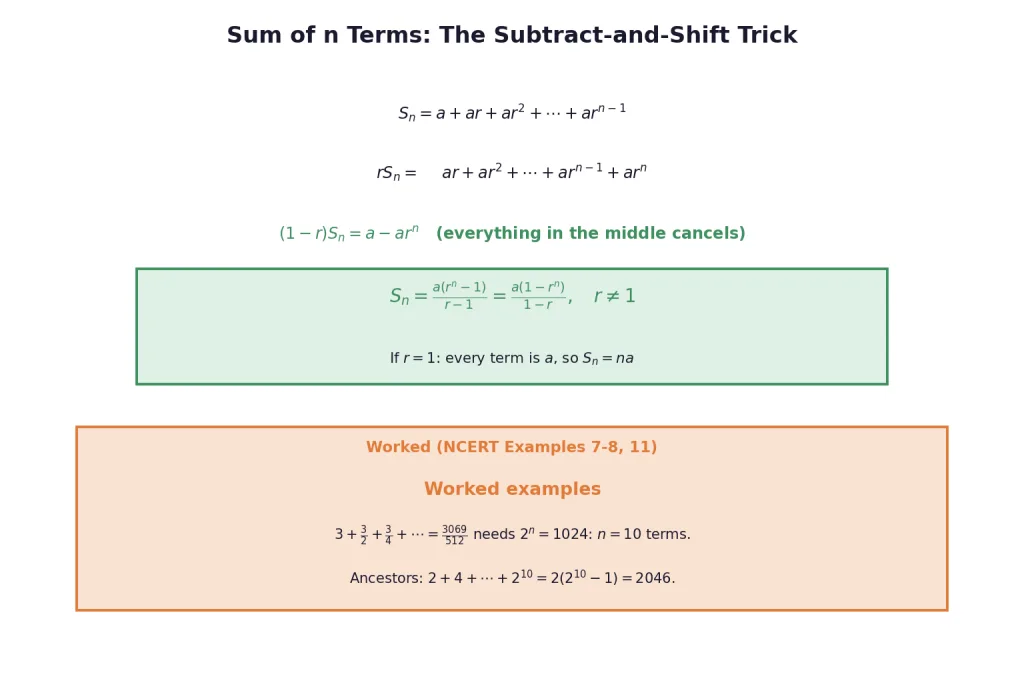
Example 7: Decimal G.P.
Find the sum of to 20 terms.
Solution:
Step 1 — Identify. , .
Step 2 — Apply the formula. .
Step 3 — Simplify. : .
Takeaway: Leave tiny powers like symbolic — the exact form is the expected answer.
Example 8: Alternating powers
Find the sum of to terms ().
Solution:
Step 1 — Identify the ratio. Each term is times the previous: .
Step 2 — Apply the formula. .
Takeaway: Keep intact — its sign depends on the parity of , and the formula handles both at once.
Example 9: Odd powers
Find the sum of to terms ().
Solution:
Step 1 — Identify. , .
Step 2 — Apply. .
Takeaway: The restriction is exactly — the formula's only demand.
Example 10: Sum and product, product 1
The first three terms of a G.P. sum to and their product is 1. Find the common ratio and the terms.
Solution:
Step 1 — Symmetric terms. : product , so .
Step 2 — Sum condition. , so .
Step 3 — Solve. gives or .
Step 4 — Write the terms. (both ratios give the same three numbers).
Takeaway: Reciprocal ratio pairs describe the same G.P. read in opposite directions.
Example 11: Sum of two terms plus a ratio condition
Find a G.P. whose first two terms sum to and whose fifth term is 4 times the third.
Solution:
Step 1 — Ratio condition first. gives : .
Step 2 — Case . : — G.P.
Step 3 — Case . : — G.P.
Takeaway: Both sign cases survive here — report both G.P.s; nothing in the problem eliminates either.
Example 12: Repdigit sum
Find the sum of to terms.
Solution:
Step 1 — Factor the digit. .
Step 2 — Powers minus ones. .
Step 3 — Sum both parts. .
Takeaway: Identical to the 7-77-777 recipe — only the leading digit changes.
Example 13: Products of paired terms
Find the sum of the products of corresponding terms of and .
Solution:
Step 1 — Form the products. .
Step 2 — Recognise the G.P. , (product of the two ratios ).
Step 3 — Sum. .
Takeaway: Products of paired G.P. terms form a G.P. with ratio — the next example proves it in general.
Example 14: Products in general
Show that the products of corresponding terms of and form a G.P., and find its common ratio.
Solution:
Step 1 — Write the -th product. .
Step 2 — Read off the structure. First term , each step multiplies by — a G.P. with common ratio . ∎
Takeaway: One-line proofs fall out when you write the general (-th) term rather than listing cases.
Growth and Money
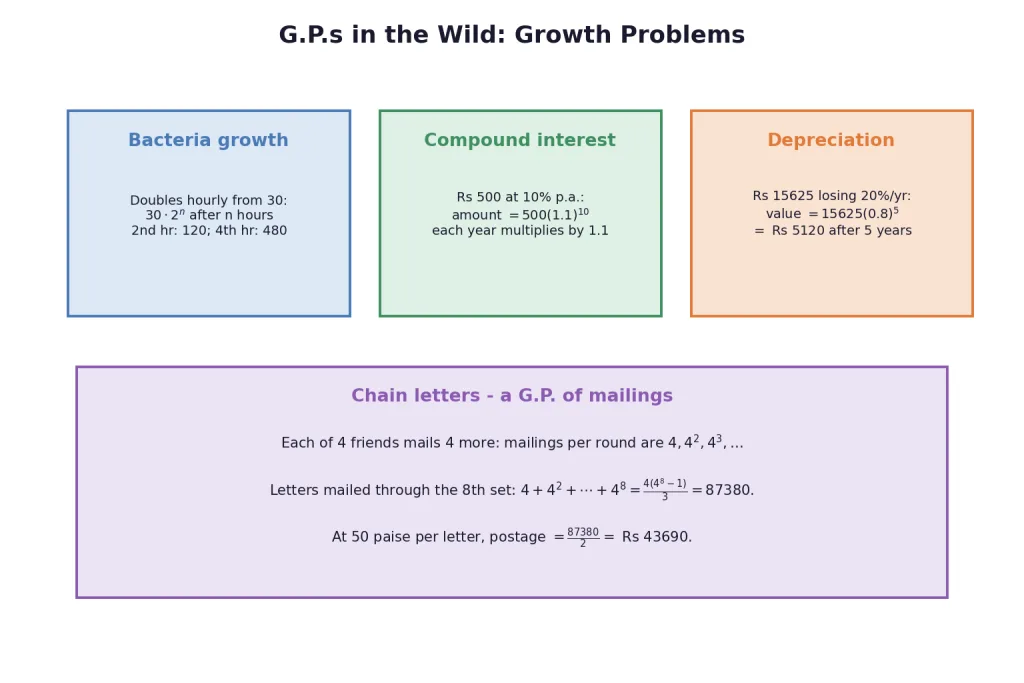
Example 15: Bacteria
Bacteria double every hour, starting from 30. How many are present at the end of the 2nd, 4th and -th hours?
Solution:
Step 1 — Model the doubling. Each hour multiplies by 2: after hours, .
Step 2 — Evaluate. 2nd hour: ; 4th hour: .
Step 3 — General. -th hour: .
Takeaway: "End of the -th hour" means doublings — the count is , not , because the start is hour 0.
Example 16: Compound interest
What will Rs 500 amount to in 10 years at 10% per annum compounded annually?
Solution:
Step 1 — One year's growth. Adding 10% multiplies by .
Step 2 — Ten years. Amount .
Step 3 — Evaluate. : amount Rs .
Takeaway: Compound interest IS a G.P. — the year-end amounts have ratio .
Example 17: Depreciation
A machine costing Rs 15625 depreciates 20% each year. Find its value after 5 years.
Solution:
Step 1 — One year's loss. Losing 20% multiplies by .
Step 2 — Five years. Value .
Step 3 — Evaluate exactly. and : value rupees.
Takeaway: Depreciation is the same G.P. machinery with — and makes the arithmetic exact.
Example 18: Chain letters
Each of 4 friends mails the letter to 4 more, and so on. At 50 paise per letter, find the postage when the 8th set is mailed.
Solution:
Step 1 — Count the letters. Rounds mail letters: .
Step 2 — Evaluate. : letters.
Step 3 — Price it. Rs .
Takeaway: Chain-letter growth is a G.P. sum, not a single term — every round's letters cost postage.
Example 19: Simple interest contrast
Rs 10000 is deposited at 5% simple interest. Find the amount in the 15th year and the total after 20 years.
Solution:
Step 1 — Recognise the A.P. Simple interest adds a FLAT Rs 500 per year — arithmetic, not geometric growth.
Step 2 — 15th year. After 14 completed years: .
Step 3 — After 20 years. .
Takeaway: Simple interest → A.P.; compound interest → G.P. — the contrast is the whole point of this pair.
Example 20: The tractor
A farmer buys a tractor for Rs 12000, pays Rs 6000 cash, and clears the balance in annual instalments of Rs 500 plus 12% interest on the unpaid amount. Find the total cost.
Solution:
Step 1 — List the unpaid balances. — an A.P. with 12 instalments.
Step 2 — Total interest. .
Step 3 — Total cost. Rs .
Takeaway: Interest on a shrinking balance sums over an A.P. — pair the first and last balances and multiply.
Example 21: The scooter
Shamshad Ali buys a scooter for Rs 22000, pays Rs 4000 cash, and clears the balance in instalments of Rs 1000 plus 10% interest on the unpaid amount. Find the total cost.
Solution:
Step 1 — Unpaid balances. — 18 instalments.
Step 2 — Interest. .
Step 3 — Total cost. Rs .
Takeaway: Same structure as the tractor — only the numbers change; learn the frame, not the figures.
Miscellaneous Classics
Example 22: A functional equation
satisfies for all , with and . Find .
Solution:
Step 1 — Generate the values. , , and inductively .
Step 2 — Sum the G.P. .
Step 3 — Solve. , so : .
Takeaway: forces exponential values — the functional equation IS the G.P. definition.
Example 23: Last term from the sum
The sum of some terms of a G.P. is 315; the first term is 5 and the ratio 2. Find the last term and the number of terms.
Solution:
Step 1 — Set up. .
Step 2 — Solve for . , so : .
Step 3 — Last term. .
Takeaway: Sum questions often hide a power match — then the last term is one substitution away.
Example 24: Ratio from a sum of terms
The first term of a G.P. is 1 and the sum of its third and fifth terms is 90. Find the common ratio.
Solution:
Step 1 — Translate. .
Step 2 — Substitute . gives or .
Step 3 — Reject and finish. kills : , so .
Takeaway: Even-power substitutions create phantom negative roots — audit them against .
Example 25: G.P. meets A.P.
Three numbers in G.P. sum to 56. Subtracting from them in order gives an A.P. Find the numbers.
Solution:
Step 1 — Set up both conditions. ; A.P. means .
Step 2 — Simplify the A.P. condition. , so .
Step 3 — Divide the conditions. gives : or .
Step 4 — Finish. : , . Numbers: . Check: is an A.P. ✓
Takeaway: Mixed G.P./A.P. conditions: simplify each separately, then divide to kill .
Example 26: Odd-place terms
A G.P. has an even number of terms. If the sum of all terms is 5 times the sum of the terms in odd places, find the common ratio.
Solution:
Step 1 — Describe the odd-place terms. With terms, positions hold — a G.P. with ratio and terms.
Step 2 — Form both sums. ; .
Step 3 — Divide. : .
Takeaway: The unknown-length sums cancel entirely — only survives the division.
Example 27: S, P, R identity
For terms of a G.P., let be the sum, the product and the sum of reciprocals. Prove .
Solution:
Step 1 — Write the three quantities. ; the reciprocals form a G.P. with first term and ratio : ; and .
Step 2 — Form . The brackets cancel: .
Step 3 — Raise to the . , i.e. . ∎
Takeaway: Never expand first — form and the messy sums vanish.
Example 28: Two quadratics
are roots of ; are roots of ; and form a G.P. Prove .
Solution:
Step 1 — Name the G.P. . Root sums: and .
Step 2 — Divide. .
Step 3 — Form and . ; .
Step 4 — Take the ratio. . ∎
Takeaway: Products of root-pairs of a G.P. differ by a power of — everything else cancels in the ratio.
Example 29: 5 + 55 + 555
Find the sum of to terms.
Solution:
Step 1 — Factor the digit. .
Step 2 — Sum. .
Takeaway: Third appearance of the repdigit recipe — by now it should take under a minute.
Example 30: The dwindling workforce
150 workers start a job; 4 drop out each subsequent day. The job takes 8 more days than planned. In how many days was the work completed?
Solution:
Step 1 — Express the planned work. With all 150 staying, the planned duration gives worker-days.
Step 2 — Express the actual work. Workforce for days: .
Step 3 — Equate and simplify. gives , so .
Step 4 — Factor. : ; the work took days.
Takeaway: Match consecutive-integer products by factoring the target — ends the problem.