A Constant Ratio
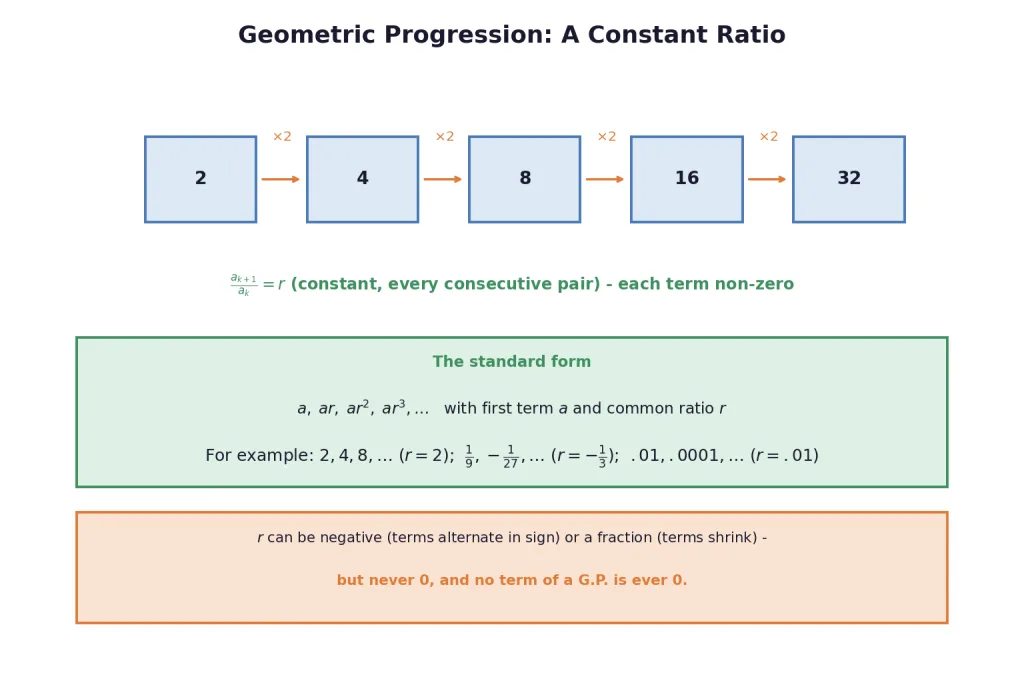
Look at 2 , 4 , 8 , 16 , … 2, 4, 8, 16, \ldots 2 , 4 , 8 , 16 , … twice the one before. In 1 9 , − 1 27 , 1 81 , … \frac{1}{9}, -\frac{1}{27}, \frac{1}{81}, \ldots 9 1 , − 27 1 , 81 1 , … − 1 3 -\frac{1}{3} − 3 1 .01 , .0001 , … .01, .0001, \ldots .01 , .0001 , … .01 .01 .01
Key Point (Definition): A sequence a 1 , a 2 , a 3 , … a_1, a_2, a_3, \ldots a 1 , a 2 , a 3 , … geometric progression (G.P.) if each term is non-zero and a k + 1 a k = r \frac{a_{k+1}}{a_k} = r a k a k + 1 = r k ≥ 1 k \ge 1 k ≥ 1 a 1 = a a_1 = a a 1 = a a , a r , a r 2 , a r 3 , … a, ar, ar^2, ar^3, \ldots a , a r , a r 2 , a r 3 , … a a a common ratio r r r
The ratio may be negative (signs alternate) or fractional (terms shrink) — but no term is ever 0, and r ≠ 0 r \ne 0 r = 0
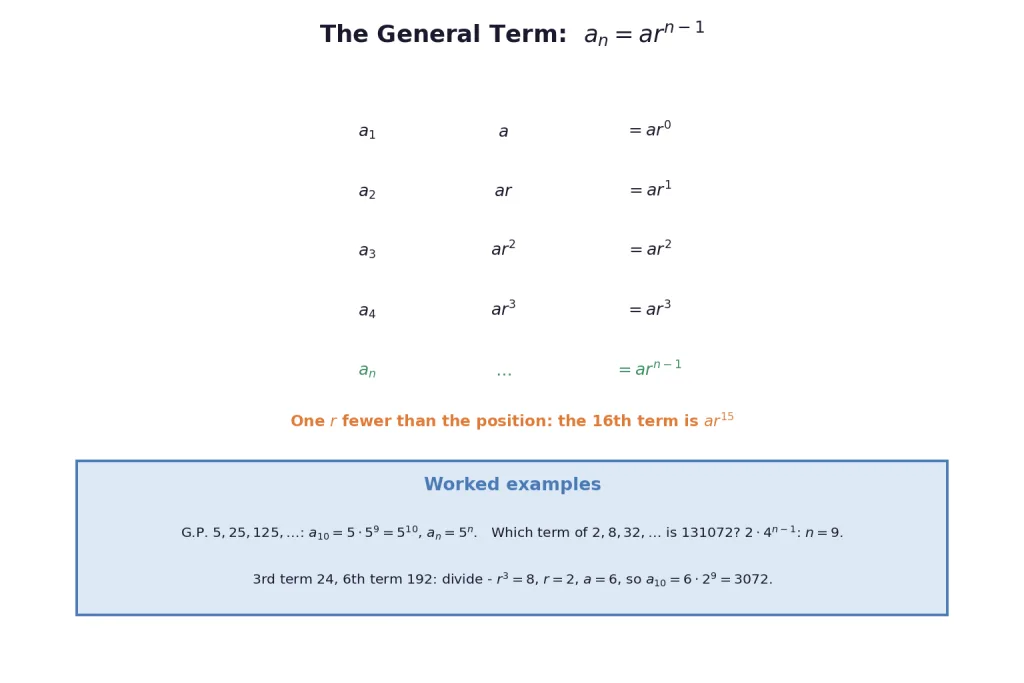
Key Point (General term): Each step multiplies by one more r r r
a n = a r n − 1 a_n = ar^{n-1} a n = a r n − 1
— one r r r a r 15 ar^{15} a r 15
[Board Tip] Two-condition problems divide cleanly: 3rd term 24 and 6th term 192 give a r 5 a r 2 = r 3 = 8 \frac{ar^5}{ar^2} = r^3 = 8 a r 2 a r 5 = r 3 = 8 r = 2 r = 2 r = 2 a = 6 a = 6 a = 6
Sum of the First n Terms
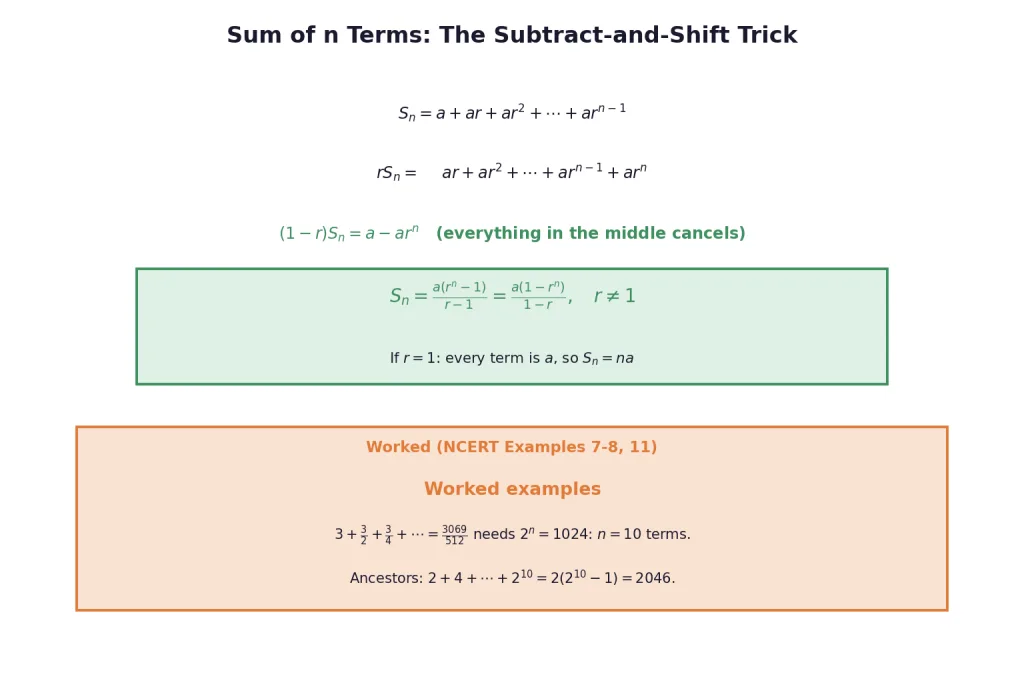
Multiply S n = a + a r + ⋯ + a r n − 1 S_n = a + ar + \cdots + ar^{n-1} S n = a + a r + ⋯ + a r n − 1 r r r
Key Point (Sum formula):
S n = a ( r n − 1 ) r − 1 = a ( 1 − r n ) 1 − r , r ≠ 1 ; S n = n a when r = 1 S_n = \frac{a(r^n - 1)}{r - 1} = \frac{a(1 - r^n)}{1 - r}, \quad r \ne 1; \qquad S_n = na \text{ when } r = 1 S n = r − 1 a ( r n − 1 ) = 1 − r a ( 1 − r n ) , r = 1 ; S n = na when r = 1
For example: for 1 + 2 3 + 4 9 + ⋯ 1 + \frac{2}{3} + \frac{4}{9} + \cdots 1 + 3 2 + 9 4 + ⋯ S n = 3 [ 1 − ( 2 3 ) n ] S_n = 3\left[1 - \left(\frac{2}{3}\right)^n\right] S n = 3 [ 1 − ( 3 2 ) n ] S 5 = 211 81 S_5 = \frac{211}{81} S 5 = 81 211 3 + 3 2 + 3 4 + ⋯ = 3069 512 3 + \frac{3}{2} + \frac{3}{4} + \cdots = \frac{3069}{512} 3 + 2 3 + 4 3 + ⋯ = 512 3069 2 n = 1024 2^n = 1024 2 n = 1024 n = 10 n = 10 n = 10
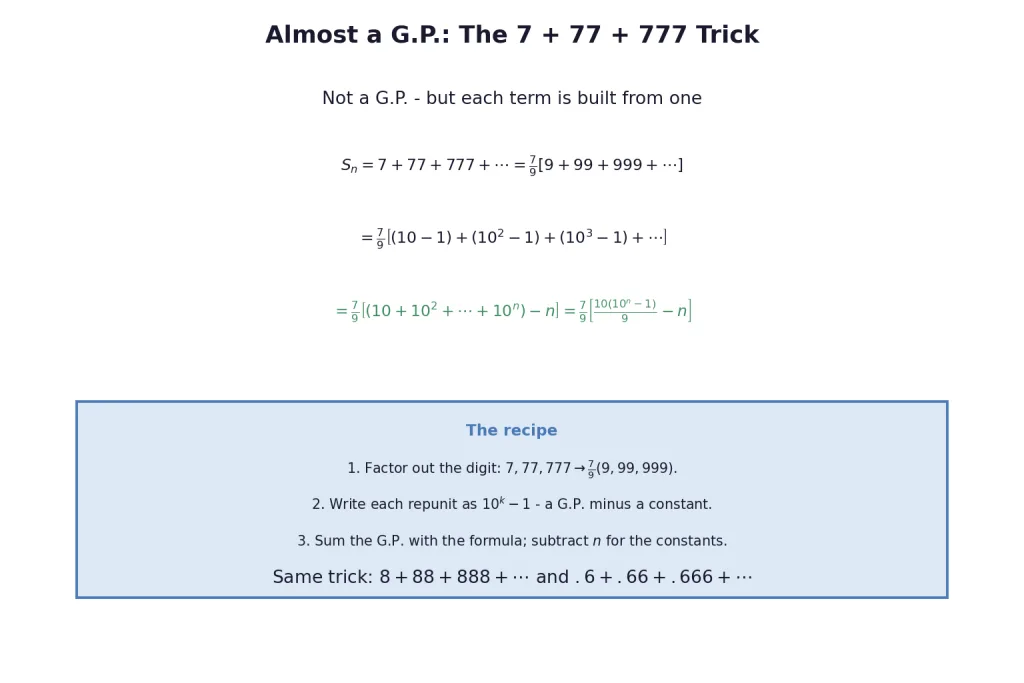
Almost-G.P.s: 7 + 77 + 777 + ⋯ 7 + 77 + 777 + \cdots 7 + 77 + 777 + ⋯ 7 9 ( 9 + 99 + 999 + ⋯ ) \frac{7}{9}(9 + 99 + 999 + \cdots) 9 7 ( 9 + 99 + 999 + ⋯ )
S n = 7 9 [ 10 ( 10 n − 1 ) 9 − n ] S_n = \frac{7}{9}\left[\frac{10(10^n - 1)}{9} - n\right] S n = 9 7 [ 9 10 ( 1 0 n − 1 ) − n ]
[JEE Tip] The same three moves — factor the digit, write repunits as 10 k − 1 10^k - 1 1 0 k − 1 8 + 88 + ⋯ 8 + 88 + \cdots 8 + 88 + ⋯ 5 + 55 + ⋯ 5 + 55 + \cdots 5 + 55 + ⋯ .6 + .66 + ⋯ .6 + .66 + \cdots .6 + .66 + ⋯
Solved Examples
Example 1: Write the terms
Find the 10th and n n n 5 , 25 , 125 , … 5, 25, 125, \ldots 5 , 25 , 125 , …
Solution:
Step 1 — Identify a a a r r r a = 5 a = 5 a = 5 r = 25 5 = 5 r = \frac{25}{5} = 5 r = 5 25 = 5
Step 2 — Apply a n = a r n − 1 a_n = ar^{n-1} a n = a r n − 1 a 10 = 5 ⋅ 5 9 = 5 10 a_{10} = 5 \cdot 5^9 = 5^{10} a 10 = 5 ⋅ 5 9 = 5 10
Step 3 — General term. a n = 5 ⋅ 5 n − 1 = 5 n a_n = 5 \cdot 5^{n-1} = 5^n a n = 5 ⋅ 5 n − 1 = 5 n
Takeaway: When a = r a = r a = r a n = r n a_n = r^n a n = r n
Example 2: Which term is it?
Which term of the G.P. 2 , 8 , 32 , … 2, 8, 32, \ldots 2 , 8 , 32 , …
Solution:
Step 1 — Set up the equation. a = 2 a = 2 a = 2 r = 4 r = 4 r = 4 2 ⋅ 4 n − 1 = 131072 2 \cdot 4^{n-1} = 131072 2 ⋅ 4 n − 1 = 131072
Step 2 — Isolate the power. 4 n − 1 = 65536 = 4 8 4^{n-1} = 65536 = 4^8 4 n − 1 = 65536 = 4 8
Step 3 — Solve. n − 1 = 8 n - 1 = 8 n − 1 = 8 n = 9 n = 9 n = 9 9th term .
Takeaway: "Which term" questions reduce to matching powers — write both sides with the same base.
Example 3: Two conditions
In a G.P. the 3rd term is 24 and the 6th term is 192. Find the 10th term.
Solution:
Step 1 — Write the two term equations. a r 2 = 24 ar^2 = 24 a r 2 = 24 a r 5 = 192 ar^5 = 192 a r 5 = 192
Step 2 — DIVIDE them. a r 5 a r 2 = r 3 = 192 24 = 8 \frac{ar^5}{ar^2} = r^3 = \frac{192}{24} = 8 a r 2 a r 5 = r 3 = 24 192 = 8 r = 2 r = 2 r = 2
Step 3 — Back-substitute. a ⋅ 4 = 24 a \cdot 4 = 24 a ⋅ 4 = 24 a = 6 a = 6 a = 6
Step 4 — Compute the target. a 10 = 6 ⋅ 2 9 = 6 × 512 = 3072 a_{10} = 6 \cdot 2^9 = 6 \times 512 = 3072 a 10 = 6 ⋅ 2 9 = 6 × 512 = 3072
Takeaway: Divide G.P. term equations (never subtract) — the a a a r r r
Example 4: Sum formula
Find S n S_n S n S 5 S_5 S 5 1 + 2 3 + 4 9 + ⋯ 1 + \frac{2}{3} + \frac{4}{9} + \cdots 1 + 3 2 + 9 4 + ⋯
Solution:
Step 1 — Identify. a = 1 a = 1 a = 1 r = 2 3 r = \frac{2}{3} r = 3 2 ∣ r ∣ < 1 |r| < 1 ∣ r ∣ < 1 1 − r n 1 - r^n 1 − r n
Step 2 — Apply the formula. S n = 1 − ( 2 / 3 ) n 1 − 2 / 3 = 3 [ 1 − ( 2 3 ) n ] S_n = \frac{1 - (2/3)^n}{1 - 2/3} = 3\left[1 - \left(\frac{2}{3}\right)^n\right] S n = 1 − 2/3 1 − ( 2/3 ) n = 3 [ 1 − ( 3 2 ) n ]
Step 3 — Evaluate S 5 S_5 S 5 ( 2 3 ) 5 = 32 243 \left(\frac{2}{3}\right)^5 = \frac{32}{243} ( 3 2 ) 5 = 243 32 S 5 = 3 ⋅ 211 243 = 211 81 S_5 = 3 \cdot \frac{211}{243} = \frac{211}{81} S 5 = 3 ⋅ 243 211 = 81 211
Takeaway: Pick the version of the sum formula that keeps the bracket positive — fewer sign slips.
Example 5: Solve for n
How many terms of 3 , 3 2 , 3 4 , … 3, \frac{3}{2}, \frac{3}{4}, \ldots 3 , 2 3 , 4 3 , … 3069 512 \frac{3069}{512} 512 3069
Solution:
Step 1 — Write S n S_n S n a = 3 a = 3 a = 3 r = 1 2 r = \frac{1}{2} r = 2 1 S n = 3 ( 1 − 2 − n ) 1 / 2 = 6 ( 1 − 1 2 n ) S_n = \frac{3(1 - 2^{-n})}{1/2} = 6\left(1 - \frac{1}{2^n}\right) S n = 1/2 3 ( 1 − 2 − n ) = 6 ( 1 − 2 n 1 )
Step 2 — Equate and isolate. 6 ( 1 − 1 2 n ) = 3069 512 6\left(1 - \frac{1}{2^n}\right) = \frac{3069}{512} 6 ( 1 − 2 n 1 ) = 512 3069 1 − 1 2 n = 3069 3072 1 - \frac{1}{2^n} = \frac{3069}{3072} 1 − 2 n 1 = 3072 3069
Step 3 — Match powers. 1 2 n = 3 3072 = 1 1024 = 1 2 10 \frac{1}{2^n} = \frac{3}{3072} = \frac{1}{1024} = \frac{1}{2^{10}} 2 n 1 = 3072 3 = 1024 1 = 2 10 1 n = 10 n = 10 n = 10
Takeaway: Solve-for-n n n
Example 6: Sum and product of three terms
The first three terms of a G.P. sum to 13 12 \frac{13}{12} 12 13 − 1 -1 − 1
Solution:
Step 1 — Choose symmetric terms. Take a r , a , a r \frac{a}{r}, a, ar r a , a , a r a 3 a^3 a 3 r r r
Step 2 — Use the product. a 3 = − 1 a^3 = -1 a 3 = − 1 a = − 1 a = -1 a = − 1
Step 3 — Use the sum. − 1 r − 1 − r = 13 12 -\frac{1}{r} - 1 - r = \frac{13}{12} − r 1 − 1 − r = 12 13 − 12 r -12r − 12 r 12 + 12 r + 12 r 2 = − 13 r 12 + 12r + 12r^2 = -13r 12 + 12 r + 12 r 2 = − 13 r 12 r 2 + 25 r + 12 = 0 12r^2 + 25r + 12 = 0 12 r 2 + 25 r + 12 = 0
Step 4 — Solve the quadratic. r = − 25 ± 7 24 = − 3 4 r = \frac{-25 \pm 7}{24} = -\frac{3}{4} r = 24 − 25 ± 7 = − 4 3 − 4 3 -\frac{4}{3} − 3 4
Step 5 — Write the terms. 4 3 , − 1 , 3 4 \frac{4}{3}, -1, \frac{3}{4} 3 4 , − 1 , 4 3
Takeaway: Symmetric choice a r , a , a r \frac{a}{r}, a, ar r a , a , a r a 3 a^3 a 3
Example 7: The 7, 77, 777 sum
Find the sum of 7 + 77 + 777 + ⋯ 7 + 77 + 777 + \cdots 7 + 77 + 777 + ⋯ n n n
Solution:
Step 1 — Factor out the digit. S n = 7 ( 1 + 11 + 111 + ⋯ ) = 7 9 ( 9 + 99 + 999 + ⋯ ) S_n = 7(1 + 11 + 111 + \cdots) = \frac{7}{9}(9 + 99 + 999 + \cdots) S n = 7 ( 1 + 11 + 111 + ⋯ ) = 9 7 ( 9 + 99 + 999 + ⋯ )
Step 2 — Write each repdigit as a power minus 1. S n = 7 9 [ ( 10 − 1 ) + ( 10 2 − 1 ) + ⋯ + ( 10 n − 1 ) ] S_n = \frac{7}{9}\left[(10-1) + (10^2-1) + \cdots + (10^n-1)\right] S n = 9 7 [ ( 10 − 1 ) + ( 1 0 2 − 1 ) + ⋯ + ( 1 0 n − 1 ) ]
Step 3 — Sum the G.P. and the constants separately.
S n = 7 9 [ 10 ( 10 n − 1 ) 9 − n ] S_n = \frac{7}{9}\left[\frac{10(10^n - 1)}{9} - n\right] S n = 9 7 [ 9 10 ( 1 0 n − 1 ) − n ]
Takeaway: Repdigit series are G.P.s in disguise — factor the digit, subtract the 1's.
Example 8: Ancestors
A person has 2 parents, 4 grandparents, 8 great-grandparents, and so on. Find the number of ancestors during the ten generations preceding his own.
Solution:
Step 1 — Recognise the G.P. Generations contribute 2 , 4 , 8 , … 2, 4, 8, \ldots 2 , 4 , 8 , … a = 2 a = 2 a = 2 r = 2 r = 2 r = 2 n = 10 n = 10 n = 10
Step 2 — Sum. S 10 = 2 ( 2 10 − 1 ) 2 − 1 = 2 ( 1024 − 1 ) = 2046 S_{10} = \frac{2(2^{10} - 1)}{2 - 1} = 2(1024 - 1) = 2046 S 10 = 2 − 1 2 ( 2 10 − 1 ) = 2 ( 1024 − 1 ) = 2046
Takeaway: Real-world doubling processes are G.P.s — identify a a a r r r n n n
Example 9: From the 8th term back
Find the 12th term of a G.P. whose 8th term is 192 and common ratio is 2.
Solution:
Step 1 — Jump forward from the known term. a 12 = a 8 ⋅ r 4 a_{12} = a_8 \cdot r^4 a 12 = a 8 ⋅ r 4 r r r
Step 2 — Evaluate. 192 × 2 4 = 192 × 16 = 3072 192 \times 2^4 = 192 \times 16 = 3072 192 × 2 4 = 192 × 16 = 3072
Step 3 — (Check via a a a a ⋅ 2 7 = 192 a \cdot 2^7 = 192 a ⋅ 2 7 = 192 a = 3 2 a = \frac{3}{2} a = 2 3 3 2 ⋅ 2 11 = 3072 \frac{3}{2} \cdot 2^{11} = 3072 2 3 ⋅ 2 11 = 3072
Takeaway: a m = a k ⋅ r m − k a_m = a_k \cdot r^{m-k} a m = a k ⋅ r m − k a a a
Example 10: A squared condition
The 4th term of a G.P. is the square of its 2nd term, and the first term is − 3 -3 − 3
Solution:
Step 1 — Translate the condition. a r 3 = ( a r ) 2 = a 2 r 2 ar^3 = (ar)^2 = a^2r^2 a r 3 = ( a r ) 2 = a 2 r 2
Step 2 — Cancel carefully. Divide by a r 2 ar^2 a r 2 r = a = − 3 r = a = -3 r = a = − 3
Step 3 — Compute. a 7 = a r 6 = − 3 ⋅ ( − 3 ) 6 = − 3 × 729 = − 2187 a_7 = ar^6 = -3 \cdot (-3)^6 = -3 \times 729 = -2187 a 7 = a r 6 = − 3 ⋅ ( − 3 ) 6 = − 3 × 729 = − 2187
Takeaway: G.P. terms are never zero, so dividing by powers of a a a r r r
Example 11: Surd ratio
Which term of 2 , 2 2 , 4 , … 2, 2\sqrt{2}, 4, \ldots 2 , 2 2 , 4 , …
Solution:
Step 1 — Identify the ratio. r = 2 2 2 = 2 = 2 1 / 2 r = \frac{2\sqrt{2}}{2} = \sqrt{2} = 2^{1/2} r = 2 2 2 = 2 = 2 1/2
Step 2 — Set up with base 2. a n = 2 ⋅ 2 n − 1 2 = 2 1 + n − 1 2 a_n = 2 \cdot 2^{\frac{n-1}{2}} = 2^{1 + \frac{n-1}{2}} a n = 2 ⋅ 2 2 n − 1 = 2 1 + 2 n − 1 128 = 2 7 128 = 2^7 128 = 2 7
Step 3 — Match exponents. 1 + n − 1 2 = 7 1 + \frac{n-1}{2} = 7 1 + 2 n − 1 = 7 n − 1 = 12 n - 1 = 12 n − 1 = 12 n = 13 n = 13 n = 13
Takeaway: Surd ratios become half-integer exponents — the power-matching method is unchanged.
Example 12: G.P. condition
For what values of x x x − 2 7 , x , − 7 2 -\frac{2}{7}, x, -\frac{7}{2} − 7 2 , x , − 2 7
Solution:
Step 1 — Use the middle-term property. In a G.P., x 2 x^2 x 2
Step 2 — Compute. x 2 = ( − 2 7 ) ( − 7 2 ) = 1 x^2 = \left(-\frac{2}{7}\right)\left(-\frac{7}{2}\right) = 1 x 2 = ( − 7 2 ) ( − 2 7 ) = 1
Step 3 — Solve. x = ± 1 x = \pm 1 x = ± 1
Takeaway: Three-in-G.P. means middle2 ^2 2
Example 13: A sigma with two parts
Evaluate ∑ k = 1 11 ( 2 + 3 k ) \sum_{k=1}^{11} (2 + 3^k) ∑ k = 1 11 ( 2 + 3 k )
Solution:
Step 1 — Split the sum. ∑ k = 1 11 2 + ∑ k = 1 11 3 k = 22 + ( 3 + 3 2 + ⋯ + 3 11 ) \sum_{k=1}^{11} 2 + \sum_{k=1}^{11} 3^k = 22 + (3 + 3^2 + \cdots + 3^{11}) ∑ k = 1 11 2 + ∑ k = 1 11 3 k = 22 + ( 3 + 3 2 + ⋯ + 3 11 )
Step 2 — Sum the G.P. 3 ( 3 11 − 1 ) 3 − 1 = 3 ( 177147 − 1 ) 2 = 531438 2 = 265719 \frac{3(3^{11} - 1)}{3 - 1} = \frac{3(177147 - 1)}{2} = \frac{531438}{2} = 265719 3 − 1 3 ( 3 11 − 1 ) = 2 3 ( 177147 − 1 ) = 2 531438 = 265719
Step 3 — Add. 22 + 265719 = 265741 22 + 265719 = 265741 22 + 265719 = 265741
Takeaway: Split mixed sigmas into a constant part and a G.P. part — each has its own one-line formula.
Example 14: How many terms
How many terms of the G.P. 3 , 3 2 , 3 3 , … 3, 3^2, 3^3, \ldots 3 , 3 2 , 3 3 , …
Solution:
Step 1 — Write S n S_n S n a = 3 a = 3 a = 3 r = 3 r = 3 r = 3 S n = 3 ( 3 n − 1 ) 2 S_n = \frac{3(3^n - 1)}{2} S n = 2 3 ( 3 n − 1 )
Step 2 — Equate. 3 ( 3 n − 1 ) 2 = 120 \frac{3(3^n - 1)}{2} = 120 2 3 ( 3 n − 1 ) = 120 3 n − 1 = 80 3^n - 1 = 80 3 n − 1 = 80 3 n = 81 = 3 4 3^n = 81 = 3^4 3 n = 81 = 3 4
Step 3 — Conclude and check. n = 4 n = 4 n = 4 3 + 9 + 27 + 81 = 120 3 + 9 + 27 + 81 = 120 3 + 9 + 27 + 81 = 120
Takeaway: After matching the power, spend five seconds adding the actual terms — a free full check.
Example 15: Two blocks of three
The sum of the first three terms of a G.P. is 16 and the sum of the next three is 128. Find a a a r r r S n S_n S n
Solution:
Step 1 — Relate the blocks. Terms 4-6 are terms 1-3 each multiplied by r 3 r^3 r 3 r 3 = 128 16 = 8 r^3 = \frac{128}{16} = 8 r 3 = 16 128 = 8
Step 2 — Solve for r r r r = 2 r = 2 r = 2
Step 3 — Find a a a a ( 1 + r + r 2 ) = a ⋅ 7 = 16 a(1 + r + r^2) = a \cdot 7 = 16 a ( 1 + r + r 2 ) = a ⋅ 7 = 16 a = 16 7 a = \frac{16}{7} a = 7 16
Step 4 — Write S n S_n S n S n = 16 7 ( 2 n − 1 ) S_n = \frac{16}{7}(2^n - 1) S n = 7 16 ( 2 n − 1 )
Takeaway: Consecutive equal-length blocks of a G.P. are in ratio r (block length) r^{\text{(block length)}} r (block length) r r r
Example 16: S 7 S_7 S 7 a a a a 7 a_7 a 7
Given a G.P. with a = 729 a = 729 a = 729 S 7 S_7 S 7
Solution:
Step 1 — Find r r r 729 r 6 = 64 729\,r^6 = 64 729 r 6 = 64 r 6 = 64 729 = ( 2 3 ) 6 r^6 = \frac{64}{729} = \left(\frac{2}{3}\right)^6 r 6 = 729 64 = ( 3 2 ) 6 r = 2 3 r = \frac{2}{3} r = 3 2
Step 2 — Apply the sum formula. S 7 = 729 ( 1 − ( 2 / 3 ) 7 ) 1 − 2 / 3 = 3 ⋅ 729 ( 1 − 128 2187 ) S_7 = \frac{729\left(1 - (2/3)^7\right)}{1 - 2/3} = 3 \cdot 729\left(1 - \frac{128}{2187}\right) S 7 = 1 − 2/3 729 ( 1 − ( 2/3 ) 7 ) = 3 ⋅ 729 ( 1 − 2187 128 )
Step 3 — Evaluate. 2187 − 2187 ⋅ 128 2187 = 2187 − 128 = 2059 2187 - 2187 \cdot \frac{128}{2187} = 2187 - 128 = 2059 2187 − 2187 ⋅ 2187 128 = 2187 − 128 = 2059
Takeaway: 729 = 3 6 729 = 3^6 729 = 3 6 64 = 2 6 64 = 2^6 64 = 2 6 r 6 r^6 r 6