
Welcome to Sets — the Alphabet of Mathematics
Before you learn a language, you learn its alphabet. Sets are exactly that for Class 11 and 12 mathematics: relations, functions, probability, sequences — every one of them is written in the language of sets. Invest a few hours here and the next two years become easier to read.
Here is the roadmap for the chapter:
- Sets and their representations (this section) — what qualifies as a set, and the two standard ways of writing one.
- Types of sets — empty, finite, infinite and equal sets.
- Subsets, intervals and Venn diagrams — sets inside sets, and how to draw them.
- Operations on sets — union, intersection, difference and complement, ending with De Morgan's laws.
The theory of sets was developed by the German mathematician Georg Cantor (1845-1918), who ran into sets while working on problems about trigonometric series. What began as a technical tool is today the foundation on which almost all of mathematics stands.
[JEE Tip] JEE Main asks a question from the Sets-Relations-Functions unit in nearly every session. The set-specific favourites — power sets, laws of set algebra and cardinality formulas like — sit just outside the rationalised textbook syllabus, so this chapter's JEE Corner section covers them in full. Board students can treat that section as optional enrichment.
What Exactly Is a Set?
In everyday life we speak of collections all the time — a pack of cards, a cricket team, the rivers of India. In mathematics, a collection earns the name set only if it passes one test:
Key Point: A set is a well-defined collection of objects. Well-defined means that for any given object, we can decide definitely — yes or no — whether it belongs to the collection. No opinions, no ambiguity.
Compare these two collections:
- "The collection of all natural numbers less than 100" — for any object, membership is beyond debate. 57 is in; 102 is out; a banana is out. This is a set.
- "The collection of the five most renowned mathematicians of the world" — renowned according to whom? Different people give different lists. This is not a set.
Words like best, most talented, most dangerous, most beautiful are the classic signals of a collection that is not well-defined.
Membership: the symbols and
Objects in a set are called its elements or members. Sets are usually named with capital letters A, B, C, and elements with small letters a, b, c.
- If is an element of set A, we write , read " belongs to A".
- If is not an element of A, we write , read " does not belong to A".
For the set V of vowels in the English alphabet: but . For the set P of prime factors of 30: but (because is not prime).
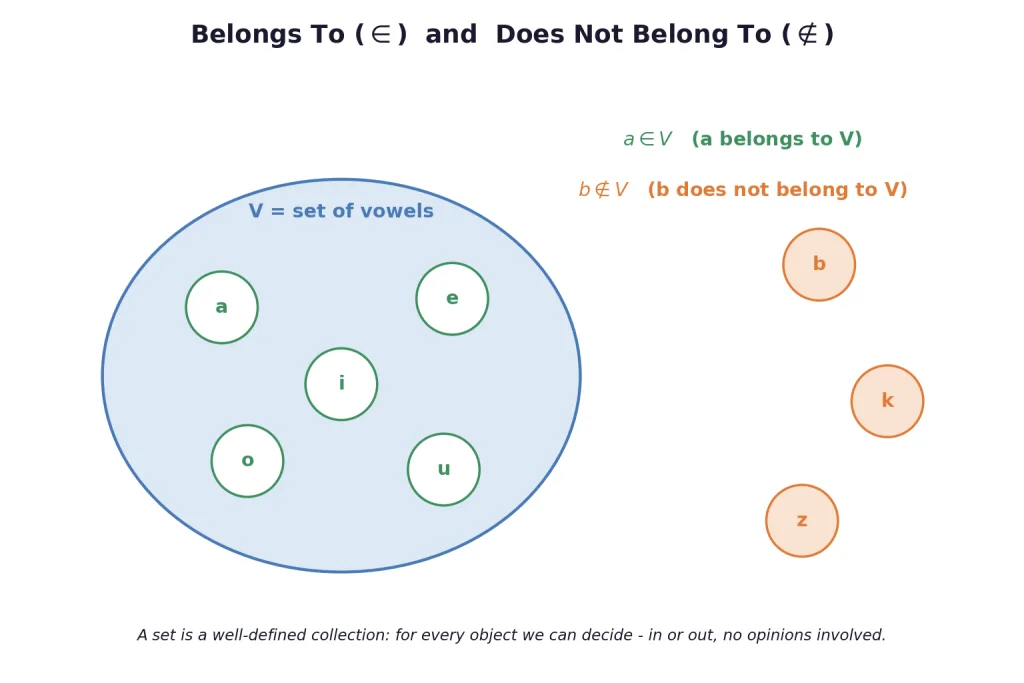
[Board Important] The membership symbol relates an element to a set — never a set to a set. Writing is wrong; the correct relation between two sets is the subset symbol, coming in Section 3.
The Standard Number Sets
Certain sets appear so often that they have reserved letters, used throughout Class 11 and 12. Learn them now and read them fluently forever:
- : the set of all natural numbers = {1, 2, 3, …}
- : the set of all integers = {…, , , , 0, 1, 2, 3, …}
- : the set of all rational numbers — numbers expressible as with ,
- : the set of all real numbers
- , , : the positive integers, positive rationals and positive reals respectively
- T : the set of irrational numbers — real numbers that are not rational, like , and
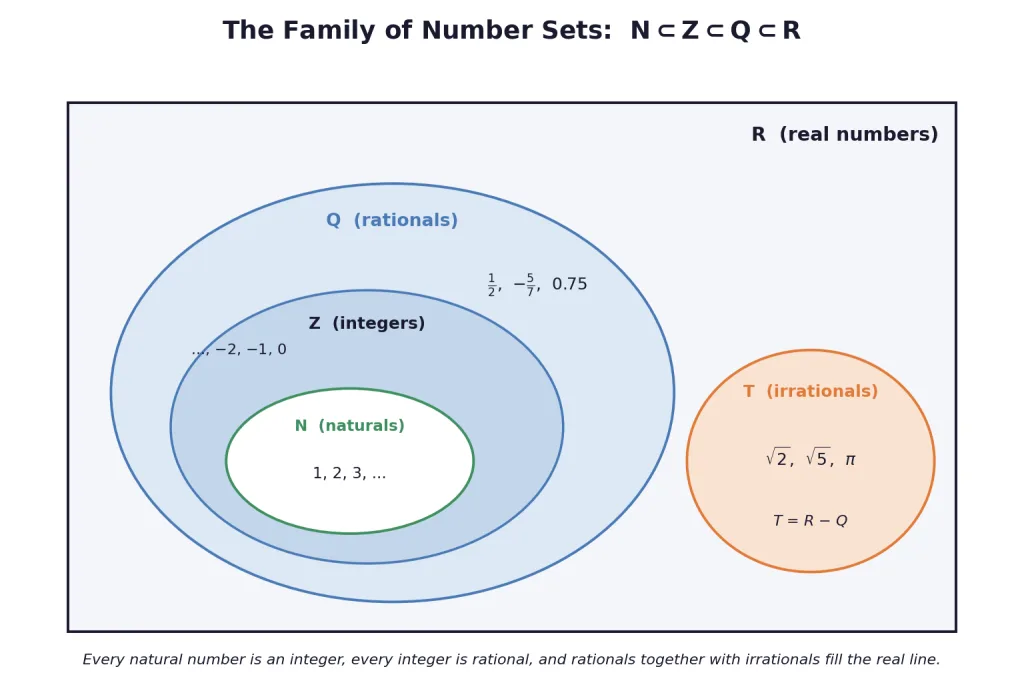
The picture to keep in your head: each family sits inside the next, , while the irrationals T fill up the rest of outside .
Key Point: The letter Z comes from the German word Zahlen (numbers), and Q from quotient — a rational number is literally a quotient of integers.
[JEE Tip] Remember that (it equals ) and (it equals ). Every integer and every terminating or repeating decimal is rational. JEE loves to test whether you know that — no natural number is irrational.
Roster (Tabular) Form
The first way to write a set: list every element, separated by commas, inside braces { }.
- The set of even positive integers less than 7 is {2, 4, 6}.
- The set of natural numbers that divide 42 is {1, 2, 3, 6, 7, 14, 21, 42}.
- The set of vowels is {a, e, i, o, u}.
- The set of odd natural numbers is {1, 3, 5, …} — the three dots say the list continues with the same pattern forever.
Two rules govern roster form:
- Order does not matter. {1, 2, 3, 6} and {6, 3, 1, 2} are the same set.
- Elements are never repeated. The set of letters of the word SCHOOL is {S, C, H, O, L} — the second O is not listed again.
Key Point: A set is completely determined by which elements it has — not by how they are ordered or how many times they are mentioned.
[Board Important] "Write the set of letters of the word…" is a frequent 1-mark question, and the whole mark rests on dropping the repeated letters. LOYAL gives {L, O, Y, A}, MATHEMATICS gives {M, A, T, H, E, I, C, S}.
Set-builder Form
The second way: instead of listing elements, state the property that exactly the elements of the set possess.
All vowels share a single common property — being a vowel — that no other letter has. So we write
Read it aloud as: "V is the set of all such that is a vowel in the English alphabet". The braces stand for "the set of all", and the colon stands for "such that".
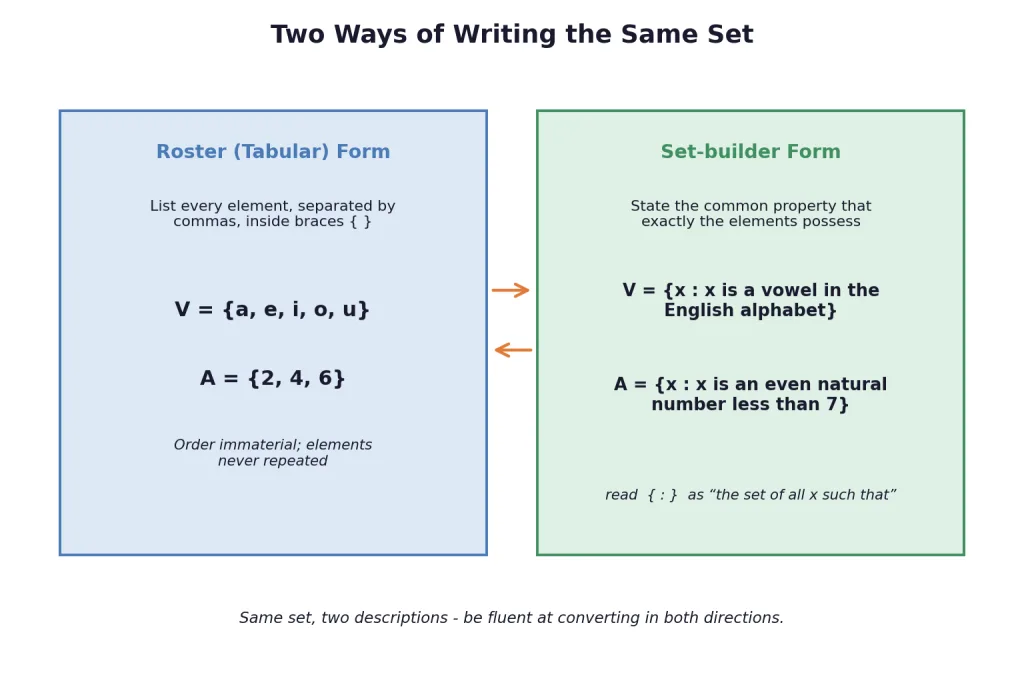
More examples:
- is the set {4, 5, 6, 7, 8, 9} in roster form.
- is {1, 3, 5, …}.
- The variable is a dummy — and are the same set.
Converting between the two forms
Roster → set-builder: hunt for the pattern. For {1, 4, 9, 16, 25, …}, every element is a perfect square, so the set is .
Set-builder → roster: solve or enumerate the condition. For , test integers: the set is {, , 0, 1, 2}.
[JEE Tip] When the defining condition is an equation, solve it completely and keep only the solutions allowed by the stated domain. is {2}, not {, 2} — the domain filter throws away . Missing the domain filter is the most common error in this topic.
Solved Examples
Example 1. Which of the following collections are sets? (i) The collection of all months of a year beginning with the letter J. (ii) The collection of the ten most talented writers of India. (iii) The collection of all even integers.
Solution.
Step 1 — recall the one test that decides. A collection is a set exactly when membership is well-defined: for ANY object, we can answer yes or no with no opinion involved.
(i) Step 2. Run the test: is a given month's first letter J or not? January, June, July pass; every other month fails; no judgement is needed. It is a set, namely {January, June, July}.
(ii) Step 3. "Most talented" is an opinion — different people produce different lists of ten, and no objective rule settles who belongs. Membership cannot be decided definitely. Not a set.
(iii) Step 4. For any object we can check definitely whether it is an even integer (is it an integer? is it divisible by 2?). It is a set: {…, , , 0, 2, 4, …}, an infinite one.
Takeaway: words like best, most talented, most beautiful signal a collection that is not well-defined.
Example 2. Write the solution set of the equation in roster form.
Solution.
Step 1 — factorise the quadratic. Look for two numbers with product and sum : they are and . So .
Step 2 — solve. forces or , i.e. or .
Step 3 — verify each root. : ✓. : ✓.
Step 4 — write the roster form. List each solution once inside braces: .
Takeaway: the solution set of a quadratic has atmost two elements; each listed exactly once, in any order.
Example 3. Write the set in roster form.
Solution.
Step 1 — understand the condition. We need positive integers whose square stays below 40.
Step 2 — march through the values. , , , , , — all below 40. Next, — fails, and every larger integer fails too (squares only grow).
Step 3 — write the set. .
Takeaway: for an inequality over integers, test values in order and stop at the first failure — monotonicity guarantees nothing beyond it works.
Example 4. Write the set A = {1, 4, 9, 16, 25, …} in set-builder form.
Solution.
Step 1 — hunt for the pattern. Rewrite each element suggestively: , , , , — every listed element is the square of a natural number, and the dots say the pattern continues.
Step 2 — express the pattern with a parameter. A generic element is where runs over .
Step 3 — write the set-builder form. .
Takeaway: roster → set-builder means finding a formula (plus the parameter's range) that produces exactly the listed elements.
Example 5. Write the set in set-builder form.
Solution.
Step 1 — compare numerators and denominators. In each fraction the denominator exceeds the numerator by exactly 1: have the shape .
Step 2 — find the parameter's range. The numerators run and then STOP (no dots this time), so goes from 1 to 6 only.
Step 3 — assemble. .
Takeaway: state the pattern AND the range — dropping would silently turn this six-element set into an infinite one.
Example 6. Match each set on the left with its set-builder description on the right: (i) {P, R, I, N, C, A, L} (ii) {0} (iii) {1, 2, 3, 6, 9, 18} (iv) {3, } with (a) (b) (c) (d) .
Solution.
Step 1 — convert every right-hand description to roster form first. (a) Divisors of 18: test — gives {1, 2, 3, 6, 9, 18}. (b) over the integers gives or : {3, }. (c) gives the single solution : {0}. (d) PRINCIPAL spells P-R-I-N-C-I-P-A-L; dropping the repeated P and I leaves {P, R, I, N, C, A, L}.
Step 2 — read off the matches. (i) ↔ (d), (ii) ↔ (c), (iii) ↔ (a), (iv) ↔ (b).
Takeaway: matching questions collapse once everything is in the same form — convert first, compare second.
Example 7. Let A = {1, 2, 3, 4, 5, 6}. Insert the correct symbol or : (i) 5 … A (ii) 8 … A (iii) 0 … A.
Solution.
Step 1 — remember what membership asks. is a pure look-up: does appear in the list of elements?
Step 2 — check each object. (i) 5 appears in the list → . (ii) 8 does not appear → . (iii) 0 does not appear → (indeed either, under the convention used in this course).
Takeaway: membership has no partial credit — the object is in the list or it is not.
Example 8. Write the set of letters of the word TRIGONOMETRY in roster form.
Solution.
Step 1 — list the letters in order of appearance. T, R, I, G, O, N, O, M, E, T, R, Y — twelve letters in all.
Step 2 — admit each NEW letter once. Scanning left to right: T ✓, R ✓, I ✓, G ✓, O ✓, N ✓, second O — skip, M ✓, E ✓, second T — skip, second R — skip, Y ✓.
Step 3 — write the set. {T, R, I, G, O, N, M, E, Y}.
Step 4 — count check. 12 letters, of which T, R, O repeat once each: distinct letters, matching the 9 listed ✓.
Takeaway: a repeated element is never written twice — the set only records WHICH letters occur.
Example 9. List the elements of .
Solution.
Step 1 — translate the bounds to decimals. We need integers strictly between and .
Step 2 — picture the number line. The integers in that window are : note falls outside on the left, and outside on the right.
Step 3 — the subtle check. Is 0 included? Yes: , so 0 satisfies the condition.
Step 4 — roster form. B = {0, 1, 2, 3, 4}.
Takeaway: fractional bounds around integers are harmless if you sketch a quick number line — the classic slip is dropping 0.
Example 10. List the elements of .
Solution.
Step 1 — apply the first filter: precedes k. The letters before k in the alphabet: a, b, c, d, e, f, g, h, i, j.
Step 2 — apply the second filter: consonant. Strike out the vowels a, e, i from that list.
Step 3 — roster form. F = {b, c, d, f, g, h, j}.
Takeaway: a condition with two requirements is two filters — apply them one at a time, in either order.
Example 11. State whether each belongs to : (i) (ii) (iii) (iv) .
Solution.
Step 1 — recall the membership test for . A number is rational exactly when it can be written as with integers and .
(i) Step 2. — a quotient of integers → .
(ii) Step 3. → . (Every terminating decimal converts this way.)
(iii) Step 4. famously admits NO such representation (a classic proof by contradiction) → ; in fact , the irrationals.
(iv) Step 5. → rational.
Takeaway: integers, fractions, mixed numbers, terminating and repeating decimals are all rational; the standard irrationals are roots like , and constants like .
Example 12. Write in roster form: (i) (ii) (iii) .
Solution.
Step 1 — solve each equation completely, THEN apply the domain filter.
(i) Step 2. gives or . The domain keeps only positives: A = {2}.
(ii) Step 3. Same solutions, but now the domain admits both: B = {, 2}.
(iii) Step 4. gives — not a natural number, so NOTHING survives the filter: C = , the empty set.
Takeaway: one equation, three domains, three different sets — always read the domain before writing the answer.
Example 13. Write in roster form.
Solution.
Step 1 — prime-factorise 60. .
Step 2 — read off the prime divisors. The primes appearing in the factorisation are exactly the prime divisors: 2, 3, 5. (Any other prime, like 7, cannot divide 60 — it is absent from the factorisation.)
Step 3 — roster form. D = {2, 3, 5}.
Takeaway: prime factorisation answers every "prime divisor" question instantly — no trial division of each prime needed.