
The Empty Set — a Set with Nothing in It
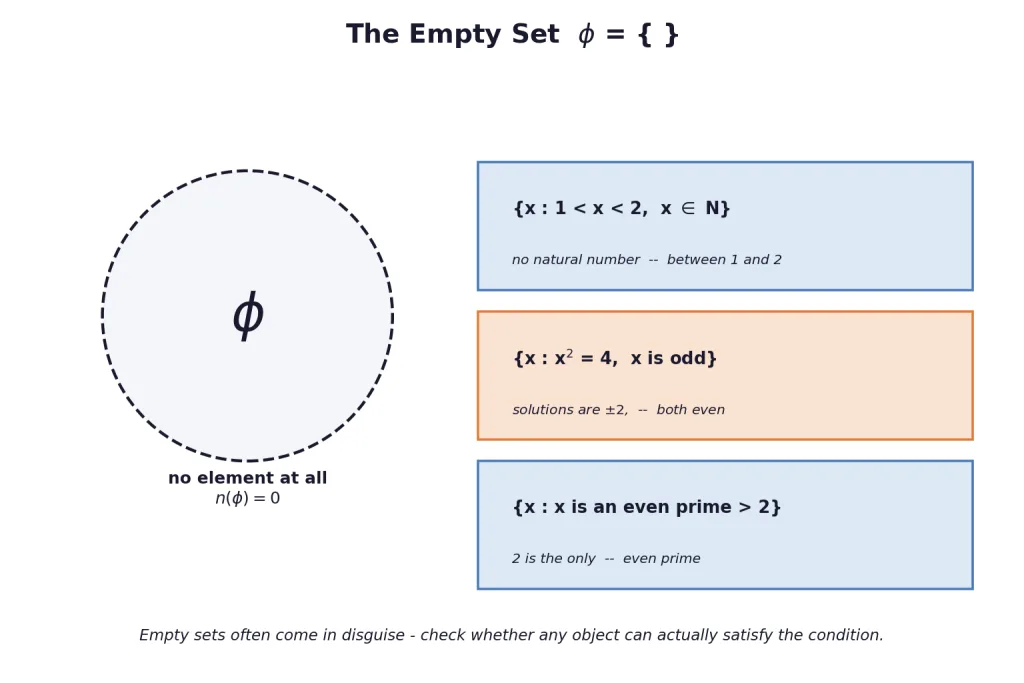
Consider the set . A student cannot study in two classes simultaneously, so B contains… nothing at all. Mathematics gives this strange-sounding object a name and a place of honour.
Key Point (Definition): A set which does not contain any element is called the empty set (or the null set or the void set). It is denoted by or by { }.
Why honour a set with nothing in it? For the same reason we honour the number 0 — it makes the whole system work smoothly. You will meet constantly: as the intersection of disjoint sets, as the solution set of impossible equations, as a subset of every set.
Spotting empty sets in disguise
The skill tested in exams is recognising when a condition is impossible to satisfy:
- — there is no natural number strictly between 1 and 2. .
- — the solutions are , both irrational. .
- — 2 is the only even prime. .
- — the solutions are both even. .
[Board Important] Write the empty set as or { } — never as {}. The set {} is NOT empty: it contains one element, namely the empty set itself. Similarly {0} is not empty — it contains the element 0.
Finite and Infinite Sets
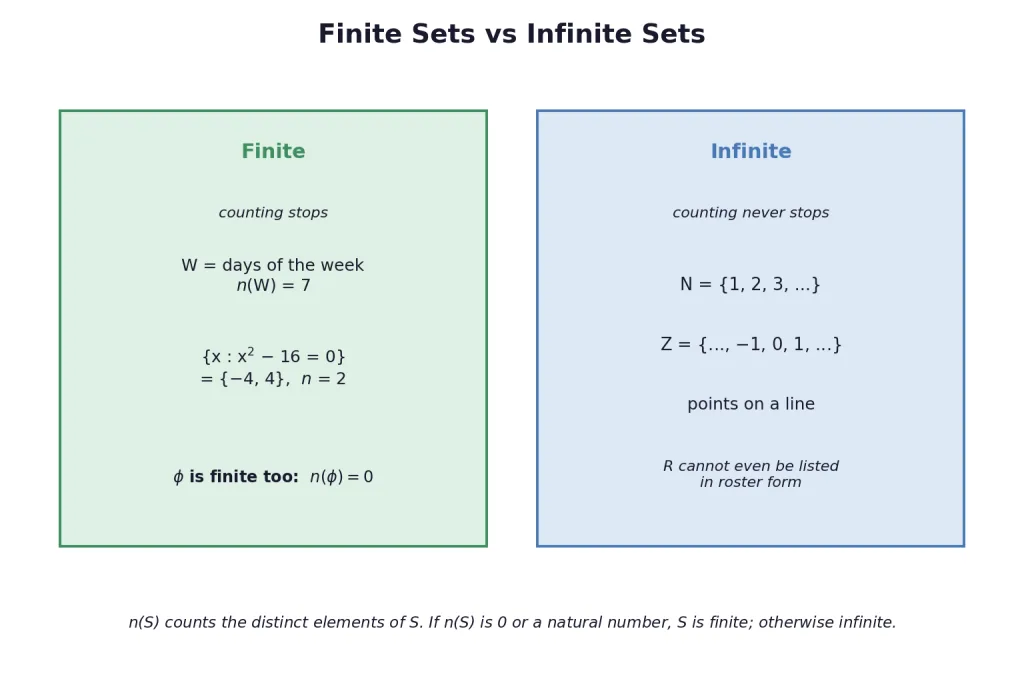
Count the elements of a set S; call the number of distinct elements . Two very different situations arise:
- Counting stops. For A = {1, 2, 3, 4, 5}, . For W = the days of the week, . Even for C = all people alive today, the count is some definite (huge) natural number.
- Counting never stops. For = {1, 2, 3, …} there is no last element to reach.
Key Point (Definition): A set which is empty or consists of a definite number of elements is called finite; otherwise it is called infinite.
Note the phrase "empty or" — the empty set is counted as finite, with .
Recognising infinite sets
Geometric and number-theoretic families are the usual suspects:
- The set of points on a line — infinite.
- The set of lines parallel to the x-axis — infinite.
- The set of circles passing through the origin — infinite.
- The set of prime numbers — infinite (a celebrated theorem of Euclid).
- The set of multiples of 5 — infinite.
Infinite sets with a clear pattern can still be written in roster form with dots: {1, 3, 5, 7, …}. But not every infinite set can be roster-listed — the set of real numbers cannot be written in roster form, because its elements follow no listable pattern.
[JEE Tip] "The set of months of a year" is finite (12), but "the set of positive integers greater than 100" is infinite — the phrase greater than opens an unbounded tail. Scan the condition for whether it bounds the set on both sides.
Equal Sets
Key Point (Definition): Two sets A and B are equal, written , if they have exactly the same elements — every element of A is in B and every element of B is in A. Otherwise they are unequal, written .
Examples:
- A = {1, 2, 3, 4} and B = {3, 1, 4, 2} — same elements, different order. .
- A = the set of prime numbers less than 6 = {2, 3, 5}, and P = the set of prime factors of 30 = {2, 3, 5}. Two totally different descriptions, same elements: .
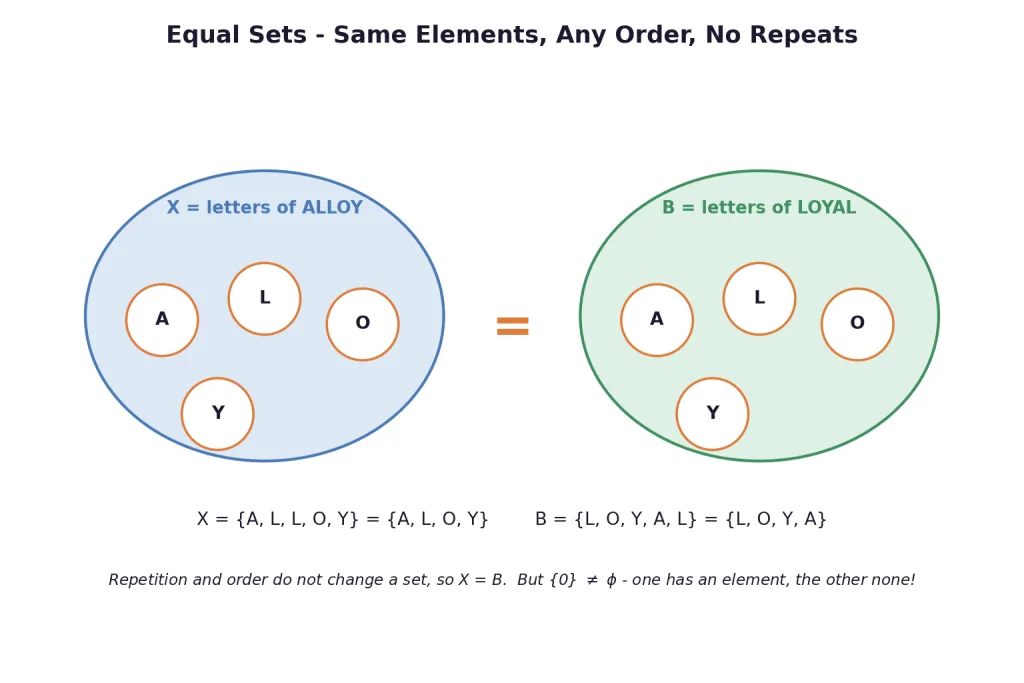
A set also does not change if elements are repeated in the description: {1, 2, 3} = {2, 2, 1, 3, 3}. That is exactly why roster form avoids repeats — the set of letters of ALLOY and of LOYAL is the same set {A, L, O, Y}.
The checklist for deciding equality
- Convert both sets to roster form (solve equations, enumerate conditions).
- Ignore order and repetition.
- Compare element by element — ONE element in either set but not the other breaks equality.
[JEE Tip] Watch for near-misses built from equations. and are NOT equal — D carries the extra element . Equations of different degree rarely give equal solution sets; check the negative root every time.
[Board Important] {0} (the first has an element, the second has none), and for the same reason. These two traps between them have appeared in some form in nearly every school exam on this chapter.
Solved Examples
Example 1. Which of the following are examples of the null set? (i) The set of odd natural numbers divisible by 2. (ii) The set of even prime numbers. (iii) . (iv) .
Solution.
Step 1 — read each condition as a demand and ask: can ANY object meet it?
(i) Step 2. An odd number leaves remainder 1 on division by 2; being divisible by 2 demands remainder 0. The two demands contradict each other, so no element exists. Null set.
(ii) Step 3. Careful — this looks contradictory but is not: 2 is even AND prime. The set is {2}, which has an element. Not a null set.
(iii) Step 4. A number below 5 cannot simultaneously exceed 7 (the demands describe disjoint parts of the number line). Null set.
(iv) Step 5. Parallel lines, by definition, never intersect — there is no common point at all. Null set.
Takeaway: test the condition for a hidden contradiction, but test honestly — "even prime" survives because of the single exception 2.
Example 2. Decide whether each set is empty: (i) (ii) (iii) .
Solution.
(i) Step 1. The natural numbers step 1, 2, 3, … — between the CONSECUTIVE naturals 1 and 2 no natural number exists. .
(ii) Step 2. Solve first: gives or . Now filter by the domain: is irrational, so neither solution lies in . Nothing survives: .
(iii) Step 3. Solve: gives or . Filter: both are even, but the condition demands odd. Nothing survives: .
Takeaway: the working pattern is always solve first, filter second — the set is empty exactly when the filter kills every solution.
Example 3. State which of the following sets are finite or infinite: (i) (ii) (iii) (iv) (v) .
Solution.
(i) Step 1. gives or , both natural. The set is {1, 2} — counting stops at 2. Finite, .
(ii) Step 2. gives ; only 2 is natural. The set is {2}. Finite, .
(iii) Step 3. gives , not a natural number, so the set is . And the empty set IS finite, with . Finite.
(iv) Step 4. Euclid proved there are infinitely many primes — the list 2, 3, 5, 7, 11, … never ends. Infinite.
(v) Step 5. The odd naturals {1, 3, 5, …} continue forever. Infinite.
Takeaway: part (iii) is the exam favourite — empty means , and 0 elements is a definite (finite) count.
Example 4. State whether each set is finite or infinite: (i) The set of lines parallel to the x-axis. (ii) The set of letters in the English alphabet. (iii) The set of animals living on the earth. (iv) The set of circles passing through the origin.
Solution.
(i) Step 1. A line parallel to the x-axis has the form , one line for EACH real number — and there are infinitely many real heights. Infinite.
(ii) Step 2. The alphabet has exactly 26 letters — a definite count. Finite.
(iii) Step 3. However enormous, the number of animals alive at any moment is a definite natural number. Finite.
(iv) Step 4. Through the origin one can draw circles of every radius and every centre direction — an unending family. Infinite.
Takeaway: "large" is not "infinite". Physical collections are finite; geometric families indexed by a real parameter (height, radius) are infinite.
Example 5. Find the pairs of equal sets, giving reasons: , , , , .
Solution.
Step 1 — convert all five to roster form. A = {0} (given). B: no number is both above 15 and below 5, so . C: gives C = {5}. D: gives , so D = {, 5}. E: factorise , roots 5 and ; the positive integral root is 5, so E = {5}.
Step 2 — compare systematically. : no other set contains 0 — matches nothing. : every other set is non-empty — matches nothing. C = {5} vs D = {, 5}: D has the extra element , so . C = {5} vs E = {5}: identical ✓. D vs E: sizes differ, unequal.
Step 3 — conclude. The only equal pair is .
Takeaway: roster-convert everything first; also note how one negative root () separates D from C — the standard near-miss between a linear and a quadratic equation.
Example 6. Are the following pairs equal? (i) X = the set of letters in ALLOY, B = the set of letters in LOYAL. (ii) , .
Solution.
(i) Step 1. ALLOY = A, L, L, O, Y → drop the repeated L → X = {A, L, O, Y}. LOYAL = L, O, Y, A, L → B = {L, O, Y, A}.
Step 2. Both sets contain exactly the letters A, L, O, Y; order is irrelevant. Equal.
(ii) Step 3. Enumerate A: integers with are , so A = {, , 0, 1, 2}. Solve for B: gives B = {1, 2}.
Step 4. Hunt for one mismatch: but . Not equal (sizes 5 vs 2 already settle it).
Takeaway: for word-sets only the pool of letters matters; for solution-sets, always enumerate before comparing.
Example 7. From the sets A = {2, 4, 8, 12}, B = {1, 2, 3, 4}, C = {4, 8, 12, 14}, D = {3, 1, 4, 2}, E = {, 1}, F = {0, a}, G = {1, }, H = {0, 1}, select the equal sets.
Solution.
Step 1 — sort the sets by size. Four-element: A, B, C, D. Two-element: E, F, G, H. Sets of different sizes can never be equal, so compare only within each group.
Step 2 — the four-element group. B = {1, 2, 3, 4} and D = {3, 1, 4, 2}: same four elements, so B = D. A vs C: but (and ) — unequal. A vs B: , — unequal. C vs B/D: 14 appears only in C — unequal.
Step 3 — the two-element group. E = {, 1} and G = {1, }: same elements, E = G. F = {0, a}: without knowing , F matches neither H = {0, 1} nor the others. H contains 0, which E and G lack.
Step 4 — conclude. B = D and E = G.
Takeaway: grouping by cardinality first cuts the number of comparisons from to just a few.
Example 8. Show that the set of letters needed to spell CATARACT and the set of letters needed to spell TRACT are equal.
Solution.
Step 1. CATARACT spells C, A, T, A, R, A, C, T. Dropping repeats (A three times, C twice, T twice): X = {C, A, T, R}.
Step 2. TRACT spells T, R, A, C, T. Dropping the repeated T: Y = {T, R, A, C}.
Step 3. Both sets consist of exactly the letters A, C, R, T, so X = Y.
Takeaway: an eight-letter word and a five-letter word can use the same four-letter pool — repetition inflates the word, never the set.
Example 9. Classify each set: (i) (ii) (iii) .
Solution.
(i) Step 1. For any real , , so has no real solution. The set is — empty, hence finite with .
(ii) Step 2. The integers strictly between and 3 are — the endpoints are excluded by the strict inequalities. Finite, .
(iii) Step 3. Between 0 and 1 sit — already an infinite list, and there are many more. Infinite.
Takeaway: the same interval holds finitely many integers but infinitely many rationals (or reals) — the DOMAIN decides, not the length of the interval.
Example 10. Find for: (i) S = the set of letters of MATHEMATICS. (ii) S = . (iii) S = . (iv) S = {}.
Solution.
(i) Step 1. MATHEMATICS = M, A, T, H, E, M, A, T, I, C, S. Distinct letters: {M, A, T, H, E, I, C, S} → (M, A, T each repeated once: ✓).
(ii) Step 2. Factorise: ; the prime divisors are 2, 3, 5 → .
(iii) Step 3. The empty set has no elements → .
(iv) Step 4. {} is a box containing ONE item — the item happens to be the empty set → .
Takeaway: parts (iii) and (iv) sit side by side deliberately: has zero elements, {} has one. Feel that difference once and the classic trap never works again.
Example 11. State whether A = B: (i) A = {4, 8, 12, 16}, B = {8, 4, 16, 18}. (ii) A = {2, 4, 6, 8, 10}, B = . (iii) , B = {10, 15, 20, 25, 30, …}.
Solution.
(i) Step 1. Hunt for one mismatch: but . That alone settles it — not equal (indeed is also missing from A).
(ii) Step 2. Enumerate B: positive even integers up to 10 are 2, 4, 6, 8, 10 — exactly A. Equal.
(iii) Step 3. Check B's elements against A's condition: , but 15 is not a multiple of 10, so . Not equal.
Takeaway: ONE mismatched element ends the comparison — equality demands agreement on every element, so a single counterexample is a complete proof of inequality.
Example 12. Show that is the empty set, and contrast it with .
Solution.
Step 1 — solve the equation. gives or .
Step 2 — filter for B (rationals). is irrational (same standard argument as for ), and so is . Neither solution is rational: .
Step 3 — filter for C (reals). Both are real numbers, so C = {, } with .
Takeaway: emptiness is a property of the equation AND the domain together — the same equation is empty over yet two-element over .
Example 13. Is the set finite or infinite? Find .
Solution.
Step 1 — spot the bounding condition. "Multiple of 3" alone is infinite, but "divides 300" caps every element at 300 — so S is finite.
Step 2 — enumerate. Factorise . The divisors of 300 that contain the factor 3 are where divides . Divisors of 100: 1, 2, 4, 5, 10, 20, 25, 50, 100 — nine of them.
Step 3 — list and count. Multiplying by 3: S = {3, 6, 12, 15, 30, 60, 75, 150, 300}, so ✓ (matches the nine divisors of 100).
Takeaway: a conjunction of conditions is only as unbounded as its MOST restrictive part — one bounding clause makes the whole set finite.