
Operations on Sets — Arithmetic for Collections
Just as addition and multiplication take two numbers and produce a number, set operations take two sets and produce a set. There are four to master: union, intersection, difference and complement. From here on, all our sets are subsets of some universal set U.
Union:
Key Point (Definition): The union of A and B is the set of all elements which are in A or in B (including those in both): .
Example: A = {2, 4, 6, 8} and B = {6, 8, 10, 12} give = {2, 4, 6, 8, 10, 12} — the common elements 6 and 8 are taken only once.
The "or" here is the inclusive or of mathematics: x may be in A, in B, or in both.
If , then — pouring a subset back into its parent adds nothing.
Properties of union:
- (commutative law)
- (associative law)
- (identity law — is the identity of )
- (idempotent law)
- (law of U)
Intersection and Disjoint Sets
Key Point (Definition): The intersection of A and B is the set of all elements common to both: .
Example: with A = {2, 4, 6, 8} and B = {6, 8, 10, 12}, = {6, 8}.
If , then — intersecting with a parent returns the subset.
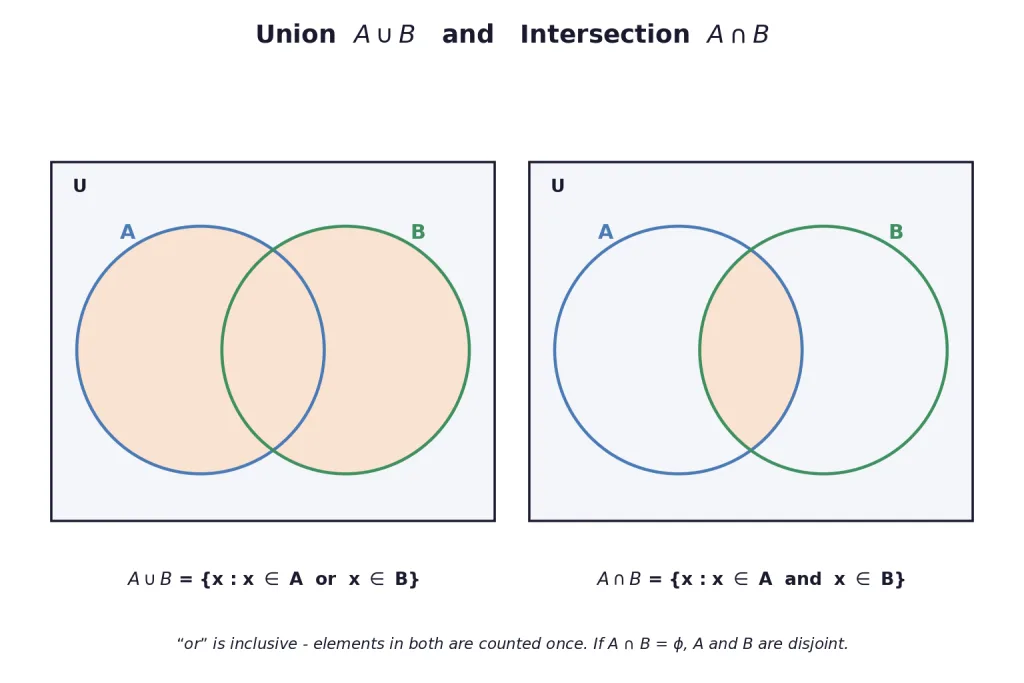
Disjoint sets
If — no common element at all — then A and B are called disjoint sets. Example: {2, 4, 6, 8} and {1, 3, 5, 7} are disjoint. In a Venn diagram, disjoint sets are drawn as non-overlapping circles.
Properties of intersection:
- (commutative law)
- (associative law)
- , (laws of and U)
- (idempotent law)
- (distributive law — distributes over )
The dual distributive law also holds: .
[JEE Tip] The distributive laws work exactly like in algebra — but in sets, BOTH distributions are valid, which has no arithmetic analogue ( for numbers!). Verifying either law by shading two Venn diagrams is a classic 3-mark question.
Difference of Sets
Key Point (Definition): The difference (read "A minus B") is the set of elements which belong to A but not to B: .
Example: A = {1, 2, 3, 4, 5, 6}, B = {2, 4, 6, 8}:
- = {1, 3, 5} — in A, not in B.
- = {8} — in B, not in A.
Notice immediately: . The difference of sets is not commutative — order matters, exactly as with subtraction of numbers.
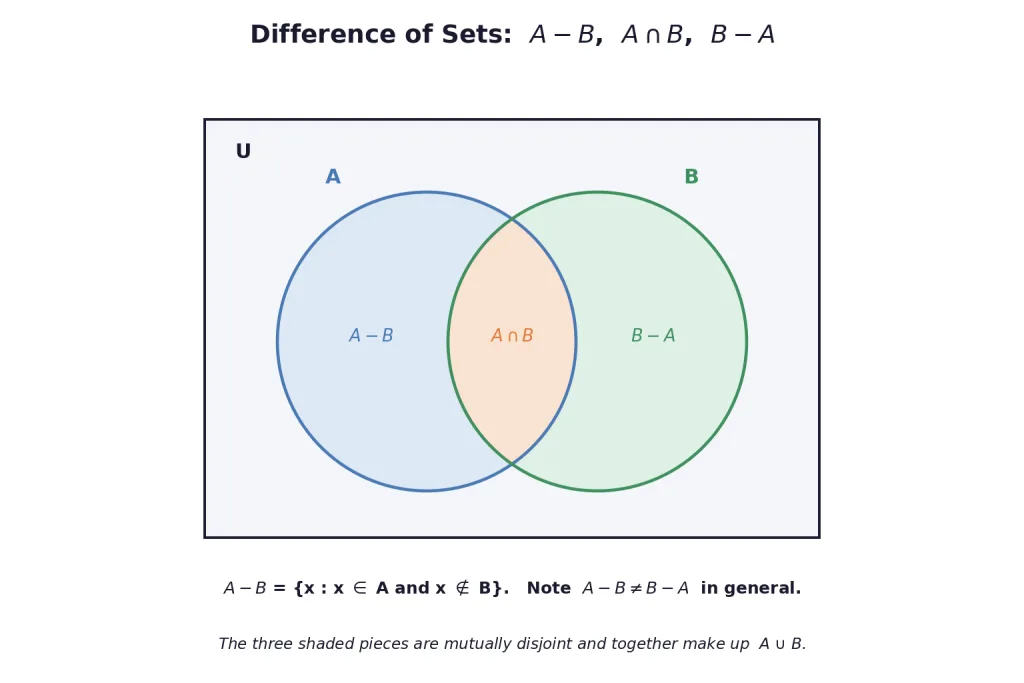
The picture shows something worth memorising: the three sets , and are mutually disjoint, and together they tile the whole of :
Also useful: — a set splits cleanly into "private part" and "shared part".
A famous instance: = the set of irrational numbers T. The difference operation defines the irrationals.
[Board Important] When computing in roster form, walk through A's elements one at a time and strike out those appearing in B. Do not touch B's extra elements — they are irrelevant to .
Complement of a Set
Fix a universal set U. For a subset A of U:
Key Point (Definition): The complement of A is the set of all elements of U which are not elements of A: . Clearly .
Example: U = {1, 2, …, 10}, A = {1, 3, 5, 7, 9} gives A' = {2, 4, 6, 8, 10}.
Example: U = all students of Class XI, A = the girls; then A' = the boys.
Taking complement twice returns the original set: — flipping membership two times restores it.
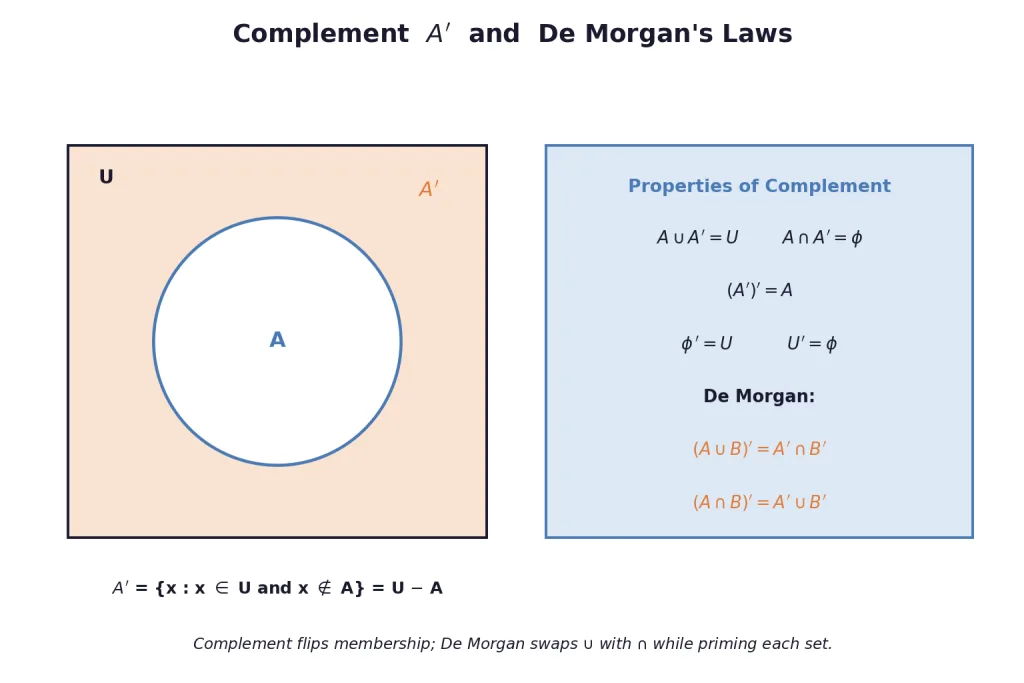
The laws of complement
- Complement laws: and — a set and its complement tile U with no overlap.
- De Morgan's laws: and .
- Double complementation: .
- Laws of and U: and .
De Morgan in words: the complement of a union is the intersection of the complements; the complement of an intersection is the union of the complements. Priming flips and .
Quick verification with U = {1, 2, 3, 4, 5, 6}, A = {2, 3}, B = {3, 4, 5}: = {2, 3, 4, 5}, so = {1, 6}. Separately A' = {1, 4, 5, 6} and B' = {1, 2, 6}, whose intersection is {1, 6}. Match! ✓
[JEE Tip] De Morgan's laws are the single most examined fact of this chapter in MCQs. An everyday translation helps: "NOT (rich or famous)" means "not rich AND not famous". The negation of an or is an and of negations.
Solved Examples
Example 1. Let A = {2, 4, 6, 8} and B = {6, 8, 10, 12}. Find .
Solution.
Step 1 — pool every element of both sets. From A: 2, 4, 6, 8. From B: 6, 8, 10, 12.
Step 2 — drop duplicates. 6 and 8 appear in both lists; a set records each element once.
Step 3 — write the union. .
Step 4 — sanity check. : total minus the 2 shared elements — exactly the counting rule .
Takeaway: union merges lists; shared elements appear once, never twice.
Example 2. Let A = {a, e, i, o, u} and B = {a, i, u}. Show that .
Solution.
Step 1 — observe the subset relation. Every element of B (a, i, u) already lies in A, so .
Step 2 — compute the union. Pooling contributes nothing new from B: .
Step 3 — extract the general rule. Whenever , we get — pouring a subset back into its parent changes nothing.
Takeaway: with a subset, union just picks the bigger set — a rule you may quote directly in exams.
Example 3. X = {Ram, Geeta, Akbar} is the hockey team and Y = {Geeta, David, Ashok} the football team. Find and , and interpret.
Solution.
Step 1 — the union. Pool both teams, listing Geeta once: = {Ram, Geeta, Akbar, David, Ashok}. Interpretation: students who play hockey OR football (or both).
Step 2 — the intersection. Scan for names on BOTH lists: only Geeta. = {Geeta}. Interpretation: students who play both games.
Step 3 — read the sizes. : the one double-counted player (Geeta) is subtracted once ✓.
Takeaway: in real-world language, union = "atleast one of the two", intersection = "both".
Example 4. Let A = {1, 2, 3, 4, 5, 6, 7, 8, 9, 10} and B = {2, 3, 5, 7}. Find and show that .
Solution.
Step 1 — find the common elements. Check B's elements against A: 2 ✓, 3 ✓, 5 ✓, 7 ✓ — every element of B lies in A.
Step 2 — write the intersection. , which is exactly B.
Step 3 — extract the general rule. Since , intersecting with the parent returns the subset: .
Takeaway: the companion of Example 2 — with a subset, union picks the bigger set and intersection picks the smaller.
Example 5. If A = {3, 5, 7, 9, 11}, B = {7, 9, 11, 13}, C = {11, 13, 15} and D = {15, 17}, find: (i) (ii) (iii) (iv) (v) .
Solution.
Step 1 — work strictly inside-out: brackets first.
(i) Step 2. Common to A and B: 7, 9, 11 → .
(ii) Step 3. Common to B and C: 11, 13 → .
(iii) Step 4. First ; then intersect with D = {15, 17}: 11 is absent → .
(iv) Step 5. Inner bracket: . Intersect with A: keep 7, 9, 11 → .
(v) Step 6. and ; the common elements are 7, 9, 11, 15 → .
Step 7 — check (iv) against the distributive law. ✓ — matches the bracket-first computation.
Takeaway: never distribute mentally in one go — compute the inner bracket, then apply the outer operation.
Example 6. With A = naturals, B = even naturals, C = odd naturals, D = primes, find , , , , , .
Solution.
Step 1 — intersections with the parent set. B, C, D are all subsets of A, so intersecting with A returns each unchanged: , , .
Step 2 — . A number even AND odd would leave remainders 0 and 1 on division by 2 simultaneously — impossible: .
Step 3 — . An even prime is divisible by 2, and primality then forces it to BE 2: .
Step 4 — . The odd primes: every prime except 2, i.e. .
Takeaway: — the lone even prime — is the most quoted intersection in mathematics; it decides dozens of empty-set questions.
Example 7. Let V = {a, e, i, o, u} and B = {a, i, k, u}. Find V − B and B − V.
Solution.
Step 1 — V − B: walk through V, striking anything found in B. a ∈ B strike; e stays; i ∈ B strike; o stays; u ∈ B strike. Result: .
Step 2 — B − V: walk through B, striking anything found in V. a strike; i strike; k stays; u strike. Result: .
Step 3 — compare. : the two differences are different sets, even of different sizes.
Takeaway: difference is NOT commutative — each difference is computed from its own left-hand set, and the shared elements (a, i, u) vanish from both answers.
Example 8. If A = {3, 6, 9, 12, 15, 18, 21}, B = {4, 8, 12, 16, 20}, C = {2, 4, 6, 8, 10, 12, 14, 16}, find (i) A − B (ii) B − C (iii) C − A (iv) B − A.
Solution.
Step 1 — identify each pair's overlap first (the elements that will be struck). ; ; .
(i) Step 2. Strike 12 from A: .
(ii) Step 3. Strike 4, 8, 12, 16 from B: .
(iii) Step 4. Strike 6, 12 from C: .
(iv) Step 5. Strike 12 from B: .
Step 6 — observe. The overlap appears in NEITHER nor — shared elements never survive a difference.
Takeaway: compute the intersection first; the difference is then a clean strike-out with no second-guessing.
Example 9. If is the set of real numbers and the set of rational numbers, what is ?
Solution.
Step 1 — apply the definition of difference. : the reals that are not rational.
Step 2 — recognise the set. Real-but-not-rational is precisely the definition of an IRRATIONAL number, so , the set of irrationals — home of , , , e.
Takeaway: the irrationals are not defined by a property of their own — they are literally a set difference. A one-line question that appears year after year.
Example 10. Let U = {1, 2, 3, 4, 5, 6, 7, 8, 9}, A = {1, 2, 3, 4}, B = {2, 4, 6, 8} and C = {3, 4, 5, 6}. Find (i) A' (ii) B' (iii) (iv) (v) (A')' (vi) .
Solution.
Step 1 — the method: every complement is U minus the set. Compute the inner set first, then strike its elements from U.
(i) Step 2. .
(ii) Step 3. .
(iii) Step 4. Inner set: . Complement: .
(iv) Step 5. Inner set: . Complement: .
(v) Step 6. ✓ — double complementation restores the set.
(vi) Step 7. Inner set: (strike 4, 6 from B). Complement: .
Takeaway: always resolve the inner operation to an explicit roster before priming — complements of unevaluated expressions invite errors.
Example 11. Let U = {1, 2, 3, 4, 5, 6}, A = {2, 3} and B = {3, 4, 5}. Verify that .
Solution.
Step 1 — compute the left side. , so .
Step 2 — compute the right side independently. and . Their common elements: 1 and 6 → .
Step 3 — compare. Both sides equal ✓ — De Morgan's first law verified for this data.
Takeaway: the verification template is always: compute each side separately, then match. The same three steps verify the twin law .
Example 12. Taking as the universal set, write the complements of: (i) (ii) (iii) .
Solution.
Step 1 — the method for infinite universes. Listing is impossible; instead NEGATE the defining condition.
(i) Step 2. Not even (within ) = odd: complement .
(ii) Step 3. Solve the inequality first: , so the set is {5, 6, 7, …}. Negate: within gives — here the complement happens to be listable.
(iii) Step 4. Complement .
Takeaway: in an infinite universe, the complement is described by negating the condition — solve inequalities BEFORE negating to avoid sign slips.
Example 13. Using properties of sets, show that .
Solution.
Step 1 — plan a two-way containment. Set equality is proved by showing each side contains the other.
Step 2 — easy direction. : any set sits inside its union with anything.
Step 3 — other direction. The union has two parts: A itself, and . But , so BOTH parts lie inside A, hence .
Step 4 — conclude. Containment both ways gives . ∎ The twin identity is proved the same way.
Takeaway: these are the absorption laws — a set absorbs its union or intersection with anything built from it, and the proof is pure containment-chasing.
Example 14. Show that implies A = B.
Solution.
Step 1 — recall the squeeze. For any sets, — every set sits between the intersection and the union.
Step 2 — show . Take . Then . Using the hypothesis : , and in particular .
Step 3 — show . Symmetric: .
Step 4 — conclude. Both containments hold, so A = B. ∎
Takeaway: when the two ends of the squeeze coincide, everything trapped between them collapses to equality.
Example 15. Show that for any sets A and B: .
Solution.
Step 1 — show every element of A lands in the right side. Take . Exactly one of two cases holds: , putting ; or , putting . Either way belongs to the union: .
Step 2 — show the right side stays inside A. ✓ and ✓, so their union is contained in A.
Step 3 — conclude. Equality holds: A splits as shared part private part, and the two parts are disjoint. ∎
Takeaway: "shared plus private rebuilds the set" — this disjoint split is what powers the counting rule used heavily in the JEE Corner.