
How to Use This Section
Here are 32 fully worked problems covering the entire chapter — representations, types of sets, subsets and intervals, and the four operations with De Morgan's laws — arranged in a deliberate easy → medium → hard progression.
A suggestion that multiplies the value of every problem: attempt each one yourself before reading the solution. Cover the solution, write your answer, then compare. The gap between "I follow the solution" and "I produced the solution" is exactly the gap between reading marks and scoring marks.
Problems 1-10 warm you up on representations and classification, 11-22 build fluency with subsets, intervals and operations, and 23-32 finish with proof-style and multi-step questions of Board and JEE difficulty.
Solved Examples
Example 1. Which of these are sets? (i) The collection of all even integers. (ii) A collection of the most dangerous animals of the world. (iii) The collection of all questions in this chapter.
Solution.
Step 1 — apply the well-defined test to each collection. A collection is a set exactly when membership can be decided objectively.
(i) Step 2. Given any object, we can check definitively whether it is an even integer (integer? divisible by 2?). Set.
(ii) Step 3. "Most dangerous" is a matter of opinion — one person's list differs from another's, and no objective rule decides membership. Not a set.
(iii) Step 4. The questions printed in this chapter form a definite, checkable list. Set.
Takeaway: objective criterion → set; subjective superlative → not a set.
Example 2. Write in roster form: (i) (ii) .
Solution.
(i) Step 1 — read the brackets on the bounds. includes ; excludes 7.
Step 2 — list the integers. A = {, , , 0, 1, 2, 3, 4, 5, 6}. Count check: from to 6 inclusive is elements ✓.
(ii) Step 3. Naturals strictly below 6: B = {1, 2, 3, 4, 5}.
Takeaway: admits the endpoint, excludes it — settle each bound before listing.
Example 3. Write in roster form: .
Solution.
Step 1 — set up a systematic scan. Write with tens digit and units digit , demanding .
Step 2 — run t from 1 upwards. ; ; ; ; ; ; ; . ( would need — stop.)
Step 3 — write the set. C = {17, 26, 35, 44, 53, 62, 71, 80}, eight elements.
Takeaway: scanning by the tens digit in increasing order guarantees nothing is missed and nothing is repeated — note 80 counts but "08" does not (not a two-digit number).
Example 4. Write in set-builder form: (i) {3, 6, 9, 12} (ii) {5, 25, 125, 625} (iii) {2, 4, 6, …}.
Solution.
(i) Step 1. Each element is 3 times its position: . The list stops, so bound the parameter: .
(ii) Step 2. Rewrite as powers: : .
(iii) Step 3. The dots signal an unending pattern — all even naturals: , with NO bound on .
Takeaway: finite list → bounded parameter; trailing dots → free parameter. The bound is part of the answer, not decoration.
Example 5. Decide whether each set is empty: (i) (ii) (iii) .
Solution.
(i) Step 1. The demands and describe disjoint stretches of the number line — no number satisfies both. .
(ii) Step 2. Parallel lines never meet, so no common point exists. .
(iii) Step 3 — check honestly before declaring emptiness. Naturals with : 1, 2, 3, 4. Keep the even ones: 2 and 4. The set is {2, 4} — not empty.
Takeaway: two conditions joined by "and" are not automatically contradictory — always run the filter before answering .
Example 6. Classify: (i) the set of concentric circles centred at the origin (ii) the set of letters of the word INFINITE (iii) .
Solution.
(i) Step 1. One circle for every positive radius , and the positive reals are unending. Infinite.
(ii) Step 2. INFINITE = I, N, F, I, N, I, T, E; distinct letters {I, N, F, T, E}. Finite, .
(iii) Step 3. means : the integers . Count: . Finite, .
Takeaway: the word INFINITE names a finite set — judge by elements, never by names; and in symmetric integer ranges, remember to count 0.
Example 7. Are A and B equal? , .
Solution.
Step 1 — solve for B. Factorise: two numbers with product and sum are , so , giving or .
Step 2 — write B and compare. B = {, }, while A = {2, 3}. The elements differ in sign: but .
Step 3 — conclude. . Sanity check: with all coefficients positive, is positive for every positive — no positive root was ever possible.
Takeaway: factorising gives roots , NOT — the sign slip here is epidemic in exams.
Example 8. A = the set of letters of REAP, B = of PEAR, C = of PAPER. Which pairs are equal?
Solution.
Step 1 — convert each word to its letter set. REAP → {R, E, A, P}. PEAR → {P, E, A, R}. PAPER → P, A, P, E, R → drop the repeated P → {P, A, E, R}.
Step 2 — compare. All three sets contain exactly the four letters A, E, P, R.
Step 3 — conclude. A = B = C — every pair is equal.
Takeaway: anagrams share a letter set automatically, and even a longer word with repeats (PAPER) can collapse to the same set.
Example 9. Let A = {1, {2}, 3}. True or false: (i) (ii) (iii) (iv) (v) .
Solution.
Step 1 — inventory A. Three elements: the number 1, the packet {2}, the number 3. The bare number 2 is NOT an element.
(i) Step 2. 1 is listed → true.
(ii) Step 3. Scan the list: 1, {2}, 3 — the number 2 is absent → false.
(iii) Step 4. The packet {2} IS listed → true.
(iv) Step 5. would require the ELEMENT 2 to belong to A, which (ii) denied → false.
(v) Step 6. Unpack {1, 3}: both 1 and 3 are elements of A → true.
Takeaway: {2} can be an element without 2 being one — unpack braces with total literal-mindedness.
Example 10. How many subsets does A = {p, q, r, s} have? How many are proper? How many contain the element p?
Solution.
Step 1 — all subsets. Each of the 4 elements is independently IN or OUT: subsets.
Step 2 — proper subsets. Proper excludes the set itself (only): .
Step 3 — subsets containing p. Fix p IN; the remaining elements q, r, s still choose freely: subsets.
Takeaway: "fix and count the free choices" answers every constrained subset count in one line — fixing elements leaves subsets.
Example 11. Let A = , B = , C = . Determine all subset relations among A, B, C.
Solution.
Step 1 — test . Take with ; then certainly . ✓ And the inclusion is proper: but .
Step 2 — test . Take with ; since and , we get . ✓ (The closed interval fits inside the strictly larger open one.)
Step 3 — chain them. , and transitivity gives as well. No reverse inclusion holds (e.g. lies in neither A nor C).
Takeaway: endpoint inclusion matters only when endpoints coincide; when one interval strictly contains the other's endpoints, brackets are irrelevant.
Example 12. Write as intervals and state their lengths: (i) (ii) (iii) .
Solution.
(i) Step 1. Strict left, inclusive right: . Length .
(ii) Step 2. From 3 (included) without upper bound: — an unbounded interval, no finite length.
(iii) Step 3 — unfold the squared inequality. : the interval , length .
Takeaway: the key conversion is (iii): — a squared bound unfolds into a symmetric closed interval.
Example 13. Find where A = and B = .
Solution.
Step 1 — roster both sets. A = {3, 6, 9, 12, …} (infinite), B = {1, 2, 3, 4, 5}.
Step 2 — merge. = {1, 2, 3, 4, 5, 6, 9, 12, 15, …} — B's small numbers plus every multiple of 3.
Step 3 — express cleanly. For an infinite union, set-builder with "or" is the polished answer: .
Takeaway: union translates to "or"; infinite unions are best LEFT in set-builder form rather than dotted rosters.
Example 14. A = , B = . Find and .
Solution.
Step 1 — roster the sets, minding the strict/inclusive bounds. A: naturals with → {2, 3, 4, 5, 6}. B: naturals with → {7, 8, 9}.
Step 2 — union. = {2, 3, 4, 5, 6, 7, 8, 9}.
Step 3 — intersection: check the boundary. 6 belongs to A (its ) but not to B (its strict ); 7 belongs to B only. No element is shared: — the sets are disjoint.
Takeaway: adjacent ranges can touch without overlapping; the verdict lives entirely at the boundary values.
Example 15. If A = {1, 2, 3}, B = , find , , and .
Solution.
Step 1. : the empty set contributes nothing → (identity law).
Step 2. : a common element would have to lie in — impossible → .
Step 3. : strike from A everything in — nothing gets struck → A = {1, 2, 3}.
Step 4. : the empty set has nothing to keep → .
Takeaway: is completely predictable: union leaves the other set alone; intersection and both differences involving on the left collapse to .
Example 16. A = {3, 6, 9, 12, 15, 18, 21}, B = {4, 8, 12, 16, 20}, C = {2, 4, 6, 8, 10, 12, 14, 16}, D = {5, 10, 15, 20}. Find (i) A − D (ii) D − A (iii) B − D (iv) C − D (v) D − C.
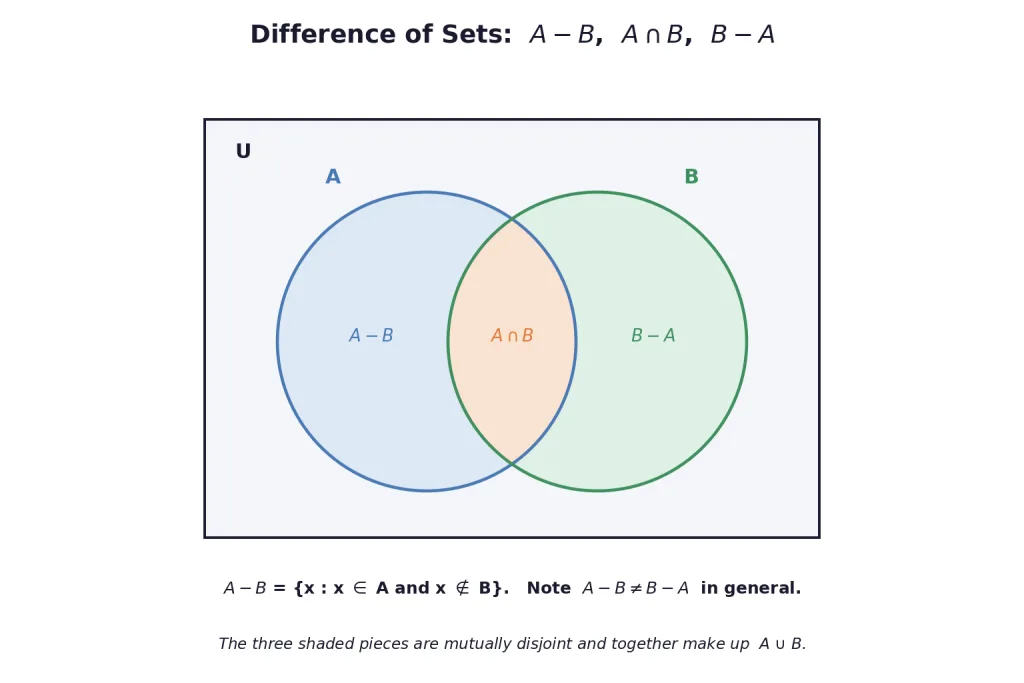
Solution.
Step 1 — find each relevant overlap first. ; ; .
(i) Step 2. Strike 15 from A: .
(ii) Step 3. Strike 15 from D: .
(iii) Step 4. Strike 20 from B: .
(iv) Step 5. Strike 10 from C: .
(v) Step 6. Strike 10 from D: .
Takeaway: compute the intersection once, then strike it from the left-hand set — two clean steps per part, no rescanning, and the shared element never survives on either side.
Example 17. Show that if and only if .
Solution.
Step 1 — forward direction (). Assume . An element of would lie in A but not in B — yet every element of A IS in B. No such element exists: .
Step 2 — reverse direction (). Assume . Take any . If , then would belong to , contradicting its emptiness. Hence .
Step 3 — conclude. Every element of A lies in B, i.e. . Both directions proved. ∎
Takeaway: this equivalence converts subset claims into difference computations and back — one of the four equivalent faces of (see Example 28).
Example 18. If U = {a, b, c, d, e, f, g, h}, find the complements of A = {a, b, c}, B = {d, e, f, g} and D = {f, g, h, a}.
Solution.
Step 1 — method. Each complement is U minus the set: strike the set's elements from U's list.
Step 2. A': strike a, b, c → .
Step 3. B': strike d, e, f, g → .
Step 4. D': strike f, g, h, a → .
Step 5 — verify with the counting check. ✓; ✓; ✓.
Takeaway: every time — an instant arithmetic check on any complement.
Example 19. U = {1, 2, 3, 4, 5, 6, 7, 8, 9}, A = {2, 4, 6, 8}, B = {2, 3, 5, 7}. Verify (i) (ii) .
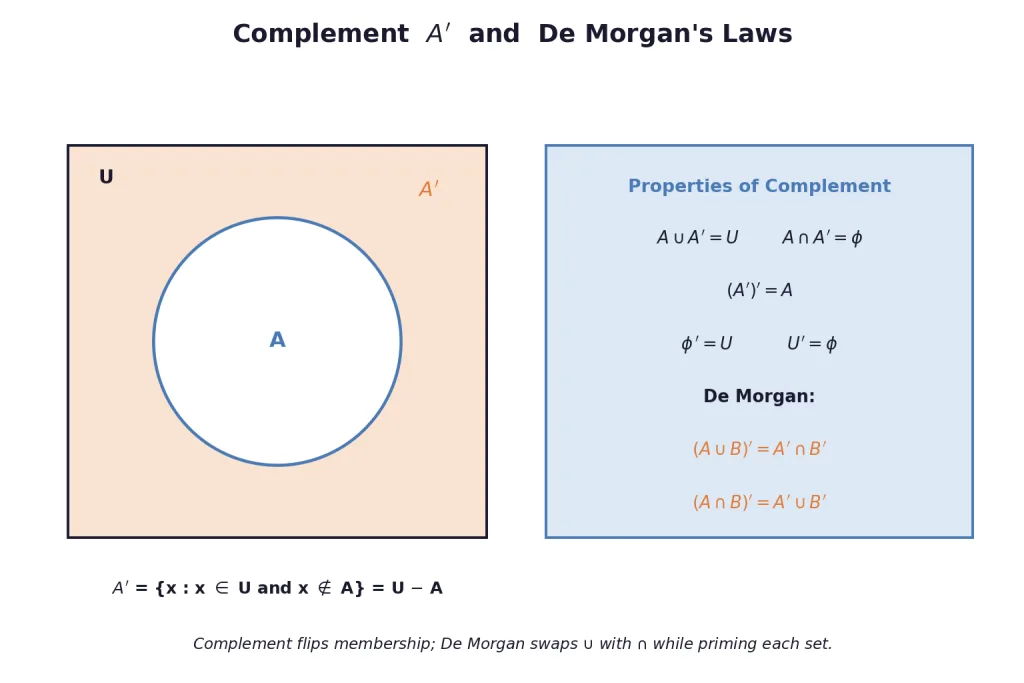
Solution.
Step 1 — compute the two complements once, for reuse. A' = U − A = {1, 3, 5, 7, 9}; B' = U − B = {1, 4, 6, 8, 9}.
(i) Step 2 — left side. , so .
Step 3 — right side. : common to {1, 3, 5, 7, 9} and {1, 4, 6, 8, 9} → {1, 9}. Match ✓.
(ii) Step 4 — left side. (the only shared element), so .
Step 5 — right side. . Match ✓.
Takeaway: both De Morgan laws verified on one dataset — compute each side independently and match; this exact verification is a recurring 3-mark question.
Example 20. With U = , describe the complements of: (i) the multiples of 3 (ii) (iii) the perfect cubes.
Solution.
Step 1 — method for an infinite universe. Listing is impossible; NEGATE the defining condition instead.
(i) Step 2. Negate "multiple of 3": = {1, 2, 4, 5, 7, 8, …}.
(ii) Step 3. Negate : , giving {1, 2, 3, 4, 5, 6} — here the complement happens to be finite and listable.
(iii) Step 4. Negate "perfect cube": — every natural except 1, 8, 27, 64, …
Takeaway: complementing negates the condition — flips to , "is" flips to "is not"; solve any inequality before negating.
Example 21. Fill in: (i) (ii) (iii) (iv)
Solution.
Step 1 — reduce the primed extreme sets first. and — memorise these two reductions.
(i) Step 2. Complement law: (everything is in A or outside it).
(ii) Step 3. (law of U).
(iii) Step 4. Complement law: (nothing is both in and out).
(iv) Step 5. (law of ).
Takeaway: two reductions plus two laws answer all four blanks — reduce first, then apply.
Example 22. Let A = and B = as subsets of . Find , and A − B.
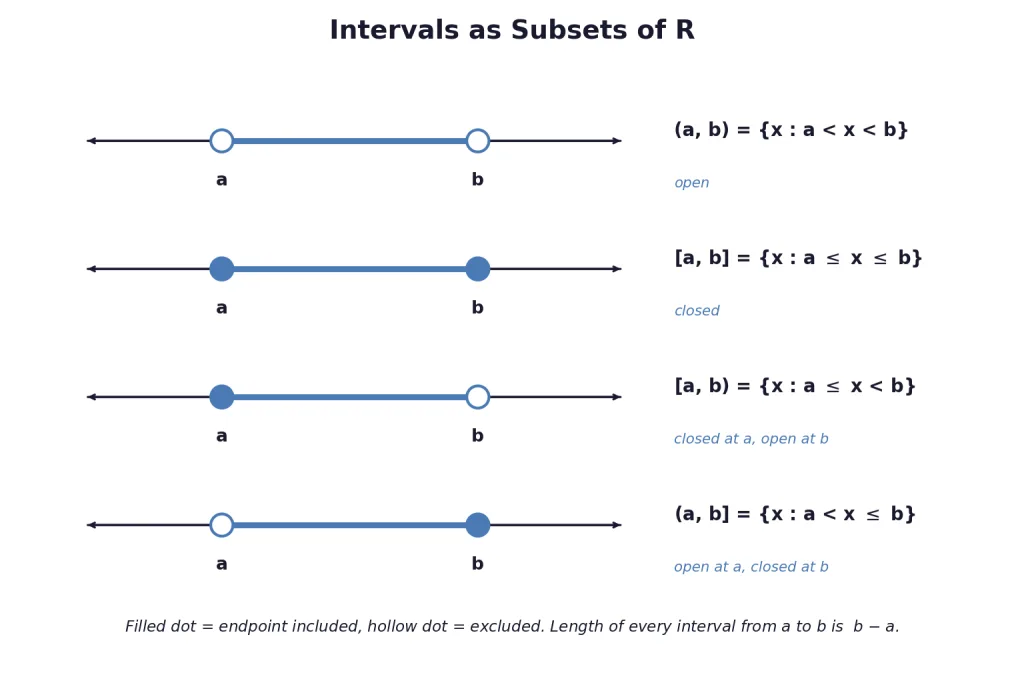
Solution.
Step 1 — sketch the number line. A runs from 1 (filled dot, in) to 5 (hollow, out); B from 3 (hollow, out) to 8 (filled, in). They overlap between 3 and 5.
Step 2 — union. Coverage starts at 1 (in, from A) and ends at 8 (in, from B) with no gap between: .
Step 3 — intersection. Both conditions at once: AND reduce to . Boundary check: 3 fails B's strict ; 5 fails A's strict . So .
Step 4 — difference. : the part of A NOT in B, i.e. with . Boundary check on 3: , so 3 SURVIVES the strike-out: .
Takeaway: do interval operations on a sketch, then interrogate each of the four boundary points separately — "is this endpoint in or out?" decides every bracket.
Example 23. Using properties of sets, show that (i) (ii) .
Solution.
(i) Step 1. — the overlap is part of A. Step 2. Union of A with one of its own subsets adds nothing: .
(ii) Step 3. — the union is a superset of A. Step 4. Intersecting A with one of its supersets keeps all of A: .
Takeaway: the absorption laws — union with a subset, intersection with a superset, both leave A untouched. They simplify monstrous expressions in one stroke.
Example 24. Show that need NOT imply B = C.
Solution.
Step 1 — plan the counterexample. We need B and C that agree INSIDE A but differ outside it — the intersection only sees the inside.
Step 2 — construct. A = {1, 2}, B = {2, 3}, C = {2, 4}.
Step 3 — verify. and — equal ✓. But while , so ✓.
Takeaway: intersection has no cancellation law — it is blind to everything outside A. (Remarkably, if BOTH AND hold, then B = C — Example 27.)
Example 25. Show that if , then .
Solution.
Step 1 — take a generic element. Let : then and .
Step 2 — push non-membership backwards. Could be in A? If it were, would force — contradicting . Hence .
Step 3 — land the element. and mean exactly .
Step 4 — conclude. Every element of lies in : . ∎
Takeaway: subtracting a BIGGER set leaves LESS — the inclusion reverses direction, exactly like taking reciprocals of positive numbers.
Example 26. Show that .
Solution.
Step 1 — left inside right. ✓ and ✓, so .
Step 2 — right inside left. Take . Case 1: — then x is in the left side directly. Case 2: — then x must come from B, so and , i.e. — again in the left side.
Step 3 — conclude. Both containments hold: . ∎
Takeaway: is exactly the "new material" B contributes to the union — draw the Venn picture once and this identity becomes obvious forever.
Example 27. Let A, B, C satisfy and . Show that B = C.
Solution.
Step 1 — start from B and absorb. by the absorption law.
Step 2 — substitute the first hypothesis. , so . Distribute: .
Step 3 — substitute the second hypothesis. , so . Factor C out by distributivity: .
Step 4 — finish with absorption. Using the first hypothesis once more: (absorption). Hence B = C. ∎
Takeaway: neither hypothesis cancels A alone (Example 24 killed one; a similar example kills the other), but TOGETHER they pin B to C — the chapter's most elegant proof; walk through it twice.
Example 28. Show that the following are equivalent: (i) (ii) (iii) (iv) .
Solution.
Step 1 — plan a cycle. Proving (i) → (ii) → (iii) → (iv) → (i) makes all four equivalent with only four implications.
Step 2 — (i) → (ii). If every element of A lies in B, no element qualifies for : it is .
Step 3 — (ii) → (iii). means A has nothing outside B, so pooling A into B adds nothing: .
Step 4 — (iii) → (iv). by the absorption law (using ).
Step 5 — (iv) → (i). If , then every element of A lies in , hence in B: . Cycle closed. ∎
Takeaway: four faces of one fact — in MCQs any of these can silently replace ""; recognise all four instantly.
Example 29. Sets A and B satisfy: and for some set X. Show A = B.
Solution.
Step 1 — absorb A into the union. by absorption.
Step 2 — substitute the union hypothesis. , so . Distribute: .
Step 3 — kill the second term. The hypothesis leaves , which gives .
Step 4 — repeat symmetrically for B. , giving .
Step 5 — conclude. Containment both ways: A = B. ∎
Takeaway: the same three tools — absorption, distributivity, disjointness — used twice symmetrically; proof questions from this chapter are permutations of exactly these moves.
Example 30. Find sets A, B, C such that , and are all non-empty but .
Solution.
Step 1 — design principle. Give each PAIR its own private shared element, and give no element to all three.
Step 2 — construct. A = {1, 2}, B = {2, 3}, C = {1, 3}: pair (A, B) shares 2, pair (B, C) shares 3, pair (A, C) shares 1.
Step 3 — verify all four conditions. ✓; ✓; ✓. Triple: an element of all three would have to be in each two-element set — check 1 (), 2 (), 3 (): none qualifies, so ✓.
Takeaway: pairwise overlap does NOT force a common core — the triangle {1,2}, {2,3}, {1,3} is the minimal counterexample, worth memorising.
Example 31. U = {1, 2, …, 10}, A = {1, 2, 3, 4, 5}, B = {4, 5, 6, 7}, C = {6, 7, 8, 9}. Compute and .
Solution.
Step 1 — first expression, inside out. , so . Intersect with C = {6, 7, 8, 9}: common elements 8, 9 → .
Step 2 — second expression: spot the De Morgan pattern. is exactly — already computed as {8, 9, 10}. No need to build A' and B' separately!
Step 3 — the remaining piece. .
Step 4 — union. .
Takeaway: recognising saved two complement computations — pattern recognition is the speed skill this chapter trains.
Example 32. State true or false with reasons: (i) If and , then . (ii) If and , then . (iii) If and , then .
Solution.
(i) Step 1 — true. Transitivity: take ; the first inclusion puts it in B, the second in C.
(ii) Step 2 — false; build a counterexample. A = {1}, B = {2}, C = {1, 3}. Check: ✓ (); ✓ (); yet ✓ (). Negative subset facts do not chain.
(iii) Step 3 — false; read the quantifier. says SOME element of A escapes B — not that every element does. With A = {1, 2}, B = {1, 3}: (2 escapes), and for , — so the claimed conclusion fails.
Takeaway: a negated subset statement asserts the EXISTENCE of one escapee, nothing more — the single most misread quantifier in this chapter.