
Why This Section Exists
The rationalised textbook chapter stops at complements — but the official JEE Main syllabus for Unit 1 explicitly lists "Sets and their representation; union, intersection and complement of sets and their algebraic properties; power set", and JEE question setters freely use subset-counting and the cardinality formulas that older textbook editions carried. This section restores every JEE-required tool:
- Power set and counting subsets;
- Laws of the algebra of sets — stated as a usable toolkit with proofs;
- Cardinality formulas — , its three-set version, and survey problems;
- Symmetric difference — a JEE favourite for one-liner MCQs.
The worked examples and practice questions here are modelled on the JEE Main and Advanced pattern and difficulty; they are practice questions in the exam style, not reproductions of specific past papers.
[Board Note] CBSE students: power set and counting are no longer in your syllabus. Treat this section as enrichment — the ideas are short and they deepen everything you learned in Sections 1-4.
The Power Set and Counting Subsets
Key Point (Definition): The power set of A, written , is the collection of all subsets of A — including and A itself. In , every element is itself a set.
For A = {1, 2}: .
The master count
Building a subset of an n-element set means making n independent in-or-out decisions — one per element:
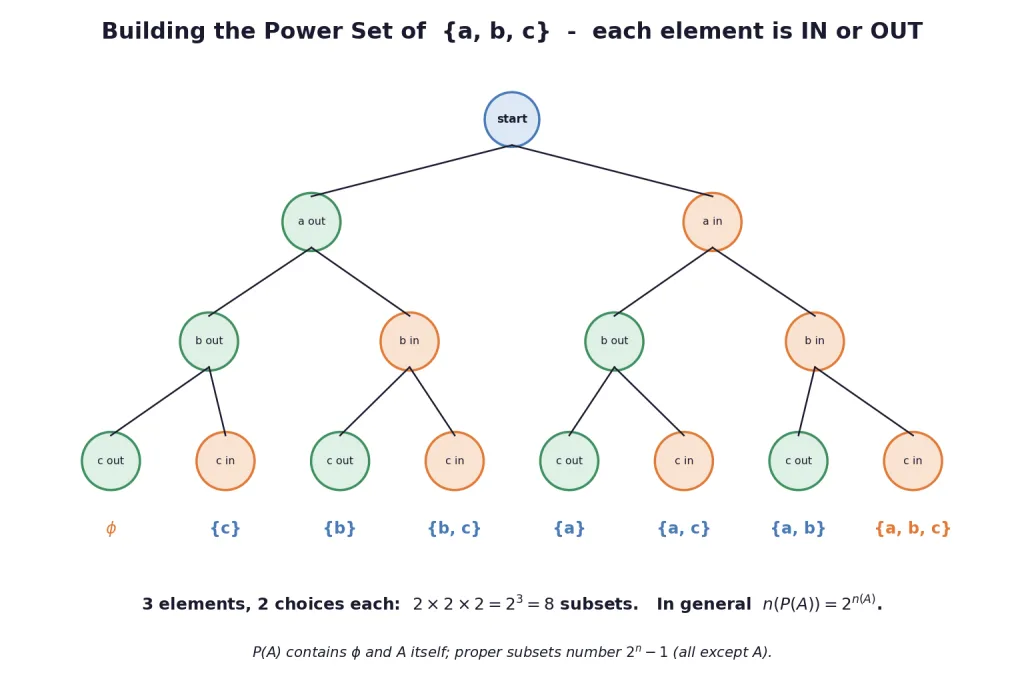
The counting toolkit that follows from it:
- Subsets of an m-element set:
- Proper subsets: (exclude the set itself)
- Non-empty proper subsets:
- Subsets containing a fixed element: (fix it in; the rest choose freely)
- Subsets of even size / odd size: each (a neat symmetry)
- when : has 1 element, so has elements.
Key Point: Distinguish and inside power sets: but . Membership in means being a subset of A: .
[JEE Tip] "If a set has 240 subsets more than another…" — such problems reduce to solving . Factor out the smaller power: , forcing and , so , . The even-times-odd factorisation cracks every problem of this family.
The Laws of the Algebra of Sets — the Full Toolkit
Collected in one place, these are the rules that let you manipulate set expressions as fluently as algebraic ones:
- Idempotent: ;
- Identity: ;
- Domination: ;
- Commutative: ;
- Associative: ; likewise for
- Distributive: and
- Absorption: ;
- Complement: ; ; ; ;
- De Morgan: ;
Difference identities (constant JEE fodder)
- — the most useful rewrite in the topic
- and (De Morgan for differences)
Proof of : and and . ∎
[JEE Tip] When an MCQ shows a jungle like , mechanically apply De Morgan and distributivity: , so the expression is . Two laws, done. Converting every difference to -with-complement form makes such simplifications automatic.
Cardinality Formulas and Survey Problems
For finite sets, counting elements interacts beautifully with the operations. The workhorse — the inclusion-exclusion principle for two sets:
Adding and counts the overlap twice; subtracting repairs it. If A and B are disjoint, this collapses to .
Companion formulas, all readable off a Venn diagram:
- — "only A" count
- — "exactly one of the two"
- and — "neither"
Three sets
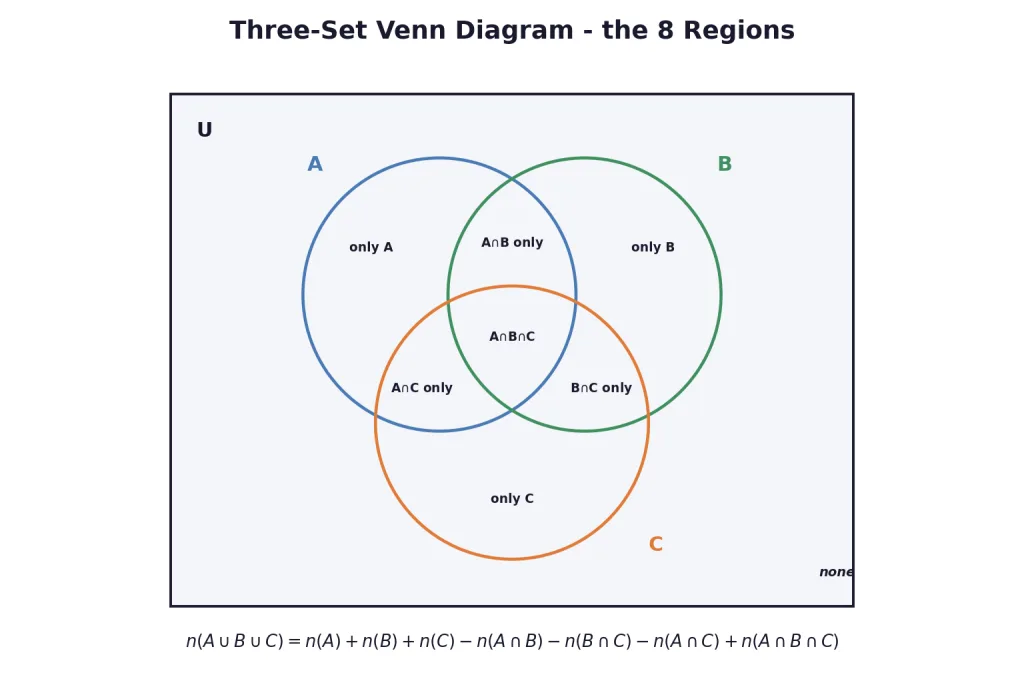
Survey-problem protocol ("In a group of 400 people, 250 speak Hindi, 200 speak English…"):
- Name the sets and write every given number as an value.
- Decide what is asked: "at least one" = union, "both" = intersection, "only A" = , "neither" = .
- Apply inclusion-exclusion; for three sets, filling the 8-region Venn diagram from the innermost region outward is faster and safer.
[JEE Tip] Bounds questions — "what is the minimum possible ?" — use (from ) and . These two inequalities settle every max/min survey MCQ.
Symmetric Difference
Key Point (Definition): The symmetric difference of A and B is — the set of elements in exactly one of A and B.
Equivalent forms, each useful:
Example: A = {1, 2, 3, 4}, B = {3, 4, 5, 6}: = {1, 2}, = {5, 6}, so = {1, 2, 5, 6} — the shared 3 and 4 vanish.
Properties worth knowing cold:
- (commutative — unlike plain difference!)
- and
- Associative:
[JEE Tip] " implies B = C" is TRUE — symmetric difference cancels (unlike and individually). Reason: B on both sides of using associativity and . A slick fact that has appeared as a direct MCQ.
Solved Examples
Example 1. Write for A = {a, b, c} and verify .
Solution.
Step 1 — list subsets by size to miss nothing. Size 0: . Size 1: {a}, {b}, {c}. Size 2: {a, b}, {a, c}, {b, c}. Size 3: {a, b, c}.
Step 2 — collect into the power set. .
Step 3 — verify the count. ✓ — three in/out decisions, one per element.
Takeaway: listing by size is systematic and self-checking; the size-counts 1, 3, 3, 1 are binomial coefficients — a preview of the Binomial Theorem chapter.
Example 2. Find , and their cardinalities.
Solution.
Step 1 — subsets of . The empty set has exactly one subset: itself. So , and .
Step 2 — go one level up. is the power set of , a ONE-element set: its subsets are and . So with elements.
Step 3 — keep the three objects straight. (size 0), (size 1), (size 2) — three DIFFERENT sets.
Takeaway: iterating power sets from climbs sizes — each application doubles exponentially; the first two levels are standard trick-question territory.
Example 3. Set A has m elements and set B has k elements. If A has 240 more subsets than B, find m and k.
Solution.
Step 1 — translate to an equation. Subset counts are and : .
Step 2 — factor out the smaller power. .
Step 3 — split 240 into even × odd. . Since is ODD, it must equal the odd part 15, and must absorb all the 2's: .
Step 4 — solve. ; and gives , so . Check: ✓.
Takeaway: every "" problem cracks the same way — split N into (power of 2) × (odd part); the two factors identify and uniquely.
Example 4. Let A = {1, 2}. Which are true? (i) (ii) (iii) (iv) (v) .
Solution.
Step 1 — write out the power set. ; membership in means being a SUBSET of A.
(i) Step 2. Is {1} a subset of A? Yes → . True.
(ii) Step 3. Is the number 1 a subset of A? No — 1 is an element of A, not a set of elements. False.
(iii) Step 4. Unpack {{1}}: its only element is {1}, which IS an element of (by (i)). So . True.
(iv) Step 5. holds, so qualifies for membership: . True.
(v) Step 6. is a subset of EVERY set, including itself. True.
Takeaway: (iv) and (v) are both true for different reasons — is simultaneously a member of every power set (because it is a subset of A) and a subset of it (because it is a subset of everything).
Example 5. Simplify: (i) (ii) (iii) .
Solution.
(i) Step 1 — factor A out by distributivity. .
Step 2 — finish with the complement law. , so the expression is .
(ii) Step 3 — kill the primed bracket with De Morgan. .
Step 4 — reuse part (i). The expression becomes .
(iii) Step 5 — distribute. .
Takeaway: two moves — De Morgan to strip primes off brackets, distributivity to factor — reduce almost any expression; and are the standard finishers.
Example 6. Prove that .
Solution.
Step 1 — rewrite every difference in intersection form. Using : the left side is .
Step 2 — apply De Morgan inside. , so the left side .
Step 3 — expand the right side. (idempotent and commutative laws).
Step 4 — match. Both sides equal . ∎
Takeaway: the rewrite turns difference identities into three-line De Morgan exercises — never element-chase what algebra does mechanically.
Example 7. In a group of 400 people, 250 can speak Hindi and 200 can speak English. Each person speaks at least one of the two languages. How many can speak both?
Solution.
Step 1 — name the sets and translate the data. , . "Each person speaks atleast one" means the union is everyone: .
Step 2 — write inclusion-exclusion. .
Step 3 — substitute and solve. , so .
Step 4 — interpret. 50 people speak both languages — exactly the amount by which the two headcounts overshoot the group size.
Takeaway: "atleast one" pins down the union; the overlap is whatever the totals exceed it by.
Example 8. In a class of 60 students, 35 like cricket, 30 like football, and 10 like neither. Find how many like (i) both games (ii) only cricket (iii) exactly one game.
Solution.
Step 1 — convert "neither" into the union. Students liking atleast one game: .
(i) Step 2 — inclusion-exclusion for the overlap. .
(ii) Step 3 — strip the overlap from cricket. Only cricket .
(iii) Step 4 — exactly one. Either by the formula , or by regions: only-cricket 20 + only-football → 35 ✓.
Step 5 — global check. Regions: 20 + 15 + 15 + 10 = 60 = class size ✓.
Takeaway: handle "neither" first to get the union, then cascade; the ten-second region check catches most slips.
Example 9. In a survey of 100 students, 72 read newspaper A and 45 read newspaper B. What are the minimum and maximum possible numbers reading both?
Solution.
Step 1 — maximum. The overlap sits inside each set, so it cannot exceed the smaller: (achieved when B A).
Step 2 — minimum. The union cannot exceed the population: , so .
Step 3 — state the range. , both ends achievable.
Takeaway: two one-line inequalities — union capped by , intersection capped by the smaller set — settle every min/max survey question.
Example 10. In a survey of 60 people, 25 read magazine H, 26 read T, 26 read I; 9 read both H and I, 11 read both H and T, 8 read both T and I; 3 read all three. Find how many read (i) at least one magazine (ii) exactly one magazine.
Solution.
(i) Step 1 — three-set inclusion-exclusion. . Compute: singles , pairs , so .
(ii) Step 2 — fill the Venn diagram from the CENTRE outward. All three: 3. Then the pairwise-only regions: H∩T only ; T∩I only ; H∩I only .
Step 3 — the only-one regions. H only ; T only ; I only .
Step 4 — answer and check. Exactly one: . Check all regions: ✓ matches (i), and read none.
Takeaway: for three sets, the centre-outward fill is faster than formula-juggling and self-checks — all eight regions must sum to .
Example 11. A = {1, 2, 3, 4, 5}, B = {4, 5, 6, 7}. Compute two ways: as and as .
Solution.
Step 1 — way 1: private parts. (strike the shared 4, 5); . Union: .
Step 2 — way 2: union minus intersection. ; ; difference: .
Step 3 — match and count-check. Both routes agree ✓, and ✓.
Takeaway: two routes, one answer — use whichever the data makes cheaper, and the other as verification.
Example 12. Let and . Show that (and hence ).
Solution.
Step 1 — expand binomially.
Step 2 — subtract the linear part. — a multiple of 9 for every ; for the value is , also a multiple of 9.
Step 3 — identify Y. — ALL non-negative multiples of 9.
Step 4 — conclude. Every element of X is a non-negative multiple of 9, so , and therefore . (The inclusion is proper: but X's elements run — 18 is skipped.)
Takeaway: the binomial expansion of is the standard tool for "multiple of 9" claims about — an evergreen exam pair.
Example 13. For A = {1, 2, 3, 4, 5, 6}, count the subsets that (i) contain both 1 and 2 (ii) contain 1 but not 6 (iii) contain at least one of 1, 2.
Solution.
(i) Step 1. Fix 1 IN and 2 IN; elements 3, 4, 5, 6 choose freely: .
(ii) Step 2. Fix 1 IN and 6 OUT; elements 2, 3, 4, 5 free: .
(iii) Step 3 — complement count. Subsets avoiding BOTH 1 and 2: the other four elements choose freely, . Total subsets: . Subsets with atleast one of 1, 2: .
Takeaway: each fixed element halves the count ( survives); and "atleast one" is fastest by counting the avoiders and subtracting.
Example 14. Given , prove B = C.
Solution.
Step 1 — apply to both sides. .
Step 2 — regroup by associativity. .
Step 3 — simplify. (a set differs from itself nowhere), and , . Hence B = C. ∎
Takeaway: under , is the identity and every set is its own inverse — so cancels like addition does. It is the ONLY basic set operation with a genuine cancellation law ( and individually have none).