
Subsets — Sets inside Sets
Let X be the set of all students in your school and Y the set of all students in your class. Every member of Y is automatically a member of X — we say Y is a subset of X.
Key Point (Definition): A set A is a subset of a set B, written , if every element of A is also an element of B. In implication form: if .
If A is not a subset of B — that is, A has at least one element not in B — we write .
Two consequences follow immediately from the definition:
- Every set is a subset of itself: , since every element of A is (of course) in A.
- The empty set is a subset of every set: for all A. There is no element of that could fail to be in A — the requirement is satisfied vacuously.
And a beautiful two-way street:
This is exactly how equality of sets is proved in mathematics — show containment both ways. The symbol reads "if and only if" (iff).
Proper subsets and supersets
If and , then A is a proper subset of B, and B is a superset of A. For example {1, 2, 3} is a proper subset of {1, 2, 3, 4}. A set with just one element, like {a}, is called a singleton set.
[Board Important] Distinguish the two symbols with a mantra: connects an element to a set; connects a set to a set. but .
Element or Subset? The vs Minefield
Sets can themselves be elements of other sets, and this is where exams set their traps. Consider
This set has four elements: the numbers 1, 2, 5 and the set {3, 4} as a single packaged object. Now test yourself:
- — true: the set {3, 4} is one of the listed elements.
- — false: that would need and , but 3 and 4 are not elements of A (they are sealed inside the packet).
- — true: this singleton's only element is {3, 4}, which does belong to A.
- — true; — false (1 is not a set here).
- — true (always); — false: is not among the listed elements.
Key Point: To check , scan A's element list for x exactly as written. To check , unpack X and scan for each of its elements in A's list.
[JEE Tip] A statement like "if and then " is FALSE in general. Counterexample: A = {1}, B = {{1}, 2}, C = {{1}, 2, 3}. Here and , but , so . Membership and containment do not chain with each other — only chains with (transitivity: ).
Subsets of R: Intervals
The most-used subsets of in all of mathematics are intervals. Let with .
- Open interval — all points between a and b, excluding both endpoints.
- Closed interval — including both endpoints.
- Semi-open intervals: includes a but not b; includes b but not a.
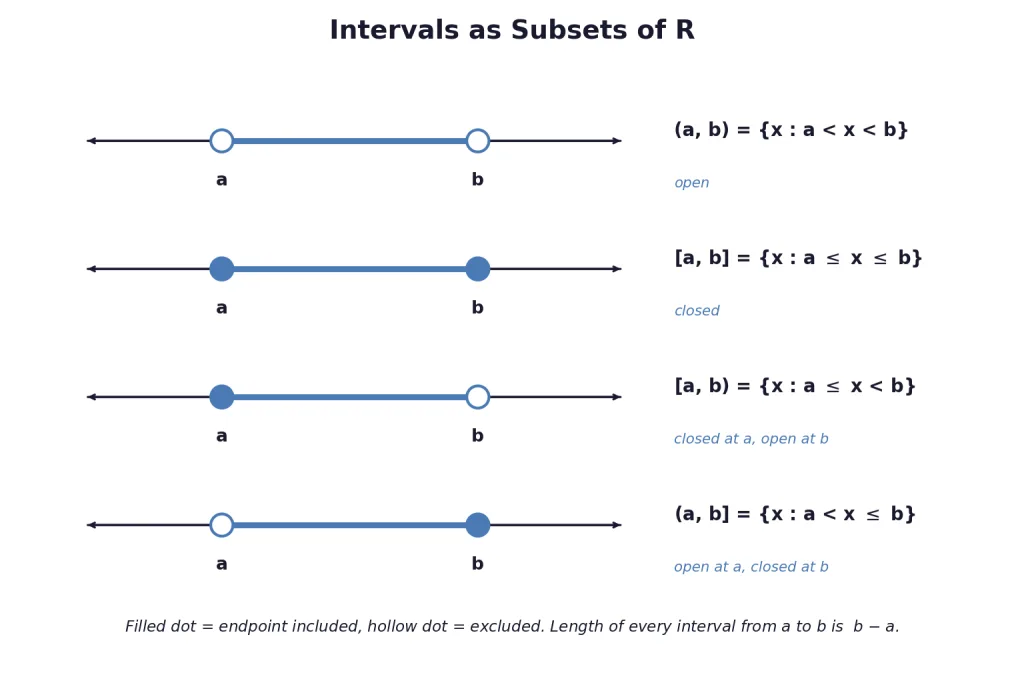
On a number line: a filled dot marks an included endpoint, a hollow dot an excluded one.
Infinity notation extends the idea: is the set of non-negative reals, the negative reals, and is itself. The side with is always open — infinity is not a number that could be included.
The number is called the length of each of the intervals , , and — inclusion of endpoints does not change length.
Key Point: Every interval contains infinitely many points — even the tiny interval .
[JEE Tip] Translation drill you must do on sight: and . In JEE answers, domains and ranges are written in interval notation by default — fluency here pays off in every later chapter.
Universal Set and Venn Diagrams
The universal set U
In any particular discussion, all sets in play are subsets of one background set fixed for the context. That background set is called the universal set, denoted U.
- Studying divisibility? U = or works.
- Studying equations and their real roots? U = .
- A survey of a town's population? U = the set of people in that town.
The universal set is a choice — for the set of integers, U could be or , whichever suits the discussion. What matters is that U contains every set under consideration.
Venn diagrams
Most relationships between sets can be drawn. In a Venn diagram (named after the English logician John Venn, 1834-1883):
- the universal set U is a rectangle;
- its subsets are circles (or other closed curves) inside the rectangle;
- elements, when shown, are written inside their regions.
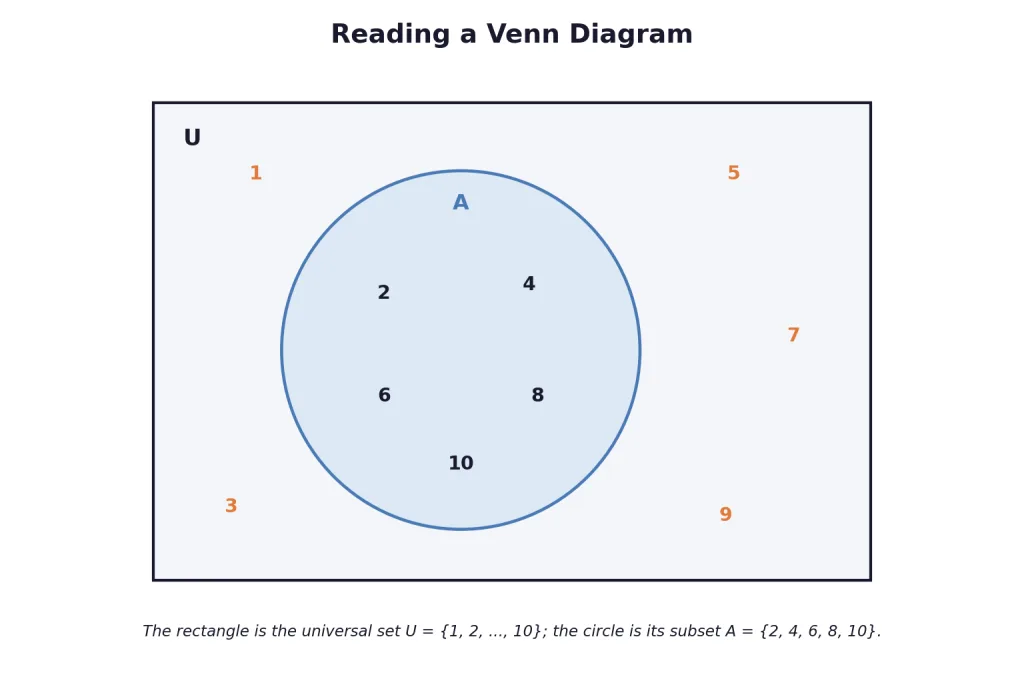
The picture above shows U = {1, 2, …, 10} with the subset A = {2, 4, 6, 8, 10} inside the circle and the non-members outside it.
When one set sits inside another, the circles nest:
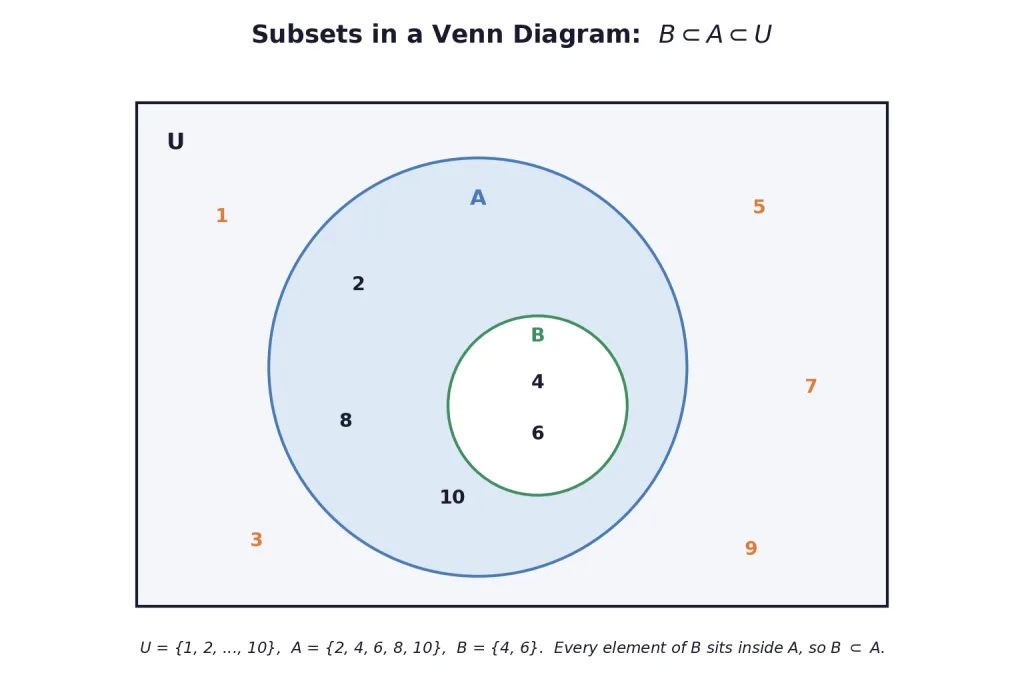
Here B = {4, 6} A = {2, 4, 6, 8, 10} U — every level of nesting is a subset relation.
[Board Important] Venn diagrams are a reasoning tool, not just decoration — in Section 4 you will verify De Morgan's laws by shading regions. Practise drawing them neatly now: rectangle first, label U, then circles with their letters outside the circle boundary.
Solved Examples
Example 1. Given , A = {1, 3}, B = {1, 5, 9}, C = {1, 3, 5, 7, 9}, insert the correct symbol or : (i) … B (ii) A … B (iii) A … C (iv) B … C.
Solution.
Step 1 — recall the test. demands that EVERY element of X lies in Y; a single straying element breaks it.
(i) Step 2. has no elements, so the demand is satisfied vacuously — nothing can stray. ✓ (true for every set).
(ii) Step 3. Check A's elements against B: ✓ but ✗. One stray is enough: .
(iii) Step 4. ✓ and ✓ — all of A accounted for: .
(iv) Step 5. ✓, ✓, ✓: .
Takeaway: subset checking is element-by-element bookkeeping, and the verdict flips on the first missing element.
Example 2. Examine whether the following are true or false: (i) {a, b} {b, c, a} (ii) {a, e} (iii) {1, 2, 3} {1, 3, 5} (iv) {a} {a, b, c}.
Solution.
(i) Step 1. Test the subset relation honestly: ✓ and ✓, so {a, b} IS a subset. The statement claims it is NOT — false.
(ii) Step 2. The vowel set is {a, e, i, o, u}; both a and e belong. True.
(iii) Step 3. Check 2: . One stray element kills it. False.
(iv) Step 4. Read the claim precisely: is the SET {a} an ELEMENT of {a, b, c}? The elements listed are the letters a, b, c — the packet {a} is not among them. False (although would be true).
Takeaway: part (iv) is the vs distinction in miniature — braces around a letter change the object, and hence the claim.
Example 3. Let A = {1, 2, {3, 4}, 5}. Decide which statements are incorrect and why: (i) {3, 4} A (ii) {3, 4} A (iii) {{3, 4}} A (iv) (v) (vi) {1, 2, 5} A (vii) (viii) .
Solution.
Step 1 — inventory A's elements first. A has exactly FOUR elements: the numbers 1, 2, 5, and the packet {3, 4} treated as one sealed object. Crucially, 3 and 4 themselves are NOT elements of A.
(i) Step 2 — incorrect. would require and ; both fail (they are sealed inside the packet).
(ii) Step 3 — correct. The packet {3, 4} is literally one of A's listed elements: .
(iii) Step 4 — correct. The set {{3, 4}} has a single element — the packet — and that packet belongs to A. So .
(iv) Step 5 — correct. 1 appears in the list: .
(v) Step 6 — incorrect. 1 is a number, not a set; writing is a category error (only sets can be subsets).
(vi) Step 7 — correct. 1, 2, 5 each belong to A, so .
(vii) Step 8 — incorrect. Scan the element list: is not among the four elements, so .
(viii) Step 9 — correct. The empty set is a subset of EVERY set: always.
Takeaway: this one example carries the whole / logic: to test , scan the element list as written; to test , unpack the candidate and scan for each of ITS elements.
Example 4. Write down all the subsets of: (i) {a} (ii) {a, b} (iii) {1, 2, 3} (iv) .
Solution.
Step 1 — build subsets by in/out decisions. For each element, a subset either takes it or leaves it — so list systematically by size.
(i) Step 2. One element: (take nothing) and {a} (take a). Two subsets.
(ii) Step 3. Size 0: . Size 1: {a}, {b}. Size 2: {a, b}. Four subsets.
(iii) Step 4. Size 0: . Size 1: {1}, {2}, {3}. Size 2: {1, 2}, {1, 3}, {2, 3}. Size 3: {1, 2, 3}. Eight subsets.
(iv) Step 5. The empty set's only subset is itself: . One subset.
Step 6 — spot the pattern. Counts 1, 2, 4, 8 for 0, 1, 2, 3 elements: each new element doubles the count, so a set with elements has subsets — the power-set formula used constantly in the JEE Corner section.
Takeaway: enumerate by size to avoid missing subsets, and remember and the set itself always appear.
Example 5. Write the following as intervals: (i) (ii) (iii) (iv) .
Solution.
Step 1 — apply the dictionary. Strict inequality ↔ round bracket (endpoint excluded); ↔ square bracket (endpoint included). Read each side separately.
(i) Step 2. strict → "(" at ; inclusive → "]" at 6: .
(ii) Step 3. Strict on both sides: .
(iii) Step 4. Inclusive left, strict right: .
(iv) Step 5. Inclusive both sides: .
Takeaway: translate one endpoint at a time — the bracket shape is decided locally by that endpoint's inequality alone.
Example 6. Write in set-builder form: (i) (ii) (iii) (iv) .
Solution.
Step 1 — run the same dictionary backwards. Round bracket → strict ; square bracket → .
(i) Step 2. .
(ii) Step 3. .
(iii) Step 4. .
(iv) Step 5. .
Takeaway: the translation is a two-way dictionary — drill both directions until each takes a second.
Example 7. If A = and B = , show that . What is the length of each interval?
Solution.
Step 1 — set up the containment check. Take any , i.e. . We must show .
Step 2 — chain the inequalities. From and : , so certainly ✓. From and : , so ✓. Every element of A lies in B: .
Step 3 — compute lengths. Length of A ; length of B . (Endpoint inclusion never affects length.)
Takeaway: interval containment reduces to endpoint comparison — the inner interval must begin later and end earlier, with bracket care only when endpoints coincide.
Example 8. Given A = {1, 3, 5}, B = {2, 4, 6} and C = {0, 2, 4, 6, 8}, which of the following may be considered a universal set for A, B, C? (i) {0, 1, 2, 3, 4, 5, 6} (ii) (iii) {0, 1, 2, 3, 4, 5, 6, 7, 8, 9, 10} (iv) {1, 2, 3, 4, 5, 6, 7, 8}.
Solution.
Step 1 — recall the requirement. A universal set must contain EVERY element of EVERY set in the discussion; equivalently , and must all hold.
(i) Step 2. A ✓ and B ✓ fit, but C needs 8 and . Not valid.
(ii) Step 3. contains nothing, so it cannot contain the non-empty sets A, B, C. Not valid.
(iii) Step 4. All needed elements 0-8 appear (9 and 10 extra are harmless). Valid universal set.
(iv) Step 5. C needs 0, and . Not valid.
Takeaway: check each candidate against each set — one missing element disqualifies; extra elements never do.
Example 9. What universal set would you propose for (i) the set of right triangles (ii) the set of isosceles triangles?
Solution.
Step 1. Both are families of triangles, so any set containing all triangles works. (i) U = the set of all triangles in the plane. (ii) The same U serves — or even larger choices like the set of all polygons.
Step 2 — note the freedom. U is a CHOICE, not a uniquely determined object; any superset of every set under discussion qualifies, and we normally pick the most natural one.
Takeaway: "propose a universal set" questions accept any sufficiently large set — justify by containment, not uniqueness.
Example 10. Let A, B, C be sets with and . Prove that .
Solution.
Step 1 — set up an element chase. To prove we take an ARBITRARY and must land it in C.
Step 2 — push through the first inclusion. and give .
Step 3 — push through the second. and give .
Step 4 — conclude. Every element of A belongs to C, which is precisely . ∎
Takeaway: "take x, push it through the inclusions" is the template for every subset proof in this chapter — transitivity is its simplest instance.
Example 11. Determine whether each statement is true or false; if false, give a counterexample. (i) If and , then . (ii) If and , then .
Solution.
(i) Step 1 — try to break it. Take A = {1} and B = {{1}, 2}. Then ✓ and ✓ (the packet {1} is an element of B).
Step 2 — check the conclusion. B's elements are the packet {1} and the number 2. The number 1 is NOT among them: . The statement is false — membership does not pass through membership.
(ii) Step 3 — prove it by contradiction. Suppose the conclusion fails, i.e. . Then forces — contradicting the hypothesis . Hence : the statement is true.
Takeaway: does not chain with , but a subset relation DOES transfer non-membership backwards — that one-line contradiction recurs throughout set-theory proofs.
Example 12. Decide which sets are subsets of one another: , B = {2, 4, 6}, C = {2, 4, 6, 8, …}, D = {6}.
Solution.
Step 1 — convert A to roster form. Factorise: , so A = {2, 6}.
Step 2 — identify C. C = {2, 4, 6, 8, …} is the set of all even natural numbers.
Step 3 — test the inclusions. D = {6}: 6 lies in A, in B, and in C → , , . A = {2, 6}: both elements lie in B and in C → , . B = {2, 4, 6}: all even naturals → . No reverse inclusion holds (e.g. but ; but ).
Step 4 — assemble the chain. .
Takeaway: solve every defining equation first; once all sets are explicit, the subset chain reads off element by element.
Example 13. Write and in interval notation, and identify their common part.
Solution.
Step 1. : from (included) rightwards without bound: . The infinity side is always open.
Step 2. : everything to the left of 3 (excluded): .
Step 3 — intersect on the number line. A number in both sets satisfies AND simultaneously: the overlap is — square bracket from the first set's included endpoint, round bracket from the second's excluded one.
Takeaway: the "common part" is the intersection; the number line shows it instantly, and Section 4 gives it the formal symbol .
Example 14. How many of the following are true? (i) (ii) (iii) (iv) .
Solution.
(i) Step 1. Unpack {0}: its only element is 0, and ✓. True.
(ii) Step 2. 0 is a number, not a set — the subset symbol does not apply to it. False.
(iii) Step 3. The elements of {0, 1} are the numbers 0 and 1; the SET {0} is not one of them. False.
(iv) Step 4. 0 is listed as an element. True.
Step 5 — count. Exactly 2 of the four statements are true.
Takeaway: braces are not decoration: {0} is a one-element set, 0 is a number — every mixed-symbol question hinges on that difference.