
About This Paper
Model Paper 1 is the 2026 Model Paper 1 with two small changes (Q7's options and Q20). There is no official scheme for model papers, so the mark splits follow the board's exam schemes.
Sit it in 3 hours before you look at any answer, then mark yourself strictly.
Already asked in the 2025–26 exams (must-know): Q1, Q3, Q4, Q8, Q10, Q13, Q14, Q16, Q21, Q22, Q25, Q28, Q29, Q35 (a), Q37 and Q44. Q41 and Q45 also came, with different numbers.
Part F (alternate questions for visually challenged students) is not included.
Question Paper: Part A
I. Select the correct option from the given choices. (15 × 1 = 15)
1. The mass percentage (w/w) of glucose in water is 10% means
(a) 10 g of glucose dissolved in 100 g of water
(b) 10 g of glucose dissolved in 90 mL of water
(c) 10 g of glucose dissolved in 100 mL of water
(d) 10 g of glucose dissolved in 90 g of water
2. Which of the following elements is liquid at normal temperature?
(a) Zinc
(b) Mercury
(c) Aluminium
(d) Water
3. The reagent used in Sandmeyer's reaction is
(a) N gas
(b) Cu and HCl
(c) CuCl and HCl
(d) CuCl
4. The main natural source of acetic acid is
(a) milk
(b) vinegar
(c) red ant
(d) butter
5. The reaction of aniline which produces a zwitter ion as the major product is
(a) direct nitration
(b) bromination
(c) sulphonation
(d) Friedel–Crafts alkylation
6. The method used to separate the isomeric products obtained when phenol reacts with dil. HNO at low temperature is
(a) steam distillation
(b) sublimation
(c) electrolysis
(d) solidification
7. The ligand which forms more stable coordination complexes is
(a) Cl
(b) CO
(c) Br
(d) HO
8. Which of the following groups, when present at para position, increases the basic strength of aniline?
(a) –NO
(b) –Br
(c) –NH
(d) –COOH
9. In the following acids, the vitamin is
(a) ascorbic acid
(b) adipic acid
(c) aspartic acid
(d) saccharic acid
10. The best reagent useful for separation and purification of aldehyde from ketone is
(a) Tollens' reagent
(b) sodium hydrogen sulphite
(c) sodium sulphate
(d) 2,4-DNP reagent
11. Statement 1: If on mixing two liquids the solution becomes hot, it implies that it shows negative deviation from Raoult's law. Statement 2: Solutions which show negative deviation are accompanied by decrease in volume.
(a) Both Statement 1 and Statement 2 are true
(b) Statement 1 is true but Statement 2 is false
(c) Both Statement 1 and Statement 2 are false
(d) Statement 1 is false but Statement 2 is true
12. Match the transition metals/compounds with their catalytic activity: (i) TiCl + Al(CH), (ii) PdCl, (iii) Ni, (iv) VO with (A) Wacker process, (B) Contact process, (C) manufacture of polyethene, (D) hydrogenation of fat.
(a) i-C, ii-A, iii-D, iv-B
(b) i-B, ii-A, iii-D, iv-A
(c) i-A, ii-C, iii-D, iv-B
(d) i-D, ii-A, iii-B, iv-C
13. Cumene hydroperoxide on hydrolysis with dilute acids gives
(a) phenol and oxygen
(b) phenol and hydrogen
(c) hydrogen and oxygen
(d) phenol and acetone
14. Among the following cells, the cell used in the Apollo space programme for providing electric power is
(a) SHE
(b) H–O fuel cell
(c) Daniell cell
(d) Mercury cell
15. The following results were obtained for A(aq) + 2B(aq) → C(aq): Exp I, [A] = 0.1, [B] = 0.1, rate = 6.0 × 10; Exp II, [A] = 0.2, [B] = 0.3, rate = 7.2 × 10; Exp III, [A] = 0.1, [B] = 0.4, rate = 2.4 × 10; Exp IV, [A] = 0.4, [B] = 0.3, rate = 2.88 × 10 (concentrations in mol L, rate in mol L min). The rate equation is
(a) Rate = k[A][B]
(b) Rate = k[A][B]
(c) Rate = k[A][B]
(d) Rate = k[A][B]
II. Fill in the blanks by choosing the appropriate word from those given in the brackets. (5 × 1 = 5)
[two, EDTA, chloroform, three, nucleotide, one]
16. The polyhalo compound used as an anaesthetic during surgery was __.
17. Nucleic acids are the long chain polymers of __.
18. Van't Hoff factor for KCl solution assuming complete dissociation is __.
19. The number of hydroxyl groups present in glycerol is __.
20. An example of a polydentate ligand is __.
Question Paper: Parts B to E
Part B
III. Answer any three of the following. Each question carries 2 marks. (3 × 2 = 6)
21. What is Lucas reagent? Which class of alcohol produces turbidity immediately with it?
22. Write the S mechanism for the conversion of chloromethane to methanol.
23. For the reaction H(g) + I(g) → 2HI(g), draw the diagram showing a plot of potential energy versus reaction coordinate to explain the role of the activated complex in a reaction.
24. Name the hormone released rapidly due to a rise in blood glucose level to keep the blood glucose level within narrow limits. Mention the number of amino acids present in this hormone.
25. What are transition elements? Give an example.
Part C
IV. Answer any three of the following. Each question carries 3 marks. (3 × 3 = 9)
26. Using Valence Bond Theory (VBT), explain the hybridisation, geometry and magnetic property of the [CoF] ion. [Given: atomic number of cobalt is 27]
27. Heteroleptic complexes with coordination number 6 show geometrical isomerism. A complex [MAB] shows geometrical isomerism. If the central metal ion M has +3 oxidation state, predict the denticity and draw the structures of the two geometrical isomers of the complex.
28. What is lanthanoid contraction? Mention two consequences of it.
29. How many square pyramidal units are present in decacarbonyldimanganese(0)? Write its molecular and structural formulae.
30. Complete the following equations: (a) _ + 8NaCO + 7O → 8NaCrO + 2FeO + 8CO (b) MnO fused with KOH and oxidised with air → (c) 2KMnO → (513 K) KMnO + O + _
V. Answer any two of the following. Each question carries 3 marks. (2 × 3 = 6)
31. Mention three factors that affect the rate of a chemical reaction.
32. Name the concentration term which is commonly used in medicine and pharmacy. Write the definition and mathematical equation for that concentration term.
33. Depending on the magnitude of conductivity of materials, mention the three types of materials.
34. The diagram shows iron exposed to atmospheric air. (a) Name the phenomenon involved. (b) Write the atmospheric oxidation reaction of iron. (c) Mention any one method to avoid this phenomenon.
Part D
VI. Answer any four of the following. Each question carries 5 marks. (4 × 5 = 20)
35. (a) Write the Haworth structure of maltose. Why does it show reducing property? (3)
(b) What are fibrous proteins? Name the protein present in hair. (2)
36. (a) Write the three steps involved in the acid catalysed dehydration of ethanol to ethoxyethane at 413 K. (3)
(b) Explain Kolbe's reaction with equation. (2)
37. (a) When alkyl chlorides react with sodium iodide in dry acetone, alkyl iodides are formed. (i) Name this reaction. (ii) Write the general equation. (iii) Mention the role of dry acetone. (3)
(b) What is meant by racemic modification? "They are optically inactive." Give reason. (2)
38. (a) Which class of amines undergoes the carbylamine reaction (isocyanide test)? Explain this reaction with a general chemical equation. (3)
(b) Identify X and Y in the conversion: CH–NH → (NaNO + 2HCl, 273–278 K) X → (Y) CH–I + KCl + N (2)
39. (a) Name the following reactions: (i) benzoyl chloride + H (Pd–BaSO) → benzaldehyde (ii) benzene + RCOCl (anhydrous AlCl) → CHCOR (iii) >C=O (Zn–Hg, HCl) → >CH + HO (3)
(b) Among methanal and ethanal, which one undergoes Cannizzaro reaction? Give reason. (2)
40. The compound A, molecular formula CH, is heated with alkaline KMnO followed by acidification to give compound B, CHO. B turns blue litmus red. The sodium salt of B is heated with reagent X to give hydrocarbon C of molecular mass 78 g mol. (a) Write the structures of A, B and C. (3) (b) Identify X and mention its role in the reaction. (2)
Part E
VII. Answer any three of the following. Each question carries 3 marks. (3 × 3 = 9)
41. For the cell in which the reaction 2Fe(aq) + 2I(aq) ⇌ 2Fe(aq) + I(s) occurs, E° = 0.236 V at 298 K. Calculate the value of log K (K = equilibrium constant) of the cell reaction.
42. The first order rate constant at 600 K is 2 × 10 s and the energy of activation is 209.8 kJ mol. Calculate the rate constant at 700 K. [Given: R = 8.314 J K mol]
43. Henry's law constant for methane in benzene at 298 K is 4.27 × 10 mm Hg. Calculate the mole fraction of methane in benzene at 298 K under 760 mm Hg.
44. Calculate the limiting molar conductivity of the Cl ion using the data: = 119.0 S cm mol and for CaCl = 271.6 S cm mol.
45. Calculate the osmotic pressure in pascals exerted by a solution prepared by dissolving 0.925 g of polymer of molar mass 185000 in 500 mL of water at 37 °C. [Given: R = 8.314 × 10 Pa L K mol]
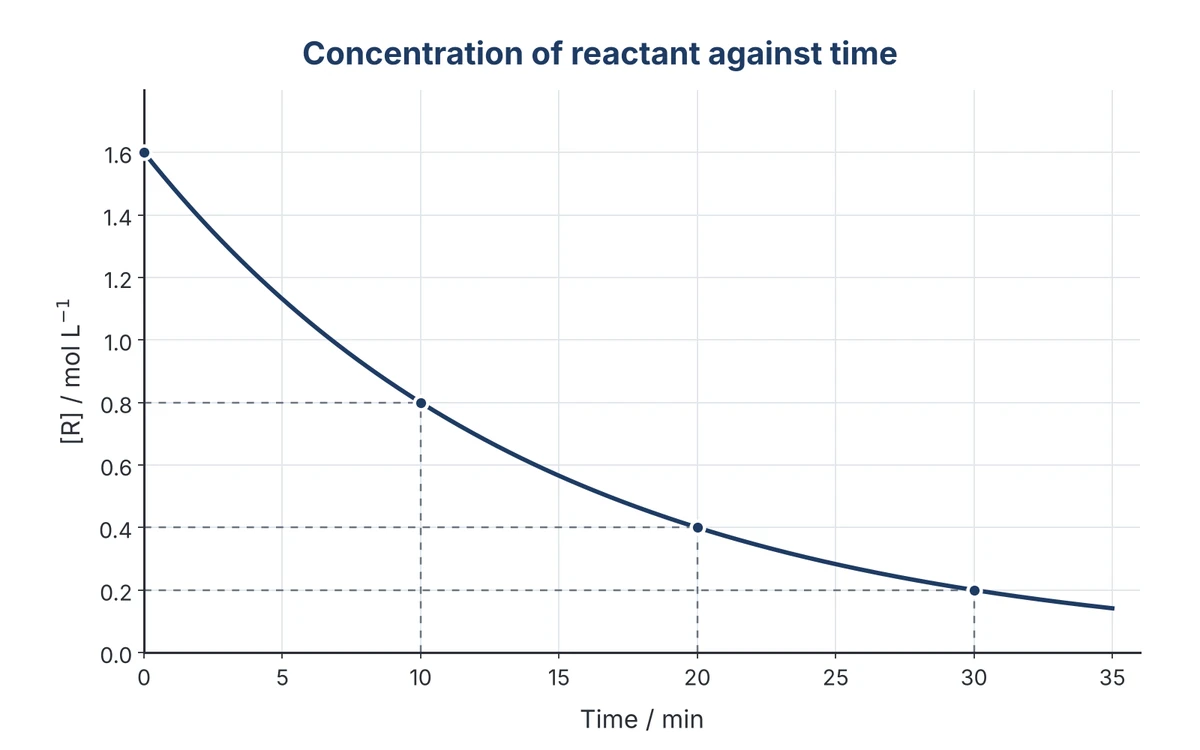
46. Analyse the given graph, drawn between concentration of reactant in mol L and time in minutes, and calculate the average rate of the reaction in terms of minutes and seconds. (The curve falls from 1.6 mol L at t = 0 to 0.8 at 10 min, 0.4 at 20 min and 0.2 at 30 min.)
Answers: Part A
Question 1: What does 10% (w/w) glucose in water mean?
Answer. (d) 10 g of glucose dissolved in 90 g of water. 10% by mass means 10 g of glucose in 100 g of solution, so the water is 90 g. Mass percentage uses masses, not volumes.
Question 2: Which element is a liquid at normal temperature?
Answer. (b) Mercury. Mercury is the only metal that is liquid at room temperature. Water is liquid but it isn't an element.
Question 3: Reagent used in Sandmeyer's reaction?
Answer. (c) CuCl and HCl. Sandmeyer's reaction uses cuprous chloride with HCl. Copper powder with HCl is Gattermann's reaction.
Question 4: Main natural source of acetic acid?
Answer. (b) vinegar. Vinegar is a 6–8% solution of acetic acid.
Question 5: Which reaction of aniline gives a zwitter ion?
Answer. (c) sulphonation. Sulphonation gives sulphanilic acid, which exists as a zwitter ion (–NH and –SO).
Question 6: How are the nitrophenols from phenol and dilute HNO separated?
Answer. (a) steam distillation. o-Nitrophenol is steam volatile because of its intramolecular hydrogen bond; p-nitrophenol isn't.
Question 7: Which ligand forms more stable complexes?
Answer. (b) CO. Oxalate is bidentate and forms a ring with the metal; this chelate effect makes its complexes more stable.
Question 8: Which para group makes aniline more basic?
Answer. (c) –NH. –NH donates electrons, making the lone pair on the amino N more available. The other three withdraw electrons.
Question 9: Which of these acids is a vitamin?
Answer. (a) ascorbic acid. Ascorbic acid is vitamin C. Aspartic acid is an amino acid; adipic and saccharic acids are dicarboxylic acids.
Question 10: Best reagent to separate an aldehyde from a ketone?
Answer. (b) sodium hydrogen sulphite. The aldehyde forms a crystalline bisulphite compound that can be filtered off and decomposed to give back the pure aldehyde.
Question 11: Statement 1: a solution that warms up on mixing shows negative deviation. Statement 2: negative deviation comes with a decrease in volume.
Answer. (a) Both Statement 1 and Statement 2 are true. Stronger A–B attractions release heat () and pull the molecules closer (). Both are true.
Question 12: Match TiCl + Al(CH), PdCl, Ni and VO with their processes.
Answer. (a) i-C, ii-A, iii-D, iv-B. Ziegler catalyst: polyethene; PdCl: Wacker process; Ni: hydrogenation of oils; VO: contact process.
Question 13: Cumene hydroperoxide with dilute acid gives?
Answer. (d) phenol and acetone. This is the cumene process: phenol, with acetone as the by-product.
Question 14: Which cell powered the Apollo space programme?
Answer. (b) H–O fuel cell. The hydrogen–oxygen fuel cell was used in the Apollo programme.
Question 15: Rate law for A + 2B → C from four experiments.
Answer. (c) Rate = k[A][B]. I and III: [B] × 4 at fixed [A] makes the rate × 4, so first order in B. II and IV: [A] × 2 at fixed [B] makes the rate × 4, so second order in A.
Question 16: The polyhalo compound used as an anaesthetic during surgery was __.
Answer. chloroform. Chloroform was once used as a general anaesthetic.
Question 17: Nucleic acids are the long chain polymers of __.
Answer. nucleotide. Nucleic acids (DNA and RNA) are polynucleotides.
Question 18: Van't Hoff factor for KCl solution assuming complete dissociation is __.
Answer. two. KCl gives K and Cl, two particles per formula unit.
Question 19: The number of hydroxyl groups present in glycerol is __.
Answer. three. Glycerol is propane-1,2,3-triol.
Question 20: An example of a polydentate ligand is __.
Answer. EDTA. EDTA binds through two N and four O atoms: it is hexadentate.
Answers: Part B
Question 21: What is Lucas reagent? Which class of alcohol produces turbidity immediately with it?
Answer. Lucas reagent is a mixture of concentrated HCl and anhydrous ZnCl.
Tertiary alcohols produce turbidity immediately with it.
Marks: composition 1, tertiary alcohols 1.
Question 22: Write the S mechanism for the conversion of chloromethane to methanol.
Answer. Step 1: The OH ion attacks the carbon from the side opposite to the chlorine. A transition state is formed in which the C–O bond is forming and the C–Cl bond is breaking.
Step 2: Cl leaves and methanol is formed, with the configuration inverted.
Marks: 1 for each step.
Question 23: For the reaction H(g) + I(g) → 2HI(g), draw the diagram showing a plot of potential energy versus reaction coordinate to explain the role of the activated complex in a reaction.
Answer. Diagram: potential energy is plotted on the y-axis and reaction coordinate on the x-axis. The curve starts at H + I, rises to a peak and falls to 2HI. Mark the peak "activated complex" and the rise from the reactants to the peak "E".
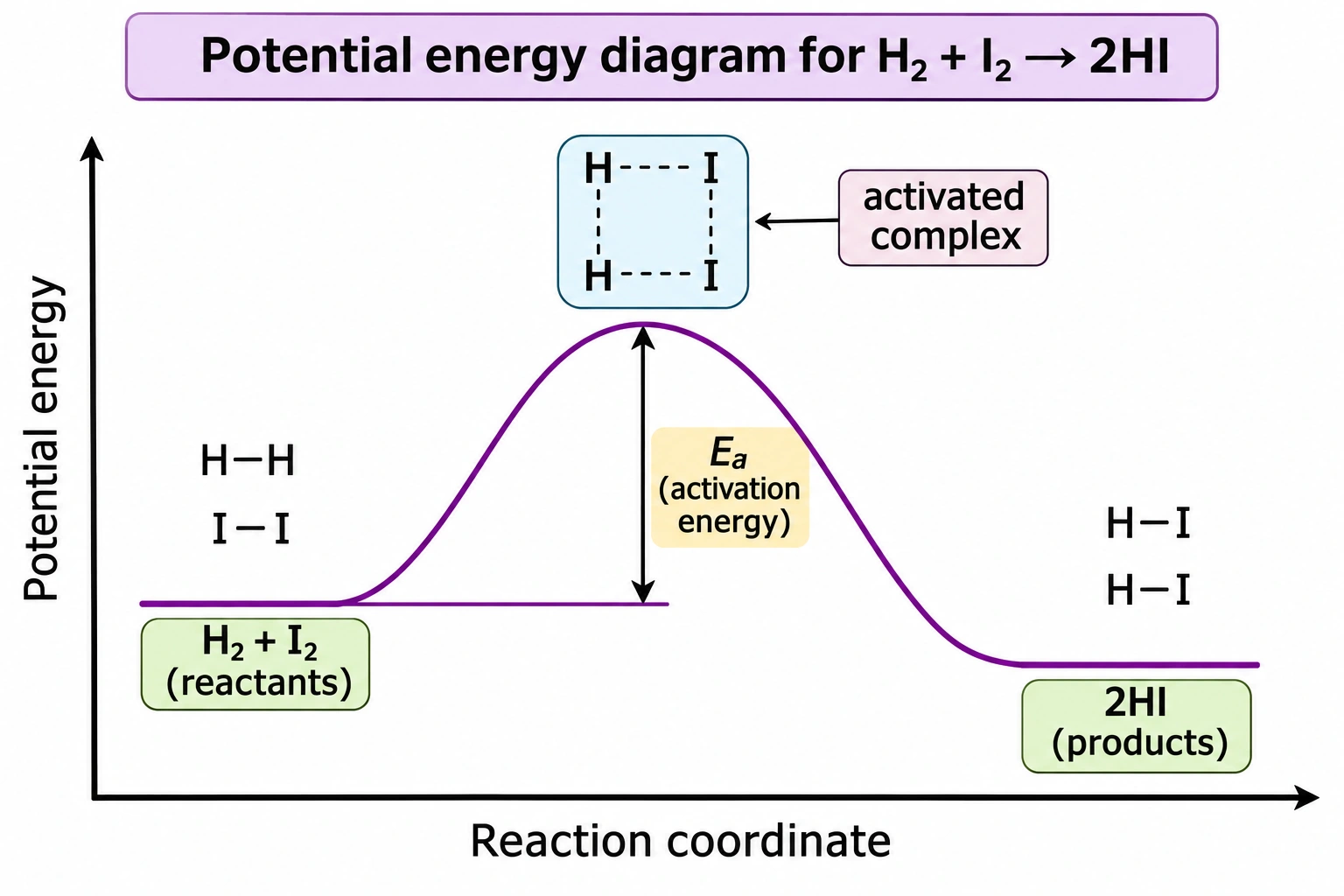
Role of the activated complex: at the peak, the H–H and I–I bonds are partly broken and two H–I bonds are partly formed. This unstable arrangement either breaks down to form 2HI or goes back to H + I. Only the molecules which have energy equal to at least E can reach it.
Marks: diagram 1, role of the activated complex 1.
Question 24: Name the hormone released rapidly due to a rise in blood glucose level to keep the blood glucose level within narrow limits. Mention the number of amino acids present in this hormone.
Answer. The hormone is insulin.
It has 51 amino acids, in two chains of 21 and 30 amino acids.
Marks: insulin 1, number of amino acids 1.
Question 25: What are transition elements? Give an example.
Answer. Transition elements are elements which have an incompletely filled d subshell, either in the atom or in their common ions.
Example: Fe (or any element from Sc to Cu).
Marks: definition 1, example 1.
Answers: Part C
Question 26: Using Valence Bond Theory (VBT), explain the hybridisation, geometry and magnetic property of the [CoF] ion. [Given: atomic number of cobalt is 27]
Answer. Co has the configuration [Ar] 3d, with four unpaired electrons. F is a weak field ligand, so the electrons do not pair up. The 4s orbital, the three 4p orbitals and two 4d orbitals hybridise to give spd hybrid orbitals, which accept six electron pairs from the six F ions. It is an outer orbital (high spin) complex.
Geometry: octahedral
Magnetic property: it has four unpaired electrons, so it is paramagnetic.
Marks: explanation with hybridisation 1, geometry 1, magnetic property 1.
Question 27: Heteroleptic complexes with coordination number 6 show geometrical isomerism. A complex [MAB] shows geometrical isomerism. If the central metal ion M has +3 oxidation state, predict the denticity and draw the structures of the two geometrical isomers of the complex.
Answer. There are six ligands and the coordination number is 6, so A and B are monodentate ligands (denticity 1).
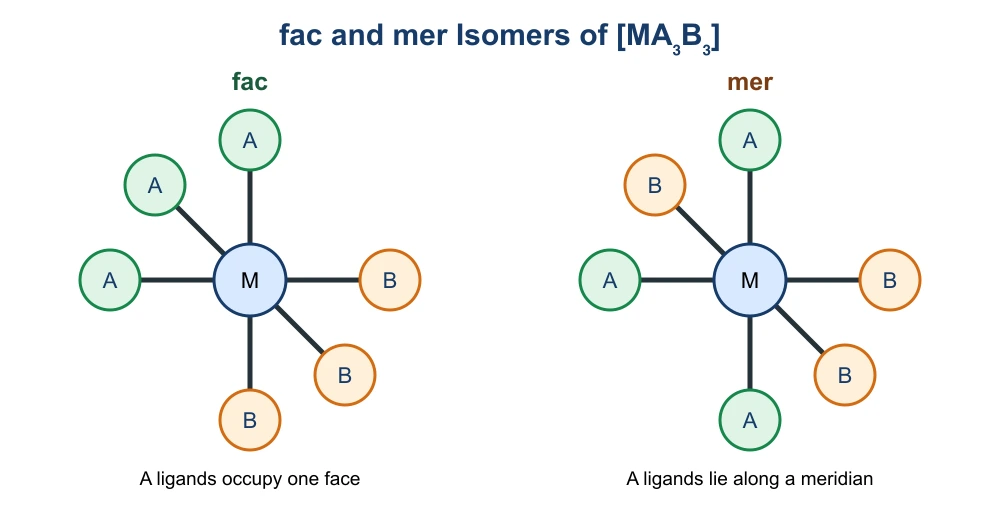
fac isomer: the three A ligands are on one triangular face of the octahedron, all at 90° to each other.
mer isomer: the three A ligands are around a meridian of the octahedron, so two of them are opposite each other.
Marks: denticity 1, fac isomer 1, mer isomer 1.
Question 28: What is lanthanoid contraction? Mention two consequences of it.
Answer. Lanthanoid contraction is the steady decrease in the atomic and ionic radii from lanthanum to lutetium.
Any two consequences:
- Zr and Hf have almost the same radius.
- Lanthanoids are hard to separate because their properties are very similar.
- The basic character of the hydroxides decreases from La(OH) to Lu(OH).
Marks: definition 1, any two consequences 1 each.
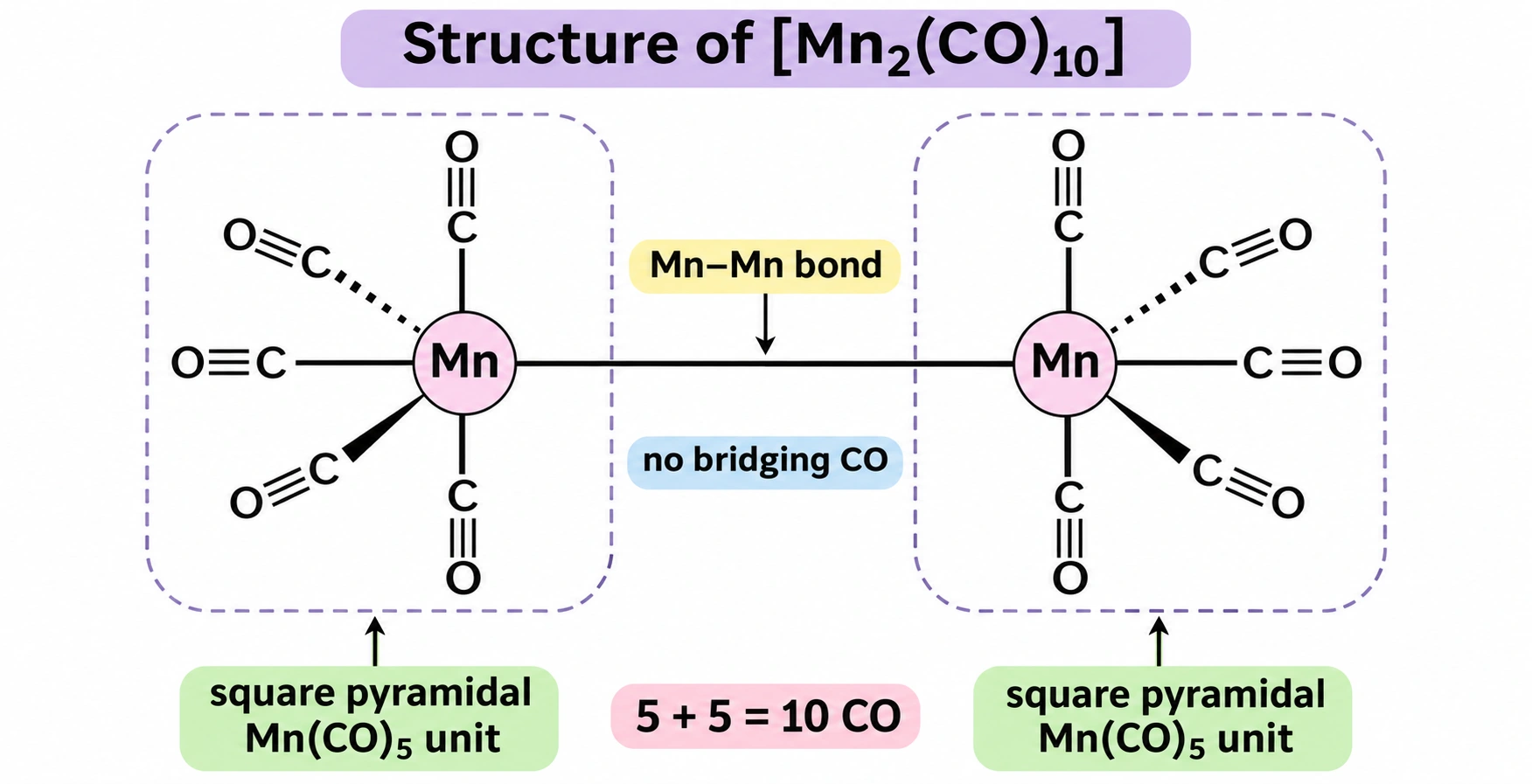
Question 29: How many square pyramidal units are present in decacarbonyldimanganese(0)? Write its molecular and structural formulae.
Answer. There are two square pyramidal Mn(CO) units.
Molecular formula: Mn(CO)
Structural formula: (OC)Mn–Mn(CO). The two Mn(CO) units are joined by an Mn–Mn bond, and there is no bridging CO group. Each Mn has four CO groups in a square around it and a fifth CO pointing away from the other Mn.
Marks: number of units 1, molecular formula 1, structure 1.
Question 30: Complete the following equations: (a) _ + 8NaCO + 7O → 8NaCrO + 2FeO + 8CO (b) MnO fused with KOH and oxidised with air → (c) 2KMnO → (513 K) KMnO + O + _
Answer.
(a) 4FeCrO
(b) KMnO (potassium manganate)
(c) MnO
Marks: 1 for each.
Question 31: Mention three factors that affect the rate of a chemical reaction.
Answer. Any three of these factors:
- Concentration of the reactants (or pressure, for gases).
- Temperature.
- Presence of a catalyst.
- Nature of the reactants.
- Surface area of solid reactants.
Marks: any three factors, 1 each.
Question 32: Name the concentration term which is commonly used in medicine and pharmacy. Write the definition and mathematical equation for that concentration term.
Answer. The concentration term used in medicine and pharmacy is mass by volume percentage (w/V).
It is the mass of solute dissolved in 100 mL of the solution.
Marks: name 1, definition 1, equation 1.
Question 33: Depending on the magnitude of conductivity of materials, mention the three types of materials.
Answer. Depending on their conductivity, materials are of three types:
- Conductors, such as metals and graphite.
- Semiconductors, such as silicon, doped silicon and gallium arsenide.
- Insulators, such as glass and ceramics.
Marks: 1 for each type.
Question 34: The diagram shows iron exposed to atmospheric air. (a) Name the phenomenon involved. (b) Write the atmospheric oxidation reaction of iron. (c) Mention any one method to avoid this phenomenon.
Answer.
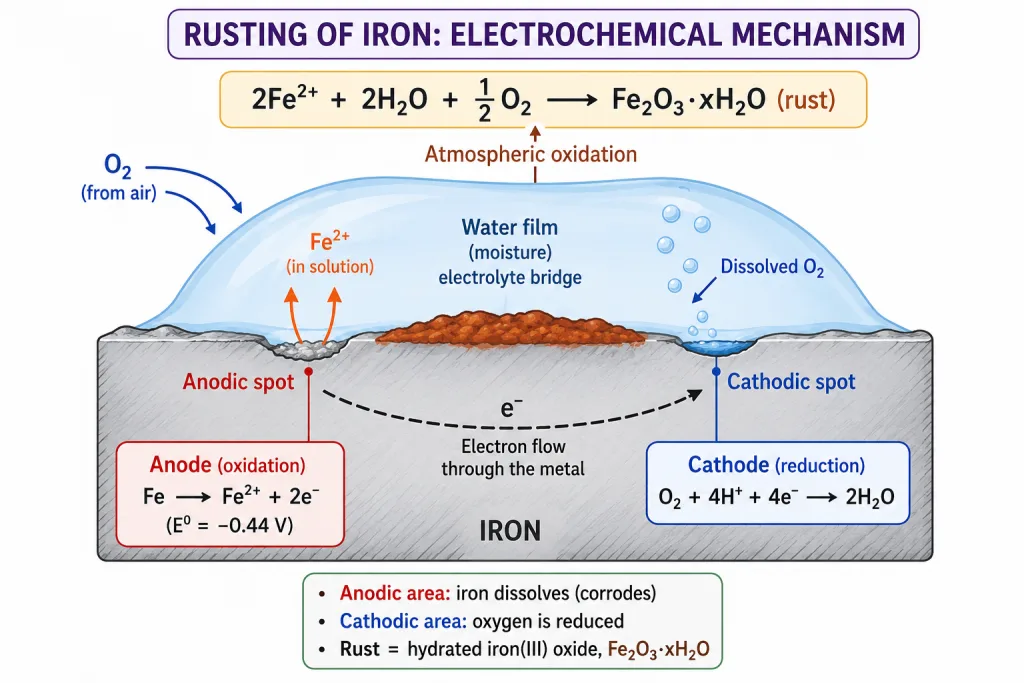
(a) The phenomenon is corrosion (rusting of iron).
(b)
(c) Any one method: painting or oiling the surface; galvanising (coating with zinc); or connecting a more reactive metal such as Mg or Zn as a sacrificial electrode.
Marks: 1 for each.
Answers: Part D
Question 35: (a) Haworth structure of maltose, and why it is a reducing sugar. (3) (b) Fibrous proteins, and the protein in hair. (2)
Answer.
(a) Maltose is made of two α-D-glucose units joined by an α-glycosidic linkage between C-1 of the first unit and C-4 of the second.
| Carbon | First glucose unit | Second glucose unit |
|---|---|---|
| C-1 | –O– link to C-4 of the second unit (down, α) | OH down (α), free |
| C-2 | OH down | OH down |
| C-3 | OH up | OH up |
| C-4 | OH down | –O– link from the first unit |
| C-5 | CHOH up | CHOH up |
Maltose is a reducing sugar because C-1 of the second glucose unit is free. The ring can open there to give an aldehyde group.
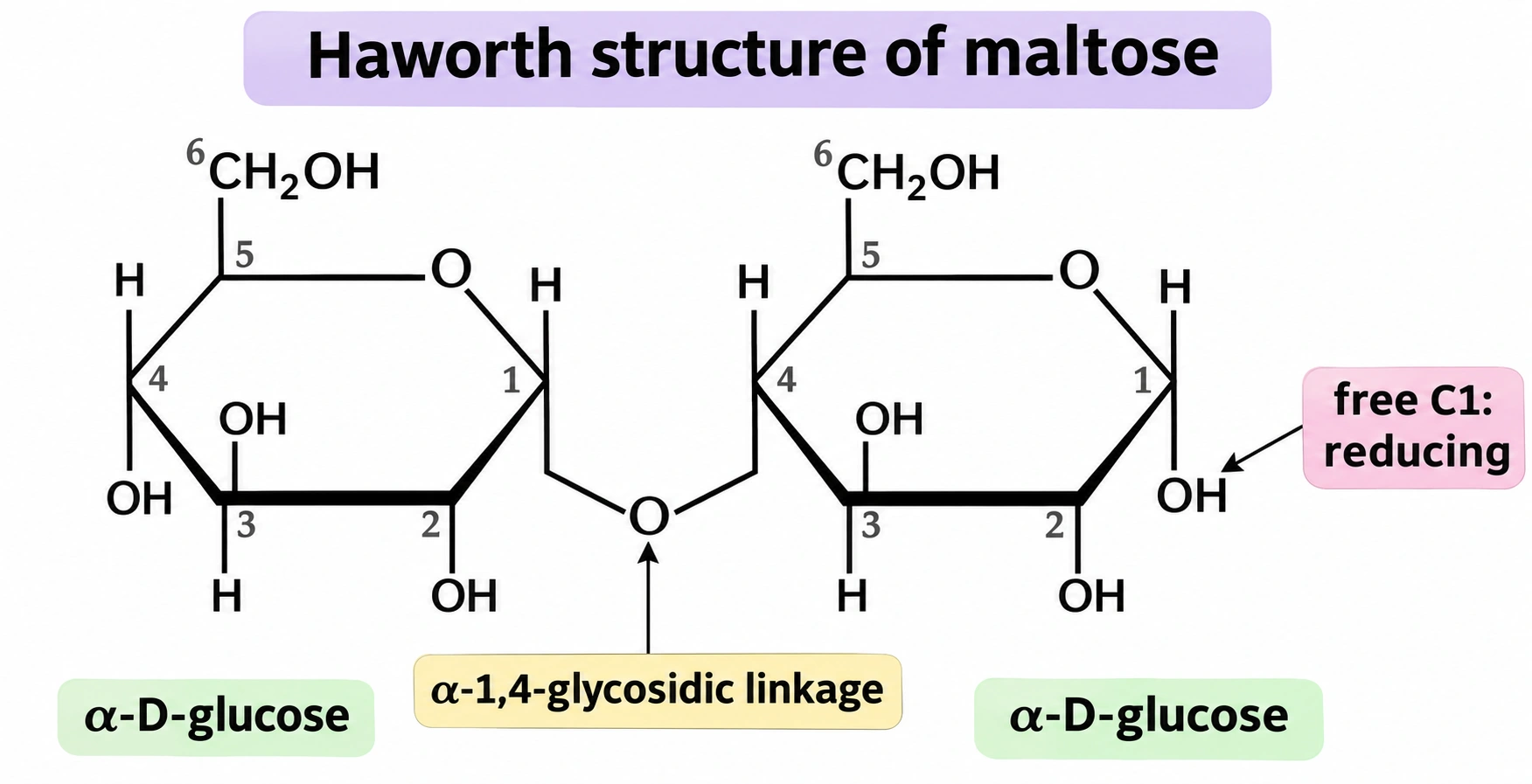
(b) In fibrous proteins, the polypeptide chains run side by side and are held together by hydrogen bonds and disulphide bonds, giving a fibre-like structure. They are insoluble in water. Hair contains the fibrous protein keratin.
Marks: (a) structure 2, reason 1; (b) definition 1, keratin 1.
Question 36: (a) Mechanism of acid-catalysed formation of ethoxyethane from ethanol at 413 K. (3) (b) Kolbe's reaction. (2)
Answer.
(a) The formation of ethoxyethane from ethanol at 413 K takes place in three steps. Show every charge.
Step 1: Protonation of ethanol.
Step 2: A second ethanol molecule attacks and pushes out water (S).
Step 3: Loss of a proton gives ethoxyethane.
(b) Sodium phenoxide reacts with carbon dioxide under pressure, and on acidifying, the product gives salicylic acid (2-hydroxybenzoic acid). This is Kolbe's reaction.
Marks: (a) 1 for each step; (b) statement 1, equation 1.
Question 37: (a) Alkyl chloride with NaI in dry acetone: name, equation, role of dry acetone. (3) (b) Racemic modification, and why it is optically inactive. (2)
Answer.
(a) (i) The reaction is the Finkelstein reaction.
(ii)
(iii) The NaCl formed does not dissolve in dry acetone and comes out as a precipitate. This pushes the reaction forward.
(b) An equimolar mixture of the d and l enantiomers is called a racemic modification. It is optically inactive because the rotation by one enantiomer is cancelled by the equal and opposite rotation of the other.
Marks: (a) name 1, equation 1, role of dry acetone 1; (b) definition 1, reason 1.
Question 38: (a) Which amines give the carbylamine reaction? Explain it with an equation. (3) (b) Aniline → X (NaNO + 2HCl, 273–278 K); X + Y → CHI + KCl + N. Identify X and Y. (2)
Answer.
(a) Primary amines, both aliphatic and aromatic, give the carbylamine reaction. When they are heated with chloroform and ethanolic KOH, foul-smelling isocyanides are formed.
(b) X = benzenediazonium chloride, CHNCl
Y = potassium iodide, KI
Marks: (a) primary amines 1, explanation 1, equation 1; (b) 1 for each of X and Y.
Question 39: (a) Name three reactions: acyl chloride + H over Pd–BaSO; benzene + RCOCl with AlCl; C=O to CH with Zn–Hg/HCl. (3) (b) Methanal or ethanal: which gives Cannizzaro's reaction, and why? (2)
Answer.
(a) (i) Rosenmund reduction
(ii) Friedel–Crafts acylation
(iii) Clemmensen reduction
(b) Methanal gives Cannizzaro's reaction, because it has no α-hydrogen. Ethanal has α-hydrogens, so it undergoes aldol condensation instead.
Marks: (a) 1 for each name; (b) methanal 1, reason 1.
Question 40: CH (A) with alkaline KMnO, then acid, gives B (CHO, acidic); the sodium salt of B heated with X gives C (M = 78). (a) Identify A, B, C. (3) (b) Identify X and its role. (2)
Answer.
(a) A = toluene, CHCH
B = benzoic acid, CHCOOH (it is acidic, so it turns blue litmus red)
C = benzene, CH (M = 78 g mol)
(b) X is soda lime, a mixture of NaOH and CaO in the ratio 3 : 1. It brings about decarboxylation: NaOH removes the –COO group as NaCO, while CaO keeps the NaOH dry and stops it from fusing with the glass.
Marks: (a) 1 for each of A, B and C; (b) X 1, role 1.
Answers: Part E
Question 41: For the cell in which the reaction 2Fe(aq) + 2I(aq) ⇌ 2Fe(aq) + I(s) occurs, E° = 0.236 V at 298 K. Calculate the value of log K (K = equilibrium constant) of the cell reaction.
Answer.
Given: = 0.236 V; n = 2; T = 298 K
To find: log
Formula:
Substitution:
Answer: log = 7.99
Marks: formula 1, substitution 1, answer 1.
Question 42: The first order rate constant at 600 K is 2 × 10 s and the energy of activation is 209.8 kJ mol. Calculate the rate constant at 700 K. [Given: R = 8.314 J K mol]
Answer.
Given: = 2 × 10 s at = 600 K; = 700 K; = 209.8 kJ mol = 209800 J mol; R = 8.314 J K mol
To find: Rate constant at 700 K,
Formula:
Substitution: , so = antilog 2.609 = 406;
Answer: Rate constant at 700 K = 8.1 × 10 s
Marks: formula 1, substitution 1, answer with unit 1.
Question 43: Henry's law constant for methane in benzene at 298 K is 4.27 × 10 mm Hg. Calculate the mole fraction of methane in benzene at 298 K under 760 mm Hg.
Answer.
Given: = 4.27 × 10 mm Hg; p = 760 mm Hg; T = 298 K
To find: Mole fraction of methane, x
Formula: , so
Substitution:
Answer: Mole fraction of methane = 1.78 × 10 (it has no unit)
Marks: formula 1, substitution 1, answer 1.
Question 44: Calculate the limiting molar conductivity of the Cl ion using the data: = 119.0 S cm mol and for CaCl = 271.6 S cm mol.
Answer.
Given: = 119.0 S cm mol; = 271.6 S cm mol
To find:
Formula:
Substitution:
Answer: = 76.3 S cm mol
Marks: formula 1, substitution 1, answer with unit 1.
Question 45: Calculate the osmotic pressure in pascals exerted by a solution prepared by dissolving 0.925 g of polymer of molar mass 185000 in 500 mL of water at 37 °C. [Given: R = 8.314 × 10 Pa L K mol]
Answer.
Given: = 0.925 g; = 185000 g mol; V = 500 mL = 0.500 L; T = 37 + 273 = 310 K; R = 8.314 × 10 Pa L K mol
To find: Osmotic pressure,
Formula:
Substitution:
Answer: Osmotic pressure = 25.8 Pa
Marks: formula 1, substitution 1, answer with unit 1.
Question 46: Analyse the given graph, drawn between concentration of reactant in mol L and time in minutes, and calculate the average rate of the reaction in terms of minutes and seconds. (The curve falls from 1.6 mol L at t = 0 to 0.8 at 10 min, 0.4 at 20 min and 0.2 at 30 min.)
Answer. Given (read from the graph): = 1.6 mol L at t = 0 and 0.2 mol L at t = 30 min
To find: Average rate in mol L min and mol L s
Formula: Average rate
Substitution: Average rate
Answer: Average rate = 0.0467 mol L min = 0.0467/60 = 7.78 × 10 mol L s
Any interval read correctly from the graph uses the same method. For example, from 0 to 10 min the average rate is 0.08 mol L min (1.33 × 10 mol L s).
Marks: formula 1, substitution 1, answer in both units 1.