
About This Paper
Model Paper 5 is the second of the two papers new to the 2027 set. There is no official scheme for model papers, so the mark splits follow the board's exam schemes.
Sit it in 3 hours. It has more untested material than any other model paper, so do it carefully.
Already asked in the 2025–26 exams: Q11, Q25, Q27, Q30, Q36 (b), Q39 (a) and Q45 (same numbers).
New topics: DDT, invert sugar and the Haworth structure of sucrose, Rochelle salt, Kolbe electrolysis, nitration of aniline, HI cleavage of a tertiary ether, the mercury cell, limitations of VBT, dichromate and permanganate redox equations, the first-order half-life proof, and a vapour pressure graph read for molality.
Part F (alternate questions for visually challenged students) is not included.
Question Paper: Part A
I. Select the correct option from the given choices. (15 × 1 = 15)
1. When a disaccharide is converted to monosaccharides, the bond that is hydrolysed is
(a) Disulphide bond
(b) Glycosidic bond
(c) Phosphodiester bond
(d) Hydrogen bond
2. If the molality of a dilute solution is doubled, the value of the molal depression constant (K) will be
(a) doubled
(b) halved
(c) tripled
(d) unchanged
3. The relation between the crystal field splitting energies of octahedral and tetrahedral complexes is
(a) Δ = (4/9) Δ
(b) Δ = (4/9) Δ
(c) 4Δ = 9Δ
(d) Δ = (9/4) Δ
4. The reducing agent used to reduce carboxylic acids to primary alcohols in excellent yield is
(a) Pd
(b) LiAlH
(c) NaBH
(d) Ni
5. In a plot of ln k against 1/T, the slope is equal to
(a) E/R
(b) E/2.303R
(c) −E/R
(d) −E/2.303R
6. The correct order of basic strength of ethyl-substituted amines and ammonia in aqueous solution is
(a) (CH)NH > (CH)N > CHNH > NH
(b) (CH)N > (CH)NH > CHNH > NH
(c) (CH)N > CHNH > (CH)NH > NH
(d) NH > (CH)NH > (CH)N > CHNH
7. Aniline undergoes bromination with excess bromine water to give 2,4,6-tribromoaniline. To obtain monobromoaniline as the major product, which sequence of reactions should be followed?
(a) bromination followed by acetylating the amino group
(b) acetylating the amino group followed by bromination and hydrolysis
(c) hydrolysis, bromination and acetylation
(d) bromination, acetylation and hydrolysis
8. Which of the following statements is not true about the acidic nature of carboxylic acids?
(a) Smaller the pK value, stronger is the acid.
(b) The presence of an electron-donating group on the phenyl ring of aromatic carboxylic acids increases their acidity.
(c) The presence of an electron-withdrawing group on the phenyl ring of aromatic carboxylic acids increases their acidity.
(d) Carboxylic acids are weaker than mineral acids.
9. The pair of electrolytes that have the same value of the constant A in Λ = Λ − A√C is
(a) NHCl, NaBr
(b) NaBr, MgSO
(c) NaCl, CaCl
(d) MgSO, NaSO
10. Match the coordination compounds in Column I with the type of isomerism in Column II. Column I: (i) [Co(en)]Cl, (ii) [Co(NH)][Cr(CN)], (iii) [Co(NH)(SCN)], (iv) [Co(NH)Cl]. Column II: (A) linkage, (B) optical, (C) geometrical, (D) coordination.
(a) i→B, ii→D, iii→A, iv→C
(b) i→C, ii→D, iii→A, iv→B
(c) i→D, ii→A, iii→A, iv→C
(d) i→B, ii→A, iii→C, iv→D
11. Two compounds A and B were tested for their boiling points. A started boiling after B under the same conditions. If B is acetone, which of the following can be A?
(a) Methoxyethane
(b) Propan-1-ol
(c) Propanal
(d) n-Butane
12. The haloarene that cannot be prepared by Sandmeyer's reaction is
(a) CH–Cl
(b) CH–Br
(c) CH–F
(d) Both a and b
13. Although +3 is the characteristic oxidation state of lanthanoids, cerium also shows +4 because
(a) Ce has a less stable half-filled 4f orbital
(b) Ce has a more stable half-filled 4f orbital
(c) Ce has the noble gas configuration 4f@@GYANGHAR_MATH@@875d@@GYANGHAR_MATH@@886s
(d) Ce has a more stable completely filled 4f orbital
14. During osmosis, the solvent molecules move from
(a) hypotonic solution to hypertonic solution
(b) hypertonic solution to hypotonic solution
(c) higher concentrated solution to lower concentrated solution
(d) higher osmotic pressure solution to lower osmotic pressure solution
15. The chemical formula of glycerol is
(a) CHO
(b) CHO
(c) CHO
(d) CHO
II. Fill in the blanks by choosing the appropriate word from those given in the brackets. (5 × 1 = 5)
[Scandium, Zn, phosphodiester, increases, decreases, geminal dihalide]
16. At the same partial pressure and temperature, as the value of Henry's constant of a gas increases, its solubility __.
17. Most of the transition metals form ionic oxides except __.
18. Ethylidene chloride is a __.
19. An electron-accepting group __ the acidity of phenol.
20. Nucleotides are joined together by __ linkage between the 5′ and 3′ carbon atoms of the pentose sugar.
Question Paper: Parts B to E
Part B
III. Answer any three of the following. Each question carries 2 marks. (3 × 2 = 6)
21. What are freons? Give an example.
22. What are the two conditions for an effective collision?
23. Name two functions of glucocorticoids.
24. Earlier members of the lanthanoids are quite reactive, similar to element A, and with increasing atomic number the lanthanoids behave more like element B. Identify A and B.
25. Explain the preparation of phenol from isopropylbenzene with chemical equation.
Part C
IV. Answer any three of the following. Each question carries 3 marks. (3 × 3 = 9)
26. Give two reasons to justify the catalytic property of transition elements. Name the catalyst used in the Wacker process.
27. Write the geometrical isomers of the complex [MX(L–L)], where M, X and L–L are central metal atom/ion, monodentate ligand and didentate ligand respectively. Identify the optically inactive form of it.
28. Write any three limitations of valence bond theory of coordination compounds.
29. Write the balanced chemical equations for: (i) potassium dichromate and iodide ion in acidic medium; (ii) potassium permanganate and iodide ion in neutral or alkaline medium; (iii) potassium permanganate and oxalate ion in acidic medium.
30. Draw the energy level diagram of crystal field splitting in an octahedral complex. Write the electronic configuration of a d system when P > Δ.
V. Answer any two of the following. Each question carries 3 marks. (2 × 3 = 6)
31. Define half-life period. Show that the half-life period of a first order reaction is independent of the initial concentration of the reactant.
32. Plot the graph of molar conductivity against concentration for KCl and acetic acid. Which electrolyte's limiting molar conductivity can be determined from this graph?
33. In a laboratory experiment, a student dissolves 6 g of urea in 180 g of water at constant temperature and observes that the vapour pressure of the solution is lower than that of pure water. Name the law that explains this observation, state the law and write its mathematical expression.
34. Name the electrolyte used in the mercury cell. Write its anodic and cathodic reactions.
Part D
VI. Answer any four of the following. Each question carries 5 marks. (4 × 5 = 20)
35. (a) Write the IUPAC name and structure of DDT. Give the reason why the use of DDT increased enormously on a worldwide basis after World War II. (3)
(b) Explain Wurtz–Fittig reaction for the preparation of toluene with chemical reaction. (2)
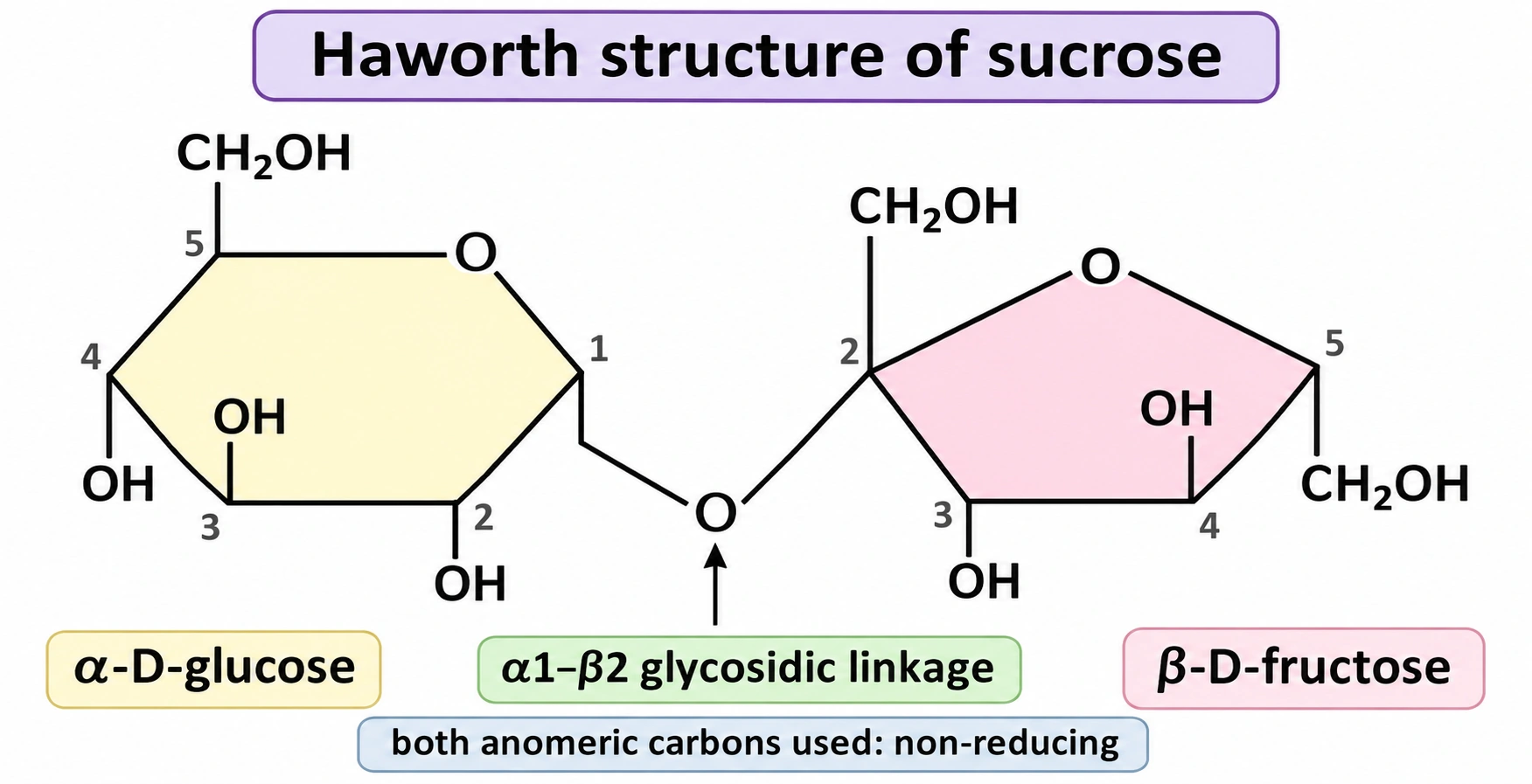
36. (a) Which disaccharide is also known as invert sugar? Write its Haworth structure. (3)
(b) What are non-essential amino acids? Give an example of an optically inactive non-essential amino acid. (2)
37. (a) Name the chemical reaction that differentiates ethanal and propanal. Write the chemical reaction of it. (3)
(b) Explain Kolbe electrolysis reaction for sodium acetate. (2)
38. (a) Write the structures of the products obtained when aniline undergoes nitration at 288 K. (3)
(b) Name one electrophilic substitution reaction that aniline does not undergo. Justify your answer. (2)
39. (a) Write the steps involved in the mechanism of acid catalysed hydration of ethene to ethanol. (3)
(b) Write the products obtained when 2-methoxy-2-methylpropane reacts with HI. (2)
40. (a) What is the chemical composition of Rochelle salt? How does it react with benzaldehyde? (3)
(b) Write the chemical reaction between cyclohexene and hot acidified KMnO. Write the IUPAC name of the product formed. (2)
Part E
VII. Answer any three of the following. Each question carries 3 marks. (3 × 3 = 9)
41. In a reaction 2A → R, the concentration of A decreases from 0.5 mol L to 0.4 mol L in 10 minutes. Calculate the rate during this interval.
42. At the same temperature, a 6% solution of urea is isotonic with a 5% solution of an unknown non-electrolyte A. Calculate the molar mass of A. (Molar mass of urea = 60 g mol)
43. An electric current of 100 amperes is passed through molten sodium chloride for 5 hours. Calculate the volume of chlorine gas liberated at the electrode at NTP.
44. The vapour pressure curves of a solution of a non-volatile solid G and of the pure solvent (water) are plotted against temperature. The pure solvent reaches 1 atm at 373.15 K and the solution at 373.202 K. Calculate the molality of the solution. (K for water = 0.52 K kg mol)
45. The rate constant of a first order reaction increases from 2 × 10 s to 4 × 10 s when the temperature changes from 300 K to 310 K. Calculate the energy of activation (E). [log 2 = 0.3010, log 2.5 = 0.3979, log 4 = 0.6020, R = 8.314 J K mol]
46. Calculate the emf of the cell in which the following reaction takes place: Ni(s) + 2Ag(0.002 M) → Ni(0.160 M) + 2Ag(s). Given that E° = 1.05 V.
Answers: Part A
Question 1: Which bond is hydrolysed when a disaccharide breaks into monosaccharides?
Answer. (b) Glycosidic bond. Monosaccharide units in a disaccharide are joined by a glycosidic (C–O–C) link.
Question 2: If molality is doubled, K becomes?
Answer. (d) unchanged. K depends only on the solvent. Doubling molality doubles ΔT, not K.
Question 3: Relation between Δ and Δ?
Answer. (a) Δ = (4/9) Δ. With only four ligands, none pointing straight at the orbitals, tetrahedral splitting is about 4/9 of octahedral.
Question 4: Reagent that reduces carboxylic acids to primary alcohols in good yield?
Answer. (b) LiAlH. LiAlH reduces –COOH to –CHOH. NaBH doesn't reduce carboxylic acids.
Question 5: Slope of ln k against 1/T?
Answer. (c) −E/R. . With log k instead of ln k, the slope would be −E/2.303R.
Question 6: Basicity order of ethylamines and NH in water?
Answer. (a) (CH)NH > (CH)N > CHNH > NH. In water, the +I effect, hydrogen bonding of the ion and crowding together make 2° > 3° > 1° > NH for ethyl groups.
Question 7: How do you get monobromoaniline instead of tribromoaniline?
Answer. (b) acetylating the amino group followed by bromination and hydrolysis. Acetylation tames the –NH group so only one Br goes in (para); hydrolysis then gives back the free –NH.
Question 8: Which statement about carboxylic acid acidity is not true?
Answer. (b) The presence of an electron-donating group on the phenyl ring of aromatic carboxylic acids increases their acidity.. Electron-donating groups destabilise the carboxylate ion and decrease acidity.
Question 9: Which pair has the same constant A in Λ = Λ − A√C?
Answer. (a) NHCl, NaBr. A depends on the type of electrolyte. NHCl and NaBr are both 1-1 electrolytes.
Question 10: Match four complexes with linkage, optical, geometrical and coordination isomerism.
Answer. (a) i→B, ii→D, iii→A, iv→C. [Co(en)] is chiral; a cation–anion pair of complexes gives coordination isomers; SCN gives linkage isomers; [Co(NH)Cl] has cis and trans forms.
Question 11: A boils above acetone (B). Which can A be?
Answer. (b) Propan-1-ol. Propan-1-ol has hydrogen bonding and boils above acetone; the others boil below it.
Question 12: Which haloarene can't be made by Sandmeyer's reaction?
Answer. (c) CH–F. Sandmeyer's reaction gives chloro- and bromobenzene; fluorobenzene is made by the Balz–Schiemann reaction.
Question 13: Why does cerium show +4?
Answer. (c) Ce has the noble gas configuration 4f@@GYANGHAR_MATH@@435d@@GYANGHAR_MATH@@446s. Ce has lost all its outer electrons and has the stable configuration of xenon.
Question 14: During osmosis, the solvent moves from?
Answer. (a) hypotonic solution to hypertonic solution. Solvent flows from the more dilute (hypotonic) side to the more concentrated (hypertonic) side.
Question 15: Formula of glycerol?
Answer. (d) CHO. Glycerol is propane-1,2,3-triol, HOCH–CH(OH)–CHOH, which is CHO.
Question 16: At the same partial pressure and temperature, as the value of Henry's constant of a gas increases, its solubility __.
Answer. decreases. x = p/K, so a larger K means a smaller mole fraction of dissolved gas.
Question 17: Most of the transition metals form ionic oxides except __.
Answer. Scandium. Every 3d metal except scandium forms an ionic monoxide, MO; scandium forms only ScO.
Question 18: Ethylidene chloride is a __.
Answer. geminal dihalide. Ethylidene chloride is CHCHCl: both Cl atoms are on the same carbon.
Question 19: An electron-accepting group __ the acidity of phenol.
Answer. increases. An electron-withdrawing group stabilises the phenoxide ion, so the phenol is more acidic.
Question 20: Nucleotides are joined together by __ linkage between the 5′ and 3′ carbon atoms of the pentose sugar.
Answer. phosphodiester. A phosphate joins C-5′ of one sugar to C-3′ of the next.
Answers: Part B
Question 21: What are freons? Give an example.
Answer. Freons are the chlorofluorocarbon compounds of methane and ethane.
Example: CClF (freon-12).
Marks: definition 1, example 1.
Question 22: What are the two conditions for an effective collision?
Answer. The two conditions for an effective collision are:
- The colliding molecules must have energy equal to or more than the threshold energy.
- They must collide with the proper orientation.
Marks: 1 for each condition.
Question 23: Name two functions of glucocorticoids.
Answer. Any two of these functions:
- They control carbohydrate metabolism.
- They modulate inflammatory reactions.
- They are involved in the body's reactions to stress.
Marks: any two functions, 1 each.
Question 24: Earlier members of the lanthanoids are quite reactive, similar to element A, and with increasing atomic number the lanthanoids behave more like element B. Identify A and B.
Answer. A = calcium and B = aluminium.
Marks: 1 for each.
Question 25: Explain the preparation of phenol from isopropylbenzene with chemical equation.
Answer. Step 1: Cumene (isopropylbenzene) is oxidised by air to cumene hydroperoxide.
Step 2: Cumene hydroperoxide is treated with dilute acid, giving phenol and acetone.
Marks: 1 for each step with its equation.
Answers: Part C
Question 26: Give two reasons to justify the catalytic property of transition elements. Name the catalyst used in the Wacker process.
Answer. Any two of these reasons:
- They show variable oxidation states.
- They have a large surface area.
- They can form complexes (intermediates) with the reactants.
The catalyst used in the Wacker process is PdCl.
Marks: any two reasons, 1 each; catalyst 1.
Question 27: Write the geometrical isomers of the complex [MX(L–L)], where M, X and L–L are central metal atom/ion, monodentate ligand and didentate ligand respectively. Identify the optically inactive form of it.
Answer. The complex is octahedral, and each L–L ligand spans two neighbouring corners.
trans isomer: the two X ligands are opposite each other, and both L–L rings lie in the middle plane.
cis isomer: the two X ligands are next to each other, at 90°.
The trans form is optically inactive, because it has a plane of symmetry. The cis form is optically active.
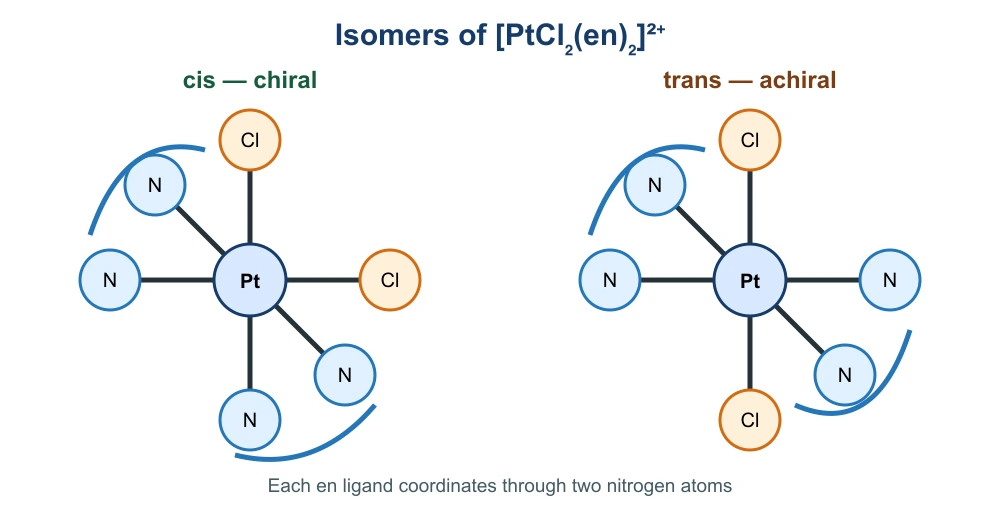
Marks: trans isomer 1, cis isomer 1, optically inactive form 1.
Question 28: Write any three limitations of valence bond theory of coordination compounds.
Answer. Any three of these limitations:
- It involves a number of assumptions.
- It does not explain the colour of coordination compounds.
- It does not give a quantitative interpretation of magnetic data.
- It does not give a quantitative interpretation of the thermodynamic or kinetic stability of complexes.
- It cannot predict exactly whether a 4-coordinate complex will be tetrahedral or square planar.
- It does not distinguish between weak and strong field ligands.
Marks: any three limitations, 1 each.
Question 29: Write the balanced chemical equations for: (i) potassium dichromate and iodide ion in acidic medium; (ii) potassium permanganate and iodide ion in neutral or alkaline medium; (iii) potassium permanganate and oxalate ion in acidic medium.
Answer.
(i)
(ii)
(iii)
Marks: 1 for each balanced equation.
Question 30: Draw the energy level diagram of crystal field splitting in an octahedral complex. Write the electronic configuration of a d system when P > Δ.
Answer. In an octahedral field, the five d orbitals split into a lower t set (three orbitals, at −0.4 Δ) and an upper e set (two orbitals, at +0.6 Δ).
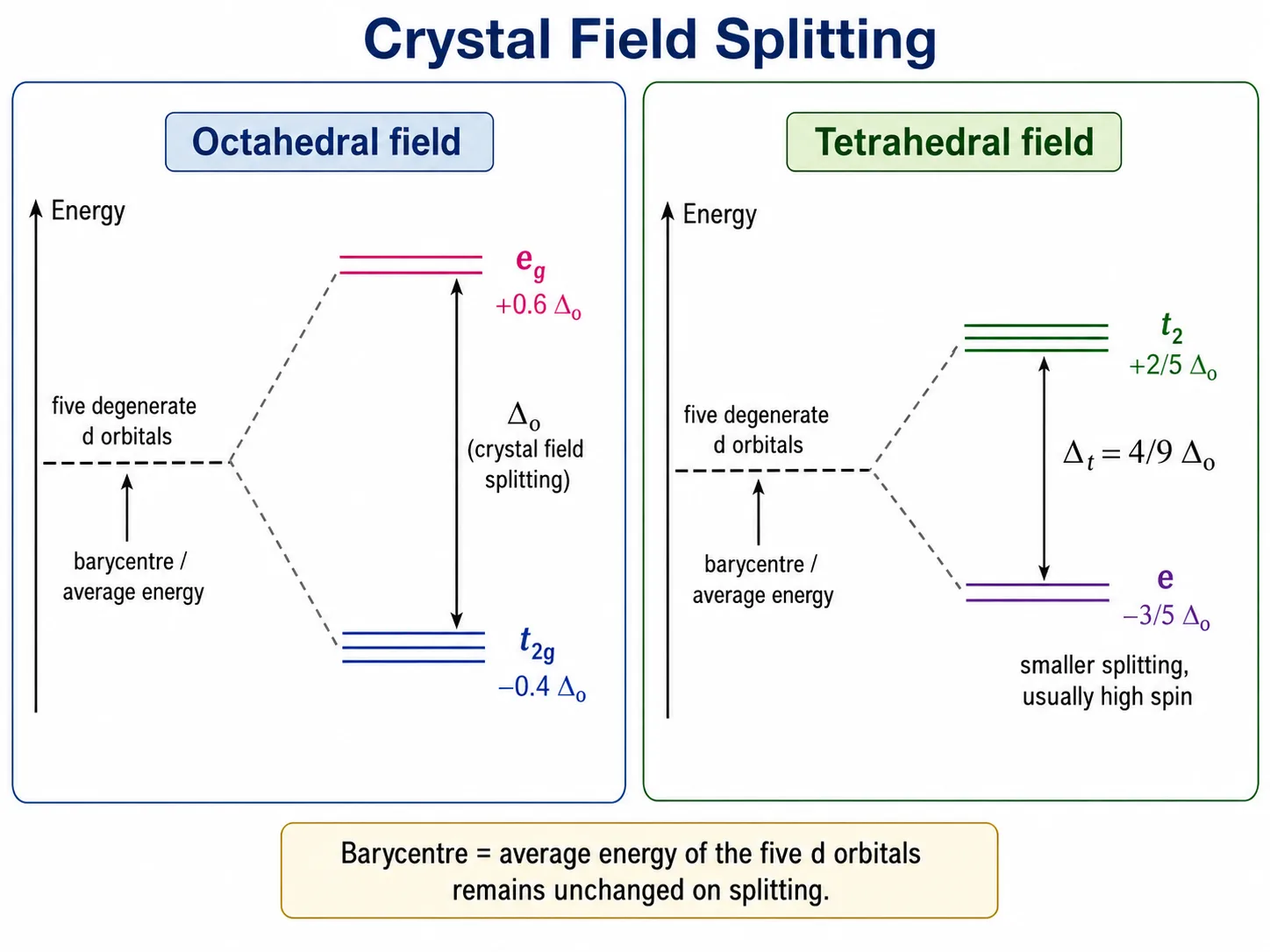
When the pairing energy P is greater than Δ, the fourth electron goes into e instead of pairing up. The configuration is t e (high spin, four unpaired electrons).
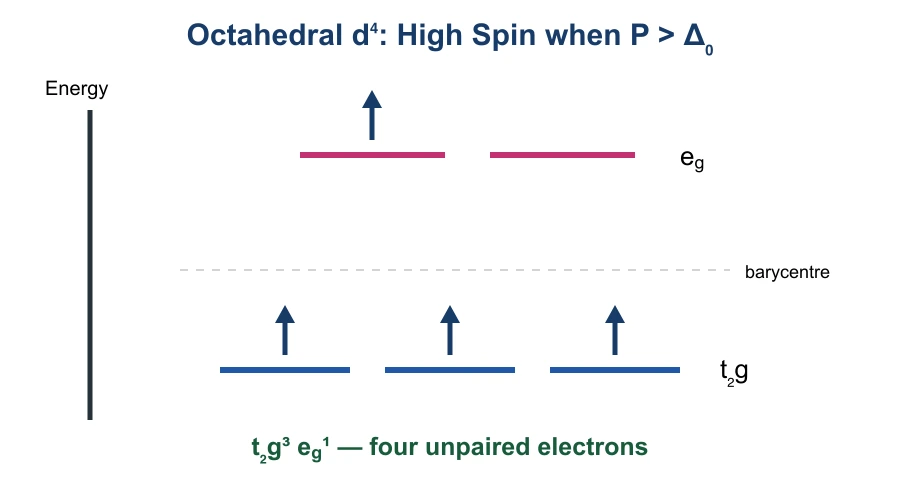
Marks: splitting diagram 2, configuration 1.
Question 31: Define half-life period. Show that the half-life period of a first order reaction is independent of the initial concentration of the reactant.
Answer. The half-life of a reaction is the time in which the concentration of a reactant falls to half of its initial value.
For a first order reaction:
At , , so
There is no in this expression, so the half-life of a first order reaction does not depend on the initial concentration.
Marks: definition 1, substitution of 1, final expression and conclusion 1.
Question 32: Plot the graph of molar conductivity against concentration for KCl and acetic acid. Which electrolyte's limiting molar conductivity can be determined from this graph?
Answer. Plot Λ against √c for both electrolytes.
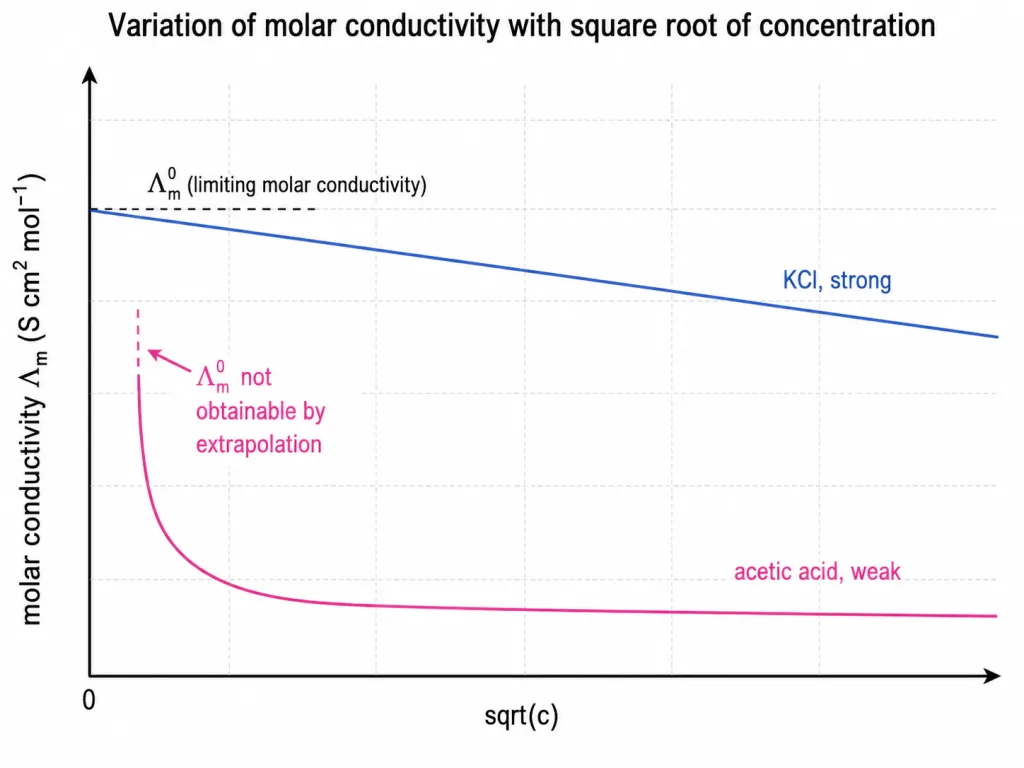
KCl (a strong electrolyte) gives a straight line which falls slowly.
Acetic acid (a weak electrolyte) stays low and rises steeply only at very low concentration.
The limiting molar conductivity of KCl can be found by extrapolating its line to √c = 0. That of acetic acid cannot be found from the graph.
Marks: graph 2, KCl 1.
Question 33: In a laboratory experiment, a student dissolves 6 g of urea in 180 g of water at constant temperature and observes that the vapour pressure of the solution is lower than that of pure water. Name the law that explains this observation, state the law and write its mathematical expression.
Answer. The law is Raoult's law.
For a solution of a non-volatile solute, the vapour pressure of the solution is equal to the vapour pressure of the pure solvent multiplied by its mole fraction. In other words, the relative lowering of vapour pressure is equal to the mole fraction of the solute.
, or
Marks: name 1, statement 1, expression 1.
Question 34: Name the electrolyte used in the mercury cell. Write its anodic and cathodic reactions.
Answer. The electrolyte is a paste of KOH and ZnO.
At the anode:
At the cathode:
Marks: electrolyte 1, anode 1, cathode 1.
Answers: Part D
Question 35: (a) IUPAC name and structure of DDT, and why its use grew after World War II. (3) (b) Toluene by the Wurtz–Fittig reaction. (2)
Answer.
(a)
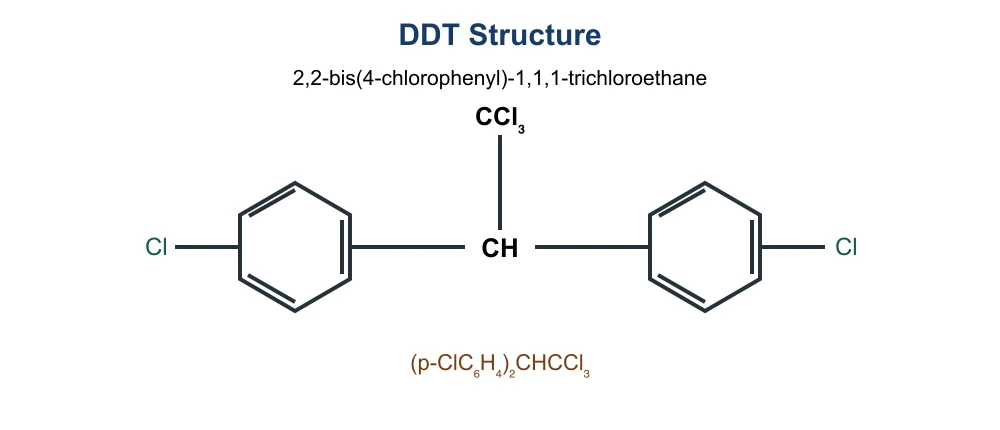
IUPAC name: 1,1,1-trichloro-2,2-bis(4-chlorophenyl)ethane (also written 2,2-bis(4-chlorophenyl)-1,1,1-trichloroethane)
Structure: (p-ClCH)CH–CCl. A CH group carries two 4-chlorophenyl groups and a CCl group.
Its use increased after World War II because it was very effective against the mosquitoes that spread malaria and the lice that carry typhus.
(b) When a mixture of an aryl halide and an alkyl halide is treated with sodium in dry ether, an alkylbenzene is formed. This is the Wurtz–Fittig reaction.
Marks: (a) name 1, structure 1, reason 1; (b) statement 1, equation 1.
Question 36: (a) The disaccharide linked to invert sugar, and its Haworth structure. (3) (b) Non-essential amino acids, and an optically inactive example. (2)
Answer.
(a) The disaccharide is sucrose. Sucrose is dextrorotatory, but on hydrolysis it gives glucose (+52.5°) and fructose (−92.4°), so the mixture is laevorotatory. This change in the sign of rotation is called inversion, and the product is called invert sugar.
Haworth structure: α-D-glucopyranose (a six-membered ring) is joined to β-D-fructofuranose (a five-membered ring) through one oxygen atom, between C-1 of glucose and C-2 of fructose.
In the glucose ring: C-1 link down (α), C-2 OH down, C-3 OH up, C-4 OH down, C-5 CHOH up.
In the fructose ring: C-2 carries the link and a CHOH (C-1), C-3 and C-4 each carry an OH, and C-5 carries the second CHOH (C-6).
Both anomeric carbons are used in the link, so sucrose is a non-reducing sugar.
(b) Amino acids which the body can make for itself are called non-essential amino acids. Glycine is non-essential and optically inactive.
Marks: (a) sucrose with inversion 1, Haworth structure 2; (b) definition 1, glycine 1.
Question 37: (a) The test that tells ethanal from propanal, with its equation. (3) (b) Kolbe electrolysis of sodium acetate. (2)
Answer.
(a) The iodoform test distinguishes them. Ethanal has a CHCO– group, so with I and NaOH it gives a yellow precipitate of iodoform. Propanal does not.
(b) When an aqueous solution of sodium acetate is electrolysed, ethane is formed at the anode. This is Kolbe electrolysis.
Marks: (a) name of test 1, explanation 1, equation 1; (b) statement 1, equation 1.
Question 38: (a) Products of nitration of aniline at 288 K. (3) (b) An electrophilic substitution aniline doesn't undergo, and why. (2)
Answer.
(a) With concentrated HNO and HSO at 288 K, aniline gives three products:
- p-Nitroaniline, p-ON–CH–NH (about 51%)
- m-Nitroaniline, m-ON–CH–NH (about 47%)
- o-Nitroaniline, o-ON–CH–NH (about 2%)
A large amount of the meta product is formed because, in strong acid, aniline becomes the anilinium ion, –NH, which is meta directing.
(b) Aniline does not undergo the Friedel–Crafts reaction (alkylation or acylation). Aniline is a base, so it forms a salt with the Lewis acid AlCl. The nitrogen then carries a positive charge, which strongly deactivates the ring.
Marks: (a) 1 for each product; (b) reaction 1, reason 1.
Question 39: (a) Mechanism of acid-catalysed hydration of ethene. (3) (b) Products of 2-methoxy-2-methylpropane with HI. (2)
Answer.
(a) The acid-catalysed hydration of ethene takes place in three steps. Show every charge.
Step 1: Ethene takes a proton from HO and forms a carbocation.
Step 2: Water attacks the carbocation.
Step 3: Loss of a proton gives ethanol.
(b) One alkyl group is tertiary, so the C–O bond breaks on the tertiary side (S@@GYANGHAR_MATH@@351) and iodine goes to the tertiary carbon.
The products are 2-iodo-2-methylpropane and methanol.
Marks: (a) 1 for each step; (b) 1 for each product.
Question 40: (a) Composition of Rochelle salt, and how it behaves with benzaldehyde. (3) (b) Cyclohexene with hot acidified KMnO, and the product's IUPAC name. (2)
Answer.
(a) Rochelle salt is sodium potassium tartrate, KNaCHO·4HO. Its alkaline solution is Fehling's solution B, which is mixed with CuSO solution (Fehling's A) for the Fehling test.
Benzaldehyde does not react with it. Aromatic aldehydes do not reduce Fehling's solution, so no red precipitate of CuO is formed.
(b) Hot acidified KMnO breaks the ring at the C=C bond, and both ends are oxidised to –COOH groups.
The product is hexanedioic acid (adipic acid).
Marks: (a) composition 1, use as Fehling's solution 1, no reaction with benzaldehyde 1; (b) reaction 1, IUPAC name 1.
Answers: Part E
Question 41: In a reaction 2A → R, the concentration of A decreases from 0.5 mol L to 0.4 mol L in 10 minutes. Calculate the rate during this interval.
Answer.
Given: [A] falls from 0.5 mol L to 0.4 mol L; = 10 min; reaction 2A → R
To find: Rate of the reaction
Formula: Rate
Substitution: Rate
Answer: Rate = 5 × 10 mol L min (= 8.33 × 10 mol L s)
Marks: formula 1, substitution 1, answer with unit 1.
Question 42: At the same temperature, a 6% solution of urea is isotonic with a 5% solution of an unknown non-electrolyte A. Calculate the molar mass of A. (Molar mass of urea = 60 g mol)
Answer. Isotonic solutions have the same molar concentration.
Given: 6% urea solution, that is, 6 g of urea in 100 mL; 5% solution of A, that is, 5 g of A in 100 mL; molar mass of urea = 60 g mol
To find: Molar mass of A,
Formula: (same volume)
Substitution:
Answer: Molar mass of A = 50 g mol
Marks: formula 1, substitution 1, answer with unit 1.
Question 43: An electric current of 100 amperes is passed through molten sodium chloride for 5 hours. Calculate the volume of chlorine gas liberated at the electrode at NTP.
Answer.
Given: I = 100 A; t = 5 h = 5 × 3600 = 18000 s; F = 96500 C mol; at the anode, , so 2 F give 1 mol of Cl; molar volume at NTP = 22.4 L
To find: Volume of chlorine at NTP
Formula: Q = It; moles of Cl = ; volume = moles × 22.4 L
Substitution: Q = 100 × 18000 = 1.8 × 10 C = = 18.65 F; moles of Cl = = 9.33 mol; volume = 9.33 × 22.4 L
Answer: Volume of chlorine = 209 L
Marks: moles of Cl 1, substitution 1, answer with unit 1.
Question 44: The vapour pressure curves of a solution of a non-volatile solid G and of the pure solvent (water) are plotted against temperature. The pure solvent reaches 1 atm at 373.15 K and the solution at 373.202 K. Calculate the molality of the solution. (K for water = 0.52 K kg mol)
Answer. Each liquid boils when its vapour pressure reaches 1 atm.
Given: Boiling point of water = 373.15 K; boiling point of the solution = 373.202 K, so = 373.202 − 373.15 = 0.052 K; = 0.52 K kg mol
To find: Molality, m
Formula: , so
Substitution:
Answer: Molality = 0.1 mol kg
Marks: formula 1, substitution 1, answer with unit 1.
Question 45: The rate constant of a first order reaction increases from 2 × 10 s to 4 × 10 s when the temperature changes from 300 K to 310 K. Calculate the energy of activation (E). [log 2 = 0.3010, log 2.5 = 0.3979, log 4 = 0.6020, R = 8.314 J K mol]
Answer. This is the same problem as Q45 of 2025 Exam-1.
Given: = 2 × 10 s at = 300 K; = 4 × 10 s at = 310 K; R = 8.314 J K mol
To find: Energy of activation,
Formula:
Substitution: , so
Answer: = 53599 J mol (about 53.6 kJ mol)
Marks: formula 1, substitution 1, answer with unit 1.
Question 46: Calculate the emf of the cell in which the following reaction takes place: Ni(s) + 2Ag(0.002 M) → Ni(0.160 M) + 2Ag(s). Given that E° = 1.05 V.
Answer.
Given: = 1.05 V; [Ni] = 0.160 M; [Ag] = 0.002 M; n = 2
To find:
Formula:
Substitution: and , so
Answer: = 0.914 V
Marks: formula 1, substitution 1, answer with unit 1.