
About This Paper
Model Paper 2 is the 2026 Model Paper 2, almost unchanged. There is no official scheme for model papers, so the mark splits follow the board's exam schemes.
Numbering slip: in the English paper, the Arrhenius problem in Part E has no number, so the next two are printed as 44 and 45. Here they are numbered 44, 45 and 46, as in the Kannada paper.
Sit it in 3 hours before you look at any answer.
Already asked in the 2025–26 exams: Q1, Q15, Q17, Q19, Q21, Q27, Q33, Q35 (b), Q38 (a) and Q42.
Part F (alternate questions for visually challenged students) is not included.
Question Paper: Part A
I. Select the correct option from the given choices. (15 × 1 = 15)
1. The mixture which shows positive deviation from Raoult's law is
(a) n-hexane and n-heptane
(b) Bromoethane and chloroethane
(c) Ethanol and acetone
(d) Chloroform and acetone
2. A cell that converts the energy of combustion of fuels like hydrogen and methane directly into electrical energy is known as
(a) Dynamo
(b) Ni–Cd cell
(c) Fuel cell
(d) Electrolytic cell
3. The common name of ethanedioic acid is
(a) Acetic acid
(b) Oxalic acid
(c) Adipic acid
(d) Succinic acid
4. Which aldehyde does not respond to Fehling's test?
(a) Formaldehyde
(b) Ethanal
(c) Benzaldehyde
(d) Propanal
5. The pK values of phenol, o-cresol and o-nitrophenol are 10.0, 10.2 and 7.2 respectively. The correct order of acidity is
(a) phenol > o-cresol > o-nitrophenol
(b) o-cresol > phenol > o-nitrophenol
(c) o-nitrophenol > o-cresol > phenol
(d) o-nitrophenol > phenol > o-cresol
6. A student took two glasses of pure water from a water filter. He cools glass A in a fridge and warms glass B on a stove. Comparing the solubility of oxygen in the two glasses, glass A contains
(a) more oxygen than glass B
(b) less oxygen than glass B
(c) the same amount of oxygen as glass B
(d) zero concentration of oxygen
7. For the reaction 2NH(g) → N(g) + 3H(g) on a platinum catalyst at 1130 K, the rate is
(a) Rate = k[NH]
(b) Rate = k[NH]
(c) Rate = k[NH]
(d) Rate = k
8. Match List-I with List-II. List-I: (i) Phosphodiester linkage, (ii) Glycosidic linkage, (iii) Peptide linkage. List-II: (A) Amino acids, (B) Nucleotides, (C) Monosaccharides, (D) Phenols.
(a) i – C, ii – D, iii – B
(b) i – C, ii – A, iii – B
(c) i – B, ii – C, iii – D
(d) i – B, ii – C, iii – A
9. When an alkene reacts with a component X in CCl, the reddish-brown colour of X disappears to yield a vicinal dihalide. Component X is
(a) Cl
(b) HBr
(c) Br
(d) I
10. Statement I: Potassium permanganate is a powerful oxidant. Statement II: KMnO oxidises I to IO in acidic solution.
(a) Both Statement I and Statement II are correct
(b) Statement I is incorrect but Statement II is correct
(c) Both Statement I and Statement II are incorrect
(d) Statement I is correct but Statement II is incorrect
11. For the reaction RCONH + Br + 4NaOH → RNH + NaCO + 2NaBr + 2HO, if the molecular formula of the amine is CHN, the molecular formula of the amide is
(a) CHNO
(b) CHNO
(c) CHNO
(d) CHNO
12. [Mn(CN)] and [FeF] are
(a) inner orbital and outer orbital complexes respectively
(b) outer orbital and inner orbital complexes respectively
(c) both inner orbital complexes
(d) both outer orbital complexes
13. Triiodomethane was used earlier as an antiseptic. The antiseptic properties are due to
(a) presence of iodoform
(b) liberation of iodine
(c) objectionable smell
(d) presence of methane
14. The electronic configuration of a transition element X in the +3 oxidation state is [Ar]3d. What is its atomic number?
(a) 24
(b) 25
(c) 26
(d) 27
15. Acetylation of salicylic acid produces a compound which has anti-inflammatory and antipyretic properties. The compound is
(a) Bakelite
(b) Acetic anhydride
(c) Formalin
(d) Aspirin
II. Fill in the blanks by choosing the appropriate word from those given in the brackets. (5 × 1 = 5)
[Primary, Amylose, One, Zero, Picric acid, tertiary]
16. The sum of the mole fractions of all the components in a binary solution is equal to __.
17. Gabriel synthesis is used for the preparation of __ amines.
18. The water-soluble component of starch is __.
19. Oxidation state of Ni in [Ni(CO)] is __.
20. 2,4,6-Trinitrophenol is commonly known as __.
Question Paper: Parts B to E
Part B
III. Answer any three of the following. Each question carries 2 marks. (3 × 2 = 6)
21. Write two differences between order and molecularity of a chemical reaction.
22. Explain Swarts reaction with an example.
23. Give an example for the following: (i) an essential amino acid (ii) a fibrous protein.
24. Give reason: (i) Separation of lanthanoids from their natural occurrence is difficult. (ii) Study of actinoids is difficult.
25. A compound has molecular formula CHO. A heated with HI gives C + D, and D with conc. HSO at 413 K gives back A. Identify compound A and write its IUPAC name.
Part C
IV. Answer any three of the following. Each question carries 3 marks. (3 × 3 = 9)
26. Explain the preparation of potassium permanganate from MnO with balanced equations. Mention the gas evolved when KMnO is heated at 513 K.
27. On the basis of Valence Bond Theory, explain the hybridisation, geometry and magnetic property of the complex [Ni(CN)]. [Given: atomic number of Ni = 28]
28. Write the geometrical isomers of the complex [PtCl(en)]. Which among them is chiral?
29. Considering the elements of the 3d transition series, write the element which is (i) unable to form a monoxide, (ii) having a positive E°(M/M) value, (iii) the base element of the Ziegler catalyst used to manufacture polythene.
30. Alfred Werner formulated his ideas about the structure of coordination compounds. When CoCl·6NH is treated with excess AgNO, 3 moles of AgCl are obtained. Based on this, (i) write the formula of the compound; (ii) mention the primary and secondary valency of the central metal atom.
V. Answer any two of the following. Each question carries 3 marks. (2 × 3 = 6)
31. What are electrochemical cells? Name the two types of cells.
32. Write three reasons to justify that the osmotic pressure method has an advantage over other colligative methods for measuring the molar mass of macromolecules.
33. Mention any three factors which decide the products of electrolysis.
34. What is meant by chemical kinetics? Give any two importances of studying chemical kinetics.
Part D
VI. Answer any four of the following. Each question carries 5 marks. (4 × 5 = 20)
35. (a) Give the differences between S@@GYANGHAR_MATH@@151 and S@@GYANGHAR_MATH@@162 mechanisms with respect to (i) order of reaction, (ii) configuration of the product, (iii) order of reactivity of alkyl halides. (3)
(b) Explain Wurtz reaction with a general chemical equation. (2)
36. (a) Provide the general reaction to prepare haloform from methyl ketones. Name a reagent which is used to detect the presence of an α-methyl group in a carbonyl compound. (3)
(b) In the given reaction, acetone + Z gives (CH)C=N–NH–CH(NO) through an addition intermediate. Write the structure and name of compound Z. (2)
37. (a) How is salicylic acid prepared from phenol? Explain with an equation. (3)
(b) Alcohols are comparatively more soluble in water than hydrocarbons of comparable molecular masses. Give reason. (2)
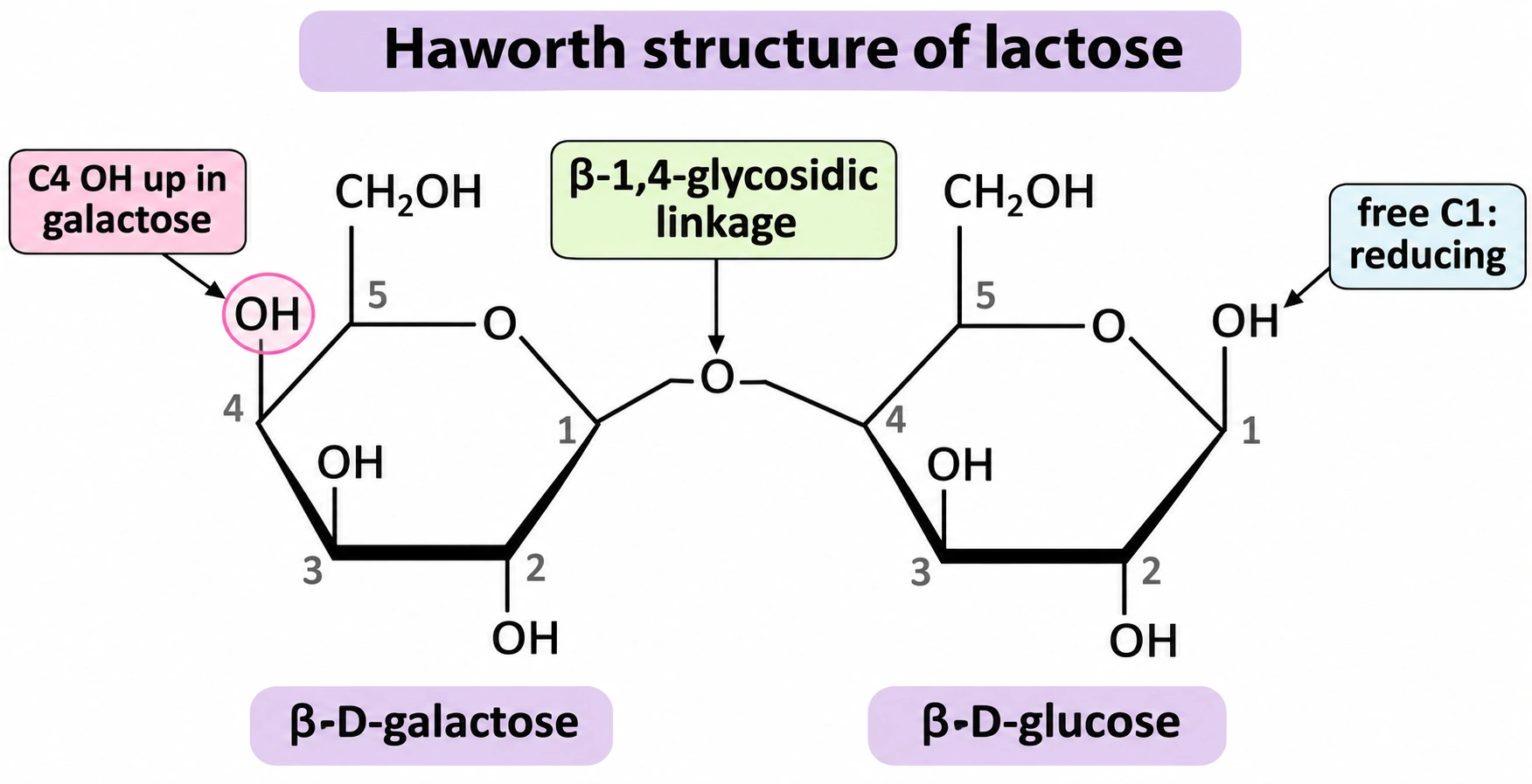
38. (a) What are reducing sugars? Write the Haworth structure of lactose. (3)
(b) Hormones are needed in adequate quantities in our body. Give reason. (1)
(c) What is the backbone of DNA? (1)
39. CHMgBr + CO → [(i) A, (ii) HO] B → [(i) Cl/red P, (ii) HO] C. (a) Identify A, B and C. (3) (b) Name the reaction for the conversion of B to C. (1) (c) C is more acidic than B. Give reason. (1)
40. (a) Write the chemical reactions to differentiate between primary and secondary amines using Hinsberg's reagent. (2)
(b) Complete the reaction: CHNCl, (i) HBF, (ii) NaNO/Cu, heat → _ + _ + N (2)
(c) Write the IUPAC name of CHCHCHNH. (1)
Part E
VII. Answer any three of the following. Each question carries 3 marks. (3 × 3 = 9)
41. The boiling point of benzene is 353.23 K. Calculate the mass of non-volatile solute to be added to 90 g of benzene so that it boils at 354.11 K. The molar mass of the solute is 58 g mol. [Given: K = 2.53 K kg mol]
42. Assuming a very dilute solution, calculate the mass of a non-volatile solute which should be dissolved in 114 g octane to reduce its vapour pressure to 80%. [Given: molecular formula of octane is CH; molar mass of solute = 40 g mol]
43. Calculate the emf of the cell for the reaction Mg(s) + Cu(0.0001 M) → Mg(0.001 M) + Cu(s). [Given: E°(Mg/Mg) = −2.37 V, E°(Cu/Cu) = +0.34 V]
44. The rate of a reaction quadruples when the temperature changes from 293 K to 313 K. Calculate the energy of activation of the reaction, assuming that it does not change with temperature.
45. The C-14 content of an ancient piece of wood was found to be 3/10 of that of a living tree. Calculate the age of that piece of wood. [Given: half-life of C-14 = 5730 years, log 3 = 0.4771, log 7 = 0.8540]
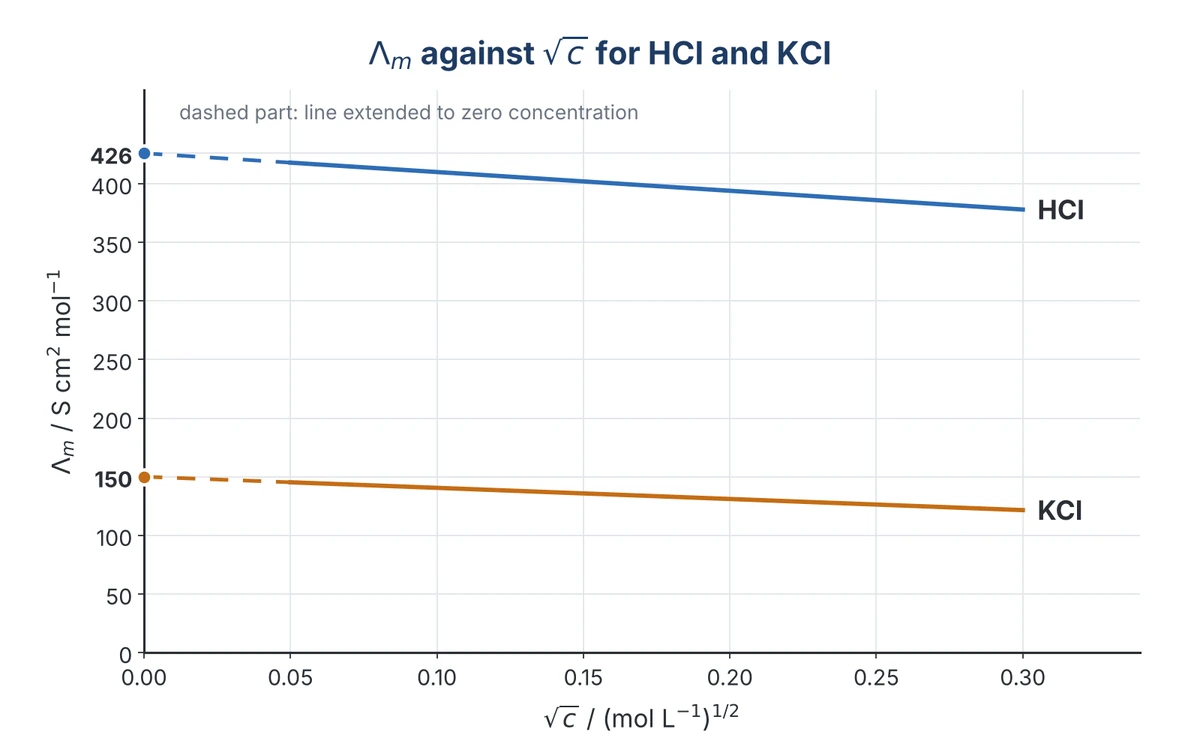
46. The limiting molar conductivity of CHCOOH is 390 S cm mol. Using the given graph of Λ against √c for HCl and KCl, and the given information, calculate the limiting molar conductivity of CHCOOK.
Answers: Part A
Question 1: Which mixture shows positive deviation from Raoult's law?
Answer. (c) Ethanol and acetone. Acetone breaks some of ethanol's hydrogen bonds, so molecules escape more easily. Chloroform and acetone show negative deviation; the first two pairs are nearly ideal.
Question 2: A cell that turns the energy of combustion of fuels directly into electricity is called?
Answer. (c) Fuel cell. That is the definition of a fuel cell, for example the H–O cell.
Question 3: Common name of ethanedioic acid?
Answer. (b) Oxalic acid. Ethanedioic acid, HOOC–COOH, is oxalic acid.
Question 4: Which aldehyde doesn't respond to Fehling's test?
Answer. (c) Benzaldehyde. Aromatic aldehydes such as benzaldehyde don't reduce Fehling's solution.
Question 5: pK: phenol 10.0, o-cresol 10.2, o-nitrophenol 7.2. Order of acidity?
Answer. (d) o-nitrophenol > phenol > o-cresol. Lower pK means stronger acid: 7.2 < 10.0 < 10.2.
Question 6: Water in glass A is cooled and in glass B is warmed. Glass A contains:
Answer. (a) more oxygen than glass B. Gases dissolve better in cold water: K is smaller at lower temperature.
Question 7: Rate law for decomposition of NH on hot platinum?
Answer. (d) Rate = k. At high pressure the metal surface is fully covered, so the rate doesn't depend on [NH]: a zero order reaction.
Question 8: Match phosphodiester, glycosidic and peptide linkages with what they join.
Answer. (d) i – B, ii – C, iii – A. Phosphodiester links join nucleotides, glycosidic links join monosaccharides, peptide links join amino acids.
Question 9: Which reagent loses its reddish-brown colour with an alkene in CCl?
Answer. (c) Br. Bromine in CCl is reddish-brown; it adds across the C=C to give a colourless vicinal dibromide.
Question 10: Statement I: KMnO is a powerful oxidant. Statement II: it oxidises I to IO in acid.
Answer. (d) Statement I is correct but Statement II is incorrect. In acid, KMnO oxidises iodide only to I. Iodate forms in neutral or faintly alkaline solution.
Question 11: Hofmann degradation gives CHN. What was the amide?
Answer. (b) CHNO. The amine has one carbon fewer than the amide. CHNH comes from CHCONH, which is CHNO.
Question 12: [Mn(CN)] and [FeF] are inner or outer orbital complexes?
Answer. (a) inner orbital and outer orbital complexes respectively. Strong field CN uses inner 3d orbitals (dsp); weak field F uses outer 4d orbitals (spd).
Question 13: Why was iodoform an antiseptic?
Answer. (b) liberation of iodine. Iodoform slowly releases free iodine, which kills germs. Its smell is why it was later replaced.
Question 14: X is [Ar]3d. Atomic number of X?
Answer. (c) 26. X has 3 more electrons than X: 18 + 5 + 3 = 26, which is iron.
Question 15: Acetylation of salicylic acid gives which drug?
Answer. (d) Aspirin. Aspirin is acetylsalicylic acid.
Question 16: The sum of the mole fractions of all the components in a binary solution is equal to __.
Answer. One. x + x = 1 for any binary solution.
Question 17: Gabriel synthesis is used for the preparation of __ amines.
Answer. Primary. Gabriel phthalimide synthesis gives primary aliphatic amines.
Question 18: The water-soluble component of starch is __.
Answer. Amylose. Amylose (15–20% of starch) dissolves in water; amylopectin doesn't.
Question 19: Oxidation state of Ni in [Ni(CO)] is __.
Answer. Zero. CO is neutral and the complex has no charge.
Question 20: 2,4,6-Trinitrophenol is commonly known as __.
Answer. Picric acid. Picric acid is 2,4,6-trinitrophenol.
Answers: Part B
Question 21: Write two differences between order and molecularity of a chemical reaction.
Answer. Any two of these differences:
| Order | Molecularity |
|---|---|
| It is the sum of the powers of the concentration terms in the experimental rate law. | It is the number of reacting species taking part in an elementary step. |
| It is found by experiment. | It is worked out from the elementary step. |
| It can be zero or a fraction. | It is always a whole number, never zero. |
| It applies to elementary and complex reactions. | It applies only to elementary reactions. |
Marks: any two differences, 1 each.
Question 22: Explain Swarts reaction with an example.
Answer. When an alkyl chloride or bromide is heated with a metallic fluoride such as AgF, HgF, CoF or SbF, an alkyl fluoride is formed. This is the Swarts reaction.
Marks: statement 1, example 1.
Question 23: Give an example for the following: (i) an essential amino acid (ii) a fibrous protein.
Answer.
(i) An essential amino acid: valine (or lysine, leucine, isoleucine, arginine).
(ii) A fibrous protein: keratin (or myosin).
Marks: 1 for each example.
Question 24: Give reason: (i) Separation of lanthanoids from their natural occurrence is difficult. (ii) Study of actinoids is difficult.
Answer.
(i) Because of lanthanoid contraction, the lanthanoids are very similar in size and so in their chemical properties. So it is difficult to separate them.
(ii) Actinoids are radioactive, and many of them have short half-lives and are made only in tiny amounts. So their study is difficult.
Marks: 1 for each reason.
Question 25: A compound has molecular formula CHO. A heated with HI gives C + D, and D with conc. HSO at 413 K gives back A. Identify compound A and write its IUPAC name.
Answer. D forms an ether with conc. HSO at 413 K, and that ether is A, so A is a symmetrical ether. The only symmetrical ether with the formula CHO is diethyl ether. HI splits it into iodoethane (C) and ethanol (D).
A = CH–O–CH
IUPAC name: ethoxyethane
Marks: compound A 1, IUPAC name 1.
Answers: Part C
Question 26: Explain the preparation of potassium permanganate from MnO with balanced equations. Mention the gas evolved when KMnO is heated at 513 K.
Answer. Step 1: MnO is fused with KOH in the presence of air, giving green potassium manganate.
Step 2: The manganate ion disproportionates in a neutral or acidic solution, giving permanganate.
When KMnO is heated at 513 K, oxygen gas is evolved.
Marks: step 1 1, step 2 1, oxygen 1.
Question 27: On the basis of Valence Bond Theory, explain the hybridisation, geometry and magnetic property of the complex [Ni(CN)]. [Given: atomic number of Ni = 28]
Answer. Ni has the configuration 3d. CN is a strong field ligand, so the two unpaired 3d electrons pair up and one 3d orbital becomes empty. One 3d orbital, the 4s orbital and two 4p orbitals hybridise to give dsp hybrid orbitals, which accept four electron pairs from the four CN ions.
Geometry: square planar
Magnetic property: there are no unpaired electrons, so it is diamagnetic.
Marks: explanation with hybridisation 1, geometry 1, magnetic property 1.
Question 28: Write the geometrical isomers of the complex [PtCl(en)]. Which among them is chiral?
Answer.
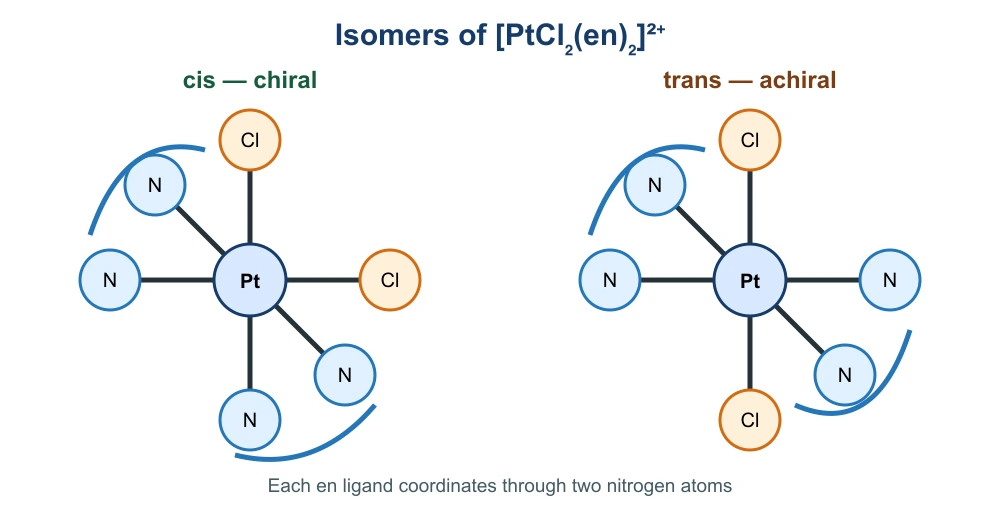
cis isomer: the two Cl ions are next to each other, at 90°.
trans isomer: the two Cl ions are opposite each other, and both en rings lie in one plane.
The cis isomer is chiral, because it has no plane of symmetry. The trans isomer is not chiral.
Marks: cis isomer 1, trans isomer 1, chiral form 1.
Question 29: Considering the elements of the 3d transition series, write the element which is (i) unable to form a monoxide, (ii) having a positive E°(M/M) value, (iii) the base element of the Ziegler catalyst used to manufacture polythene.
Answer.
(i) Scandium is unable to form a monoxide.
(ii) Copper has a positive E°(M/M) value (+0.34 V).
(iii) Titanium is the base element of the Ziegler catalyst (TiCl with Al(CH)).
Marks: 1 for each.
Question 30: Alfred Werner formulated his ideas about the structure of coordination compounds. When CoCl·6NH is treated with excess AgNO, 3 moles of AgCl are obtained. Based on this, (i) write the formula of the compound; (ii) mention the primary and secondary valency of the central metal atom.
Answer. All three Cl ions are precipitated as AgCl, so none of them is bonded to cobalt.
(i) The formula is [Co(NH)]Cl.
(ii) Primary valency = 3; secondary valency = 6.
Marks: (i) formula 1; (ii) 1 for each valency.
Question 31: What are electrochemical cells? Name the two types of cells.
Answer. Electrochemical cells are devices which convert chemical energy into electrical energy or electrical energy into chemical energy.
The two types are:
- Galvanic (voltaic) cells, which convert the chemical energy of a spontaneous reaction into electrical energy.
- Electrolytic cells, which use electrical energy to carry out a non-spontaneous reaction.
Marks: definition 1, 1 for each type.
Question 32: Write three reasons to justify that the osmotic pressure method has an advantage over other colligative methods for measuring the molar mass of macromolecules.
Answer. Any three of these reasons:
- The measurement is done at room temperature, so it suits biomolecules which break down on heating.
- It uses molarity, not molality.
- Osmotic pressure is large enough to measure even for very dilute solutions, which is all that polymers with poor solubility can give.
Marks: any three reasons, 1 each.
Question 33: Mention any three factors which decide the products of electrolysis.
Answer. Any three of these factors:
- The nature of the material being electrolysed.
- The type of electrodes used.
- The oxidising and reducing species present and their standard electrode potentials.
- The concentration of the electrolyte.
Marks: any three factors, 1 each.
Question 34: What is meant by chemical kinetics? Give any two importances of studying chemical kinetics.
Answer. Chemical kinetics is the branch of chemistry which deals with the rates of chemical reactions, the factors affecting them and the mechanisms by which they take place.
Any two importances:
- It helps us choose conditions so that industrial reactions go at a useful speed.
- It helps us work out reaction mechanisms.
- It tells us how long a substance, such as a drug or a pollutant, will last.
Marks: definition 1, any two importances 1 each.
Answers: Part D
Question 35: (a) S vs S: order, configuration of product, reactivity order. (3) (b) Wurtz reaction. (2)
Answer.
(a)
| S | S | |
|---|---|---|
| Order | First order: rate = k[RX] | Second order: rate = k[RX][Nu] |
| Configuration of product | Racemisation (both forms) | Inversion |
| Reactivity order | 3° > 2° > 1° > CHX | CHX > 1° > 2° > 3° |
(b) When an alkyl halide is treated with sodium in dry ether, two alkyl groups join and an alkane with double the number of carbon atoms is formed. This is the Wurtz reaction.
Marks: (a) 1 for each row; (b) statement 1, equation 1.
Question 36: (a) Haloform reaction of methyl ketones, and a reagent to detect a CHCO– group. (3) (b) Acetone + Z gives the 2,4-dinitrophenylhydrazone. Identify Z. (2)
Answer.
(a) Methyl ketones are oxidised by sodium hypohalite, and the CH group is converted into haloform. This is the haloform reaction.
The reagent used to detect a CHCO– group is sodium hypoiodite (I + NaOH). A yellow precipitate of iodoform shows that the CHCO– group is present (iodoform test).
(b) Z is 2,4-dinitrophenylhydrazine (2,4-DNP, Brady's reagent): HN–NH–CH(NO), with the two NO groups at positions 2 and 4 of the ring.
Marks: (a) haloform reaction with equation 2, reagent 1; (b) structure 1, name 1.
Question 37: (a) Salicylic acid from phenol. (3) (b) Why alcohols are more soluble in water than hydrocarbons. (2)
Answer.
(a) Salicylic acid is made from phenol by Kolbe's reaction.
Step 1: Phenol reacts with NaOH to give sodium phenoxide.
Step 2: Sodium phenoxide reacts with CO under pressure.
Step 3: Acidifying gives salicylic acid.
(b) The –OH group of an alcohol forms hydrogen bonds with water molecules, so alcohols dissolve in water. Hydrocarbons have no such group and cannot form hydrogen bonds with water.
Marks: (a) 1 for each step; (b) hydrogen bonding in alcohols 1, none in hydrocarbons 1.
Question 38: (a) Reducing sugars; Haworth structure of lactose. (3) (b) Why hormones are needed in the right amounts. (1) (c) The backbone of DNA. (1)
Answer.
(a) Sugars which reduce Fehling's solution and Tollens' reagent are called reducing sugars. They have a free aldehyde or ketone group.
Lactose is made of β-D-galactose and β-D-glucose, joined by a β-glycosidic linkage between C-1 of galactose and C-4 of glucose.
| Carbon | β-D-galactose unit | β-D-glucose unit |
|---|---|---|
| C-1 | –O– link to glucose C-4 (up, β) | OH up (β) |
| C-2 | OH down | OH down |
| C-3 | OH up | OH up |
| C-4 | OH up | –O– link from galactose |
| C-5 | CHOH up | CHOH up |
(b) Hormones keep the activities of the body in balance. Too little or too much of a hormone upsets this balance and causes disease; for example, a lack of insulin causes diabetes.
(c) The backbone of DNA is the sugar–phosphate backbone: deoxyribose units joined by phosphodiester linkages.
Marks: (a) definition 1, structure 2; (b) 1; (c) 1.
Question 39: CHMgBr + CO, (i) A, (ii) HO gives B; B with Cl/red P, then water, gives C. (a) Identify A, B, C. (3) (b) Name the B to C reaction. (1) (c) Why C is more acidic than B. (1)
Answer.
(a) A = dry ether, the solvent for the Grignard reaction
B = ethanoic acid, CHCOOH
C = chloroethanoic acid, ClCHCOOH
(b) The conversion of B to C is the Hell–Volhard–Zelinsky (HVZ) reaction.
(c) Cl is an electron-withdrawing group (–I effect). It spreads out the negative charge of the carboxylate ion and makes it more stable, so C is a stronger acid than B.
Marks: (a) 1 for each of A, B and C; (b) 1; (c) 1.
Question 40: (a) Hinsberg test for primary and secondary amines. (2) (b) CHNCl with HBF, then NaNO/Cu, heat. (2) (c) IUPAC name of CHCHCHNH. (1)
Answer.
(a) Both amines are treated with benzenesulphonyl chloride (Hinsberg's reagent).
A primary amine gives a sulphonamide which still has an acidic H atom on nitrogen, so the product dissolves in alkali.
A secondary amine gives a sulphonamide with no H atom on nitrogen, so the product does not dissolve in alkali.
(b) The products are nitrobenzene and NaBF.
(c) Propan-1-amine
Marks: (a) primary amine 1, secondary amine 1; (b) 1 for each product; (c) 1.
Answers: Part E
Question 41: The boiling point of benzene is 353.23 K. Calculate the mass of non-volatile solute to be added to 90 g of benzene so that it boils at 354.11 K. The molar mass of the solute is 58 g mol. [Given: K = 2.53 K kg mol]
Answer.
Given: Boiling point of benzene = 353.23 K; boiling point of solution = 354.11 K, so = 354.11 − 353.23 = 0.88 K; = 90 g; = 58 g mol; = 2.53 K kg mol
To find: Mass of the solute,
Formula: , so
Substitution:
Answer: Mass of the solute = 1.82 g
Marks: formula 1, substitution 1, answer with unit 1.
Question 42: Assuming a very dilute solution, calculate the mass of a non-volatile solute which should be dissolved in 114 g octane to reduce its vapour pressure to 80%. [Given: molecular formula of octane is CH; molar mass of solute = 40 g mol]
Answer.
Given: Mass of octane, = 114 g; molar mass of octane (CH), = 114 g mol; = 40 g mol; vapour pressure falls to 80%, so
To find: Mass of the solute,
Formula (dilute solution):
Substitution:
Answer: Mass of the solute = 8 g
Marks: formula 1, substitution 1, answer with unit 1.
Question 43: Calculate the emf of the cell for the reaction Mg(s) + Cu(0.0001 M) → Mg(0.001 M) + Cu(s). [Given: E°(Mg/Mg) = −2.37 V, E°(Cu/Cu) = +0.34 V]
Answer.
Given: E°(Mg/Mg) = −2.37 V; E°(Cu/Cu) = +0.34 V; [Mg] = 0.001 M; [Cu] = 0.0001 M; n = 2
To find:
Formulae: and
Substitution: = 0.34 − (−2.37) = 2.71 V;
Answer: = 2.68 V
Marks: formula 1, substitution 1, answer with unit 1.
Question 44: The rate of a reaction quadruples when the temperature changes from 293 K to 313 K. Calculate the energy of activation of the reaction, assuming that it does not change with temperature.
Answer.
Given: = 4; = 293 K; = 313 K; R = 8.314 J K mol
To find: Energy of activation,
Formula:
Substitution: , so
Answer: = 52863 J mol (52.86 kJ mol)
Marks: formula 1, substitution 1, answer with unit 1.
Question 45: The C-14 content of an ancient piece of wood was found to be 3/10 of that of a living tree. Calculate the age of that piece of wood. [Given: half-life of C-14 = 5730 years, log 3 = 0.4771, log 7 = 0.8540]
Answer. Radioactive decay is a first order process.
Given: = 5730 years; C-14 left = 3/10 of the original, so ; log 3 = 0.4771
To find: Age of the wood, t
Formulae: and
Substitution: , so
Answer: Age of the wood ≈ 9957 years (about 9.96 × 10 years)
Marks: formulae 1, substitution 1, answer with unit 1.
Question 46: The limiting molar conductivity of CHCOOH is 390 S cm mol. Using the given graph of Λ against √c for HCl and KCl, and the given information, calculate the limiting molar conductivity of CHCOOK.
Answer.
Given: = 390 S cm mol. Extrapolating the two straight lines to √c = 0, the intercepts are about 426 S cm mol for HCl and about 150 S cm mol for KCl.
To find:
Formula (Kohlrausch's law):
Substitution:
Answer: = 114 S cm mol
Readings from the graph may differ by a few units, so write down the intercepts you read before using them.
Marks: reading the intercepts 1, formula 1, answer with unit 1.