
About This Paper
Model Paper 4 is one of the two papers new to the 2027 set, so no 2026 exam could have used it. There is no official scheme for model papers, so the mark splits follow the board's exam schemes.
Sit it in 3 hours before you look at any answer, and give the new topics extra time.
Already asked in the 2025–26 exams: Q22, Q23, Q24, Q26, Q29, Q31, Q33 and Q46 (same numbers).
New topics: VBT of [NiCl], bonding in metal carbonyls, lanthanoids vs actinoids, reading a Λ against √c graph, Grignard reagent with water, Friedel–Crafts methylation of anisole, glucose from starch, Wolff–Kishner reduction, basicity of amines and hydrolysis of benzamide.
Part F (alternate questions for visually challenged students) is not included.
Question Paper: Part A
I. Select the correct option from the given choices. (15 × 1 = 15)
1. The main component of the cell wall of plants is
(a) starch
(b) glucose
(c) cellulose
(d) amino acids
2. Desalination of sea water is carried out by the process
(a) Exosmosis
(b) Endosmosis
(c) Reverse osmosis
(d) Osmosis
3. Identify the incorrect statement about [Co(NH)].
(a) It is a low spin complex
(b) Its hybridisation is spd
(c) It is diamagnetic in nature
(d) Its geometry is octahedral
4. The alcohol which reacts immediately with anhydrous ZnCl + HCl and gives an insoluble alkyl chloride is
(a) isopropyl alcohol
(b) methanol
(c) 2-methylpropan-2-ol
(d) 2-butanol
5. The factor that changes in the presence of a catalyst during a chemical reaction is
(a) Activation energy of reaction
(b) Gibbs energy of reaction
(c) Equilibrium constant
(d) Enthalpy of reaction
6. The amine which forms an isocyanide with chloroform and alcoholic potassium hydroxide is
(a) N-Methylmethanamine
(b) N,N-Dimethylmethanamine
(c) N-Ethylethanamine
(d) Benzenamine
7. Choose the weakest acid among the following.
(a) (CH)CHCOOH
(b) FCCOOH
(c) CHCOOH
(d) FCHCOOH
8. Statement I: The cell potential becomes half if the cell reaction is divided by 2 throughout. Statement II: Cell voltage is an extensive quantity.
(a) Both Statement I and Statement II are incorrect
(b) Both Statement I and Statement II are correct
(c) Statement I is incorrect but Statement II is correct
(d) Statement I is correct but Statement II is incorrect
9. Which of the following cannot be prepared by Gabriel phthalimide synthesis?
(a) Ethylamine
(b) Methylamine
(c) Aniline
(d) Propylamine
10. The coordination number and oxidation state of Fe in the complex [Fe(CO)] are
(a) 6, +3
(b) 5, +2
(c) 4, +3
(d) 3, +6
11. The formation of a cyanohydrin from a ketone is an example of
(a) nucleophilic addition reaction
(b) electrophilic substitution reaction
(c) electrophilic addition reaction
(d) nucleophilic substitution reaction
12. Chlorobenzene on reaction with NaOH at 623 K and 300 atm pressure, followed by acidic hydrolysis, produces
(a) Phenol
(b) Sodium phenoxide
(c) Benzaldehyde
(d) Benzoic acid
13. The pair of ions that has the same electronic configuration is
(a) Cu, Cr
(b) Co, Ni
(c) Fe, Mn
(d) Sc, Cr
14. The mixture that forms a maximum boiling azeotrope is
(a) heptane + octane
(b) water + nitric acid
(c) ethanol + water
(d) acetone + carbon disulphide
15. Pick the correct increasing order of boiling points: propan-1-ol, butan-1-ol, butan-2-ol, pentan-1-ol.
(a) Propan-1-ol, butan-2-ol, butan-1-ol, pentan-1-ol
(b) Propan-1-ol, butan-1-ol, butan-2-ol, pentan-1-ol
(c) Pentan-1-ol, butan-2-ol, butan-1-ol, propan-1-ol
(d) Pentan-1-ol, butan-1-ol, butan-2-ol, propan-1-ol
II. Fill in the blanks by choosing the appropriate word from those given in the brackets. (5 × 1 = 5)
[cyanides, alcohols, Zr, oligosaccharides, increases, decreases]
16. When a non-volatile solute is added to a pure solvent, the freezing point of the solvent __.
17. Hf and __ have almost identical radii.
18. Haloalkanes react with KCN to form __ as the major product.
19. Hydroxyl derivatives of alkanes are called __.
20. Carbohydrates that yield two to ten monosaccharide units on hydrolysis are called __.
Question Paper: Parts B to E
Part B
III. Answer any three of the following. Each question carries 2 marks. (3 × 2 = 6)
21. Explain the preparation of methyl iodide by Finkelstein reaction with the chemical equation.
22. What is the half-life of a reaction? Represent it symbolically.
23. List any two nitrogenous bases commonly found in both DNA and RNA.
24. Write any two characteristics of interstitial compounds.
25. Explain Williamson's ether synthesis with the general chemical equation.
Part C
IV. Answer any three of the following. Each question carries 3 marks. (3 × 3 = 9)
26. State any three postulates of Werner's theory of coordination compounds.
27. Write any three differences between lanthanoids and actinoids.
28. Using Valence Bond Theory, account for the hybridisation, geometry and magnetic property of the [NiCl] ion.
29. Complete the following chemical equations: (i) _ + 8NaCO + 7O → 8NaCrO + 2FeO + 8CO (ii) 2NaCrO + → NaCrO + 2Na + HO (iii) NaCrO + 2KCl → _ + 2NaCl
30. Explain the formation of the M–C σ-bond and the M–C π-bond in metal carbonyls with structure, where M and C are the metal and the carbon atom of the carbonyl group respectively.
V. Answer any two of the following. Each question carries 3 marks. (2 × 3 = 6)
31. Derive the integrated rate equation for a first order reaction.
32. From the given graph of Λ against √c (curve A rises steeply at low concentration; line B falls slowly and straight), identify the nature (type) of electrolyte A and electrolyte B. Among A and B, which electrolyte's limiting molar conductivity cannot be obtained from this graph?
33. What are ideal solutions? Write two characteristics of them.
34. What are galvanic cells? Write the reduction and oxidation half reactions for the reaction Zn(s) + Cu(aq) → Zn(aq) + Cu(s).
Part D
VI. Answer any four of the following. Each question carries 5 marks. (4 × 5 = 20)
35. (a) What are organometallic compounds? Explain how RMgX (Grignard reagent) reacts with water with the help of a chemical equation. (3)
(b) Write the IUPAC name of the major product obtained when anisole undergoes Friedel–Crafts methylation and mention the catalyst used in it. (2)
36. (a) Illustrate the preparation of glucose from starch with a chemical equation. (2)
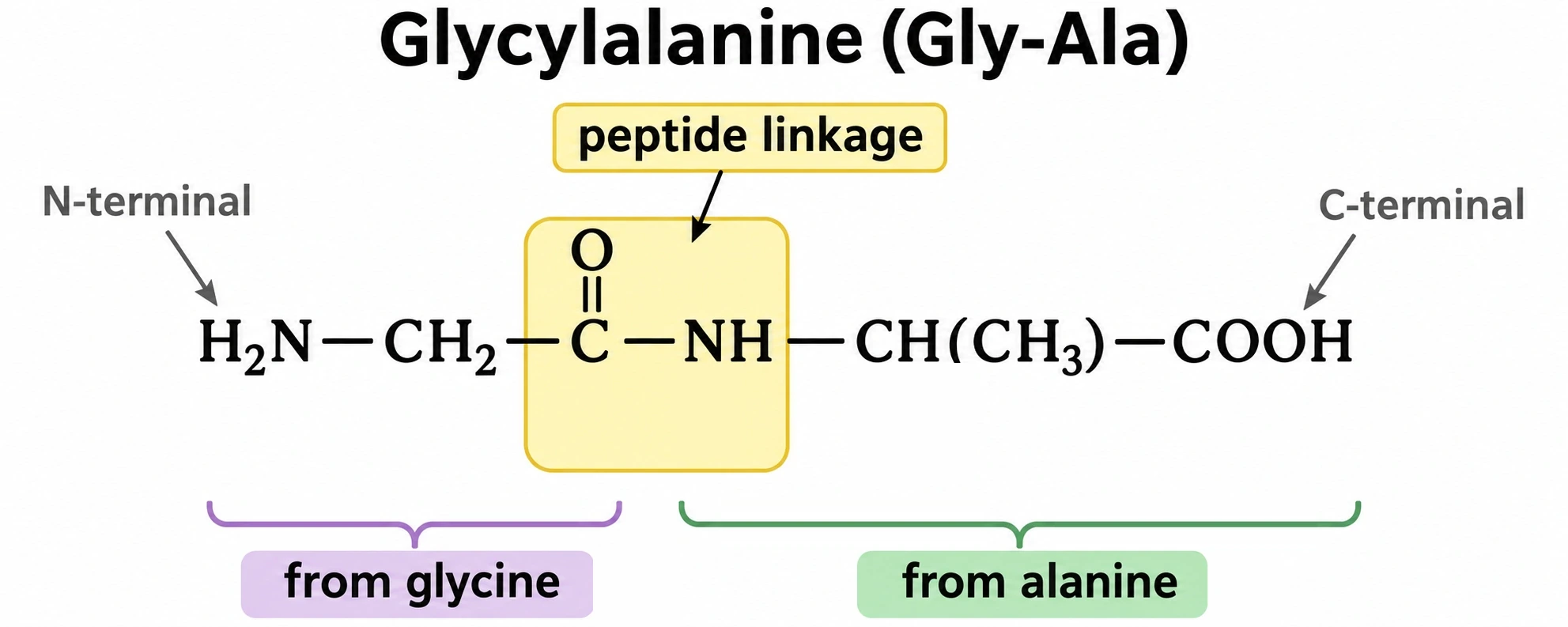
(b) Write the structure of glycine. Mention the number of peptide linkages present in glycylalanine. (2)
(c) Which vitamin deficiency causes convulsions? (1)
37. (a) How is benzene converted into benzaldehyde by the Gattermann–Koch reaction? Write a chemical equation. (2)
(b) Write the chemical equation involved in the Wolff–Kishner reduction of ethanal and mention the stable gas evolved in this reaction. (2)
(c) Give the chemical composition of Tollens' reagent. (1)
38. (a) Mention any three factors which decide the basic strength of alkyl amines in aqueous solution. (3)
(b) How is aniline obtained from nitrobenzene? Write the chemical equation. (2)
39. (a) Mention the hybridisation of the carbon atoms to which the hydroxyl group is bonded in allylic alcohols, phenol and vinylic alcohols, respectively. (3)
(b) How do you prepare aspirin from salicylic acid? Write the chemical equation. (2)
40. (a) What is the final organic product obtained on hydrolysis of benzamide? Write the chemical equation. (2)
(b) How do electron-withdrawing groups and electron-donating groups affect the acidic strength of carboxylic acids? (2)
(c) Write the composition of soda lime. (1)
Part E
VII. Answer any three of the following. Each question carries 3 marks. (3 × 3 = 9)
41. The time required to decompose SOCl to half of its initial amount is 60 minutes. If the decomposition is a first order reaction, calculate the rate constant of the reaction.
42. A solution containing 34.2 g of cane sugar (CHO) dissolved in 500 cm of water froze at −0.374 °C. Calculate the freezing point depression constant of water. [Given: density of water = 1.0 g cm]
43. Calculate the potential of a hydrogen electrode in contact with a solution whose pH is 10.
44. The vapour pressure of water is 92 mm Hg at 323 K. When 18.1 g of a non-electrolyte solute is dissolved in 100 g of water, the vapour pressure is reduced by 5 mm Hg. Calculate the molar mass of the solute.
45. The rate constants of a reaction at 500 K and 700 K are 0.02 s and 0.07 s respectively. Calculate the value of E. [Given: R = 8.314 J K mol]
46. A solution of Ni(NO) is electrolysed between platinum electrodes using a current of 5 amperes for 20 minutes. What mass of Ni is deposited at the cathode? [Given: atomic mass of Ni = 58.70 g mol, F = 96500 C mol]
Answers: Part A
Question 1: Main component of plant cell walls?
Answer. (c) cellulose. Cellulose is the main structural material of plant cell walls.
Question 2: Sea water is desalinated by?
Answer. (c) Reverse osmosis. A pressure larger than the osmotic pressure pushes pure water out of the salt water through a membrane.
Question 3: Incorrect statement about [Co(NH)]?
Answer. (b) Its hybridisation is spd. NH pairs the 3d electrons, so the hybridisation is dsp (inner orbital), not spd.
Question 4: Which alcohol gives turbidity immediately with Lucas reagent?
Answer. (c) 2-methylpropan-2-ol. 2-Methylpropan-2-ol is tertiary, so it reacts at once with Lucas reagent.
Question 5: What does a catalyst change?
Answer. (a) Activation energy of reaction. A catalyst gives a path with lower activation energy; ΔG, K and ΔH stay the same.
Question 6: Which amine gives the carbylamine test?
Answer. (d) Benzenamine. Only primary amines give isocyanides. Benzenamine (aniline) is primary; the others are secondary or tertiary.
Question 7: Weakest acid among (CH)CHCOOH, FCCOOH, CHCOOH, FCHCOOH?
Answer. (a) (CH)CHCOOH. The isopropyl group pushes electrons in more than methyl does and destabilises the carboxylate ion. F atoms do the opposite.
Question 8: Statement I: halving the cell reaction halves E. Statement II: cell voltage is extensive.
Answer. (a) Both Statement I and Statement II are incorrect. Cell potential is intensive: it stays the same however the equation is multiplied or divided. Both statements are wrong.
Question 9: Which can't be made by Gabriel synthesis?
Answer. (c) Aniline. Aryl halides don't react with potassium phthalimide, so aromatic amines can't be made this way.
Question 10: CN and oxidation state of Fe in [Fe(CO)]?
Answer. (a) 6, +3. Each oxalate is bidentate: 3 × 2 = 6. x + 3(−2) = −3, so x = +3.
Question 11: Cyanohydrin formation from a ketone is which type of reaction?
Answer. (a) nucleophilic addition reaction. CN (a nucleophile) adds to the C=O group.
Question 12: Chlorobenzene + NaOH at 623 K and 300 atm, then acid, gives?
Answer. (a) Phenol. Under these harsh conditions OH replaces Cl to give sodium phenoxide, which acid converts to phenol.
Question 13: Which pair of ions has the same electronic configuration?
Answer. (c) Fe, Mn. Fe (26 − 3) and Mn (25 − 2) both have 23 electrons: [Ar]3d.
Question 14: Which mixture forms a maximum boiling azeotrope?
Answer. (b) water + nitric acid. Nitric acid and water show negative deviation and form a maximum boiling azeotrope (about 68% HNO). Ethanol–water gives a minimum boiling one.
Question 15: Increasing boiling points: propan-1-ol, butan-1-ol, butan-2-ol, pentan-1-ol.
Answer. (a) Propan-1-ol, butan-2-ol, butan-1-ol, pentan-1-ol. Boiling point rises with chain length; among isomers, branching lowers it, so butan-2-ol is below butan-1-ol.
Question 16: When a non-volatile solute is added to a pure solvent, the freezing point of the solvent __.
Answer. decreases. Adding a solute lowers the vapour pressure, so the solution freezes at a lower temperature.
Question 17: Hf and __ have almost identical radii.
Answer. Zr. Lanthanoid contraction makes Hf almost the same size as Zr.
Question 18: Haloalkanes react with KCN to form __ as the major product.
Answer. cyanides. KCN is ionic, so the carbon end of CN attacks and gives alkyl cyanides. AgCN gives isocyanides.
Question 19: Hydroxyl derivatives of alkanes are called __.
Answer. alcohols. Replacing an H of an alkane by –OH gives an alcohol.
Question 20: Carbohydrates that yield two to ten monosaccharide units on hydrolysis are called __.
Answer. oligosaccharides. Oligosaccharides give 2–10 units; polysaccharides give many more.
Answers: Part B
Question 21: Explain the preparation of methyl iodide by Finkelstein reaction with the chemical equation.
Answer. When methyl chloride (or bromide) is heated with sodium iodide in dry acetone, methyl iodide is formed. The NaCl formed comes out as a precipitate. This is the Finkelstein reaction.
Marks: statement 1, equation 1.
Question 22: What is the half-life of a reaction? Represent it symbolically.
Answer. The half-life of a reaction is the time in which the concentration of a reactant falls to half of its initial value.
It is represented as .
Marks: definition 1, symbol 1.
Question 23: List any two nitrogenous bases commonly found in both DNA and RNA.
Answer. Any two of these bases: adenine, guanine and cytosine.
Marks: 1 for each base.
Question 24: Write any two characteristics of interstitial compounds.
Answer. Any two of these:
- They have high melting points, higher than those of the pure metals.
- They are very hard.
- They keep metallic conductivity.
- They are chemically inert.
Marks: any two characteristics, 1 each.
Question 25: Explain Williamson's ether synthesis with the general chemical equation.
Answer. When an alkyl halide reacts with a sodium alkoxide, an ether is formed. This is Williamson's ether synthesis.
Marks: statement 1, equation 1.
Answers: Part C
Question 26: State any three postulates of Werner's theory of coordination compounds.
Answer. Any three of these postulates:
- In coordination compounds, metals show two types of valency: primary and secondary.
- Primary valency is ionisable and is satisfied by negative ions.
- Secondary valency is non-ionisable and is satisfied by negative ions or neutral molecules. It is equal to the coordination number.
- Secondary valencies are directional, so they give the complex its shape.
Marks: any three postulates, 1 each.
Question 27: Write any three differences between lanthanoids and actinoids.
Answer. Any three of these differences:
| Lanthanoids | Actinoids |
|---|---|
| Electrons enter 4f orbitals. | Electrons enter 5f orbitals. |
| They mainly show +3, with +2 and +4 in a few cases. | They show a wider range of oxidation states, up to +7. |
| They are not radioactive (except promethium). | They are all radioactive. |
| They have less tendency to form complexes. | They have a greater tendency to form complexes. |
| The contraction from one element to the next is smaller. | The contraction from one element to the next is greater. |
Marks: any three differences, 1 each.
Question 28: Using Valence Bond Theory, account for the hybridisation, geometry and magnetic property of the [NiCl] ion.
Answer. Ni has the configuration [Ar] 3d, with two unpaired electrons. Cl is a weak field ligand, so the electrons stay unpaired. The 4s orbital and the three 4p orbitals hybridise to give sp hybrid orbitals, which accept four electron pairs from the four Cl ions.
Geometry: tetrahedral
Magnetic property: it has two unpaired electrons, so it is paramagnetic.
Marks: explanation with hybridisation 1, geometry 1, magnetic property 1.
Question 29: Complete the following chemical equations: (i) _ + 8NaCO + 7O → 8NaCrO + 2FeO + 8CO (ii) 2NaCrO + → NaCrO + 2Na + HO (iii) NaCrO + 2KCl → _ + 2NaCl
Answer.
(i) 4FeCrO
(ii) 2H
(iii) KCrO
Marks: 1 for each. In (ii), the equation already has 2Na on the right, so only 2H balances it; in 2026 Exam-1 the scheme did not accept HSO or 2HCl here.
Question 30: Explain the formation of the M–C σ-bond and the M–C π-bond in metal carbonyls with structure, where M and C are the metal and the carbon atom of the carbonyl group respectively.
Answer.
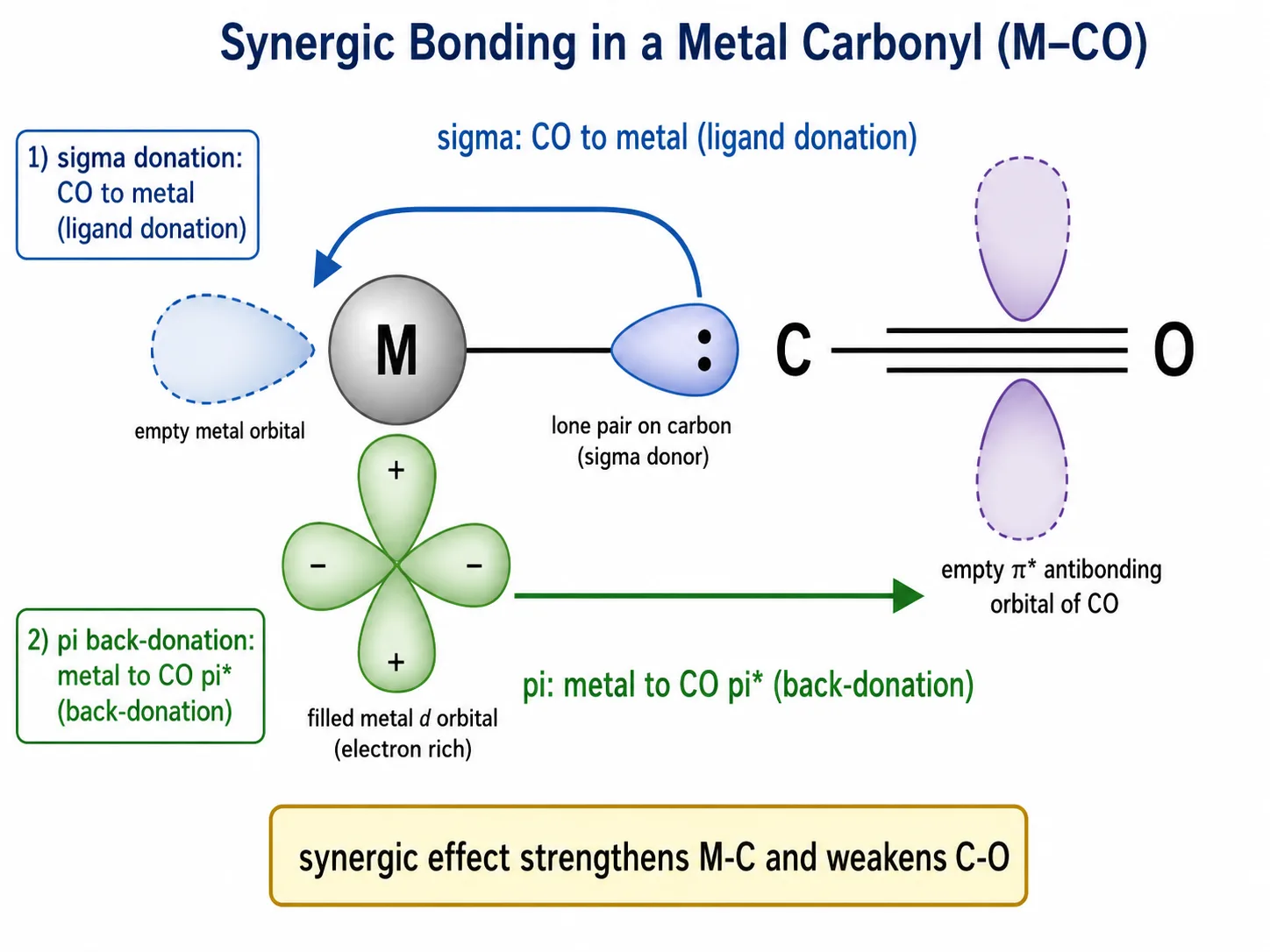
σ bond: the lone pair of electrons on the carbon of CO is donated into an empty orbital of the metal, forming the M–C σ bond.
π bond: electrons from a filled d orbital of the metal are donated back into the empty antibonding π* orbital of CO, forming the M–C π bond.
The two effects support each other (synergic bonding) and strengthen the M–C bond. In the diagram, show M ← C≡O with the σ arrow towards M and the π back-donation arrow from M to CO.
Marks: σ bond 1, π bond 1, synergic bonding with structure 1.
Question 31: Derive the integrated rate equation for a first order reaction.
Answer. Consider the first order reaction R → P.
Integrating both sides:
At , , so . Substituting:
Marks: rate expression and integration 1, value of I 1, final equation 1.
Question 32: From the given graph of Λ against √c (curve A rises steeply at low concentration; line B falls slowly and straight), identify the nature (type) of electrolyte A and electrolyte B. Among A and B, which electrolyte's limiting molar conductivity cannot be obtained from this graph?
Answer.
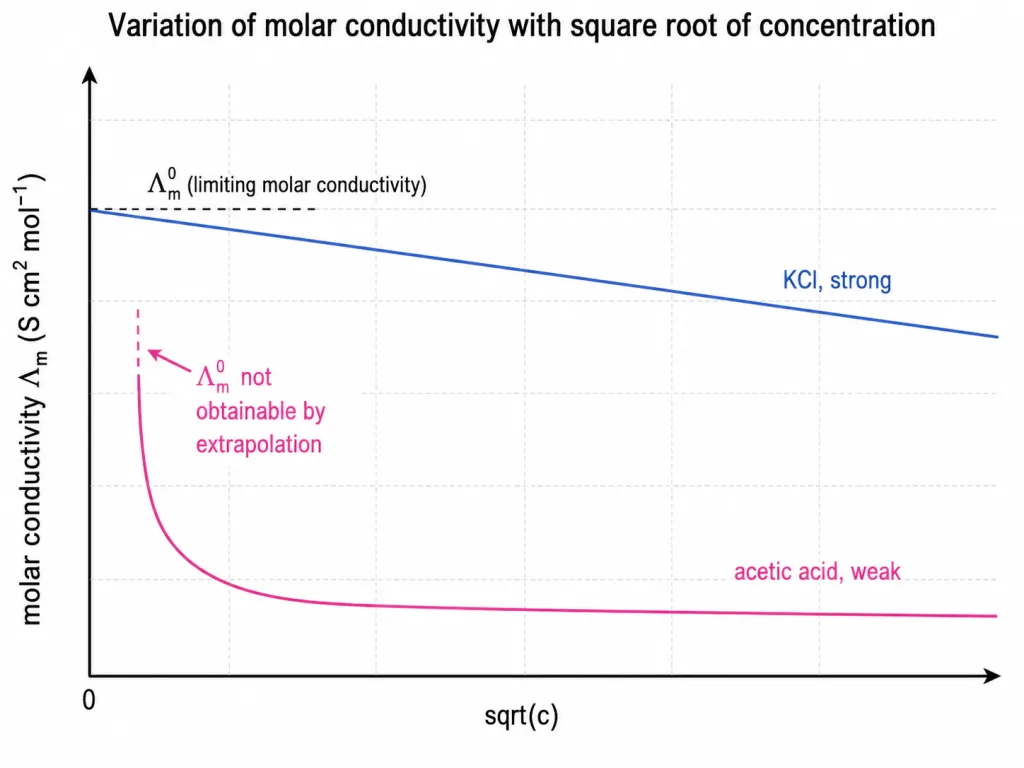
A is a weak electrolyte (like acetic acid). Its Λ rises steeply only at very low concentration, because it ionises more on dilution.
B is a strong electrolyte (like KCl). Its Λ falls slowly in a straight line.
The limiting molar conductivity of A cannot be obtained from the graph by extrapolation, because its curve does not meet the axis in a straight line. It is found using Kohlrausch's law instead.
Marks: A 1, B 1, electrolyte whose Λ cannot be found 1.
Question 33: What are ideal solutions? Write two characteristics of them.
Answer. Ideal solutions are solutions which obey Raoult's law over the entire range of concentration.
Any two characteristics:
- The A–A, B–B and A–B attractive forces are nearly the same.
Marks: definition 1, any two characteristics 1 each.
Question 34: What are galvanic cells? Write the reduction and oxidation half reactions for the reaction Zn(s) + Cu(aq) → Zn(aq) + Cu(s).
Answer. A galvanic cell is a cell which converts the chemical energy of a spontaneous redox reaction into electrical energy.
Reduction half reaction (at the cathode):
Oxidation half reaction (at the anode):
Marks: definition 1, reduction 1, oxidation 1.
Answers: Part D
Question 35: (a) Organometallic compounds; Grignard reagent with water. (3) (b) Major product of Friedel–Crafts methylation of anisole, and the catalyst. (2)
Answer.
(a) Compounds which have a direct carbon–metal bond are called organometallic compounds. Example: Grignard reagent, RMgX.
Grignard reagent reacts even with a trace of water. Water gives a proton to the carbon bonded to Mg, and an alkane is formed.
(b) The –OCH group is ortho and para directing, and the para product is the main one.
Major product: 1-methoxy-4-methylbenzene (4-methylanisole)
Catalyst: anhydrous AlCl
Marks: (a) definition 1, statement 1, equation 1; (b) major product 1, catalyst 1.
Question 36: (a) Glucose from starch. (2) (b) Structure of glycine; peptide links in glycylalanine. (2) (c) Vitamin whose lack causes convulsions. (1)
Answer.
(a) Starch is boiled with dilute HSO at 393 K under pressure (2–3 atm), and it is hydrolysed to glucose.
(b) Structure of glycine: HN–CH–COOH
Glycylalanine is a dipeptide, so it has one peptide linkage.
(c) Lack of vitamin B (pyridoxine) causes convulsions.
Marks: (a) statement 1, equation 1; (b) structure of glycine 1, number of peptide links 1; (c) 1.
Question 37: (a) Gattermann–Koch reaction. (2) (b) Wolff–Kishner reduction of ethanal, and the gas given off. (2) (c) Composition of Tollens' reagent. (1)
Answer.
(a) When benzene is treated with carbon monoxide and hydrogen chloride in the presence of anhydrous AlCl (or CuCl), benzaldehyde is formed. This is the Gattermann–Koch reaction.
(b) Ethanal reacts with hydrazine to form a hydrazone, which on heating with KOH in ethylene glycol gives ethane.
The gas given off is nitrogen.
(c) Tollens' reagent is ammoniacal silver nitrate, [Ag(NH)].
Marks: (a) statement 1, equation 1; (b) equation 1, nitrogen 1; (c) 1.
Question 38: (a) Three factors that decide the basicity of alkyl amines in water. (3) (b) Aniline from nitrobenzene. (2)
Answer.
(a) The basicity of alkyl amines in water depends on:
- The +I (inductive) effect of the alkyl groups, which pushes electrons onto nitrogen.
- Solvation of the substituted ammonium ion by hydrogen bonding with water. More N–H bonds mean better solvation.
- Steric hindrance from the alkyl groups around nitrogen.
(b) Nitrobenzene is reduced with iron scrap and HCl (or Sn/HCl, or H with Pd) to give aniline.
Marks: (a) 1 for each factor; (b) statement 1, equation 1.
Question 39: (a) Hybridisation of the carbon carrying –OH in allylic alcohols, phenol and vinylic alcohols. (3) (b) Aspirin from salicylic acid. (2)
Answer.
(a) Allylic alcohols: sp
Phenol: sp
Vinylic alcohols: sp
(b) Salicylic acid is acetylated with acetic anhydride, using a little acid as a catalyst, to give aspirin.
Marks: (a) 1 for each; (b) statement 1, equation 1.
Question 40: (a) Product of hydrolysis of benzamide. (2) (b) Effect of electron-withdrawing and electron-donating groups on acidity of carboxylic acids. (2) (c) Composition of soda lime. (1)
Answer.
(a) Benzamide on hydrolysis gives benzoic acid.
(b) Electron-withdrawing groups (–NO, –Cl, –F) spread out the negative charge of the carboxylate ion and increase the acidity.
Electron-donating groups (–CH, –OCH) increase the negative charge on the carboxylate ion and decrease the acidity.
(c) Soda lime is a mixture of NaOH and CaO in the ratio 3 : 1.
Marks: (a) product 1, equation 1; (b) 1 for each type of group; (c) 1.
Answers: Part E
Question 41: The time required to decompose SOCl to half of its initial amount is 60 minutes. If the decomposition is a first order reaction, calculate the rate constant of the reaction.
Answer.
Given: = 60 min
To find: Rate constant, k
Formula:
Substitution:
Answer: Rate constant = 1.155 × 10 min (= 1.925 × 10 s)
Marks: formula 1, substitution 1, answer with unit 1.
Question 42: A solution containing 34.2 g of cane sugar (CHO) dissolved in 500 cm of water froze at −0.374 °C. Calculate the freezing point depression constant of water. [Given: density of water = 1.0 g cm]
Answer.
Given: Mass of sucrose = 34.2 g; molar mass of sucrose = 342 g mol; volume of water = 500 cm, so mass of water = 500 g = 0.500 kg; freezing point = −0.374 °C, so = 0.374 K
To find: Freezing point depression constant,
Formula: , so
Substitution: moles of sucrose = = 0.100 mol; = 0.200 mol kg;
Answer: = 1.87 K kg mol
Marks: molality 1, substitution 1, answer with unit 1.
Question 43: Calculate the potential of a hydrogen electrode in contact with a solution whose pH is 10.
Answer.
Given: pH = 10, so [H] = 10 M; for at 1 bar, = 0
To find: Electrode potential, E
Formula:
Substitution:
Answer: Electrode potential = −0.591 V
Marks: formula 1, substitution 1, answer with unit 1.
Question 44: The vapour pressure of water is 92 mm Hg at 323 K. When 18.1 g of a non-electrolyte solute is dissolved in 100 g of water, the vapour pressure is reduced by 5 mm Hg. Calculate the molar mass of the solute.
Answer.
Given: = 92 mm Hg; = 5 mm Hg; = 18.1 g; = 100 g; = 18 g mol
To find: Molar mass of the solute,
Formula (dilute solution): , so
Substitution:
Answer: Molar mass of the solute ≈ 60 g mol (59.9)
Using the exact form gives about 57 g mol; either method, shown clearly, is sound.
Marks: formula 1, substitution 1, answer with unit 1.
Question 45: The rate constants of a reaction at 500 K and 700 K are 0.02 s and 0.07 s respectively. Calculate the value of E. [Given: R = 8.314 J K mol]
Answer.
Given: = 0.02 s at = 500 K; = 0.07 s at = 700 K; R = 8.314 J K mol
To find: Energy of activation,
Formula:
Substitution: , so
Answer: = 18231 J mol (18.23 kJ mol)
Marks: formula 1, substitution 1, answer with unit 1.
Question 46: A solution of Ni(NO) is electrolysed between platinum electrodes using a current of 5 amperes for 20 minutes. What mass of Ni is deposited at the cathode? [Given: atomic mass of Ni = 58.70 g mol, F = 96500 C mol]
Answer.
Given: I = 5 A; t = 20 min = 20 × 60 = 1200 s; atomic mass of Ni = 58.70 g mol; F = 96500 C mol; , so n = 2
To find: Mass of Ni deposited, w
Formula: Q = It and
Substitution: Q = 5 × 1200 = 6000 C;
Answer: Mass of Ni deposited = 1.825 g
Marks: formula 1, substitution 1, answer with unit 1.