
About This Paper
Model Paper 3 is the 2026 Model Paper 3 with one change: Q21 now asks for the drawbacks of collision theory. There is no official scheme for model papers, so the mark splits follow the board's exam schemes.
This paper matters most. Seventeen of its questions came up in the 2026 exams, two of them as full five-mark questions (Q39 and Q40). The repeats are Q1, Q2, Q4, Q5, Q7, Q14, Q16, Q20, Q23, Q26, Q27, Q30, Q33, Q38, Q39, Q40 and Q45.
Sit it in 3 hours. Any repeat you can't answer fully is a priority.
Part F (alternate questions for visually challenged students) is not included.
Question Paper: Part A
I. Select the correct option from the given choices. (15 × 1 = 15)
1. The common oxidation state shown by the element with atomic number 21 is
(a) +3
(b) +4
(c) +5
(d) Both +3 and +4
2. Which of the following is a homoleptic complex?
(a) [Co(NH)Cl]
(b) [Co(NH)Cl]Cl
(c) [Co(NH)(HO)]Cl
(d) [Co(NH)]Cl
3. The correct name of the reaction R–X + NaI (dry acetone) → R–I + NaX is
(a) Finkelstein reaction
(b) Wurtz reaction
(c) Swarts reaction
(d) Friedel–Crafts reaction
4. The chemical formula of Hinsberg's reagent is
(a) CHSOCl
(b) CHSOCl
(c) CHSOCl
(d) CHSOH
5. A doctor advised a 50-year-old woman enough exposure to sunlight and addition of fish and egg yolk to her diet. Name the vitamin deficiency for the possible disease diagnosed by the doctor.
(a) Vitamin D
(b) Vitamin A
(c) Vitamin C
(d) Vitamin B
6. Salicylaldehyde can be prepared from which of the following reactants?
(a) Phenol and chloroform
(b) Phenol, chloroform and aq. NaOH
(c) Phenol and CCl
(d) Phenol, CCl and NaOH
7. The major product formed when CH–CH–CH(Br)–CH is heated with alcoholic KOH is
(a) 1-butene
(b) 2-butanol
(c) 1-bromobutane
(d) 2-butene
8. Statement I: In benzylic alcohols, the –OH group is attached to an sp carbon atom next to an aromatic ring. Statement II: In vinylic alcohols, the –OH group is bonded to a carbon atom of a carbon–carbon double bond.
(a) Both Statement I and Statement II are correct
(b) Statement I is incorrect but Statement II is correct
(c) Both Statement I and Statement II are incorrect
(d) Statement I is correct but Statement II is incorrect
9. For the reaction 2A + 3B + ½C → P, the correct rate expression is
(a)
(b)
(c)
(d)
10. Match the terms in Column I with their units in Column II. Column I: (i) Λ, (ii) E, (iii) κ, (iv) G*. Column II: (A) S cm, (B) cm, (C) S cm mol, (D) V.
(a) i-C, ii-D, iii-B, iv-A
(b) i-C, ii-D, iii-A, iv-B
(c) i-D, ii-A, iii-C, iv-B
(d) i-B, ii-D, iii-A, iv-C
11. Hydration of acetylene (ethyne) with dil. HSO and HgSO gives
(a) Acetone
(b) 2-phenylethanol
(c) Acetaldehyde
(d) Acetic acid
12. 10 mL of liquid A and 20 mL of liquid B are mixed at 25 °C. The volume of the solution was measured to be 30.1 mL. Then
(a) ΔH > 0, solution shows negative deviation from Raoult's law
(b) ΔH < 0, solution shows negative deviation from Raoult's law
(c) ΔH > 0, solution shows positive deviation from Raoult's law
(d) ΔH < 0, solution shows positive deviation from Raoult's law
13. Arrange the following complexes in increasing order of crystal field splitting: [Co(CN)], [CoF], [Co(HO)] and [NiCl].
(a) [NiCl] < [CoF] < [Co(HO)] < [Co(CN)]
(b) [Co(CN)] < [Co(HO)] < [CoF] < [NiCl]
(c) [Co(CN)] < [Co(HO)] < [NiCl] < [CoF]
(d) [CoF] < [NiCl] < [Co(HO)] < [Co(CN)]
14. A binary solution has two components A and B. The mole fraction of component A is 0.5; then the number of moles of components A and B in the solution is
(a) n > n
(b) n < n
(c) n = n
(d) zero
15. The reagent which does not react with both acetone and benzaldehyde is
(a) Sodium hydrogensulphite
(b) Phenylhydrazine
(c) Fehling's solution
(d) Grignard reagent
II. Fill in the blanks by choosing the appropriate word from those given in the brackets. (5 × 1 = 5)
[reducing, one, o-cresol, orange, yellow, +3]
16. Van't Hoff factor (i) for a non-electrolyte in a solution is __.
17. The actinoids generally show __ oxidation state.
18. The colour of p-hydroxyazobenzene is __.
19. In __, the –OH group is attached to a carbon that is sp hybridised.
20. The carbohydrates which reduce Fehling's solution and Tollens' reagent are called __ sugars.
Question Paper: Parts B to E
Part B
III. Answer any three of the following. Each question carries 2 marks. (3 × 2 = 6)
21. Give any two drawbacks of collision theory.
22. What are optically active compounds? Give the condition for a molecule to be optically active.
23. Write the products formed when anisole reacts with ethanoyl chloride in the presence of anhydrous AlCl catalyst.
24. With respect to the first transition series, which element has (i) the highest second ionisation enthalpy? (ii) the lowest enthalpy of atomisation?
25. Identify the proteins present in hair and egg albumin. Mention one difference between these two proteins with respect to solubility.
Part C
IV. Answer any three of the following. Each question carries 3 marks. (3 × 3 = 9)
26. Write the balanced chemical equations involved in the manufacture of potassium dichromate from chromite ore.
27. Using Valence Bond Theory (VBT), explain the geometry, hybridisation and magnetic property of the [Co(NH)] ion. [Given: atomic number of cobalt is 27]
28. On treating CoCl·4NH with excess AgNO solution, 1 mole of AgCl is formed. Formulate the complex and write its geometrical isomers.
29. Write the formulae of the three different types of compounds formed when lanthanoids are heated with carbon.
30. Write the IUPAC name and structure of [Co(CO)] and mention the number of bridged CO groups.
V. Answer any two of the following. Each question carries 3 marks. (2 × 3 = 6)
31. Give an example of an inert electrode. Write the representation and half-cell reaction for the bromine electrode.
32. Write the overall reaction of the Ni–Cd battery. Mention its anode and cathode.
33. Derive an integrated rate equation for the rate constant of a zero order reaction.
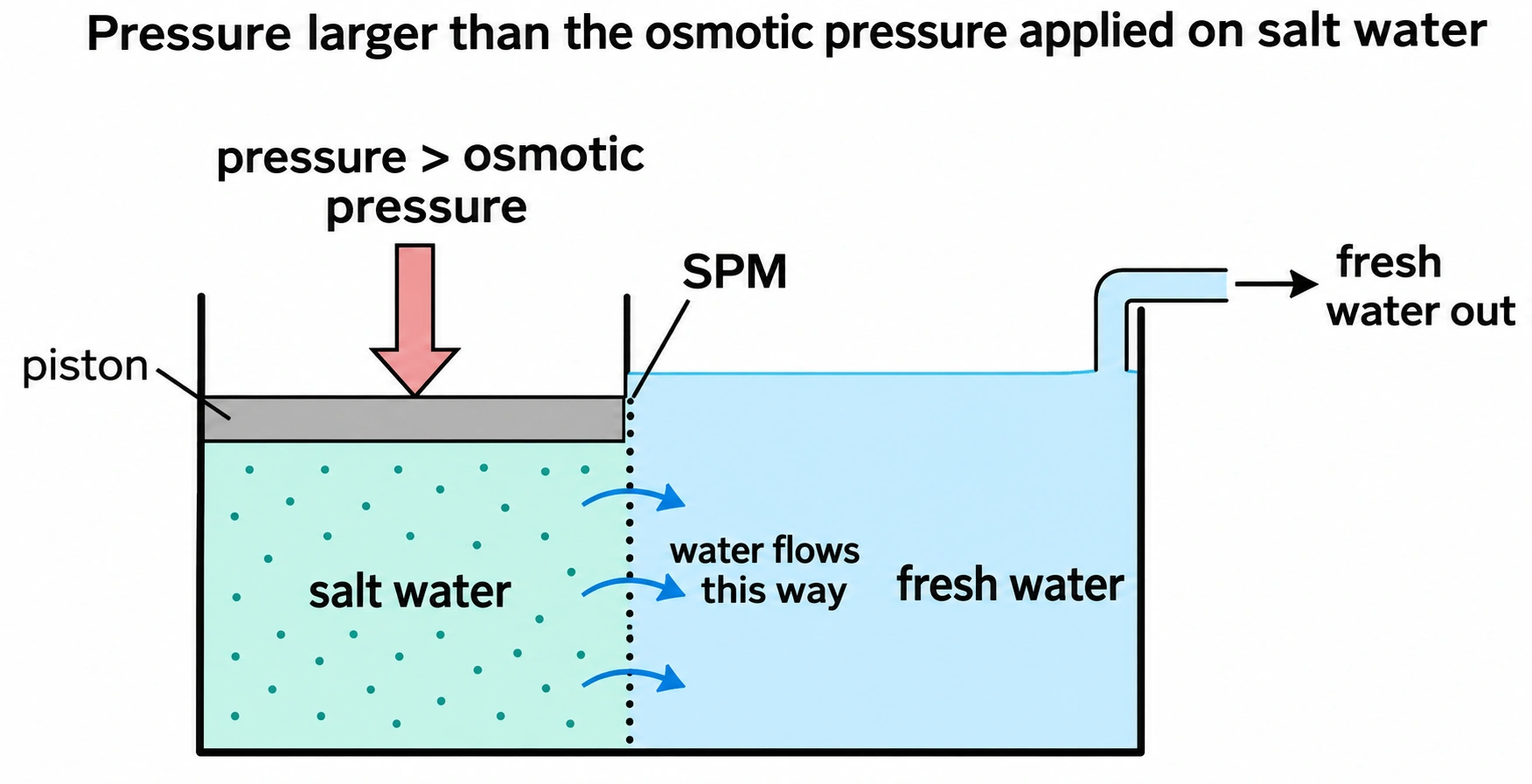
34. Given below is the sketch of a plant in which pressure greater than the osmotic pressure is applied on salt water, separated from fresh water by an SPM. (i) Name the process occurring in the plant. (ii) Name any one SPM which can be used in this plant. (iii) Give one practical use of the plant.
Part D
VI. Answer any four of the following. Each question carries 5 marks. (4 × 5 = 20)
35. (a) Identify A, B and C: 2CHCOCl + (CH)Cd → A (with loss of CdCl); A with NaOI gives B + C. (3)
(b) An organic compound P (CHO) reacts with thionyl chloride to give Q. Q undergoes hydrogenation in the presence of Pd–BaSO to form R. Write the equations involved. (2)
36. (a) Explain Hofmann bromamide degradation reaction with chemical equation. (2)
(b) Discuss the coupling reaction of benzenediazonium chloride with aniline. Give equation. (2)
(c) Write the IUPAC name of CH–N(CH)–CH(CH)–CH–CH. (1)
37. (a) Glucose is a monosaccharide and an aldohexose. Which oxidising agent should be used to oxidise only the aldehyde group of glucose? Write the chemical equation. (2)
(b) Mention any two forces which stabilise the 2° and 3° structures of proteins. (2)
(c) Name the type of linkage present in a dinucleotide obtained by joining two nucleotides. (1)
38. (a) Explain Fittig reaction with general equation. (2)
(b) Write the mechanism for the conversion of methyl chloride to methanol. (2)
(c) How many stereocentres are present in butan-2-ol? (1)
39. (a) Write the steps involved in the mechanism of acid catalysed dehydration of ethanol to ethene. (3)
(b) Complete the reactions: (i) phenol with NaCrO and HSO → _ (ii) phenol + 3Br → _ + 3HBr (2)
40. (a) Explain Hell-Volhard-Zelinsky reaction with chemical equation. (2)
(b) Write the reaction for the conversion of toluene to benzaldehyde using chromyl chloride. Name the reaction. (2)
(c) Name the gas used to facilitate the nucleophilic addition of ethylene glycol to aldehydes and ketones. (1)
Part E
VII. Answer any three of the following. Each question carries 3 marks. (3 × 3 = 9)
41. Calculate the osmotic pressure of a 0.5% (w/v) aqueous solution of sucrose at 300 K. (R = 0.08314 L bar K mol; molar mass of sucrose = 342 g mol)
42. Calculate the emf of the cell in which the following reaction takes place at 25 °C: Cu(s) + 2Ag(1 × 10 M) → Cu(0.250 M) + 2Ag(s). E° = 0.46 V.
43. A column of 0.05 M NaOH with an area of cross-section of 0.785 cm and a length of 1 m shows a resistance of 1.11 × 10 Ω. Calculate the molar conductivity of the solution.
44. A first order reaction has a rate constant of 2.3 × 10 s at 500 K. At what temperature does the rate constant become 17.25 × 10 s? (E = 191.472 kJ mol, R = 8.314 J K mol)
45. A first order reaction has a half-life of 23 min. How much time will be needed for 30% completion of the reaction?
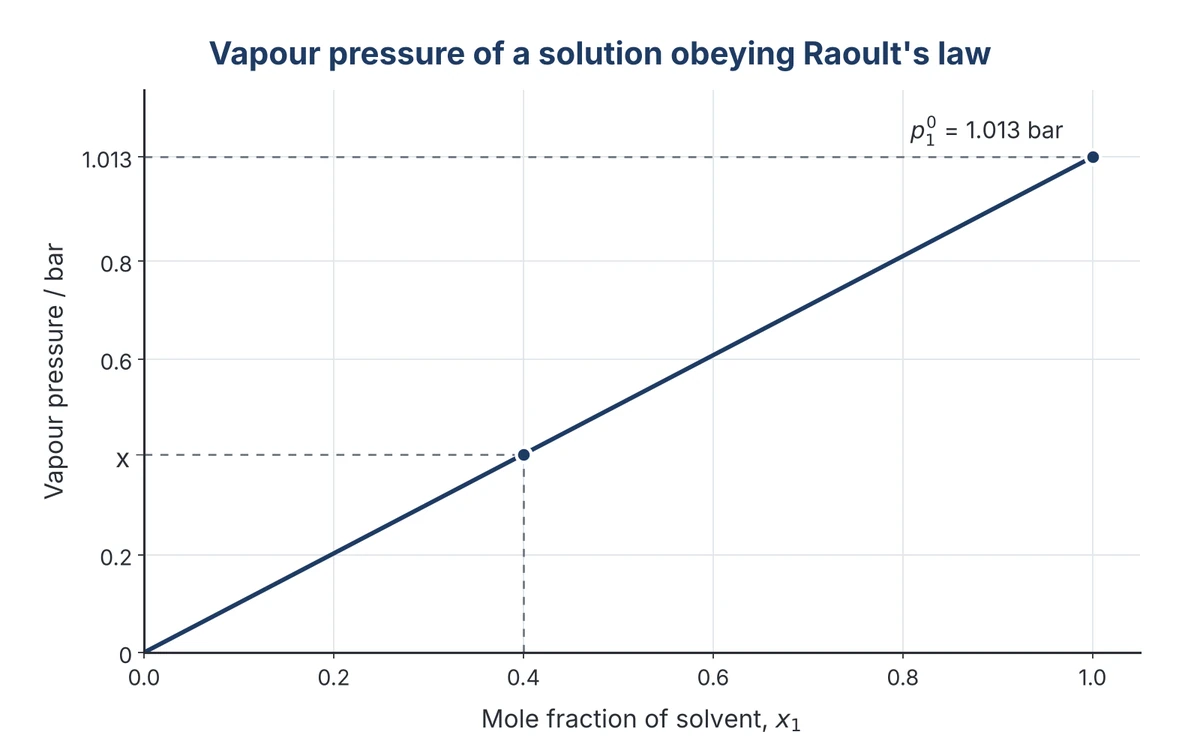
46. If a solution obeys Raoult's law for all concentrations, its vapour pressure varies linearly from zero to the vapour pressure of the pure solvent (1.013 bar) as shown in the graph. Calculate the value of x, the vapour pressure when the mole fraction of the solvent is 0.4.
Answers: Part A
Question 1: Common oxidation state of the element with Z = 21?
Answer. (a) +3. Z = 21 is scandium, 3ds; it shows only +3.
Question 2: Which is a homoleptic complex?
Answer. (d) [Co(NH)]Cl. Only [Co(NH)] has a single kind of ligand around the metal.
Question 3: Name the reaction R–X + NaI (dry acetone) → R–I + NaX.
Answer. (a) Finkelstein reaction. Halogen exchange with NaI in dry acetone is the Finkelstein reaction. Swarts uses metal fluorides.
Question 4: Formula of Hinsberg's reagent?
Answer. (c) CHSOCl. Hinsberg's reagent is benzenesulphonyl chloride.
Question 5: Sunlight, fish and egg yolk advised: which vitamin is lacking?
Answer. (a) Vitamin D. All three are sources of vitamin D; in adults its lack causes osteomalacia.
Question 6: Salicylaldehyde is prepared from?
Answer. (b) Phenol, chloroform and aq. NaOH. This is the Reimer–Tiemann reaction; with CCl instead of CHCl the product is salicylic acid.
Question 7: 2-Bromobutane heated with alcoholic KOH gives mainly?
Answer. (d) 2-butene. Elimination follows Zaitsev's rule: the more substituted alkene, 2-butene, is the main product.
Question 8: Statement I: benzylic –OH is on an sp carbon next to a ring. Statement II: vinylic –OH is on a C=C carbon.
Answer. (a) Both Statement I and Statement II are correct. Both are the definitions: benzylic C is sp next to the ring; vinylic C is sp in the C=C.
Question 9: Correct rate expression for 2A + 3B + ½C → P?
Answer. (a) . Rate . Multiplying through by 2 gives the first option. Reactants are used up, so the signs must be negative.
Question 10: Match Λ, E, κ and G* with their units.
Answer. (b) i-C, ii-D, iii-A, iv-B. Molar conductivity: S cm mol; cell emf: V; conductivity: S cm; cell constant: cm.
Question 11: Ethyne with dilute HSO and HgSO gives?
Answer. (c) Acetaldehyde. Ethyne gives ethanal (acetaldehyde); propyne would give acetone.
Question 12: 10 mL A + 20 mL B gives 30.1 mL of solution. What follows?
Answer. (c) ΔH > 0, solution shows positive deviation from Raoult's law. The volume increased (ΔV > 0), which goes with weaker A–B attractions, positive deviation and ΔH > 0.
Question 13: Increasing crystal field splitting of four complexes.
Answer. (a) [NiCl] < [CoF] < [Co(HO)] < [Co(CN)]. Tetrahedral splitting is smallest (about 4/9 of octahedral). For the Co complexes, the spectrochemical series gives F < HO < CN.
Question 14: x = 0.5: how do n and n compare?
Answer. (c) n = n. Half the moles are A, so the other half are B.
Question 15: Which reagent reacts with neither acetone nor benzaldehyde?
Answer. (c) Fehling's solution. Ketones and aromatic aldehydes don't reduce Fehling's solution. The other three react with both, through the C=O group.
Question 16: Van't Hoff factor (i) for a non-electrolyte in a solution is __.
Answer. one. A non-electrolyte neither dissociates nor associates.
Question 17: The actinoids generally show __ oxidation state.
Answer. +3. +3 is common to all actinoids, though many show higher states too.
Question 18: The colour of p-hydroxyazobenzene is __.
Answer. orange. Coupling of benzenediazonium chloride with phenol gives the orange dye p-hydroxyazobenzene; the aniline product is yellow.
Question 19: In __, the –OH group is attached to a carbon that is sp hybridised.
Answer. o-cresol. o-Cresol is a phenol: its –OH sits on a ring carbon, which is sp.
Question 20: The carbohydrates which reduce Fehling's solution and Tollens' reagent are called __ sugars.
Answer. reducing. Sugars with a free aldehyde or ketone group are reducing sugars.
Answers: Part B
Question 21: Give any two drawbacks of collision theory.
Answer. Any two of these drawbacks:
- It treats atoms and molecules as hard spheres and ignores their structure.
- It cannot explain why many collisions with enough energy still do not lead to reaction, unless an extra orientation (steric) factor is added.
- The rates it predicts for complex molecules often do not match experiment.
Marks: any two drawbacks, 1 each.
Question 22: What are optically active compounds? Give the condition for a molecule to be optically active.
Answer. Compounds which rotate the plane of plane-polarised light are called optically active compounds.
Condition: the molecule must be chiral, that is, it cannot be superimposed on its mirror image. For example, it has a carbon atom bonded to four different groups.
Marks: definition 1, condition 1.
Question 23: Write the products formed when anisole reacts with ethanoyl chloride in the presence of anhydrous AlCl catalyst.
Answer. This is Friedel–Crafts acylation. The –OCH group is ortho and para directing, so two products are formed.
(+ HCl)
The products are 2-methoxyacetophenone (minor) and 4-methoxyacetophenone (major).
Marks: 1 for each product.
Question 24: With respect to the first transition series, which element has (i) the highest second ionisation enthalpy? (ii) the lowest enthalpy of atomisation?
Answer.
(i) Copper has the highest second ionisation enthalpy. Cu is 3d, and removing an electron from a completely filled d subshell needs a lot of energy.
(ii) Zinc has the lowest enthalpy of atomisation. Its 3d subshell is completely filled, so no d electrons take part in metallic bonding.
Marks: 1 for each.
Question 25: Identify the proteins present in hair and egg albumin. Mention one difference between these two proteins with respect to solubility.
Answer. Hair contains keratin, and egg white contains albumin.
Keratin is a fibrous protein and is insoluble in water, while albumin is a globular protein and is soluble in water.
Marks: proteins 1, difference 1.
Answers: Part C
Question 26: Write the balanced chemical equations involved in the manufacture of potassium dichromate from chromite ore.
Answer. Step 1: Chromite ore is fused with sodium carbonate in free access of air, giving sodium chromate.
Step 2: The sodium chromate solution is acidified, giving sodium dichromate.
Step 3: Sodium dichromate is treated with potassium chloride, giving potassium dichromate.
Marks: 1 for each step.
Question 27: Using Valence Bond Theory (VBT), explain the geometry, hybridisation and magnetic property of the [Co(NH)] ion. [Given: atomic number of cobalt is 27]
Answer. Co has the configuration [Ar] 3d. NH makes the six d electrons pair up in three 3d orbitals, so two 3d orbitals become empty. These two 3d orbitals, the 4s orbital and the three 4p orbitals hybridise to give dsp hybrid orbitals, which accept six electron pairs from six NH molecules. It is an inner orbital complex.
Geometry: octahedral
Magnetic property: all the electrons are paired, so it is diamagnetic.
Marks: explanation with hybridisation 1, geometry 1, magnetic property 1.
Question 28: On treating CoCl·4NH with excess AgNO solution, 1 mole of AgCl is formed. Formulate the complex and write its geometrical isomers.
Answer. Only one Cl ion is precipitated, so only one Cl is outside the coordination sphere. The complex is [Co(NH)Cl]Cl.
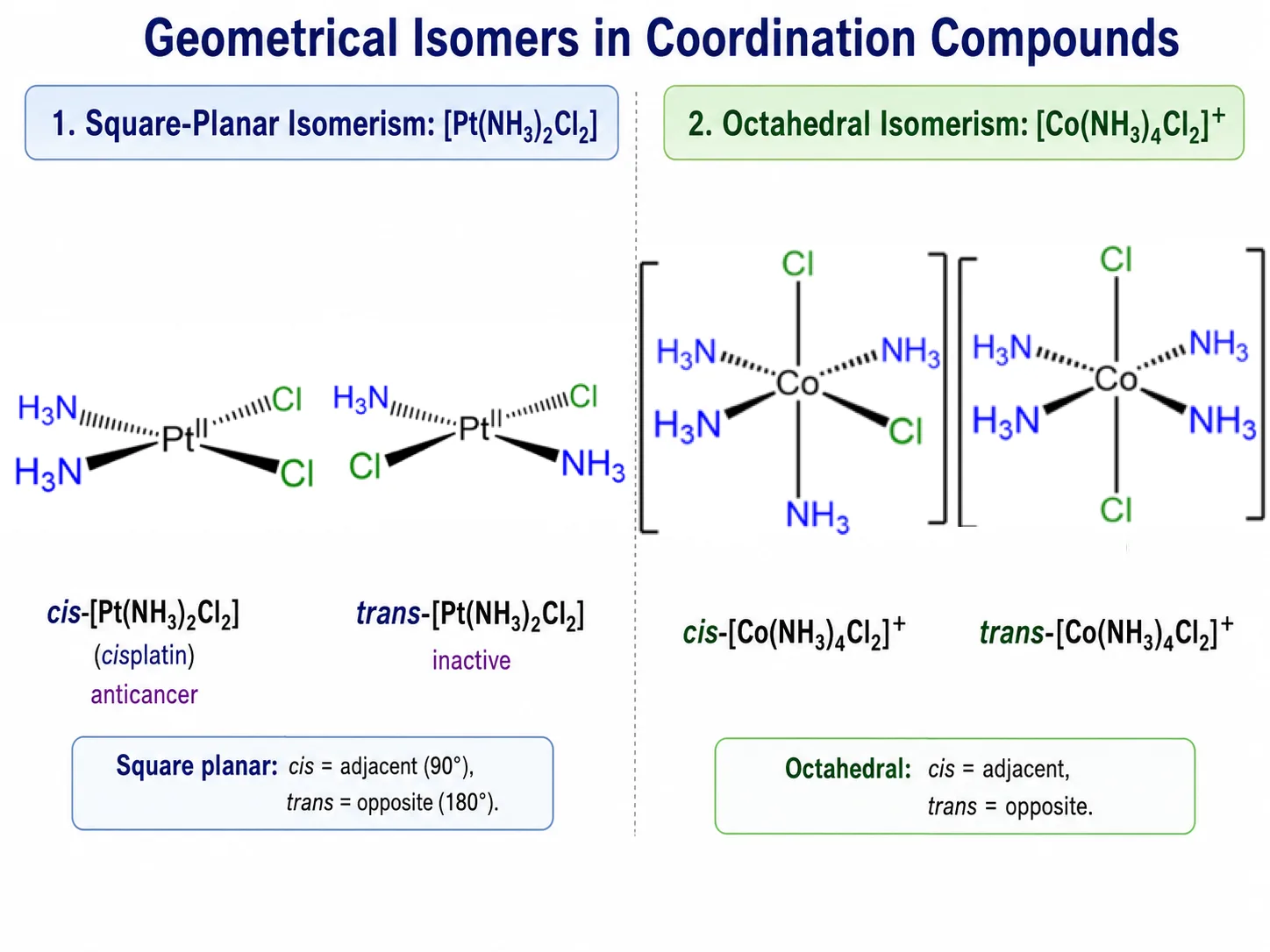
cis isomer: the two Cl ions are next to each other, at 90°.
trans isomer: the two Cl ions are opposite each other, at 180°.
Marks: formula 1, cis isomer 1, trans isomer 1.
Question 29: Write the formulae of the three different types of compounds formed when lanthanoids are heated with carbon.
Answer. When lanthanoids are heated with carbon at about 2773 K, they form three types of carbides: LnC, LnC and LnC.
Marks: 1 for each formula.
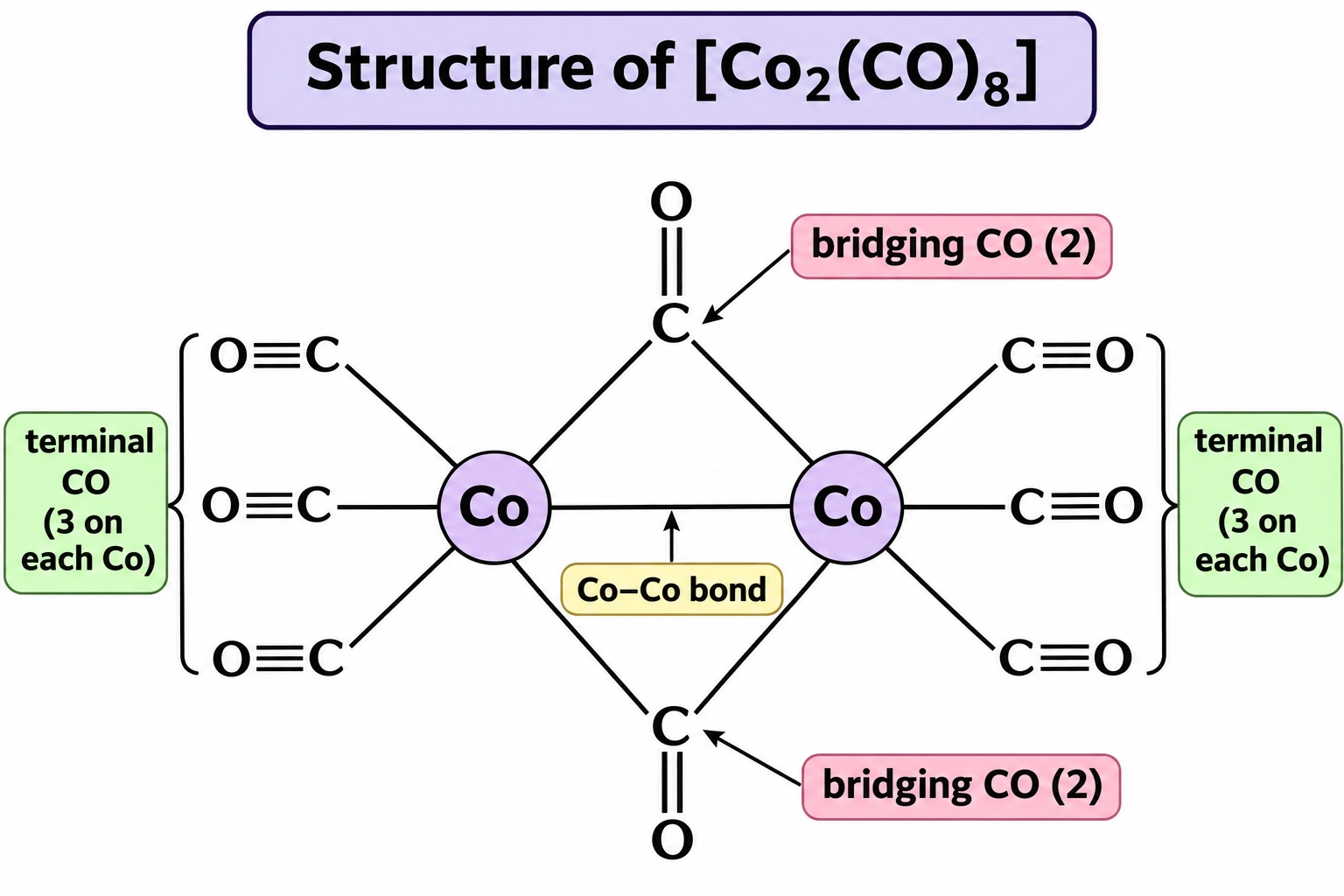
Question 30: Write the IUPAC name and structure of [Co(CO)] and mention the number of bridged CO groups.
Answer. IUPAC name: octacarbonyldicobalt(0)
Structure: the two Co atoms are joined by a Co–Co bond. Two CO groups bridge the two Co atoms, and each Co has three terminal CO groups.
Number of bridging CO groups: two
Marks: name 1, structure 1, number of bridging CO groups 1.
Question 31: Give an example of an inert electrode. Write the representation and half-cell reaction for the bromine electrode.
Answer. Inert electrode: platinum (or graphite).
Representation of the bromine electrode: Pt(s) | Br(l) | Br(aq)
Half-cell reaction:
Marks: inert electrode 1, representation 1, half-cell reaction 1.
Question 32: Write the overall reaction of the Ni–Cd battery. Mention its anode and cathode.
Answer. Overall reaction during discharge:
Anode: cadmium
Cathode: nickel(III) hydroxide, a metal grid packed with Ni(OH)
Marks: overall reaction 1, anode 1, cathode 1.
Question 33: Derive an integrated rate equation for the rate constant of a zero order reaction.
Answer. Consider the zero order reaction R → P.
Integrating both sides:
At , , so . Substituting:
Marks: rate expression and integration 1, value of I 1, final equation 1.
Question 34: Given below is the sketch of a plant in which pressure greater than the osmotic pressure is applied on salt water, separated from fresh water by an SPM. (i) Name the process occurring in the plant. (ii) Name any one SPM which can be used in this plant. (iii) Give one practical use of the plant.
Answer.
(i) The process is reverse osmosis. A pressure larger than the osmotic pressure pushes pure water out of the salt water through the semipermeable membrane.
(ii) A cellulose acetate film can be used as the SPM.
(iii) The plant is used for the desalination of sea water to get drinking water.
Marks: 1 for each.
Answers: Part D
Question 35: (a) 2CHCOCl + (CH)Cd gives A; A with NaOI gives B + C. Identify A, B, C. (3) (b) P (CHO) with SOCl gives Q; Q over Pd–BaSO gives R. Write the equations. (2)
Answer.
(a) Dimethylcadmium converts the acyl chloride into a ketone, and acetone gives the iodoform reaction with NaOI.
A = propanone (acetone), CHCOCH
B = iodoform, CHI
C = sodium ethanoate, CHCOONa
(b) P is benzoic acid, Q is benzoyl chloride and R is benzaldehyde.
Marks: (a) 1 for each of A, B and C; (b) 1 for each equation.
Question 36: (a) Hofmann bromamide degradation. (2) (b) Coupling of benzenediazonium chloride with aniline. (2) (c) IUPAC name of CH–N(CH)–CH(CH)–CHCH. (1)
Answer.
(a) When an amide is heated with bromine and aqueous NaOH, a primary amine with one carbon atom less is formed. This is Hofmann bromamide degradation.
(b) Benzenediazonium chloride couples with aniline at the para position, giving the yellow dye p-aminoazobenzene.
(c) N,N-Diethylbutan-2-amine
Marks: (a) statement 1, equation 1; (b) statement 1, equation 1; (c) 1.
Question 37: (a) Oxidising agent that oxidises only the CHO group of glucose, with the equation. (2) (b) Two forces stabilising the 2° and 3° structures of proteins. (2) (c) The linkage in a dinucleotide. (1)
Answer.
(a) Bromine water, a mild oxidising agent, oxidises only the –CHO group of glucose and gives gluconic acid.
(b) Any two of these forces: hydrogen bonds, disulphide linkages, van der Waals forces and electrostatic forces of attraction.
(c) The two nucleotides are joined by a phosphodiester linkage.
Marks: (a) reagent 1, equation 1; (b) any two forces, 1 each; (c) 1.
Question 38: (a) Fittig reaction. (2) (b) Mechanism of methyl chloride to methanol. (2) (c) Stereocentres in butan-2-ol. (1)
Answer.
(a) When an aryl halide is heated with sodium in dry ether, two aryl groups join and a diaryl compound is formed. This is the Fittig reaction.
(b) Methyl chloride is converted to methanol by the S@@GYANGHAR_MATH@@272 mechanism.
Step 1: OH attacks the carbon from the side opposite to the chlorine, forming the transition state.
Step 2: Cl leaves and methanol is formed, with inversion of configuration.
(c) Butan-2-ol has one stereocentre: C-2, which carries H, OH, CH and CH.
Marks: (a) statement 1, equation 1; (b) 1 for each step; (c) 1.
Question 39: (a) Mechanism of acid-catalysed dehydration of ethanol to ethene. (3) (b) Complete: (i) phenol with NaCrO/HSO; (ii) phenol + 3Br → ? + 3HBr. (2)
Answer. This whole question was asked in 2026 Exam-1 (Q38) and again in 2026 Exam-2 (Q36).
(a) The acid-catalysed dehydration of ethanol takes place in three steps. Show every charge.
Step 1: Protonation of ethanol.
Step 2: Loss of water to form a carbocation.
Step 3: Loss of a proton to form ethene.
(b)
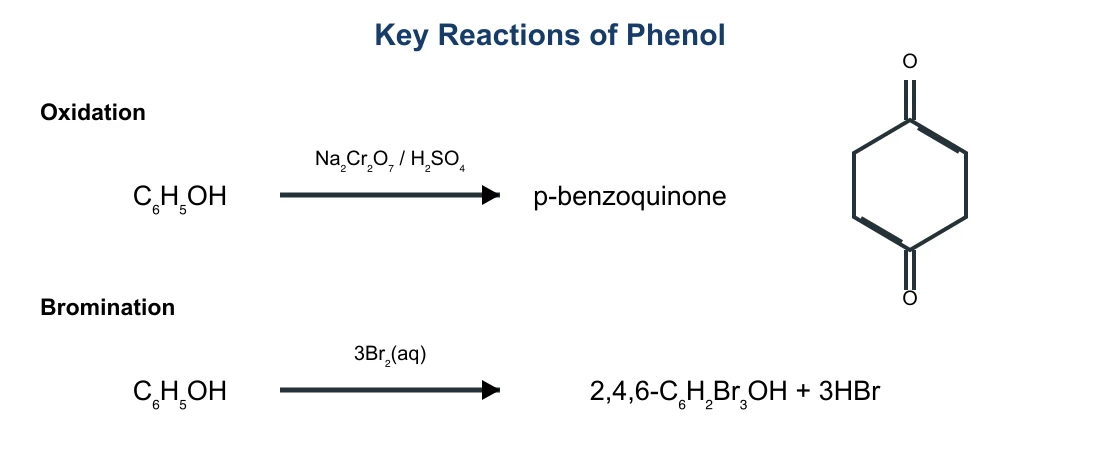
(i) Phenol is oxidised to p-benzoquinone.
(ii) The product is 2,4,6-tribromophenol.
Marks: (a) 1 for each step, with charges; (b) 1 for each product.
Question 40: (a) HVZ reaction. (2) (b) Toluene to benzaldehyde with chromyl chloride, and its name. (2) (c) The gas used for adding ethylene glycol to carbonyl compounds. (1)
Answer. This whole question was asked in 2026 Exam-1 (Q40).
(a) Carboxylic acids having an α-hydrogen are halogenated at the α-position when treated with chlorine or bromine in the presence of red phosphorus. This is the Hell–Volhard–Zelinsky (HVZ) reaction.
(b) Chromyl chloride oxidises the methyl group of toluene to a chromium complex, which on hydrolysis gives benzaldehyde.
This is the Etard reaction.
(c) Dry HCl gas is used.
Marks: (a) statement 1, equation 1; (b) equation 1, name 1; (c) 1.
Answers: Part E
Question 41: Calculate the osmotic pressure of a 0.5% (w/v) aqueous solution of sucrose at 300 K. (R = 0.08314 L bar K mol; molar mass of sucrose = 342 g mol)
Answer.
Given: 0.5% (w/v) sucrose means 0.5 g in 100 mL, that is, 5 g in 1 L; molar mass of sucrose = 342 g mol; T = 300 K; R = 0.08314 L bar K mol
To find: Osmotic pressure,
Formula:
Substitution: = 0.0146 mol L;
Answer: Osmotic pressure = 0.365 bar
Marks: concentration 1, substitution 1, answer with unit 1.
Question 42: Calculate the emf of the cell in which the following reaction takes place at 25 °C: Cu(s) + 2Ag(1 × 10 M) → Cu(0.250 M) + 2Ag(s). E° = 0.46 V.
Answer.
Given: = 0.46 V; [Cu] = 0.250 M; [Ag] = 1 × 10 M; n = 2; T = 25 + 273 = 298 K
To find:
Formula:
Substitution: and , so
Answer: = 0.30 V
Marks: formula 1, substitution 1, answer with unit 1.
Question 43: A column of 0.05 M NaOH with an area of cross-section of 0.785 cm and a length of 1 m shows a resistance of 1.11 × 10 Ω. Calculate the molar conductivity of the solution.
Answer.
Given: C = 0.05 M; A = 0.785 cm; l = 1 m = 100 cm; R = 1.11 × 10 Ω
To find: Molar conductivity,
Formulae: and
Substitution: = 1.148 × 10 S cm;
Answer: Molar conductivity = 229.5 S cm mol
Marks: conductivity 1, substitution 1, answer with unit 1.
Question 44: A first order reaction has a rate constant of 2.3 × 10 s at 500 K. At what temperature does the rate constant become 17.25 × 10 s? (E = 191.472 kJ mol, R = 8.314 J K mol)
Answer.
Given: = 2.3 × 10 s at = 500 K; = 17.25 × 10 s; = 191.472 kJ mol = 191472 J mol; R = 8.314 J K mol
To find: Temperature
Formula:
Substitution: and K, so , which gives
Answer: = 551.7 K
Marks: formula 1, substitution 1, answer with unit 1.
Question 45: A first order reaction has a half-life of 23 min. How much time will be needed for 30% completion of the reaction?
Answer.
Given: = 23 min. Taking = 100, after 30% completion = 70
To find: Time for 30% completion, t
Formulae: and
Substitution: = 0.0301 min;
Answer: Time for 30% completion = 11.8 min
Marks: k 1, substitution 1, answer with unit 1.
Question 46: If a solution obeys Raoult's law for all concentrations, its vapour pressure varies linearly from zero to the vapour pressure of the pure solvent (1.013 bar) as shown in the graph. Calculate the value of x, the vapour pressure when the mole fraction of the solvent is 0.4.
Answer.
Given: = 1.013 bar; mole fraction of solvent, = 0.4
To find: Vapour pressure, x
Formula (Raoult's law):
Substitution:
Answer: x = 0.405 bar
Marks: formula 1, substitution 1, answer with unit 1.