
Four Culprits Behind the Losses
The accelerated rates of species extinction the world faces today are largely the result of human activities. Ecologists group the drivers into four major causes, and the set has earned a memorable sobriquet — 'The Evil Quartet'.
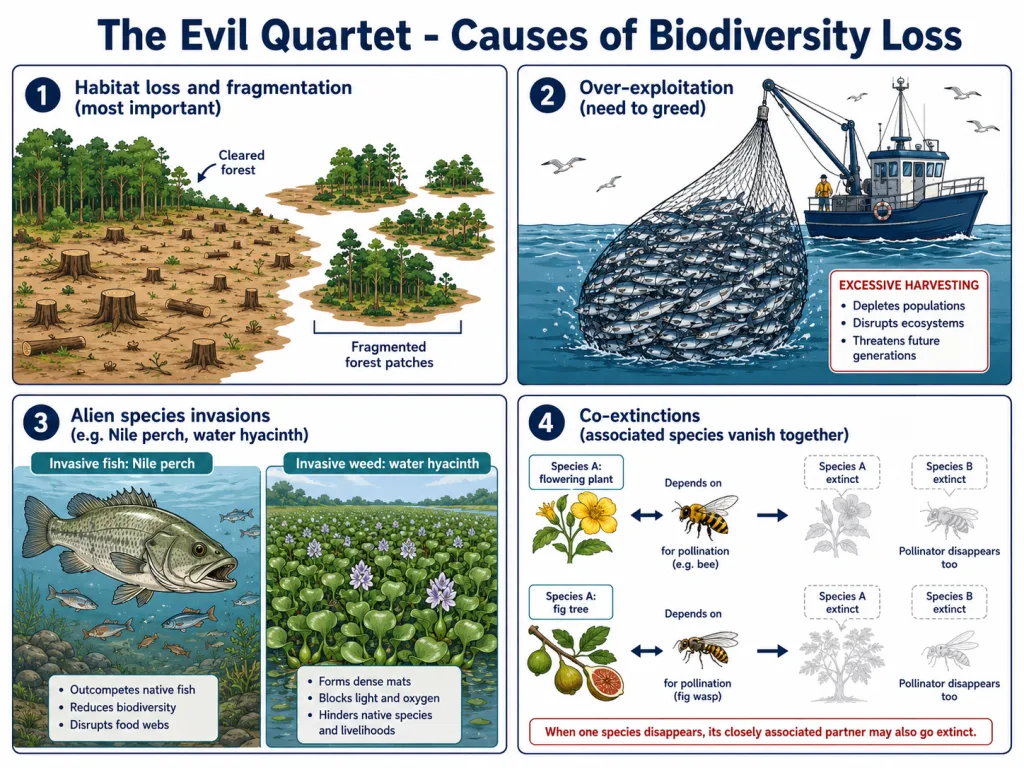
The four members are habitat loss and fragmentation, over-exploitation, alien species invasions and co-extinctions. Understanding each one separately makes it easy to see how human choices translate into vanishing species.
Habitat Loss and Fragmentation
This is the single most important cause driving animals and plants to extinction. The most dramatic examples come from tropical rainforests. Once covering more than 14 per cent of the earth's land surface, these forests now cover no more than 6 per cent, and they continue to shrink fast.
The Amazon rainforest — so vast it is called the 'lungs of the planet' — is being cut and cleared to grow soya beans and to raise beef cattle on grasslands. Beyond outright loss, pollution degrades many habitats and threatens the species living in them. And when large habitats are broken into small fragments, the animals that need large territories, along with migratory species, are badly affected, leading to steady population declines.
Over-exploitation
Humans have always depended on nature for food and shelter, but the balance tips when 'need' turns to 'greed'. That is when natural resources are over-exploited to the point of collapse.
Several extinctions in the last 500 years — the Steller's sea cow and the passenger pigeon among them — were the direct result of over-exploitation by humans. The same pressure continues today: many marine fish populations around the world are now over-harvested, endangering the survival of several commercially important species.
Alien Species Invasions and Co-extinctions
When species are introduced into a new area — whether by accident or on purpose — some of them turn invasive and cause the decline or extinction of native species. A classic case is the Nile perch introduced into Lake Victoria in East Africa, which eventually wiped out an ecologically unique assemblage of more than 200 species of cichlid fish. On land, invasive weeds such as carrot grass (Parthenium), Lantana and water hyacinth (Eichhornia) damage our native flora, while the illegal introduction of the African catfish Clarias gariepinus for aquaculture now threatens indigenous catfishes in Indian rivers.
The fourth cause is co-extinction. When a species becomes extinct, the plant and animal species bound to it in an obligatory way vanish with it. When a host fish goes extinct, its unique assemblage of parasites meets the same fate; and in a coevolved plant-pollinator mutualism, the extinction of one partner inevitably leads to the extinction of the other.
Quick Recap
- The four major causes of accelerated extinction are called 'The Evil Quartet'.
- Habitat loss and fragmentation is the most important cause; tropical rainforests have shrunk from more than 14 per cent to no more than 6 per cent of the earth's land — the Amazon is cleared for soya beans and cattle, and fragmentation hits large-territory and migratory species hardest.
- Over-exploitation — when 'need' becomes 'greed'; it drove the Steller's sea cow and passenger pigeon extinct and now over-harvests marine fish.
- Alien species invasions — the Nile perch in Lake Victoria wiped out more than 200 cichlid species; invasive weeds include Parthenium, Lantana and Eichhornia; Clarias gariepinus threatens native catfishes in India.
- Co-extinctions — obligately associated species disappear together, as with host fish and their parasites, or partners in a plant-pollinator mutualism.
Solved Examples — Section 7
Q1. What is 'The Evil Quartet'?
Answer: The sobriquet for the four major causes of species extinction — habitat loss and fragmentation, over-exploitation, alien species invasions and co-extinctions.
Q2. Which of the four causes is the most important, and give a striking example.
Answer: Habitat loss and fragmentation; tropical rainforests, once covering more than 14 per cent of the earth's land, now cover no more than 6 per cent.
Q3. Name two animals driven extinct by over-exploitation.
Answer: The Steller's sea cow and the passenger pigeon.
Q4. What was the effect of introducing the Nile perch into Lake Victoria?
Answer: It led to the extinction of more than 200 species of cichlid fish in the lake.
Q5. Give three examples of invasive plants that threaten India's native species.
Answer: Carrot grass (Parthenium), Lantana and water hyacinth (Eichhornia).
Q6. Explain co-extinction with an example.
Answer: When a species becomes extinct, species obligately associated with it also die out — for instance, when a host fish goes extinct its unique parasites do too, and in a plant-pollinator mutualism the loss of one partner leads to the loss of the other.