
Saving the Forest to Save the Tiger
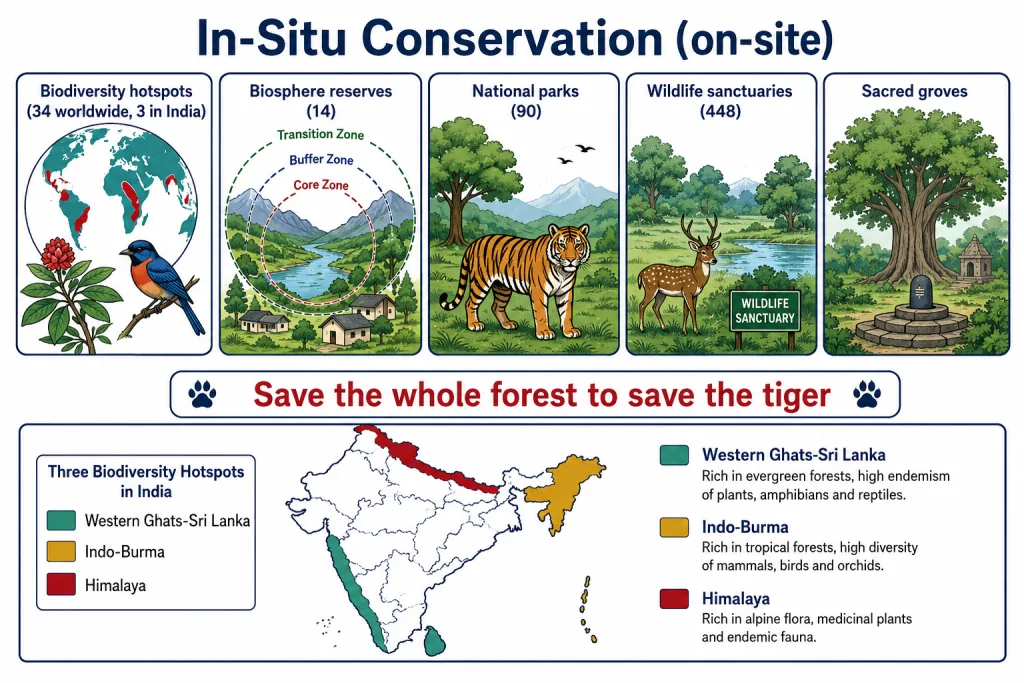
When we conserve and protect a whole ecosystem, its biodiversity at every level is protected along with it. The neat way to remember this is the phrase — we save the entire forest to save the tiger. This approach, of protecting species in their natural home, is called in situ (on-site) conservation.
The difficulty is that conservation resources are limited, while the number of species needing protection is vast. Faced with the conflict between development and conservation, most nations find it neither realistic nor economically feasible to protect all their biological wealth. So conservationists have had to decide where to focus their effort.
Biodiversity Hotspots
To get maximum protection from limited resources, eminent conservationists identified certain biodiversity hotspots — regions with very high levels of species richness together with a high degree of endemism. Endemism means the species are confined to that region and found nowhere else, so losing the region means losing those species entirely.
Initially 25 hotspots were identified; nine more were later added, bringing the world total to 34. These are also regions of accelerated habitat loss, which makes protecting them urgent. Three of these hotspots cover India's exceptionally rich regions — Western Ghats and Sri Lanka, Indo-Burma, and the Himalaya. Remarkably, although all the hotspots together cover less than 2 per cent of the earth's land area, they harbour a huge share of its species, and strict protection of them could reduce the ongoing mass extinctions by almost 30 per cent.
India's Protected Areas
In India, ecologically unique and biodiversity-rich regions are legally protected as biosphere reserves, national parks and wildlife sanctuaries. At present the country has 14 biosphere reserves, 90 national parks and 448 wildlife sanctuaries.
A useful way to keep these straight (a beyond-NCERT summary — NCERT itself gives only the names and counts) is by the degree of protection and human activity each allows: biosphere reserves are large areas that protect whole ecosystems (often containing national parks within them), national parks are strictly reserved for wildlife where activities like grazing and forestry are not permitted, and wildlife sanctuaries focus on protecting particular species while allowing certain regulated human activities. Together these form the backbone of India's in situ conservation network.
Sacred Groves
India also has a long tradition of protecting nature through religion and culture. In many communities, tracts of forest were set aside where every tree and animal was venerated and given total protection. These are the sacred groves.
Sacred groves are found in the Khasi and Jaintia Hills of Meghalaya, the Aravalli Hills of Rajasthan, the Western Ghat regions of Karnataka and Maharashtra, and the Sarguja, Chanda and Bastar areas of Madhya Pradesh. Their conservation value is real, not merely symbolic — in Meghalaya, the sacred groves serve as the last refuges for a large number of rare and threatened plants that survive nowhere else nearby.
Quick Recap
- In situ (on-site) conservation protects species in their natural habitat by conserving the whole ecosystem — 'save the forest to save the tiger'.
- Biodiversity hotspots have very high species richness and high endemism (species found nowhere else); 25 were identified first, then 9 more, totalling 34.
- India's three hotspots: Western Ghats and Sri Lanka, Indo-Burma and the Himalaya.
- All hotspots together cover less than 2 per cent of land, yet strict protection could cut ongoing mass extinctions by almost 30 per cent.
- India's protected areas: 14 biosphere reserves, 90 national parks, 448 wildlife sanctuaries, plus sacred groves (e.g. in Meghalaya, last refuges for many rare and threatened plants).
Solved Examples — Section 9
Q1. What is in situ conservation?
Answer: Conserving biodiversity on site by protecting the whole ecosystem in its natural habitat — for example, saving the entire forest to save the tiger.
Q2. What are biodiversity hotspots?
Answer: Regions with very high species richness and a high degree of endemism (species confined to that region and found nowhere else), identified for maximum protection.
Q3. How many biodiversity hotspots are there in the world, and how did the number reach that figure?
Answer: There are 34 hotspots; 25 were identified initially and nine more were later added.
Q4. Name the three hotspots that cover India's biodiversity-rich regions.
Answer: Western Ghats and Sri Lanka, Indo-Burma, and the Himalaya.
Q5. How many biosphere reserves, national parks and wildlife sanctuaries does India have?
Answer: 14 biosphere reserves, 90 national parks and 448 wildlife sanctuaries.
Q6. What are sacred groves, and why are they important in Meghalaya?
Answer: They are tracts of forest given total protection through religious and cultural tradition; in Meghalaya they are the last refuges for a large number of rare and threatened plants.