
Diversity Is Not Spread Evenly
The diversity of plants and animals is not uniform across the world; it is distributed rather unevenly. For many groups of animals and plants, this uneven distribution follows interesting patterns, and the best known of these is the latitudinal gradient in diversity.
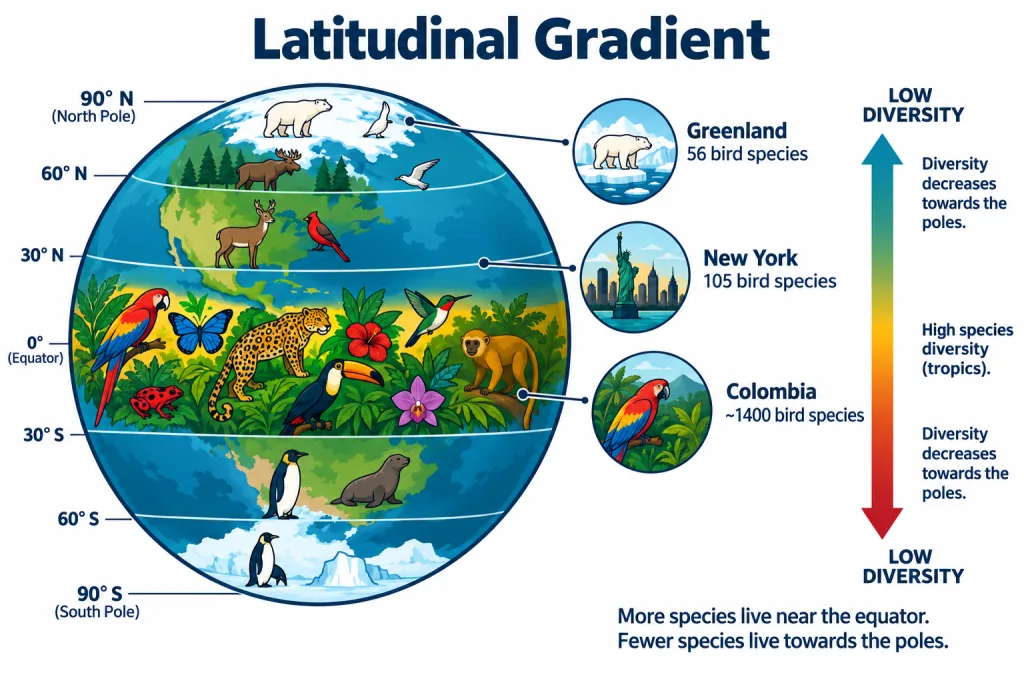
The pattern itself is simple to state. In general, species diversity decreases as we move away from the equator towards the poles. With very few exceptions, the tropics — the latitudinal band from 23.5 degrees N to 23.5 degrees S — harbour more species than temperate or polar regions.
Reading the Pattern in Numbers
Birds make the gradient easy to see. Colombia, sitting near the equator, has nearly 1,400 species of birds. Move north to New York at 41 degrees N and the count drops to just 105 species; go further to Greenland at 71 degrees N and only 56 species remain. India, with much of its land in tropical latitudes, has more than 1,200 species of birds.
Plants tell the same story. A forest in a tropical region like Ecuador can hold up to 10 times as many species of vascular plants as a forest of equal area in a temperate region such as the Midwest of the USA. Species richness, in short, climbs steadily as we approach the equator.
The Richest Place on Earth
The largely tropical Amazonian rainforest in South America has the greatest biodiversity on earth. It is home to more than 40,000 species of plants, 3,000 fishes, 1,300 birds, 427 mammals, 427 amphibians, 378 reptiles and more than 1,25,000 invertebrates. And that is only what has been catalogued so far — scientists estimate that these rainforests may hold at least two million insect species still waiting to be discovered and named.
No other region on the planet comes close to packing so many species into a single ecosystem, which is why the Amazon is the standard example of tropical richness.
Why the Tropics Are So Rich
What is so special about the tropics that could account for their greater biological diversity? Ecologists and evolutionary biologists have put forward several hypotheses, and three of them are worth knowing.
The first is evolutionary time. Speciation is generally a function of time. Unlike temperate regions, which were subjected to frequent glaciations in the past, tropical latitudes have remained relatively undisturbed for millions of years, giving species a long stretch of time to diversify.
The second is a constant environment. Tropical environments, unlike temperate ones, are less seasonal and relatively more constant and predictable. Such stability promotes niche specialisation and leads to greater species diversity.
The third is solar energy. There is more solar energy available in the tropics, which contributes to higher productivity; this in turn may contribute indirectly to greater diversity.
Quick Recap
- Diversity is not uniform; the best-known pattern is the latitudinal gradient — species diversity decreases from the equator towards the poles.
- The tropics (23.5 degrees N to 23.5 degrees S) harbour more species than temperate or polar areas.
- Birds: Colombia ~1,400 species; New York (41 degrees N) 105; Greenland (71 degrees N) 56; India more than 1,200.
- A tropical forest can have up to 10 times as many vascular plant species as an equal-area temperate forest.
- The Amazonian rainforest has the greatest biodiversity on earth (>40,000 plants, 3,000 fishes, 1,300 birds, 427 mammals, 427 amphibians, 378 reptiles, >1,25,000 invertebrates).
- Three hypotheses for tropical richness: more evolutionary time, a constant/less-seasonal environment, and more solar energy driving productivity.
Solved Examples — Section 3
Q1. What is the latitudinal gradient in diversity?
Answer: Species diversity generally decreases as we move away from the equator towards the poles, so the tropics hold more species than temperate or polar regions.
Q2. State the latitudinal range of the tropics.
Answer: From 23.5 degrees N to 23.5 degrees S.
Q3. How does bird diversity change from Colombia to Greenland?
Answer: Colombia (near the equator) has nearly 1,400 bird species, New York at 41 degrees N has 105, and Greenland at 71 degrees N has only 56.
Q4. Which region has the greatest biodiversity on earth, and give two figures for it.
Answer: The Amazonian rainforest; it has more than 40,000 species of plants and more than 1,25,000 invertebrates (among many other groups).
Q5. Give the three main hypotheses proposed for the high species richness of the tropics.
Answer: (a) Tropics had more evolutionary time for diversification as they escaped frequent glaciations; (b) their constant, less-seasonal environment promotes niche specialisation; (c) more solar energy raises productivity and indirectly diversity.
Q6. How does the plant diversity of a tropical forest compare with a temperate forest of equal area?
Answer: A tropical forest (e.g. in Ecuador) can have up to 10 times as many vascular plant species as a temperate forest of the same area.