
What Biodiversity Means
The living world is astonishingly varied. There are more than 20,000 species of ants, 3,00,000 species of beetles, 28,000 species of fishes and nearly 20,000 species of orchids — and that variety exists not only at the level of species but at every level of biological organisation, from the macromolecules within a cell right up to whole biomes.
The word biodiversity captures all of this. It was popularised by the sociobiologist Edward Wilson to describe the combined diversity at all the levels of biological organisation. Three of these levels matter most, and the chapter opens with them.
Genetic Diversity
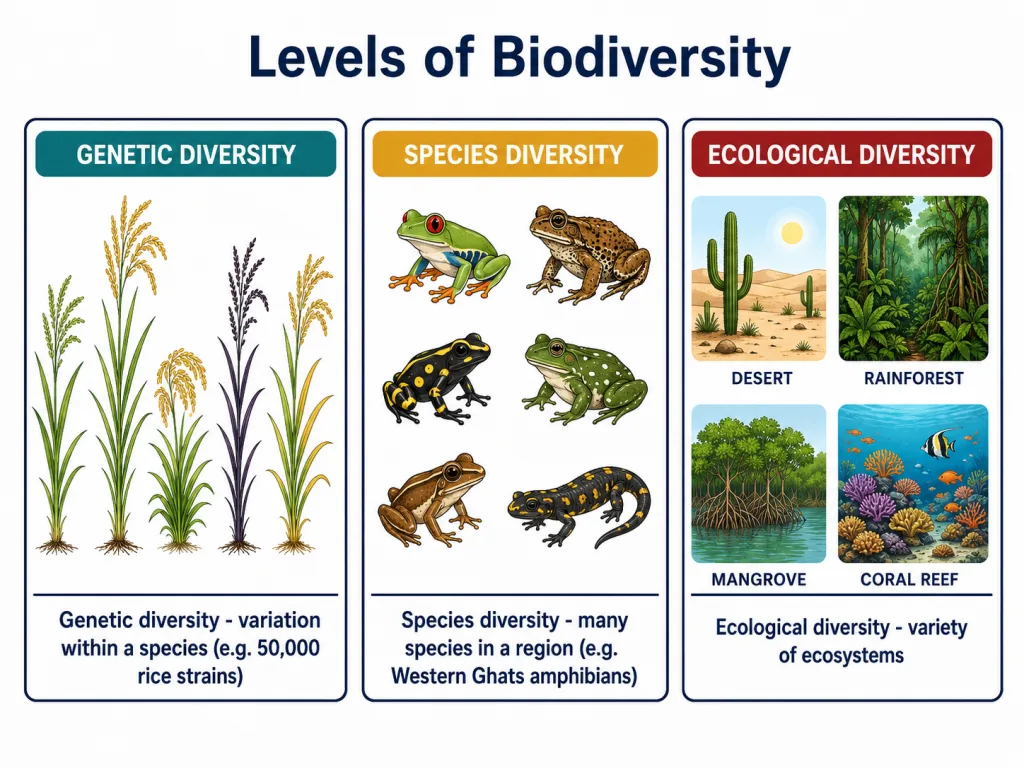
The first level is genetic diversity — the variation that a single species shows at the genetic level across its range. A good example is the medicinal plant Rauwolfia vomitoria growing in different Himalayan ranges: the plants can differ in the potency and concentration of the active chemical reserpine they produce.
India is remarkably rich here. It has more than 50,000 genetically different strains of rice and about 1,000 varieties of mango — all the same species, but each genetically distinct.
Species and Ecological Diversity
The second level is species diversity — diversity at the level of species. For example, the Western Ghats have a greater amphibian species diversity than the Eastern Ghats.
The third level is ecological diversity — diversity at the ecosystem level. India, with its deserts, rainforests, mangroves, coral reefs, wetlands, estuaries and alpine meadows, has a far greater ecosystem diversity than a Scandinavian country like Norway. Together, these three levels — genetic, species and ecological — describe the full sweep of what we mean by biodiversity.
Why It Matters Now
It has taken millions of years of evolution to accumulate this rich diversity, yet we could lose most of it in less than two centuries if present rates of species loss continue.
That is why biodiversity and its conservation have become vital environmental issues of international concern. More and more people around the world are realising how critical biodiversity is for our own survival and well-being — a theme the rest of this chapter develops, from how many species exist to how we can protect them.
Quick Recap
- Biodiversity = the combined diversity at all levels of biological organisation; the term was popularised by Edward Wilson.
- Genetic diversity: variation within a species (e.g. Rauwolfia vomitoria and its reserpine; India's 50,000 rice strains and 1,000 mango varieties).
- Species diversity: diversity at the species level (e.g. Western Ghats have more amphibian species than the Eastern Ghats).
- Ecological diversity: diversity at the ecosystem level (India's deserts, rainforests, mangroves, coral reefs, etc., versus Norway).
- Diversity took millions of years to build but could be lost in under two centuries — hence the concern for conservation.
Solved Examples — Section 1
Q1. Who popularised the term 'biodiversity'?
Answer: The sociobiologist Edward Wilson.
Q2. Name the three most important levels of biodiversity.
Answer: Genetic diversity, species diversity and ecological diversity.
Q3. Give an example of genetic diversity within a single species.
Answer: Rauwolfia vomitoria in different Himalayan ranges differs in the potency and concentration of reserpine; India also has over 50,000 rice strains and about 1,000 mango varieties.
Q4. Which region has greater amphibian species diversity — the Western or the Eastern Ghats?
Answer: The Western Ghats.
Q5. What does ecological diversity refer to, with an example?
Answer: Diversity at the ecosystem level; e.g. India (with deserts, rainforests, mangroves, coral reefs, etc.) has greater ecosystem diversity than Norway.
Q6. How long did it take to build the present biodiversity, and how fast could it be lost?
Answer: It took millions of years of evolution to accumulate, but could be lost in less than two centuries at present rates of species loss.