
Medicines Made to Match the Human Body
Recombinant DNA technology has had an immense impact on healthcare by enabling the mass production of safe and more effective therapeutic drugs. The advantage is not only quantity. Because these recombinant therapeutics are made to match human proteins, they do not induce the unwanted immunological responses that are common with similar products isolated from non-human sources.
The scale is already substantial. At present about 30 recombinant therapeutics have been approved for human use across the world, and in India 12 of these are being marketed. The first and most famous of them is genetically engineered insulin.
The Old Way of Getting Insulin
Insulin is taken at regular intervals to manage adult-onset diabetes. Before biotechnology stepped in, the insulin used by patients was extracted from the pancreas of slaughtered cattle and pigs. It worked, but it came from a foreign animal source, and in some patients this animal insulin caused allergy or other immune reactions to the foreign protein.
There is also a reason insulin cannot simply be swallowed as a tablet: being a protein, it would be digested in the gut before it could act. So a reliable, human-matched supply of injectable insulin was exactly what was needed.
The Shape of the Insulin Molecule
Insulin consists of two short polypeptide chains — chain A and chain B — linked together by disulphide bridges. That final linked structure is the mature, functional hormone.
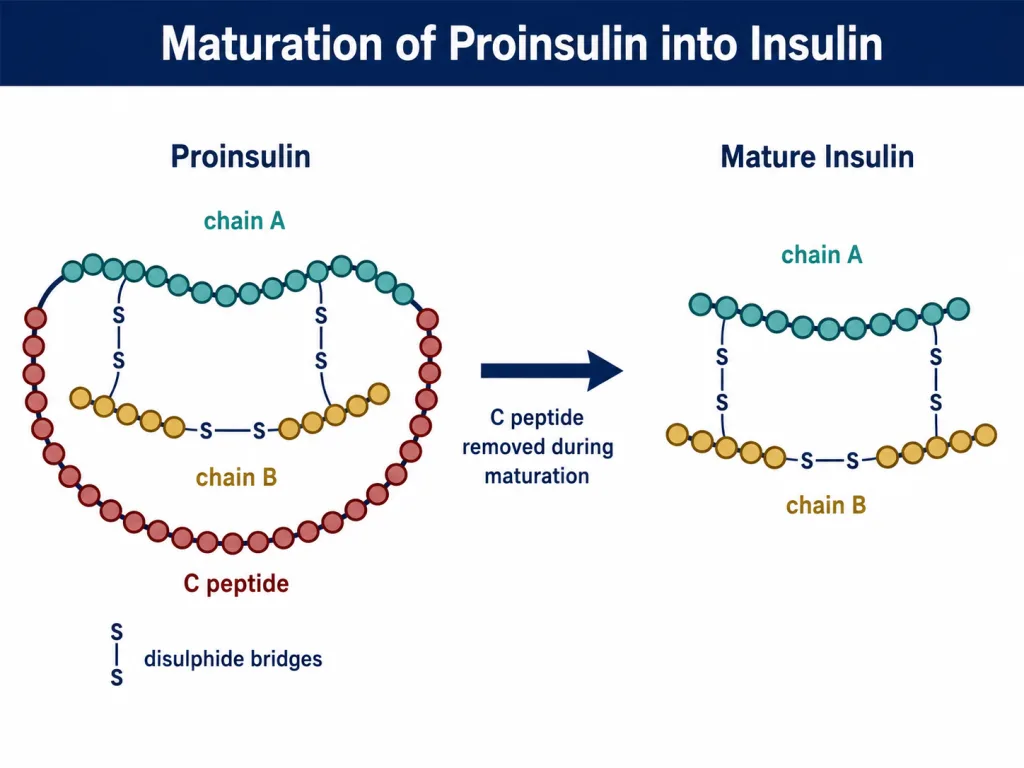
In mammals, including humans, insulin is first synthesised as a pro-hormone — much like a pro-enzyme, it has to be processed before it becomes fully mature and functional. This pro-hormone contains an extra stretch called the C peptide. The C peptide is not present in mature insulin; it is removed during maturation into the finished hormone. This detail is exactly what made the recombinant version tricky.
How Eli Lilly Assembled Human Insulin
The main challenge in producing insulin by rDNA techniques was getting it assembled into the mature form with its two chains correctly joined. In 1983, the American company Eli Lilly solved this in an elegant way.
They prepared two DNA sequences corresponding to chain A and chain B of human insulin and introduced them into plasmids of E. coli. The two chains were produced separately, then extracted and combined by creating the disulphide bonds between them to form human insulin. The result is a molecule structurally identical to natural human insulin, made cleanly in bacteria and free of the immune problems of the animal-derived product.
Quick Recap
- Recombinant DNA processes allow mass production of safe, effective therapeutics that do not induce unwanted immunological responses.
- About 30 recombinant therapeutics are approved worldwide; 12 are marketed in India.
- Insulin manages adult-onset diabetes; earlier it was extracted from the pancreas of slaughtered cattle and pigs, sometimes causing allergy or immune reactions.
- Insulin has two chains, A and B, linked by disulphide bridges; it is made as a pro-hormone with an extra C peptide that is removed during maturation.
- In 1983, Eli Lilly made DNA sequences for chains A and B, expressed them separately in plasmids of E. coli, then extracted and combined them via disulphide bonds to form human insulin.
Solved Examples — Section 7
Q1. Why do recombinant therapeutics not cause unwanted immune reactions?
Answer: Because they match human proteins, unlike similar products isolated from non-human sources.
Q2. How many recombinant therapeutics are approved worldwide, and how many are marketed in India?
Answer: About 30 are approved for human use worldwide, and 12 of these are marketed in India.
Q3. From where was insulin obtained before recombinant technology, and what problem did it cause?
Answer: It was extracted from the pancreas of slaughtered cattle and pigs; this animal insulin caused allergy or other immune reactions in some patients.
Q4. Describe the structure of insulin.
Answer: It consists of two short polypeptide chains, chain A and chain B, linked together by disulphide bridges.
Q5. What is the C peptide, and what happens to it?
Answer: It is an extra stretch present in the pro-hormone form of insulin; it is absent from mature insulin and is removed during maturation.
Q6. How did Eli Lilly produce human insulin in 1983?
Answer: They prepared two DNA sequences for chains A and B, introduced them into plasmids of E. coli to produce the chains separately, then extracted and combined them by creating disulphide bonds to form human insulin.