
What Makes an Animal Transgenic
An animal whose DNA has been manipulated so that it possesses and expresses an extra (foreign) gene is called a transgenic animal. The word says it plainly: a gene from outside has been added and switched on.
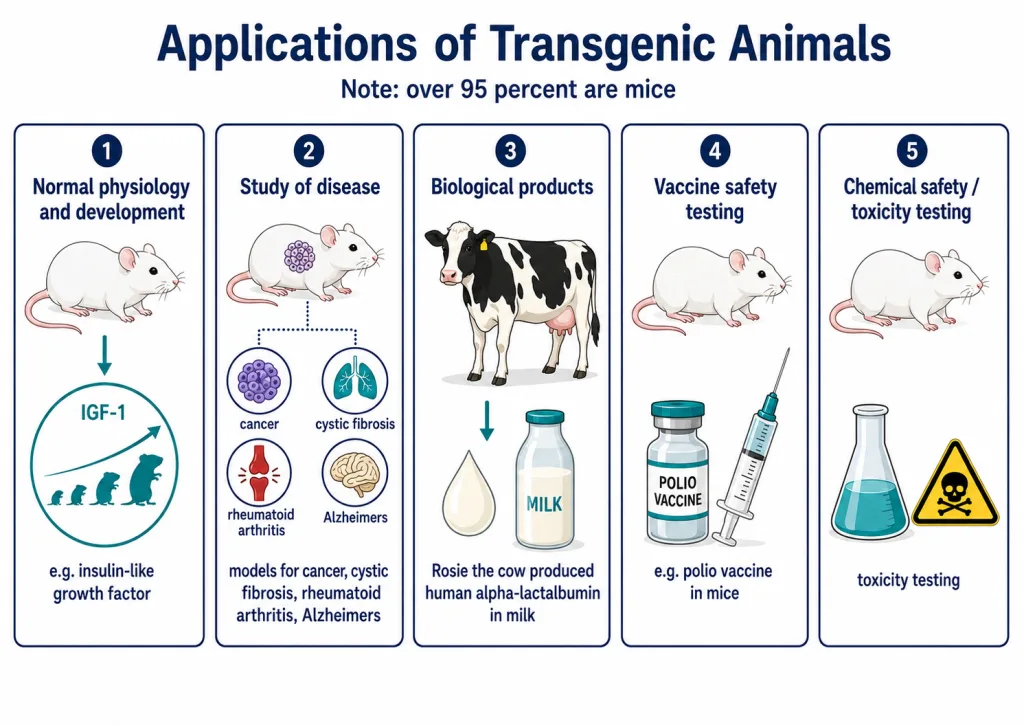
Many species have been engineered this way — rats, rabbits, pigs, sheep, cows and fish have all been produced. Yet one animal dominates the field completely: over 95 per cent of all transgenic animals are mice. Their short life cycle and well-mapped genetics make them the workhorse of the laboratory.
Studying Normal Physiology and Disease
The first two uses of transgenic animals are about understanding the body — both when it works and when it breaks down.
In the study of normal physiology and development, transgenic animals let scientists watch how genes are regulated and how they shape the body's normal functioning and growth. A classic example is the study of insulin-like growth factor: by introducing genes that alter how this factor forms and observing the biological effects, its role in the body can be worked out.
The second use is the study of disease. Many transgenic animals are built to serve as models for human diseases, so that new treatments can be investigated. Models already exist for cancer, cystic fibrosis, rheumatoid arthritis and Alzheimer's.
Biological Products and Rosie the Cow
Some medicines rely on biological products that are expensive to make. A transgenic animal can be engineered to manufacture such a product cheaply by inserting the DNA that codes for it. One example is the human protein alpha-1-antitrypsin, used to treat emphysema; similar attempts are being made for phenylketonuria (PKU) and cystic fibrosis.
The landmark case came in 1997 with Rosie, the first transgenic cow. Rosie produced human-protein-enriched milk — 2.4 grams per litre — containing human alpha-lactalbumin. This milk was nutritionally a more balanced product for human babies than natural cow milk.
Testing Vaccines and Chemicals Safely
The last two uses turn transgenic animals into safety-testing tools.
For vaccine safety, transgenic mice are used to test whether a vaccine is safe before it is given to humans. They are already being used to test the safety of the polio vaccine, and if proven reliable they could replace monkeys in checking vaccine batches.
For chemical safety testing — also called toxicity testing — transgenic animals are made to carry genes that make them more sensitive to toxic substances than ordinary animals. When exposed to a toxic substance, they show the effects quickly, so toxicity testing can be completed in less time.
Quick Recap
- A transgenic animal possesses and expresses an extra (foreign) gene introduced into its DNA.
- Rats, rabbits, pigs, sheep, cows and fish have been made, but over 95 per cent of transgenic animals are mice.
- Normal physiology and development — studying gene regulation and development, e.g. insulin-like growth factor.
- Study of disease — models for cancer, cystic fibrosis, rheumatoid arthritis and Alzheimer's.
- Biological products — costly medicines such as alpha-1-antitrypsin (for emphysema); in 1997 the transgenic cow Rosie gave milk with 2.4 g/litre human alpha-lactalbumin.
- Vaccine safety — mice test the polio vaccine, possibly replacing monkeys.
- Chemical (toxicity) safety testing — animals made more sensitive to toxins give results in less time.
Solved Examples — Section 10
Q1. Define a transgenic animal.
Answer: An animal whose DNA has been manipulated to possess and express an extra (foreign) gene.
Q2. Which animal makes up over 95 per cent of all transgenic animals?
Answer: The mouse.
Q3. Give one example of a factor studied through transgenic animals in normal physiology.
Answer: Insulin-like growth factor, whose biological role is studied by altering its formation and observing the effects.
Q4. Name any two human diseases for which transgenic models exist.
Answer: Any two of cancer, cystic fibrosis, rheumatoid arthritis and Alzheimer's.
Q5. What did Rosie, the first transgenic cow, produce, and in what amount?
Answer: In 1997 Rosie produced human-protein-enriched milk containing human alpha-lactalbumin at 2.4 grams per litre, nutritionally more balanced for human babies than natural cow milk.
Q6. How do transgenic animals speed up chemical (toxicity) safety testing?
Answer: They carry genes that make them more sensitive to toxic substances than non-transgenic animals, so on exposure they show effects quickly and results are obtained in less time.