
Healthy Plants from Diseased Ones
One of the most useful applications of tissue culture is the recovery of healthy plants from diseased ones. This may sound impossible, but it rests on a simple biological fact: even when a plant is infected with a virus, the meristem — both apical and axillary — remains free of the virus.
Because the growing tip escapes infection, a grower can carefully remove the meristem from an infected plant and grow it in vitro to obtain virus-free plants. Scientists have successfully cultured the meristems of banana, sugarcane and potato in exactly this way, turning diseased stock into clean, healthy planting material.
Naked Protoplasts
Tissue culture has also allowed scientists to work with plant cells in a much more intimate way. Single cells can be isolated from a plant, and their cell walls digested away, leaving behind naked protoplasts — cells surrounded only by their plasma membrane.
Stripping off the rigid cell wall is what makes the next step possible. Without the wall in the way, two protoplasts can be brought together and made to fuse. This opens the door to combining the characters of two different plants in a single cell, something that ordinary breeding cannot easily achieve.
Somatic Hybridisation
Protoplasts isolated from two different varieties of plants — each carrying a desirable character — can be fused together to produce hybrid protoplasts. Such a hybrid protoplast can then be grown into a whole new plant. Plants produced this way are called somatic hybrids, and the whole process is known as somatic hybridisation.
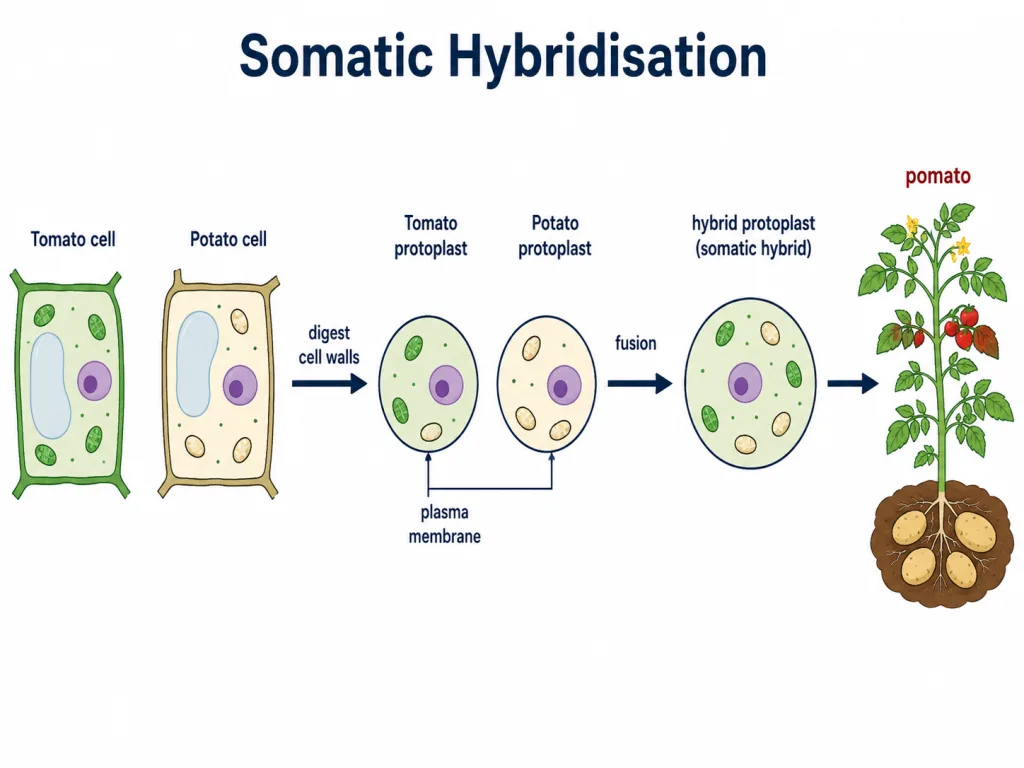
The striking feature of this technique is that it sidesteps sexual reproduction altogether. Two varieties that could never be crossed by normal breeding can, in principle, have their protoplasts fused to blend their traits.
The Pomato Story
The classic example of somatic hybridisation is the fusion of a tomato protoplast with a potato protoplast. When these fused hybrid protoplasts were grown, they produced a new plant nicknamed the pomato — a plant meant to combine the characteristics of tomato and potato.
The experiment succeeded technically, but the outcome was a reminder that biology does not always cooperate with our plans. The pomato did not have all the desired combination of characteristics needed for it to be commercially useful. It remains a valuable teaching example of what somatic hybridisation can do, and of the gap that can exist between a clever technique and a marketable crop.
Quick Recap
- Tissue culture allows recovery of healthy plants from diseased ones.
- Even in a virus-infected plant, the meristem (apical and axillary) is free of virus; growing it in vitro gives virus-free plants — done for banana, sugarcane and potato.
- Digesting away the cell wall of an isolated cell leaves a naked protoplast, surrounded only by the plasma membrane.
- Fusing protoplasts of two varieties (each with a desirable trait) gives hybrid protoplasts, grown into somatic hybrids; the process is somatic hybridisation.
- Classic example: fusing tomato and potato protoplasts gave the pomato, which did not have all the desired combination of characteristics for commercial utilisation.
Solved Examples — Section 3
Q1. Which part of an infected plant is best suited for producing virus-free plants, and why?
Answer: The meristem (apical and axillary), because it remains free of the virus even in an infected plant; growing it in vitro yields virus-free plants.
Q2. Name three plants whose meristems have been cultured to obtain virus-free plants.
Answer: Banana, sugarcane and potato.
Q3. What is a naked protoplast?
Answer: A plant cell whose cell wall has been digested away, so that it is surrounded only by the plasma membrane.
Q4. Define somatic hybridisation.
Answer: The process of fusing protoplasts from two different plant varieties to form hybrid protoplasts, which are then grown into new plants called somatic hybrids.
Q5. What is a pomato and how was it produced?
Answer: The pomato is a somatic hybrid produced by fusing a protoplast of tomato with a protoplast of potato and growing the hybrid protoplast into a plant.
Q6. Why did the pomato fail to become a commercial crop?
Answer: It did not have all the desired combination of characteristics needed for commercial utilisation.