
Correcting a Fault in the Genes
If a person is born with a hereditary disease, can a corrective therapy be given for it? Gene therapy is the attempt to do exactly that. It is a collection of methods that allow the correction of a gene defect diagnosed in a child or embryo, by inserting genes into a person's cells and tissues to treat the disease.
The logic is straightforward. Correcting a genetic defect means delivering a normal gene into the individual or the embryo so that it takes over the function of, and compensates for, the non-functional gene. Instead of managing symptoms, the aim is to fix the underlying instruction.
The First Patient and Her Disorder
The first clinical gene therapy was given in 1990 to a 4-year-old girl suffering from adenosine deaminase (ADA) deficiency. The enzyme ADA is crucial for the immune system to function, so a child who lacks it cannot mount proper immune defences.
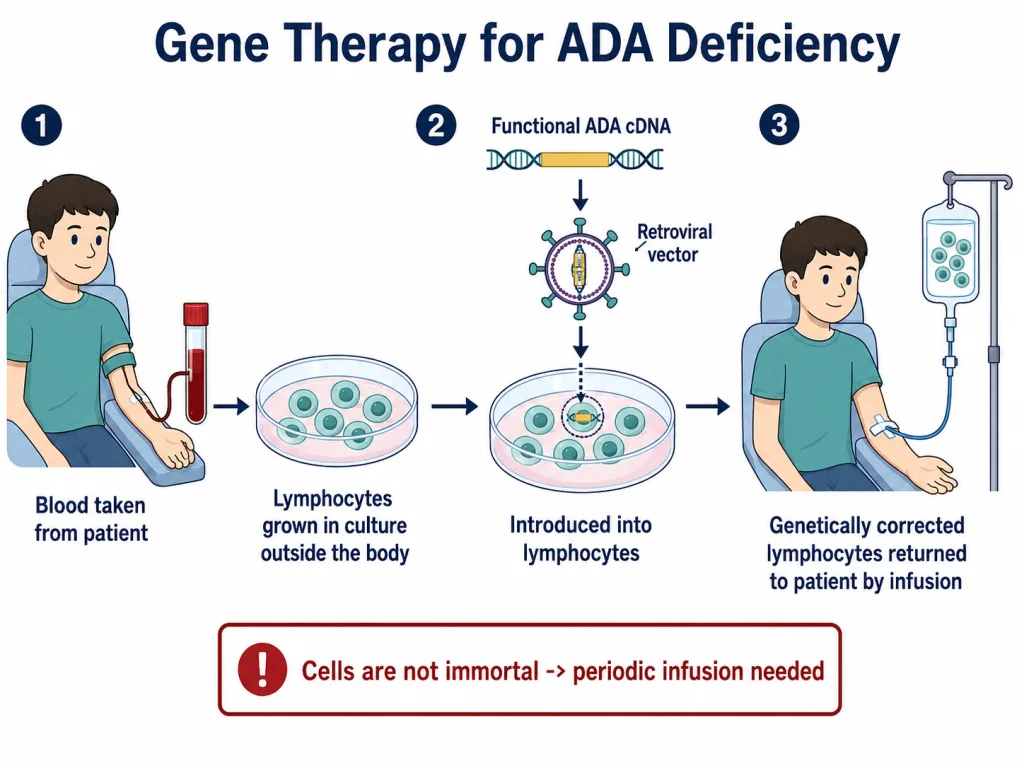
The disorder is caused by the deletion of the gene for adenosine deaminase. Because the gene itself is missing, the body simply cannot make the enzyme — which is what makes this condition such a clear target for a gene-based correction.
What Came Before Gene Therapy
ADA deficiency was not left untreated before gene therapy arrived, but the earlier options had limits. In some children the deficiency is treated by bone marrow transplantation. In others it is managed by enzyme replacement therapy, in which functional ADA is given to the patient by injection.
The difficulty with both approaches is that neither is completely curative. Bone marrow transplantation depends on a suitable donor, and injected enzyme has to be given again and again because it does not restore the body's own ability to make ADA. This is the gap that gene therapy set out to close.
The Gene Therapy Procedure and Its Limitation
As a first step, lymphocytes from the patient's blood are grown in a culture outside the body. A functional ADA cDNA, carried by a retroviral vector, is then introduced into these lymphocytes, which are afterwards returned to the patient. The corrected cells can now make the missing enzyme.
There is, however, a catch. Because these lymphocytes are not immortal, the patient needs periodic infusions of such genetically engineered cells to keep the effect going. A more lasting solution would be to introduce the functional ADA gene from marrow cells at early embryonic stages, which could act as a permanent cure.
Quick Recap
- Gene therapy corrects a gene defect diagnosed in a child or embryo by delivering a normal gene to compensate for a non-functional gene.
- The first clinical gene therapy (1990) treated a 4-year-old girl with adenosine deaminase (ADA) deficiency, a disorder caused by deletion of the ADA gene.
- Earlier treatments were bone marrow transplantation and enzyme replacement therapy (injected ADA), but neither is completely curative.
- In gene therapy, the patient's lymphocytes are cultured, a functional ADA cDNA is introduced using a retroviral vector, and the cells are returned to the patient.
- Since these cells are not immortal, periodic infusions are needed; introducing the ADA gene at early embryonic stages could give a permanent cure.
Solved Examples — Section 8
Q1. What is gene therapy?
Answer: A collection of methods that correct a gene defect diagnosed in a child or embryo by inserting genes into a person's cells and tissues to treat a disease.
Q2. How does gene therapy correct a genetic defect?
Answer: By delivering a normal gene into the individual or embryo to take over the function of and compensate for the non-functional gene.
Q3. To whom was the first clinical gene therapy given, and in which year?
Answer: It was given in 1990 to a 4-year-old girl with adenosine deaminase (ADA) deficiency.
Q4. What causes ADA deficiency, and why is the enzyme important?
Answer: It is caused by deletion of the gene for adenosine deaminase; the enzyme is crucial for the immune system to function.
Q5. Name the two earlier treatments for ADA deficiency and their common limitation.
Answer: Bone marrow transplantation and enzyme replacement therapy (injected functional ADA); neither is completely curative.
Q6. Why does the gene-therapy patient need periodic infusions, and how might a permanent cure be achieved?
Answer: Because the treated lymphocytes are not immortal, periodic infusions are needed; introducing the functional ADA gene at early embryonic stages could give a permanent cure.