
A Bacterium That Kills Insects
One of the most successful agricultural applications of biotechnology is the production of pest-resistant plants that need far less insecticide. At the heart of this lies the Bt toxin, produced by a soil bacterium called Bacillus thuringiensis — Bt for short.
The key step was genetic. The Bt toxin gene was cloned from the bacterium and expressed in plants, giving them resistance to insects without the need for chemical insecticides. In effect, the plant makes its own bio-pesticide. Crops engineered this way include Bt cotton, Bt corn, rice, tomato, potato and soybean.
The Insects It Targets
Not every strain of the bacterium is the same. Some strains of Bacillus thuringiensis produce proteins that kill only certain groups of insects, which is what makes the toxin useful and relatively specific.
The targets fall into three broad groups: lepidopterans such as the tobacco budworm and armyworm; coleopterans, the beetles; and dipterans, which include flies and mosquitoes. Because most Bt toxins are insect-group specific, the choice of which toxin gene to use depends on the crop being protected and the particular pest that attacks it.
Crystals, Protoxins and Alkaline Guts
During a particular phase of its growth, Bacillus thuringiensis forms protein crystals that contain a toxic insecticidal protein. A natural question is why this toxin does not kill the bacterium that makes it. The answer is that the toxin exists as an inactive protoxin.
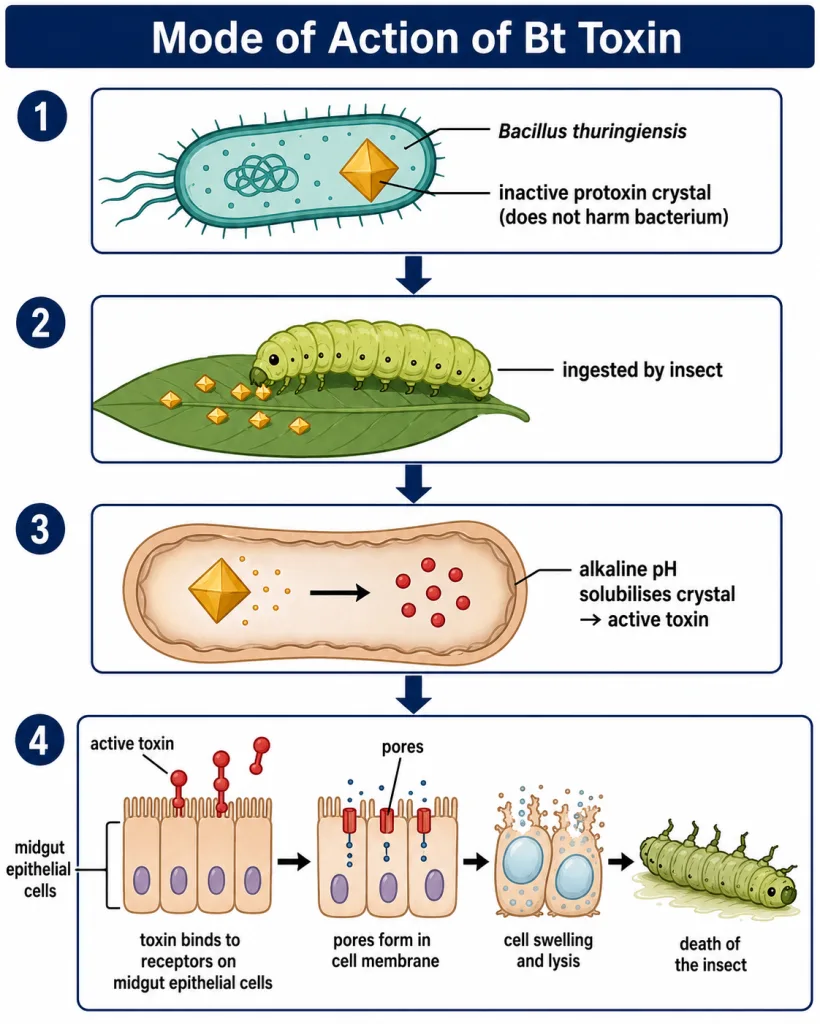
The protoxin only becomes dangerous once an insect ingests it. The alkaline pH of the insect gut solubilises the crystals and converts the inactive protoxin into the active toxin — a switch that happens inside the pest, not inside the bacterium.
How the Toxin Kills, and the Cry Genes
Once activated, the toxin binds to the surface of the midgut epithelial cells of the insect. There it creates pores in the cell membranes, causing the cells to swell and burst (lysis), and the insect eventually dies.
The toxin is coded by a gene named cry. There are many cry genes, and each targets different pests, which is why the crop and pest must be matched to the right gene. The proteins encoded by cryIAc and cryIIAb control the cotton bollworms, while cryIAb controls the corn borer. Specific Bt toxin genes are isolated from Bacillus thuringiensis and incorporated into crops such as cotton to make them pest-resistant.
Quick Recap
- Bt toxin is produced by Bacillus thuringiensis (Bt); its gene was cloned and expressed in plants to give a bio-pesticide — e.g. Bt cotton, Bt corn, rice, tomato, potato, soybean.
- The toxin targets specific insect groups: lepidopterans (tobacco budworm, armyworm), coleopterans (beetles) and dipterans (flies, mosquitoes).
- The bacterium forms protein crystals of an insecticidal protein that exist as inactive protoxins, so they do not harm the bacterium.
- The alkaline pH of the insect gut solubilises the crystals and activates the toxin, which binds midgut epithelial cells, creates pores, causing swelling and lysis and death.
- The toxin is coded by cry genes: cryIAc and cryIIAb control cotton bollworms; cryIAb controls corn borer.
Solved Examples — Section 5
Q1. Which organism produces the Bt toxin?
Answer: The bacterium Bacillus thuringiensis (Bt for short).
Q2. Why does the Bt toxin not kill the Bacillus that produces it?
Answer: Because inside the bacterium the toxin exists as an inactive protoxin, and is only converted to the active form in the alkaline gut of an insect that ingests it.
Q3. Name the three insect groups killed by different Bt toxins.
Answer: Lepidopterans (tobacco budworm, armyworm), coleopterans (beetles) and dipterans (flies, mosquitoes).
Q4. How does the activated Bt toxin kill an insect?
Answer: It binds to the surface of midgut epithelial cells and creates pores that cause the cells to swell and undergo lysis, eventually killing the insect.
Q5. What are Cry proteins and by what genes are they coded?
Answer: Cry proteins are the insecticidal Bt toxins, coded by cry genes such as cryIAc, cryIIAb and cryIAb.
Q6. Which cry genes control cotton bollworms and which controls corn borer?
Answer: cryIAc and cryIIAb control cotton bollworms, while cryIAb controls corn borer.